Escape from Huang Shi aka The Children of Huang Shi (2008)

Believe it or not but Escape from Huang Shi is an Australian, Chinese, German co-production telling the true story of a British journalist. What a combination. This gives the movie a very authentic feel, especially due to the fact that we hear as much Chinese as English (and some Japanese).

If anyone has liked the movie Crouching Tiger, Hidden Dragon as much as I did (I think it is one of the best movies ever. One could almost call it a martial-arts fairytale), he or she will be pleased to see Michelle Yeoh and  Yun-Fat Chow in the same movie (however no joint scenes).

But this is not the only pleasant surprise of this quite enjoyable movie.

The story is similar to Welcome to Sarajevo, only this journalist here, played by Jonathan Rhys Meyers (who is really good in this), is doing something even more courageous. He stays in the country to help the orphans.

It is absolutely incredible what some people are capable of doing even when facing adversity at its worst. This is a story of someone who was capable of overcoming his own fear, of reinventing a life for himself and a group of orphan boys and creating a home for them.

George Hogg, a young British journalist, arrives in China in 1937 finding the country being invaded by the Japanese. Air raids, floods of refugees on the streets, he´s afraid and thrilled at the same time hoping for the story of his life. He gets it only not the way he had hoped for. He soon sees himself in great danger and is led by an Australian nurse to Huang Shi. She leaves him there to struggle with famine, the depressions and aggressions of some 60 orphaned boys who have seen the worst and the insecurity of a life on the border of a war.

In wonderful pictures we see him overcome the urge to escape and help those children transform the barren land around them into a fertile garden. He is assisted in this  by a mysterious tradeswoman Madam Wang (Michelle Yeoh) who sells more than just seeds, by Chen (Yun-Fat Chow) the leader of a communist partisan group and of course the Australian nurse (Radha Mitchell) he is secretly in love with.

When the Japanese and the air raids start to approach Huang Shi, Hogg must make a decision. He wants to flee and take the children on a journey over 500 perilous miles across the snow-bound Liu Pan Shan mountains to safety on the edge of the Mongolian desert. This seems almost impossible to achieve.

The movie reminded me a little bit of  The Painted Veil (no, it is not a war movie). Same beautifully filmed landscapes. And those sumptuous  and, for us exotic, Chinese interiors of the time. The story is already quite captivating but the beauty of those landscapes alone would have been enough to enchant us.
10 Reasons Why you should (re) discover Merry Christmas Mr. Lawrence (1983)

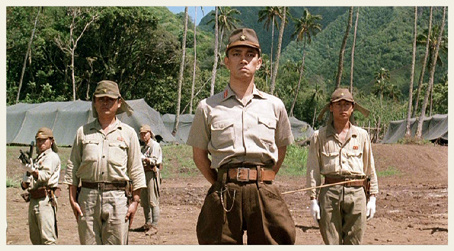
I am probably going to review this movie at length in a few days. It is worth to look into some cultural elements.  Here, as a starter, 10 reasons why you should watch Merry Christmas Mr. Lawrence.

  1. Highly original. Really not your everyday material.
  2. It is not sufficiently known or almost forgotten.
  3. POW movie that is by many people believed to be better than Bridge on the River Kwai.
  4. The main title, Forbidden colors, is very haunting (there are two versions, the instrumental one by Ryuichi Sakamoto and the vocal one by Sakamoto and David Sylvian).
  5. Beautifully filmed.
  6. Japanese culture and esthetics (Samurai, hara-kiri, honor, belief in demons and what not).
  7. Not your average war movie theme. Captain Yonoi is tragically attracted to Maj Celliers.
  8. Nagisha Oshima has directed it (he is famous for his very sensuous and erotic movies, albeit bordering the sadomasochistic. Undertones are clearly present here.)
  9. Great acting. Not only by the two singers Ryuichi Sakamoto and David Bowie but also by Tom Conti and Takeshi Kitano.
  10. Very impressive. Once you have seen it, you will never forget it.

My Boy Jack (2007) or Why Daniel Radcliffe should not be starring in the Remake of All Quiet on the Western Front

This post is about two very different things. A good movie and a bad choice for a cast.

Based on the play with the same name written by the very same actor who is playing Kipling, David Haig, the movie tells us the tragic story of Kipling´s only son who went missing during WWI on the Western front in the Battle of Loos.

For reasons I will elaborate here My Boy Jack was an interesting, touching if a somewhat disappointing movie. Interesting since it showed the famous author Rudyard Kipling in another light and because it depicted the very onset of WWI and Britain’s reluctance to participate in this war at first. The tragedy of the war in the trenches with its enormous loss of lives in a very brief moment (we hear that the first day of the armed conflict cost almost 12000 British lives) is illustrated eloquently.
Kipling is shown as a dominant figure for whom the love of his country comes long before anything else. His values of manly courage and seeking of glory are really off-putting. The whole character is obnoxious. From the moment he knows the war will finally start his sole aim is to have his only 17-year-old son participate.
Unfortunately Jack is extremely short-sighted and without his glasses he is almost blind. The doctors performing the medical examinations do not want him to join the navy nor the army since it would be much too dangerous should he lose his spectacles during battle. His father being the influential and stubborn  man he is pulls every string to have  his son accepted against all better judgement.
Knowing the tragic story we sadly watch the inevitable unfold.
After his initial training and having been appointed lieutenant Jack is sent to France. He gets to know constant rain and shelling, the bleakness of the trenches and the muddy no-man’s-land around them.
After days of waiting his company is finally told they will have to attack.
The fear and anguish of the men who know  by now that most of them will face a certain death is quite touching.
It will be Jacks first and last battle. A few weeks after his departure to France his family gets notified that he’ s been reported missing in action.
What  follows is quite dramatic and good acting. Kim Cattrall (Sex and the City–yes, indeed) playing the mother is very convincing, so are the sister (Carey Mulligan) and David Haig as the father. The family wants to know what happened. Is Jack wounded but alive? Is he dead? Did he suffer? Of course Kipling constantly asks himself if he is guilty. The depiction of their grief and the father’s despair is very heartfelt. It moves you to tears. It is difficult to imagine what it was like to wait more than a year  until they finally had some hints about what had happened. So why was I disappointed? Because I found Daniel Radcliffe absolutely not good.
(To know that he will have the leading role in  the remake of All Quiet on the Western Front is hard to stomach).
He is really not a very good actor. Or maybe not yet. He should have some more qualifications for a role than his age. But actually it is not so much his acting that I criticize than the way he  looks. For me he has absolutely no charisma.
Since the movie in itself is good and knowing that many people are very fond of him as an actor and also consider him great in My Boy Jack, I still suggest you watch this movie. Even more so should you be interested in Rudyard Kipling.

For the interested reader I posted Kipling’s poem about the loss of his only son.  And who likes can also watch the video below and see David Haig render it in the movie.

“Have you news of my boy Jack?”
Not this tide.
“When d’you think that he’ll come back?”
Not with this wind blowing, and this tide.

“Has any one else had word of him?”
Not this tide.
For what is sunk will hardly swim,
Not with this wind blowing, and this tide.

“Oh, dear, what comfort can I find?”
None this tide,
Nor any tide,
Except he did not shame his kind —
Not even with that wind blowing, and that tide.

Then hold your head up all the more,
This tide,
And every tide;
Because he was the son you bore,
And gave to that wind blowing and that tide!

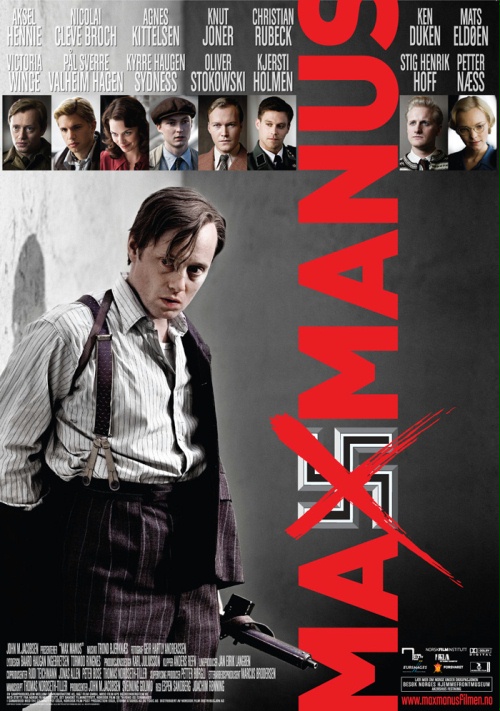
Two Movies on Nordic Resistance: Flame & Citron (2008) and Max Manus (2008)

Two movies on the same theme, Nordic Resistance, yet how different their tone. While Max Manus (aka  Frihedskæmperen Max Manus) is a hero story with tragic and uplifting moments, Flame & Citron (aka Flammen & Citronen) is depressing and full of angst. Both movies are based on true stories and illustrate aspects of lesser known WWII history.

Max Manus tells the story of the Norwegian saboteur Max Manus and his resistance group. After having fought in Finland against the Communists he joins the norwegian resistance. They fight the Nazis very effectively by blowing up supply ships, stealing documents and shooting people. They are hunted down by the Germans and many lose their lives, only Max escapes miraculously every time which fills him with survivor’s guilt but at the same time gives him an aura of invulnerability.

Flame & Citron is the story of two very famous Danish Nazi assassins. Where Max attacks mostly buildings and objects, they shoot Nazis and their allies, mostly execution style up-close.Early on it is evident that this weighs heavily on their conscience. Especially Citron has a hard time to kill.

At one time Flame says: “I almost forgot we are not shooting people but Nazis” as if to take the humanity away from the enemy makes the deed easier. Here lies their problem and this is very obviously the source for the depressing heaviness of this film. We watch two good people doing very bad things although for a just cause. After a while they really doubt that what they do is right. But worst of all they can´t trust anyone and see themselves surrounded by double agents and traitors.

Like the more famous Black Book (aka Zwart Boek 2006) these movies show that there was very effective resistance in the Northern European countries, like the Netherlands, Denmark and Norway. It seems as if it took those countries quite a long time to tell their own story. All three movies are in original language with subtitles. They are all convincing.

Black Book ist the most entertaining, Max Manus is thoughtful and uplifting but I liked Flame & Citron best. I found it the most honest. The pictures are very beautiful and apart from that the acting is great. Mads Mikkelsen (King Arthur) as Citron is just brilliant and so is Thure Lindhardt as Flame.

A Soldier´s Story (1984) or Racism in the Military

The worst thing you can do, in this part of the country, is pay too much attention to the death of a negro under mysterious circumstances. (Colonel Nivens)

Norman Jewison´s movie A Soldier´s Story (1984) shows you what great acting can be.

It is one of Denzel Washigton´s first movies. Although he is not the leading actor you can already tell what he´s capable of. What is very obvious, that´he´s not only a movie actor but one hell of a good theater actor as well. The story is based on a theater play and almost the whole cast is from the original ensemble.

The movie takes place in a base in Louisiana during WWII.

Sgt. Waters, a black sergeant, is found dead and an army attorney is sent from Washington to investigate the murder. What no one suspects, least the white commanding officers, is the fact that the attorney is also Afro-American. The base which consists to a great extent of black Americans has never seen a black decorated officer before. They are awed whereas the white officers are outraged. It´s one of the best moments in this movie.

Soon it is obvious what a contradictory character the victim was. However the investigation is hindered by uncooperative officers and fearful soldiers. Bit by bit,shown through flashbacks, the victims true character and the actual events are revealed. The shocking truth is that the killed sergeant though African-American himself was a racist at heart and punished every act that he deemed unworthy of other black people, notably singing and dancing.In his own words:

You know the damage one ignorant Negro can do? We were in France in the first war; we’d won decorations. But the white boys had told all them French gals that we had tails. Then they found this ignorant colored soldier, paid him to tie a tail to his ass and run around half-naked, making monkey sounds. Put him on the big round table in the Cafe Napoleon, put a reed in his hand, crown on his head, blanket on his shoulders, and made him eat *bananas* in front of all them Frenchies. Oh, how the white boys danced that night… passed out leaflets with that boy’s picture on it. Called him Moonshine, King of the Monkeys. And when we slit his throat, you know that fool asked us what he had done wrong?

He was cruel, unjust and unfair. He wasn´t liked by neither white nor black soldiers and officers and really had it coming.

The character portraits in this movie are all extremely convincing, the acting is outstanding, the tale is gripping and it really doesn´t leave you untouched. This is a 100% convincing anti-racism movie and one of the few movies about racism in the military. A must-see.