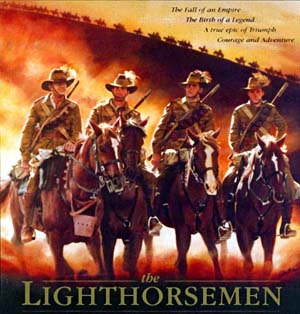
Lighthorsemen is wonderful for many reasons. It tells the true story of the Australian Cavalry´s participation in WWI in Palestine. British and Australian troops had to confront the German and Turkish forces. The Light Horse had already fought in many battles, among them at Gallipoli. The movie´s realism is convincing. The character portraits are nicely drawn. One soldier is more likable than the other and we slowly get to know each one in the regiment, and follow them from the early beginning to the battle scenes. This is one of those movies in which you really care about the protagonists. There is even a love story between Dave, the soldier who can´t shoot, and a nurse but it is discreetly kept in the background.
The essential story line of Lighthorsemen follows the 4th Light Horse Brigade in Palestine in 1917 until the battle of Beersheba where they achieve what 60000 infantry men could not do. They break through the entrenched infantry and free the city. This is not an easy endeavor. The heat is scorching, water is scarce and it is a massive strain on the horses.
The battle scenes, especially the final charge, are really exciting. We see the whole regiment fly along under the line of fire. A fabulous scene.
I am not sure it is a 5 star movie, but it certainly is a solid 4.5.
And, maybe surprising for a war movie involving combat, it has a certain lighthearted quality and cheerfulness stemming from the fact that those nice lads manage to achieve the impossible.
Was I a bit cryptic? Hope so. Just want to lure you into watching this fine film.
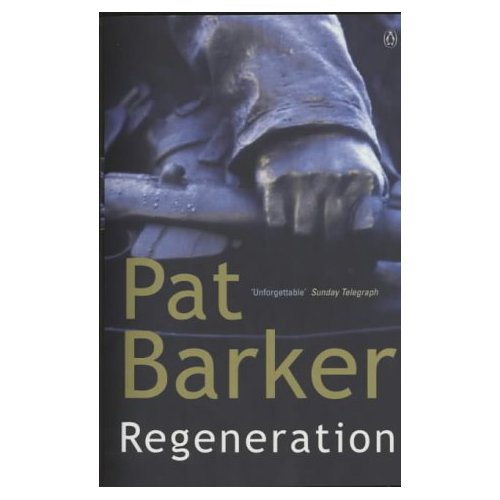
Based on British novelist Pat Barker´s incredible book Regeneration, the first book in her Regeneration trilogy, this movie has an awful lot to offer. Unfortunately like some other brilliant war movies (e.g. When Trumpets Fade) it never got its due appreciation by the public. This is a bit sad since everybody included in this film, especially the actors, did a brilliant job. Jonathan Pryce´s way of playing the eminent Dr. Rivers in such an understated manner impressed me a lot.
Set in WWI England and the French trenches Regeneration looks into so much more than just into it´s central theme shell shock. Class and duty, courage and a sense of utter futility coming from the colossal losses of lives are some of many themes.
Another interesting aspect is that Regeneration also looks at the birth of a medical discipline namely psychiatry in its struggle to become a well-respected way to cure people. During the times depicted in the movie however its sole purpose was to restore the ill young men and make them fit to be sent back to the trenches.
A further central theme is the poetry of young poets such as Siegfrid Sassoon and Wilfred Owen. The people we encounter at the heart of this movie are mostly intellectuals.
The story circles around the poet Sassoon (James Wilby) who is considered to be a war hero. He has written a letter of protest against this war that is still going on despite all better understanding. To avoid court-martial he is sent to the asylum to be treated for shell shock. He does have recurring nightmares but apart from that he seems unharmed.
As mentioned before we also find a thematization of the topic of class. The officers were mostly from the leading upper class. One patient however made it to a higher rank without the usually required background. One more look from another angle at this complex mess of a war.
There are many other patients in the asylum that have been marked more deeply than Sassoon. Some stammer, some lost their speech altogether, others suffer from hallucinations, delusions or other forms of psychotic reactions. One of them, Billy Prior (Johnny Lee Miller), is a very interesting character, so is Wilfred Owen (Stuart Bunce), the young poet.
Dr. Rivers (Jonathan Pryce) who is also a leading anthropologist is a very gentle psychiatrist (We learn more about him in the novels. The sequels to Regeneration, The Eye in the Door and The Ghost Road elaborate these aspects. Being an anthropologist myself I would have liked to see sequels of those movies. As an avid reader it is rare I am truly impressed by books but I was when reading this trilogy. Unbelievably good.). He tries to heal by listening to his patients and help them regain their memory of often unspeakable horrors. Empathy and compassion are Rivers´ trademarks. He cares deeply for his patients and it is tragic when he ultimately realises that all he does is cure them to send them off to face a certain death.
During the movie we are also shown one other doctor´s techniques at curing mutism originating in shell shock. They are revolting to say the least.
What made this movie so remarkable is the way it chose to show the scenes in the trenches. Even tough it is a color movie, the use of color during the trench scenes is attenuated, creating almost black and white sequences. This is convincingly artful. The just middle between the black and white of All Quiet on the Western Front and the corny choice of color in Passchendaele.
Regeneration is one of the best war movies on WWI. It excells in showing the absurdity of war, friendship among men, the birth of a discipline, the power of poetry to convey even the most horrible adequately. Yes, it is a rich movie. Would I want to do it justice, this already long post would be at least three times longer. Putting my review in two words: Watch it!
Should you be interested in more background information you should read a first hand account of one the people shown in the movie. Why not read Robert Graves´ (played by Dougray Scott) autobiography Goodbye to All That? Graves was Sassoon´s closest friend and responsible for his escaping court-martial. Of course Paul Fussell´s book The Great War and Modern Memory does also take a closer look at the above mentioned poets. This is dense however not less recommended reading.
“The British couldn´t do it, the French couldn´t do it. It´s only us, the Canadian corps” (quote from the movie).
I was tempted to write: “Once we had Pearl Harbor now we have Passchendaele” and leave it at that. But that won´t do. I´m afraid I must say, that this would have been an easy escape in terms of criticism for Passchendaele. And extremely unfair to Pearl Harbor. This coming from someone who thinks that Pearl Harbor does not even deserve the label “war movie”.
The story in a few words: As the war went on Canadians were getting more and more involved. Being only a little nation at the time, the participation of 600000 was enormous. 1 out of 10 did not come back. At Passchendaele alone 4 000 Canadians died and 12 000 were wounded. This unspeakable tragedy is meant to be shown. To illustrate this we see the exemplary story of one Sgt. who comes back after having fought at Ypern, on Vimy ridge etc. He’s a decorated war hero but shell-shocked. He has done something unspeakable and cannot forgive himself (apparently this bit is taken from Paul Gross´grandfather´s story of his participation in WWI). He is really bad off and won´t have to return. But, as some sort of love sacrifice (not going into details here I leave all the enjoyment of watching this movie and discover a piece of subtle sophisticated filmmaking to you. YES… I´m being sarcastic.), he goes back and ends up fighting at Passchendaele. This is one of the biggest and most notorious battles off WWI. Initially a success for the Canadians and their allies, in the end a failure due to the fact that a few months later Passchendaele was lost again to the Germans.
Watching Passchendaele I was feeling extremely stupid. Why did it escape my attention that this was again a hero + nurse + absurd conflict romance disguised as war movie? Unfortunately the romance part is nowhere near as good as the one from Pearl Harbor (Yes, I think Pearl Harbor is a very entertaining romance, well done). And the war parts? They are odd to say the least. We do see quite a bit of fighting. Between town ruins and in moors and muddy trenches. The odd bits reminded me of Windtalkers (so watch out all you who liked Windtalkers). Many explosions, one unconvincing “in the trench of the enemy scene” plus, this was quite original, people keep on flying like puppets. Oh and… I almost forgot this…the way the Canadians are depicted is priceless. What a jolly crowd. Jolly, jolly, jolly. They never stop laughing not even when they are torn apart or their comrades come flying over their heads. Why? What in the name of everything does this mean? One last word: the conversations are among the worst ever heard. In the trench Sgt Dunne actually says to his lover´s young brother, explaining the war : “Forests burn cos they have to, oceans go up and down cos they have to…and I don´t think we are that different…(…) this is something we do cos we are good at it…” Forests burn cos they have to, eh? The inherent nature of the forest is to burn? Very deep. Abysmal.
You know what? Even though many Canadians appreciated this movie (probably purely because at last their heroic participation was brought to our awareness. NO. I´m not being sarcastic now.). … I think they would have deserved better. To be really blunt: I think this movie is shit.
Be it as it may, there is one good bit related to the death of the nurse´s father – no I won´t tell what it is – and I am sure: this movie has and will have its fans.
If I had watched the trailer before buying the DVD I would at least have known about the romance bit. Can´t judge a film by its cover, can we ? (Liked this one too much for my own good).
This post is about two very different things. A good movie and a bad choice for a cast.
Based on the play with the same name written by the very same actor who is playing Kipling, David Haig, the movie tells us the tragic story of Kipling´s only son who went missing during WWI on the Western front in the Battle of Loos.
For reasons I will elaborate here My Boy Jack was an interesting, touching if a somewhat disappointing movie. Interesting since it showed the famous author Rudyard Kipling in another light and because it depicted the very onset of WWI and Britain’s reluctance to participate in this war at first. The tragedy of the war in the trenches with its enormous loss of lives in a very brief moment (we hear that the first day of the armed conflict cost almost 12000 British lives) is illustrated eloquently.
Kipling is shown as a dominant figure for whom the love of his country comes long before anything else. His values of manly courage and seeking of glory are really off-putting. The whole character is obnoxious. From the moment he knows the war will finally start his sole aim is to have his only 17-year-old son participate.
Unfortunately Jack is extremely short-sighted and without his glasses he is almost blind. The doctors performing the medical examinations do not want him to join the navy nor the army since it would be much too dangerous should he lose his spectacles during battle. His father being the influential and stubborn man he is pulls every string to have his son accepted against all better judgement.
Knowing the tragic story we sadly watch the inevitable unfold.
After his initial training and having been appointed lieutenant Jack is sent to France. He gets to know constant rain and shelling, the bleakness of the trenches and the muddy no-man’s-land around them.
After days of waiting his company is finally told they will have to attack.
The fear and anguish of the men who know by now that most of them will face a certain death is quite touching.
It will be Jacks first and last battle. A few weeks after his departure to France his family gets notified that he’ s been reported missing in action.
What follows is quite dramatic and good acting. Kim Cattrall (Sex and the City–yes, indeed) playing the mother is very convincing, so are the sister (Carey Mulligan) and David Haig as the father. The family wants to know what happened. Is Jack wounded but alive? Is he dead? Did he suffer? Of course Kipling constantly asks himself if he is guilty. The depiction of their grief and the father’s despair is very heartfelt. It moves you to tears. It is difficult to imagine what it was like to wait more than a year until they finally had some hints about what had happened. So why was I disappointed? Because I found Daniel Radcliffe absolutely not good.
He is really not a very good actor. Or maybe not yet. He should have some more qualifications for a role than his age. But actually it is not so much his acting that I criticize than the way he looks. For me he has absolutely no charisma.
Since the movie in itself is good and knowing that many people are very fond of him as an actor and also consider him great in My Boy Jack, I still suggest you watch this movie. Even more so should you be interested in Rudyard Kipling.
For the interested reader I posted Kipling’s poem about the loss of his only son. And who likes can also watch the video below and see David Haig render it in the movie.
“Have you news of my boy Jack?”
Not this tide.
“When d’you think that he’ll come back?”
Not with this wind blowing, and this tide.
“Has any one else had word of him?”
Not this tide.
For what is sunk will hardly swim,
Not with this wind blowing, and this tide.
“Oh, dear, what comfort can I find?”
None this tide,
Nor any tide,
Except he did not shame his kind —
Not even with that wind blowing, and that tide.
Then hold your head up all the more,
This tide,
And every tide;
Because he was the son you bore,
And gave to that wind blowing and that tide!
Apart from being one of the rare movies about cavalry combat this movie depicts a very interesting problem: The soldier who can´t kill. This is interesting in many ways. Sure it is commonly acknowledged that killing at war and killing in peace time is not the same. While one qualifies as simple killing, the other is said to be murder. You never hear anyone say about a soldier that he “murdered” enemies. He killed them. No judgement here, just a fact. Now what about the soldier himself? Is this really just “killing” for him, a justified way of taking someone else´s life? I don´t think so. Many soldiers suffer from nightmares when back from war and often, one of the elements they dream about, is the enemies they killed coming after them. Undoubtedly they feel guilty. Pacifists all over the planet will agree with them.
Dave in The Lighthorsmen is a good hunter in civil life. He knows how to handle a weapon, he is able to aim and shoot. But he is incapable of killing.




 All About War Movies