Rape and Love among Ruins: Anonyma – The Downfall of Berlin aka Anonyma – Eine Frau in Berlin (2008)

I was not sure if it was in good taste to use the title I gave this post but somehow it sums  up the film in a very few words. It is as if I had wanted to find two ways to speak about this movie: With brevity first and later at great length.
The Downfall of  Berlin has two contrasting parts taking place  shortly before and after the war ends. The beginning shows the taking over of Berlin by the Russian Army and the  mass rape that was soon every woman’s daily reality. The second half is dedicated to the love story with a Russian Major and the home-coming of Anonyma’s husband. All this takes place among ruins which accentuates the subliminal theme of the fragility of the depicted relationships.
The movie starts in 1945,  at the end of the war when the  Red Army troops enter the city of Berlin. What the German women had to endure from the moment the Russian Army set foot on the Ground of the city is an unparalleled horror.  Mass rape, brutalities and cruelty are the order of the day. One of these women, Anonyma,  kept a diary in which she carefully noted all the shocking events for her husband who had been sent to the Eastern front.
As the horrors go on she decides to look for a protector who might shield her from being constantly raped and abused by other men.

I have seen a few movies dealing with the German civilian population at the end of the war. There is a common moment in many of those movies. The inhabitants of a village or town hear troops approach and one of them is sent to find out who is coming. When the messenger returns there is this crucial moment when everybody just wonders whether he has spotted  Russian or American troops. Should it be the Soviet Army, the civilians flee in terror, whenever they hear it´s the Americans they are overjoyed.

A lot of the discussions whether this is a good movie circle around the comparison with the book and the liberties that have been taken to turn it into a movie.
First published in English in 1955 it has not been reissued until 2003, after the author’s death,  and this time under the pseudonym Anonyma. The reception of the book in Germany in 1959 was very harsh and aggressive and shocked the author a great deal. Germany was not ready for the  content of this  book.
The author of the diary was a  journalist and well-travelled woman. In  noting the horrible events and describing in great details the daily terrors of the women facing the Red Army she has left us an invaluable first-hand account.
The movie shows that hardly any woman, young or old,  escaped being raped.
There is a brief part in the movie when Anonyma meets a friend that she hasn’t seen in a long time and asks her “How many?” And they both know without any further clarification what they are referring to. Some 2´000´000 German women were raped in this time.  Payback for the massive loss of Russian lives.
It was criticised that the movie was not able to  transmit the whole extent of the horror that the book  shows. And of course the invention of the love affair which does not take place in the book was criticised as well. I  liked this doomed love story a great deal even though I normally do not like it when grim facts are sugar-coated by romance. But as a matter of fact this is a very realistic love story. Not very sugary at all and even though not in the book I think it manages to add another dimension.

Anonyma is a very fine movie, especially since it is in large parts bilingual German/Russian. The Russian cast is absolutely great. I especially liked Yevgeni Sidhikin in the role of Major Andreij Rybkin who becomes Anonyma´s protector and lover. Apparently already well-known in Russia we might see some more of him in the future. I was not too thrilled by the German actors. Apart from Nina Hoss who plays her role with an almost severe dignity, they are a bit too dramatic and wooden at times.

The shocking story of mass rape  is told in a very convincing manner. Evident but not voyeuristic. Without being shown  too explicitly we know what is going on.

I consider this to be an important movie as it shows how much the Germans suffered as well.
From reading German reviews on this movie I see that to this day the feeling of guilt runs so deep in Germany that they still feel uneasy to mourn these events.

And nowhere have I ever seen this called a war crime. Why not? Because the war was almost over? That would be a little bit cynical. Or because the aggressor has no right to complain?

Maybe it is just because no matter how it is called, no one really wants to speak about it. Rape like torture are hard to deal with. For both. Those who commit it and those who endure it.

I would really like to read comments, thoughts and whatever not about this movie from others.

amazon.com  Anonyma – The Movie

amazon.com Anonyma – The Book

True Blood and The Vietnam Vet

I read a lot. All sorts of things. Classics, literature, prize winners, pure entertainment, crime and thriller, some Fantasy… I am curious when I hear people enthuse about a book. That´s how I got lured into reading the first two in the Southern Vampire Series, Dead Until Dark and Living Dead in Dallas by Charlaine Harris. I do not really want to go into this reading experience here (I do understand why the series is succesful), nor is this the place to analyse women´s obsession with vampires (…. maybe…or,…..no, I don´t even go there…), what caught my attention early on was the character Terry Bellefleur. I felt he was very intense and with very few words Charlaine Harris captured the personality of a truly traumatized person. Without elaborating this character much she added another dimension to the already multi-faceted people swarming these books. Like in many Vampire novels before the Sookie Stackhouse series, one of the major themes is the outsider, someone who has lost contact with the society or was never part of it. And since the Southern Vampire books are populated with so many different types of fictitious and real outsiders like vampires, shape-shifters, homosexuals, Afro-Americans, addicts, the addition of a Vietnam vet seems of almost stringent logic.

I had read the books before even hearing of the series but was very curious to watch it. Six Feet Under will always be my favourite series so it was only logical I would at least have a look at what magic Alan Ball would be weaving  in True Blood. I was not disappointed. This series is just great fun. Very sexy and daring. Great cast, great stories, greatest intro song to any series ever (sure, it is only my humble opinion).

Writers and director took quite a few liberties especially with the cast. Many characters are much more developed than those in the book. Some are totally different, like Tara. Other types of outsiders are added, like alcoholics.

And what about our Vietnam vet? Miraculously transformed into an Iraq veteran to offer identification to the younger audience and to raise the awareness and understanding of and for those returning from Iraq and Afghanistan. This is more or less the explanation given by the producers. Quite nice, only it does not work for me. It does not feel right. I cannot explain it, but to me he is and will always be a Vietnam vet. No matter how much rationalization they put into his “transformation”.

When the actor Todd Lowe, whom many know from Gilmore Girls, was asked how he did prepare for the role, he explained he pictured a Vietnam vet that he had known as a young man. A homeless guy that talked him into giving him his cigarettes.

I wonder if there is not another reason to switch from Vietnam to Iraq. Maybe the age? Would a Vietnam vet not be much older than a guy returning from Iraq and Afghanistan? Of course this is a rhetorical question. Maybe the producers, even though they are extremely inclusive of marginal groups did not want to embrace the elderly? Now, don´t tell me this is not food for thought. Aren´t we living in a society that is ever so obsessed with age? Aren´t the vampires  ageless…always young, always beautiful? There is a certain logic in ostracizing the elderly from a vampire movie, right?

Or – which is not much better – did they think it was too hard to believe that someone could still suffer from PTSD after having come back such a long time ago? If so, what do they know?

I think they should have let this be. And I don´t buy the explanations. I would have preferred Terry Bellefleur to be an elderly Vietnam vet.

What about you?

I have to post the opening credits here for you, they are just too good to be missed and, let´s be honest, when will I ever get another chance to do this in a blog on war movies? Although…Come to think of it… what about a post dedicated to Generation Kill and  Alexander Skarsgard….

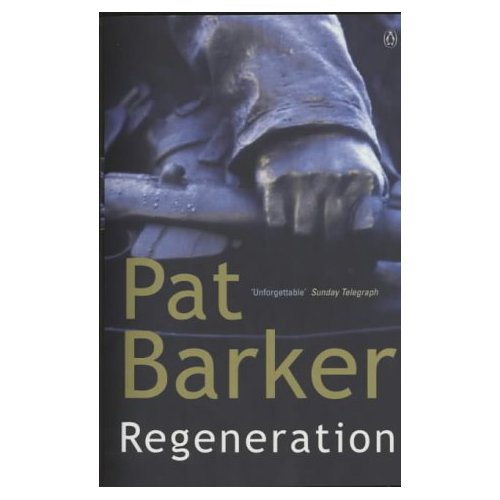
Regeneration aka Behind the Lines (1997) or Psychiatry, Poetry and Shell Shock during WWI

Based on British novelist Pat Barker´s incredible book Regeneration, the first book in her Regeneration trilogy, this movie has an awful lot to offer. Unfortunately like some other brilliant war movies (e.g. When Trumpets Fade) it never got its due appreciation by the public. This is a bit sad since everybody included in this film, especially the actors, did a brilliant job. Jonathan Pryce´s way of playing the eminent Dr. Rivers in such an understated manner impressed me a lot.

Set in WWI England and the French trenches Regeneration looks into so much more than  just into it´s central theme shell shock. Class and duty, courage and a sense of utter futility coming from the colossal losses of lives are some of many themes.

Another interesting aspect is that Regeneration also looks at the birth of a medical discipline namely psychiatry in its struggle to become a well-respected way to cure people. During the times depicted in the movie however its sole purpose was to restore the ill young men and make them fit to be sent back to the trenches.

A further central theme is the poetry of young poets such as Siegfrid Sassoon and  Wilfred Owen. The people we encounter at the heart of this movie are mostly intellectuals.

The story circles around the poet Sassoon (James Wilby) who is considered to be a war hero. He has written a letter of protest against this war that is still going on despite all better understanding. To avoid court-martial he is sent to the asylum to be treated for shell shock. He does have recurring nightmares but apart from that he seems unharmed.

As mentioned before we also find a thematization of the topic of class. The officers were mostly from the leading upper class. One patient however made it to a higher rank without the usually required background. One more  look from another angle at this complex mess of a war.

There are many other patients in the asylum that have been marked more deeply than Sassoon. Some stammer, some lost their speech altogether, others suffer from hallucinations, delusions or other forms of psychotic reactions. One of them, Billy Prior (Johnny Lee Miller), is a very interesting character, so is Wilfred Owen (Stuart Bunce), the young poet.

Dr. Rivers (Jonathan Pryce) who is also a leading anthropologist is a very gentle psychiatrist (We learn more about him in the novels. The sequels to Regeneration, The Eye in the Door and The Ghost Road elaborate these aspects. Being an anthropologist myself I would have liked to see sequels of those movies. As an avid reader it is rare I am truly impressed by books but I was when reading this trilogy. Unbelievably good.). He tries to heal by listening to his patients and help them regain their memory of often unspeakable horrors. Empathy and compassion are Rivers´ trademarks. He cares deeply for his patients and it is tragic when he  ultimately realises that all he does is cure them to send them off to face a certain death.

During the movie we are also shown one other doctor´s techniques at curing mutism originating in shell shock. They are revolting to say the least.

What made this movie so remarkable  is the way it chose to show the scenes in the trenches. Even tough it is a color movie, the use  of color during the trench scenes is attenuated, creating almost black and white sequences. This is convincingly artful. The just middle between the black and white of All Quiet on the Western Front and the corny choice of color in Passchendaele.

Regeneration is one of the best war movies on WWI. It excells in showing the absurdity of war, friendship among men, the birth of a discipline, the power of poetry to convey even the most horrible adequately. Yes, it is a rich movie. Would I want to do it justice, this already long post would be at least three times  longer. Putting  my review in two words: Watch it!

Should you be interested in more background information you should read a first hand account of one the people shown in the movie.  Why not read Robert Graves´ (played by Dougray Scott) autobiography Goodbye to All That?  Graves was Sassoon´s closest friend and responsible for his escaping court-martial. Of course Paul Fussell´s book  The Great War and Modern Memory does also take a closer look at the above mentioned poets. This is dense however not less recommended reading.

Regeneration at amazon.com, amazon.co.uk ,amazon.de

To Remake or Not to Remake: e.g. All Quiet on the Western Front, Psycho, Dangerous Liaisons

We have been flooded by a recent wave of remakes (Fame, Predators, …) some of which seem redundant to say the least. I do not think it does make any sense to remake a movie that is fairly recent and to re-do it just the way it was, only exchanging the actors to attract a younger crowd of spectators.

However, some movies  like theater plays (e.g. Hamlet, hence the title of this post) make interesting material for reinterpretation.

I remember that when I heard Hitchcock´s Psycho had been remade by Gus Van Sant I thought it was pointless but when I saw it  I found that it had its charm. Adding color and playing with this gave it a totally new feel. If you want to get a bit of an impression watch this YouTube movie someone did to compare both versions.

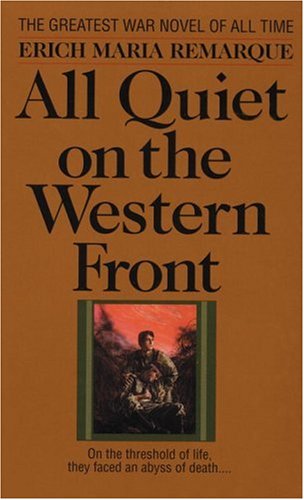
All Quiet on the Western Front is one of those movies that can do with a remake. I know it is a classic and one of the most important war movies of all times and many a reader will think it hateful to encourage such a thing. Still I believe it would benefit from it. (I know that it has already been done for TV).  All Quiet on the Western Front is really old. We are talking 1930. The acting has still the feel of  the silent movie era that only just ended in 1927. The acting is over dramatic. A lot of  the facial expressions are exaggerated (not as bad as in the real silent movies more like on the stage).  The whole pictorial language of the acting, so to speak, is hard for us to understand. To enjoy a movie like this nowadays you have to know a lot about film history and be interested in it.

What works very well in the original All Quiet on the Western Front is the depiction of the atrocities of war. Whenever the focus is not on the actors it is fabulous. Hands that are gripping barbed wire but are no longer attached to a body… Those very nuanced shots in black and white accentuate the horror and give a more realistic impression. Black blood looks somehow more like the real blood than overly red blood does.

All this will be a challenge for the film director of the upcoming 2012 version.

Furthermore let´s not forget that the movie is also already a reinterpretation since it is based on the novel by Erich Maria Remarque.  And like with plays where no one takes offense when another director takes it up again, one could claim that this is not really a remake of the movie but a reinterpretation of the book. (I can think of another literary phenomenon that has been turned into a movie at least three times and all of the versions I have seen are extremely interesting and well done. I´m thinking of Les liaisons dangereuses aka Dangerous liaisons the novel by Choderlos de Laclos. First there was the French movie by Vadim (1959), then the Stephen Frear´s remake (1988) with Michelle Pfeiffer, Glenn Close and John Malkovich and last but not least Cruel Intentions (1999) with Ryan Phillippe, Reese Witherspoon and Sarah Michelle Gellar.)

I have uttered my reservations as to the cast of the new All Quiet on the Western Front (see my post on My Boy Jack and Daniel Radcliffe) but apart from that I´m curious to see if they will do the book (and not so much the film) justice.

Remarques´s book is one of the best anti-war books of all times. It is so good that when I had finished  it and read that it had been translated into 50 languages and sold over 20 million times I could not believe that anyone anywhere in this world could have ever wanted to start a war again.

Unfortunately literature is not as powerful as that.

Under Fire: A Century of War Movies, edited by Jay Slater (2009)

Under Fire is simply a must-have for people seriously interested in war movies or even movies in general.

It contains a collection of essays on all sorts of topics regarding war movies, from WWI to the wars in Afghanistan and Iraq. Many different people have contributed to this very dense work. Well-known film critics and academics alike.

This is really something to sink your teeth into. Quite demanding reading but extremely insightful.

For example did you know how important YouTube´s influence was on contemporary Iraq movies (yes, I even started to understand Redacted)? Or how Vietnam changed the war movies? Do you know a lot about British propaganda movies of WWII? Did you consider to interpret Starship Troopers as WWII and Nazi satire?

These are only a few topics of many that are analysed in these very thoroughly researched essays.

Sure, this is no movie guide as such. It is not recommending or rating anything. Under Fire provides criticism and analysis for those who like to interpret not only the apparent but also the subtext.

This book is really worth having and I am quite excited about this find that manages so well to show the variety, the depth and the virtuosity of war movies.

Here you find the link to the publishing house. It contains an interview with the editor and interesting additional chapters.

Barnes and Noble

amazon.com

amazon co.uk