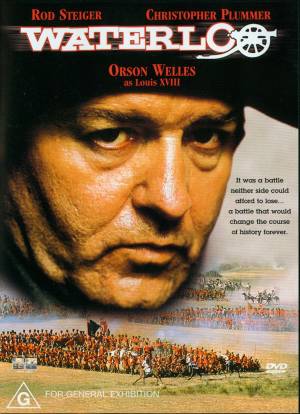
Waterloo (1970) “Next to a battle lost, the saddest thing is a battle won”

Waterloo was more than just a movie for me. Watching it meant jumping head first into childhood memories.

“Waterloo, Waterloo, morne plaine…” No, this isn’t the French version of the AbbA song. I am afraid the words are not bound to tell you much. I can still hear my father’s voice drone this part of  Victor Hugo’s famous poem L’Expiation (an endless poem by the way) on Sunday mornings. I said it in my last post, I went through a bit of an obsession with Napoléon as a child and guess I deserved a little punishment and therefore frequently had to listen to the long and never-ending recitation of that poem. Sorry for this little digression… Back to my review.

I haven’t seen this movie before and I must say it was high time. It is a worthy candidate for a place among my Top 20. I loved every minute of it (with the exception of the animal stunts. Being reminded that this a Russian production and the well-being of horses might not have been high on the agenda did NOT help. It is funny how all of a sudden one likes the idea of CGI. I never thought I would ever write such a sacrilegious thing.)

As the title indicates, this is not a Napoléon biopic. It doesn’t show the great man’s life, only a fatal and tragic part of it, the battle of Waterloo. Maybe the best known of all the French battles (apart from Austerlitz) in France.

The movie starts with what has become in French the synonym for something long, endless and wearisome, namely “Les adieux de Fontainebleau” or “The Goodbyes at Fontainebleau” in which Napoléon, before being exiled to Elba,  says goodbye to his troops. He states in the movie that he deplores that he can not say goodby to each and every one of them still it is said that it took hours. After having been defeated on the battlefield he was forced to abdicate and go into exile to the island of Elba.

Rod Steiger manages masterfully to show how emotional Napoléon was. This man was driven by strong emotions and passions. And it seems that the troops loved him for this display of feelings.

He stayed at Elba some ten moths and then returned to Paris where Louis XVIII (Orson Welles) had taken back the throne. The moment when he meets the troops is another highlight in this movie. He wins them back easily and becomes emperor once more.

After this episode he heads the troops and marches towards Belgium to engage the troops of Wellington.

Before the movie takes us to the battlefield it briefly stops in a ballroom in Belgium where Wellington (Christopher Plummer) and his men are introduced.

Two thirds of this movie are dedicated to the battle of Waterloo. I think it is incredibly well done. I liked those costumes and the way we could see the battle formations. There was such a huge difference whether cavalry charged against cavalry or against infantry. The moment when the French cavalry attacks the British infantry is horrible. The horses are shot down one by one. The square battle formations of the infantry made it impossible to win for the attacking cavalry. Like this the horses could be shot down from every angle.

At moments, while I watched this and saw the tactics the two men applied, how they overlooked the battlefield, sent troops from here to there, removed them from somewhere else, I was reminded of chess.

The two great men, Napoléon and Wellington are shown as complete opposites. Naploéon goes through every possible emotional change while Wellington stays poised and self-possessed. While one is of very humble origins, the other is an aristocrat through and through.

We all know the outcome of the battle and when it is over, not even Wellington is unmoved and he says the famous words:

Next to a battle lost, the saddest thing is a battle won.

I really enjoyed Waterloo. I liked the costumes, the uniforms, the battle formations, Wellington’s poise, Napoléon’s sadness, the composition of the British regiment, the Irish troops with their rosaries and the Scottish with the bagpipes.

I would recommend this movie to every one who is interested in French and British history and the Napoleonic Wars, who likes costumes and has an interest in miltary tactics of the time.
Movies on the Napoleonic Wars (1792-1815): A List

I watched the Hornblower series last year and enjoyed it very much. I re-watched Master & Commander and thought once again that it is really a good movie. Finally I discovered the Sharpe series with Sean Bean and I like it a great deal as well (at least those I have seen so far). Considering that they are all based on the Napoleonic Wars, I thought it might be high time to see what else there is. I found quite a few movies, some I have seen a long time ago, like Abel Gance’s Napoléon, and others that I still would like to watch. I also included movies on the man himself as I figured there will not be many biopics on Napoléon leaving out the wars. When I was a child I went through a bit of a Napoléon obsession and remember contemplating his wax figure at the Musée Grévin in Paris with awe. I should have been awed that even as a ten-year old child I wasn’t that much smaller. There are quite a lot of German and French productions of the topic. I did include them although not all of them have been subtitled.

The movies that I would like to watch soon are Waterloo with Rod Steiger, the mini-series Napoléon and Ridley Scott’s The Duellists.

As ususal any comments, additions or ratings are highly welcome. The Duellists is a movie I wouldn’t have known of, if it hadn’t been for Guy Savage‘s recommendation in a comment.

Neil Jordan’s Michael Collins (1996) The Irish Fight For Independence

Neil Jordan’s Michael Collins is a UK/US/Ireland co-production. International productions guarantee an international cast which can be nice but in this case, I would say, it did prevent the movie from being great. There is no drama teacher in the world who will achieve to make Julia Roberts or Aidan Quinn sound Irish. Liam Neeson as Michael Collins, Alan Rickman as De Valera and a very young Johnathan Rhys Meyers, striking the fatal blow, are well-chosen.

Michael Collins was probably one of the most controversial and tragic figures of Irish history. A charismatic man who knew how to convince those who followed him. A man who wouldn’t shy away from killing yet didn’t take it lightly.

The movie starts with the Easter Rising in 1916 with Michael Collins rallying the masses against the British occupation. It would take another three years until this initial movement lead to the Irish war of Independence. It is a fierce and bloody war. A the end of the war stands the treaty, something that was unthinkable for 700 years. The British government allowed the Irish Free State but kept the Northern Provinces and wanted the Free State to swear allegiance to the king. Michael Collins considered this to be the best he could achieve and wanted to sign the treaty but the men around the future president de Valera wanted a completely free Ireland and this is where the movement for Independence split into two sections who would fight each other fiercly.

The movie shows us a Michael Collins who is tired of fighting and bloodshed and longs for peace. He is sure, if the treaty isn’t signed the bloodshed will be endless.

An important part of the movie is dedicated to the friendship between Michael Collins and his best friend Harry Boland (Aidan Quinn). For four years they are also caught up in some sort of love triangle as both men love Kitty (Julia Roberts). It takes a while until she confesses that she loves Collins. Her confession is not the only thing that drives the men apart. Politically they are not on the same page anymore. Best friends become enemies.

Michael Collins is shot in 1922 by one of de Valera’s men. This is the beginning of the Irish Civil War.

I liked the movie despite its flaws, one being, as already stated, the choice of American actors, the other being quite a few historical inaccuracies. Apparently Neil Jordan had good reasons for altering the facts. I am not sufficiently familiar with the details to point out what is correct or not. There is one particularly awful scene in which a British tank opens fire on a the players in a sports game. In reality this was much more horrible.

Michael Collins is a fascinating character and I could very well see myself read a biography in the future. He was a leader and an adept fighter. His fighting tactics seem to have inspired quite a few future struggles. The group around him was constantly hunted by British secret agents and policemen. Michael Collins’ tactic was to know more about the agents than they knew about them and then to hunt them down. There are a lot of executions to be seen as they operated according to the dictum “who is not with me is against me”. At times the movie reminded me of movies about the resistance. Torture, execution, changing of sleeping quarters etc.

A while back I reviewed another movie on the Irish War of Independence and the subsequent Civil War, The Wind that Shakes the Barely. Michael Collins is never seen but constantly spoken of in the movie so I was really curious to see this. Comparing the two movies I’m afraid I must say, The Wind that Shakes the Barley feels more authentic, it is a truly outstanding movie.

Despite its flaws Michael Collins being a Neil Jordan film offers a lot and is beautifully filmed. It is as much a character portrait, as the story of a friendship and a romance. I enjoyed it and would recommend it.

Historically Misleading War Movies as Seen by the TIME Magazine

I discovered an article today in TIME magazine in which they made a list of 10 historically misleading movies. As was to be expected quite a few of the movies are war movies. The whole article was spurred by the movie The King’s Speech which is also among the 10.

I will only concentrate on the war movies they name and give a brief summary why they chose to include them.

The Patriot (2000)

They critizied that The Patriot portrays British soldiers as evil. Another point was the fact that Benjamin Martin whose character was a mix of different real charcters, was shown as a family man while  Swamp Fox who was one of the real characters was no family man and actively persecuted Cherokee Indians. Further more the movie showed a total ignorance of slavery and whitewashing of history. They consider it to be pure American propaganda.

Robin Hood (2010)

Robin Hood tried to transform myth into history. Although it was correct to transform Richard Lionheart into a bloodthirsty monarch, the accuracy ended there.

Braveheart (1995)

This movie has, according to the TIME Magazine, too many inaccuracies to be named. How about the kilts? Scotsmen in the 13th century didn’t wear belted plaid. Gibson’s Wallace is born poor, the real Wallace was a nobleman. And why is he wielding a Chinese weapon? Wallace never met Princess Isabella and certainly did not impregnate her. At the time the movie took place she was only 9 years old anyway.

300 (2006)

Sparta was not a free city-state at all but on the contrary  known for mistreatment and exploitation of its slaves. The Persians were not as debauched as they are shown and their monarch wasn’t a circus freak.

Pearl Harbor (2001)

Pearl Harbor was mostly criticized for the rearranging of chronological events and its sappy simplistic nationalism.

Yeah well, not so surprising after all. At least I didn’t have the feeling any of the ones mentioned were very accurate or at least not in every element.

What strikes me is the title of the post and its explanation. They actually imply that people learn their history through the watching of movies.

For those of you who are curious about the other movies, here are the non-war movie ones: The Far Horizon, 10 000 BC, JFK, The King’s Speech, Shakespeare in Love.

Shooting Dogs aka Beyond the Gates (2005) An Unspairing Look at the Genocide in Rwanda


What a shocking movie. Incredibly good but so sad. I have seen the outstanding Hotel Rwanda a few years back but Shooting Dogs, that is less flawless from a cinematographic point of view, is even better. It is a UK/German co-production starring German, British and African actors.

The story, that is based on true events, takes place in a school compound in 1994. A young British teacher (Hugh Dancy) and an elderly British priest, father Christopher, (John Hurt), are responsible for the school. It is a school to which as well Hutu as Tutsi children come. Early on arrives a troop of UN soldiers who also stay inside the school gates while outside the world as they know it falls apart.

The beginning of the movie is slow and shows with great detail the almost idyllic, if somewhat chaotic life in the city of Kigali, in Rwanda. The moment the Hutu president is killed, the situation changes drastically. The Hutu majority fears that the Tutsi minority wants to overthrow their government and be in charge of Rwanda again. Out of fear and wanting to control a situation that gets out of hands they start what can only be called a genocide. They systematically kill every Tutsi that they can find. To say they “kill” them is an understatement and gives the wrong impressions of the atrocities that happened in Rwanda. The people are not only killed, they are butchered with machetes. Old people, young people, men, women, children and even babies are literally chopped up.

The courageous priest opens up the gate and lets a few thousand Tutsi find refuge inside of the school gates. They are guarded by the UN who are only spectators in what becomes more and more atrocious. They have a very strict mandate which states that they are not allowed to intervene. They watch the butchery without doing anything. Only if they were shot at, would they be allowed to act. The commanding officer (Dominique Horwitz who has an outstanding role in Stalingrad) is helpless and ashamed but there is nothing he can do. The irony is, if the events would be called “genocide”, he would be free of his mandate and could intervene. But no one officially calls it a genocide.

In the beginning we do not see many of the horrible acts but towards the end the movie gets more and more graphic and I could feel the fear that these hordes must have instilled in those threatened by them. They seem so mindless. A mass of violent men, slaughtering, raping and butchering innocent people. And no one helped the Tutsi.

There is a scene that I found particularly profound in which a journalist, talking to the teacher, compares her reaction to the horrors in Bosnia with her reaction to those she sees here. She explains that she cried all the time in Bosnia when she saw dead people but that she was somewhat unfazed by the dead in Rwanda. The young teacher argues that she is probably numbed but she admits that it is more awful than that. “No,” she says. ” It is worse than that. I constantly think, they are only dead Africans.” This is such a shocking confession but how true. I wonder how often Europeans and Americans did think like that during the war. “It’s only Africans”.

When things get worse, the French Army sends soldiers to get the Europeans out of the compound and to the airport. The priest and the young teacher stay until the UN troops get the order to leave as well. At that moment the teacher leaves but father Christopher stays.

This movie is really highly watchable. It is sad and moving and the most touching is that the people who took part in the making, the people in charge of costumes and the settings, the electricians and carpenters, were all Rwandans who lost most of their familiy members in this genocide in which far over 800 000 people were killed.

This is one of the saddest chapters in the history of the 20th century. It should not be forgotten. There is no such thing as “only Africans”.

This movie saddened me a great deal and left me speechless for a long while.