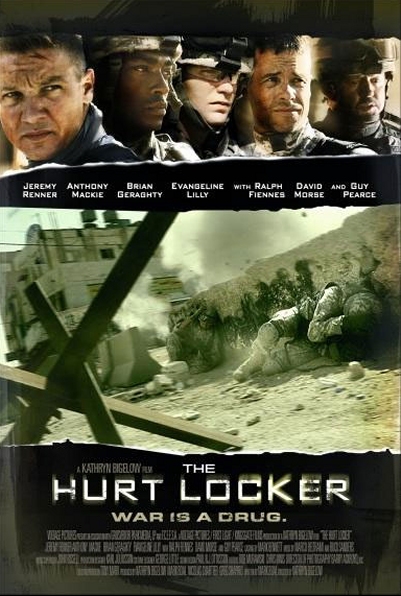
A War Movie Gone Thriller: The Hurt Locker (2008)

Yes, I had to do it. I had to add something on this ubiquitous film.

The story of The Hurt Locker should be sufficiently known by now. We are shown a bomb squad on their mission to disarm bombs in Iraq. When a real danger addict is appointed to be the new leader of the squad things get really exciting.

Somehow, when I realized I liked it, I felt a soft tingling feeling of shame that made me wonder.

But the fact that I did enjoy The Hurt Locker doesn´t necessarily mean I think it is a good war movie. There was a whole lot of suspense going on. It was entertaining and it sure felt like a thriller. The possibility of every  bomb or object to prove deadly seemed like a serial killer lurking around in the dark. He sees you, you sense him. Creepy. I stopped breathing every time Sgt. First Class James started to cut those little wires.

While I was watching it I did not for one second question it. I felt just so swept away and liked it. Period. But afterwards I found it kind of problematic. One is almost grateful wars take place and offer us such a great topic of suspense.

I remember that I had very comparable feelings after having seen Apocalypse Now. The anti-war message was just not clear enough for me.

Same here. It´s like saying: yeah well, war is shit, we shouldn´t do it but so what, it´s fun.

Of course that is not what Kathryn Bigelow tried to say but it is what the audience could understand.

This potential to be misunderstood comes from the blending of the genres. Or rather the blending of major techniques of different genres. War movies don´t normally create this type of suspense. It would have been possible to show the same without creating the suspense.

Maybe I should put it that way: The Hurt Locker is one hell of an exciting movie but a dubious war movie. It is especially problematic as it shows a very specific bit of warfare in Iraq. Where every other movie with an attempt at realism (the most extreme example would be Redacted. Come to think of it, Redacted is actually the antithesis of The Hurt Locker. It is so boring it hurts) has often long boring stretches where nothing else happens but watching road blocks, this one shows it as if the war in Iraq had nothing else but moments that got your adrenaline pumping.

Be it as it may it is great filmmaking. Kathryn Bigelow is very good at that. If you want to watch another one of her movies either try Point Break (1991) or Strange Days (1995). Both are highly enjoyable without creating any guilty feelings. Especially the first one is one of the rare movies that I can watch again and again. And, as an additional asset, it will help you understand her technique and where she comes from genre and theme wise.
amazon.com

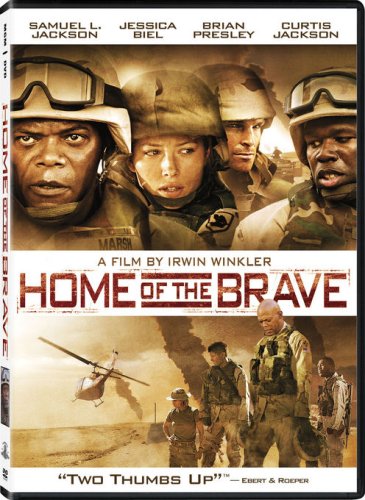
Home of the Brave (2006) or When a movie really fails

Home of the Brave is about a group of soldiers who came under heavy attack shortly before being sent home. After their return they try to cope with what they have been through. They all fail to some extent before they realise they need psychological help.

What a bad, bad, bad movie! I´m embarrassed I watched it. Worst acting ever. Ridiculous dialogue, dragging storyline, wrong cast, pathetic music…

And yet, there are a lot of people who like this movie and say: that´s exactly how it was.

I don´t doubt for one sec, that this is how it was. I don´t doubt for one sec that the returning soldiers need medication, treatment, can´t make their relatives understand, despair, start to drink, get violent, blame everyone including themselves and the government.

Fine. But DO NOT show a message like this in such a way. After a while you start to wonder, why there is not a constant voice in the off telling you: ha…that was impressive, ha…see how horrible, ha….start to blame the government and now ha….

This doesn´t work. It´s like someone telling you a joke and immediately explaining you afterwards why it was funny.

The opening is quite similar to many other opening scenes of movies located in Iraq, be it Battle for Haditha, Stop-Loss or any other. But the similarity is a purely exterior one. The acting is too bad to actually induce feeling. The convoy gets ambushed, people die and get mutilated. And all this happens after we have been told that exactly these people are about to go back home. This is repeated so many times that the thickest moviegoer starts to scratch his head thinking: Are they telling me something here? Fate playing tricks is an old theme in war movies, after all it´s one of life´s themes, but usually it is handled with more subtlety.

Next thing, they are all back home. One has lost his best friend, one (a doctor) had to amputate many limbs, one had her hand amputated and now they start to struggle and stumble and fail like the movie.

Sad. They meant well. They wanted to tell us: This should not happen. America shouldn´t meddle. This is not WWII. We won´t get statues and memorials and see people with tears in their eyes still thanking us years later. No, they hate us, they want us out and if we don´t get it, they shoot us up.

A few final words on the actors.

Jessica Biel: Very bad start but then okish.

Samuel L. Jackson: He can’t really be very bad, can he? No, unless he unconvincingly tries to play a drunk. But he has his moments still.

Brian Presley: Who´s that geek? He´d be good in a movie like My Beautiful Laundrette. But only for the looks. Talentwise it´s rather… well…any bad series. Whatever.

Chad Michael Murray: How to get shot and look ridiculous at it. He should keep on making series like  One Tree Hill (not that I´d watch that) or movies like Cinderella Story.

50Cent:  Mumble, mumble, mumble or How do I act without having the tiniest facial muscle move.

Christina Ricci: What the heck were you thinking accepting this role?

The only good thing was the movie´s attempt at showing that medication is no solution to trauma and consequential sleeplessness. It´s in the end no better than drinking. You can´t ignore the trauma, you can´t block it, you have to accept it and  talk about it.

Stop-Loss (2008): The End of Denial or The War that Takes Place in Living rooms

Stop-Loss

“Sand, fleas, flies, heat, boredom. Or you can get shot at. Or blown up. That’s pretty much it. There are sheep on the highway”, says SSgt. Brandon King (a remarkable Ryan Philippe) in Stop-Loss after Steve’s girlfriend tells him that Steve doesn’t talk much about being over there. Brandon doesn’t go into details, he sums it up and turns it into a joke. It’s difficult to talk about it. And not even wanted as his father tells Brandon when he is getting too graphic. There is denial in both camps. Those who stay home do not want to know because they want to believe in their sons/lovers/friends/brothers doing the right thing. To be invulnerable heroes and return as such. Nothing really bad happens over there, right? Soldiers like Steve do not want to talk about it because they simply do not want to think about it. As soon as they start thinking, like Brandon does, the only thing they want is: getting out! And that’s when the trouble begins

Brandon has seen it all. His people dying, being terribly wounded and crippled for life. Dead civilians. The war taking  place in living rooms. He’s done his job. He returns from a completed tour of duty in Iraq a hero and now he wants out. Unfortunately he is stop-lossed. In times of war, when there is no draft and not enough volunteers, the government can stop-loss soldiers, meaning send them back even if they want out.

What begins as a war movie with heavy fighting, interspersed with grunt-video like elements, turns now into a road movie. Brandon wants out and goes AWOL.

He and his best buddies girlfriend Michelle are taking a trip to… A new life with a fake identity or back to where his friends are?

Watch it and you will find out. It should suffice to say that this movie is a character study, a very critical look at what is going on “over there” and a way out of the speechlessness of those involved and those waiting for them. The young men, depicted in this movie are of the kind who rather hit you in the face than voice their uneasiness. They drink, they fight, they like to shoot guns and listen to heavy music. They are self-destructive but loyal friends. They do not have much other professional options but join the army.

The movie’s strength is not only to be highly watchable but to convey a deep feeling of  sadness. Sadness about many things: the loss of naivety,  the governments cheating, the waste of lives and ultimately hope.