Alexander Skarsgard aka Sgt. Brad “Iceman” Colbert in Generation Kill

Alexander Skarsgard, the Swedish actor nowadays better known as Eric the Vampire, had a life before True Blood. And quite an interesting one, I dare say.

I am not the world’s most patient person and when I started to watch HBO´s Generation Kill this lack of patience almost cost me a great viewing experience. I was really tempted to give up after episode 1 since I found it a bit boring. But since I am also a curious person I did hang on. I watched the whole series until the final episode and when I realised it was over I  thought: I am actually going to miss the series and its characters. It is a great show and if I can belive the many comments I have read on it coming from Marines, it seems to be truly authentic and captures the feel of the real thing. It is not always about combat and action. A lot is pure boredom and killing time. (And don´t forget, those guys cannot fast forward when it gets too slow).

Part of the series´ success is certainly founded in Alexanders Skarsgard´s impersonation of Sgt. Brad “Iceman” Colbert. The guy is so composed and calm, any cooler than him and you´re probably a glacier.

Today I found this really great video post on YouTube in which Alexander, the real Iceman and the Rolling Stone reporter Evan Wright on whose book the series is based all get their say.

More on Generation Kill and Alexander Skarsgard will follow soon.

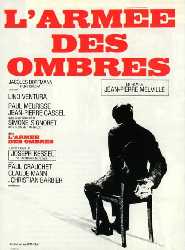
The Army of Shadows aka L´armée des ombres (1969): The Classic Movie on French Resistance

Bad memories, I welcome you nevertheless,  you are my distant youth.

If you are really interested in the topic of French Resistance there is no escaping this movie.  If you are truly interested in film there is no escaping this movie either. Especially not since there has been a recent wave of Resistance movies (Les femmes de l´ombre (Female Agents), L´armée du Crime ( The Army of Crime), Flame and Citron, Black Book, Winter in Wartime, Max Manus) and it is always good to see where they come from, what influences they had.

Jean-Pierre Melvilles´s L´armée des ombres aka The Army of Shadows (or in the Shadows) is a classic and a work of art.

It is beautiful like a foggy autumn evening, like the solitary cawing of a crow, like bare branches of a tree in winter, like the bluish colour of an early nightfall, like bitter sweet music and coffee drunk at midnight in an empty bar. (Would I  have to compare it to a contemporary movie, I think I would choose Shutter Island.  The movie as a whole and particularly the sad song during the end credits, Dinah Washington´s Bitter Earth blended with Max Richter´s On the Nature of Daylight, has a similar dense atmospheric quality.)

Gerbier (Lino Ventura) is captured by the Gestapo early in the movie. He manages to escape but knows he has been betrayed. Only one of his own could have told the Gestapo where this overly careful man was hiding.

Gerbier is head of a Resistance cell that operates between Paris, London, Lyon and Marseille. They always on the look out for people they can trust. They must always be careful, they could be betrayed anytime. They are hunted and on the run continuously. When they are caught by the Germans or the collaborators, they will be tortured mercilessly as the film shows drastically. But the group will risk everything to save one of their own.

The cell kills traitors as well  as people who become too risky. No matter how much they helped them in the past, no matter how much they like them. The group ultimately lives and dies for the cause.

Lino Ventura and Simone Signoret are fabulous in this movie. It is a pleasure to watch such assured actors.

A feeling of abandonment and utter loneliness pervades the whole film. It seems to illustrate the existentialist angst of the times. Melancholy in its purest form.

What impressed me most was the sound. No effects like we know them nowadays but so artfully and sparingly used noises and sounds and just a little bit of music. The rain in the beginning, echoing footsteps in empty streets, the ticking of a pendulum in a room, the distant cry of birds.

It is quite a sad movie and I would not recommend you watch it should you feel very blue. It would not cheer you up. But on days when you feel balanced enough you will admire these brave people and suffer with them when they find out one of them is being tortured but won´t speak, not even when he knows he is going to die.

And, please remember, this is a true story.

Ice Cold in Alex (1958) or When did Beer ever Taste this Good?

Picture this: It is a hot summer day. 45°/113° in the shade. The sun is blaring. Water is scarce. You are more than just thirsty. You have to overcome a lot of obstacles to get out of the sweltering heat. But at the end of the day the coldest lager in the Middle East is waiting for you.

What are you going to say: “Worth waiting for”.

Now this is exactly what John Mills´ character Captain Anson says after they finally arrive at Alex. Ice Cold in Alex tells how they get there.

In 1942 a little group of people, two nurses, two British officers and a suspicious South African officer attempt to cross the desert from Tobruk to Alexandria, crossing minefields and enemy territory. They have to fight more than the heat, flat tires and  German attacks. Captain Mills must try and come to terms with his alcohol problem. After his drinking leads to a disaster he swears he will not drink anymore until they are in Alex.

Ice Cold in Alex is a real classic. The black and white makes the actors look twice as expressive as they would have been anyway. It is an adventure story in front of a WWII background.

It is not your ordinary action-driven, combat-flick but a fine piece of British cinema. And the end-scene, when they finally make it to the bar and get their lager is memorable.

Apparently they had to shoot the scene so often that John Mills was really drunk at the end of it.

Another interesting observation: this is probably one of the earliest examples of product placement in a movie.

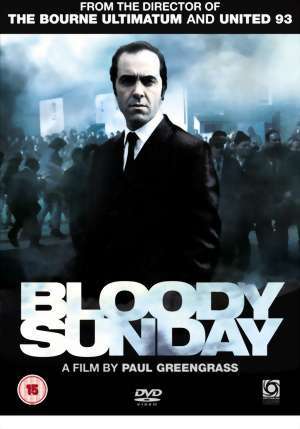
Bloody Sunday (2002) or The Day Innocence Died

Maybe it is debatable whether this is a real war movie in the strict sense of the term (but then, what is that anyway?) but I believe whenever there is armed conflict executed by an army or large group of people, even though not on a global scale we have to speak of war.

On January 30 1972 the British army opened fire on a peaceful Civil Rights March in the city of Londonderry in Northern Ireland. On this day 27 people were shot and 13 of them lost their lives. A further victim died a few months later. This day was from then on called  Bloody Sunday. It was a huge blow to the Civil Rights Movement and ended in countless young men entering the IRA. What followed is a history of bloodshed and terrorism that would not end until the 90´s.

On June 15 2010, after an investigation of 12 years had been conducted and found that the British army had opened fire without  a reason, the British Prime Minister Cameron apologized for this crime.

The so-called Saville Report has cost 230 million Euro. It proved without any doubt  that  the soldiers were at no time shot at. They opened fire on people who tried to flee, take refuge or wanted to help others. Two thirds of the victims were only 17 years old.

When this movie was shot, although largely known, there was no actual evidence as to the truth of these facts. We know them now and thus the movie unfurls vividly before the spectators eyes the whole extent of this tragedy.

Bloody Sunday is not easy to watch and the first two thirds were so annoying that I was tempted to stop it. This is solely due to the technique. It is filmed documentary style with a shaky hand-held camera. We see three complementary points of view. The Civil Rights Movement´s, the Police Headquarter´s and The Army Company´s stationed in the street. The camera fades to black for every scene. During the bits at the Police Headquarters there is a constant ringing of telephones that drove me almost mad. Also at the Civil Rights Movement´s Head Quarters, just before they assemble on the street, phones keep on ringing. The movie basically shows the whole day from early morning until its bloody end. We see the people prepare for the march, the police debating at what point they should stop the march and the soldiers on the street taking position.

It is worthwhile to sit through these annoyances though. The last third, when the march turns into a tragedy, is extremely powerful and the documentary style filming adds to the realism to an almost unbearable extent. What we watch is such a tragedy that we can barely believe it. To shoot at people who shout for help or try to help others looks like an execution.

Saying all this I think the movie shows nevertheless, no matter how misguided the army was or how brutal their reaction, that  they were also under a lot of stress. Some of their own had been killed a few days before, they were constantly attacked, bottles thrown at them.

As so very often it is shown that those on the street (very much like those on the battle field) depend on their command in the Head Quarters who failed them completely. They misjudged everything, thought that sheer force would end it all and boy were they wrong. And, as always, they never pay a price in lives.

At the end of the movie there is a scene when every single victim is named. Every individual anonymous victim seems to become a face.

When watching the end I was surprised at how much this movie got to me.

Rape and Love among Ruins: Anonyma – The Downfall of Berlin aka Anonyma – Eine Frau in Berlin (2008)

I was not sure if it was in good taste to use the title I gave this post but somehow it sums  up the film in a very few words. It is as if I had wanted to find two ways to speak about this movie: With brevity first and later at great length.
The Downfall of  Berlin has two contrasting parts taking place  shortly before and after the war ends. The beginning shows the taking over of Berlin by the Russian Army and the  mass rape that was soon every woman’s daily reality. The second half is dedicated to the love story with a Russian Major and the home-coming of Anonyma’s husband. All this takes place among ruins which accentuates the subliminal theme of the fragility of the depicted relationships.
The movie starts in 1945,  at the end of the war when the  Red Army troops enter the city of Berlin. What the German women had to endure from the moment the Russian Army set foot on the Ground of the city is an unparalleled horror.  Mass rape, brutalities and cruelty are the order of the day. One of these women, Anonyma,  kept a diary in which she carefully noted all the shocking events for her husband who had been sent to the Eastern front.
As the horrors go on she decides to look for a protector who might shield her from being constantly raped and abused by other men.

I have seen a few movies dealing with the German civilian population at the end of the war. There is a common moment in many of those movies. The inhabitants of a village or town hear troops approach and one of them is sent to find out who is coming. When the messenger returns there is this crucial moment when everybody just wonders whether he has spotted  Russian or American troops. Should it be the Soviet Army, the civilians flee in terror, whenever they hear it´s the Americans they are overjoyed.

A lot of the discussions whether this is a good movie circle around the comparison with the book and the liberties that have been taken to turn it into a movie.
First published in English in 1955 it has not been reissued until 2003, after the author’s death,  and this time under the pseudonym Anonyma. The reception of the book in Germany in 1959 was very harsh and aggressive and shocked the author a great deal. Germany was not ready for the  content of this  book.
The author of the diary was a  journalist and well-travelled woman. In  noting the horrible events and describing in great details the daily terrors of the women facing the Red Army she has left us an invaluable first-hand account.
The movie shows that hardly any woman, young or old,  escaped being raped.
There is a brief part in the movie when Anonyma meets a friend that she hasn’t seen in a long time and asks her “How many?” And they both know without any further clarification what they are referring to. Some 2´000´000 German women were raped in this time.  Payback for the massive loss of Russian lives.
It was criticised that the movie was not able to  transmit the whole extent of the horror that the book  shows. And of course the invention of the love affair which does not take place in the book was criticised as well. I  liked this doomed love story a great deal even though I normally do not like it when grim facts are sugar-coated by romance. But as a matter of fact this is a very realistic love story. Not very sugary at all and even though not in the book I think it manages to add another dimension.

Anonyma is a very fine movie, especially since it is in large parts bilingual German/Russian. The Russian cast is absolutely great. I especially liked Yevgeni Sidhikin in the role of Major Andreij Rybkin who becomes Anonyma´s protector and lover. Apparently already well-known in Russia we might see some more of him in the future. I was not too thrilled by the German actors. Apart from Nina Hoss who plays her role with an almost severe dignity, they are a bit too dramatic and wooden at times.

The shocking story of mass rape  is told in a very convincing manner. Evident but not voyeuristic. Without being shown  too explicitly we know what is going on.

I consider this to be an important movie as it shows how much the Germans suffered as well.
From reading German reviews on this movie I see that to this day the feeling of guilt runs so deep in Germany that they still feel uneasy to mourn these events.

And nowhere have I ever seen this called a war crime. Why not? Because the war was almost over? That would be a little bit cynical. Or because the aggressor has no right to complain?

Maybe it is just because no matter how it is called, no one really wants to speak about it. Rape like torture are hard to deal with. For both. Those who commit it and those who endure it.

I would really like to read comments, thoughts and whatever not about this movie from others.

amazon.com  Anonyma – The Movie

amazon.com Anonyma – The Book