Habermann (2010)

The German/Czech/Austrian co production Habermann tells a chapter of German history which is easily forgotten. The movie is based on a true story and tries to exemplify the destiny of the Germans living in Sudetenland. This is one of those movies which touch on a historical fact which is so painfully absurd in its arbitrariness one can hardly believe it.

Habermann is a rich mill owner in Sudetenland. The tragedy of the Sudetenland was that it belonged to Czechoslovakia before the war but almost 90% of the people living there were Germans. When Germany decided to annex the Sudetenland in 1938 this posed a huge problem to people like Habermann who lived peacefully with the Czechs. Habermann’s best friend is a Czech (Karel Roden), many of his mill workers, his accountant and other people in important positions are Czechs. Being so friendly with the Czechs makes him look suspicious to the German authorities who take up residence in the small village in which he lives. When the despotic and sadistic Sturmbannführer Karl Koslowski (Ben Becker) arrives in the village, things go from bad to worse. He wants Habermann to get rid of the Czech workers, spies on him and the Czechs, bullies and controls him.

But the worst isn’t even known to Habermann and his wife yet. Although she grew up as an orphan and was  brought up by Catholic nuns, her father was a Jew. When Koslowski finds out, the tragedy cannot be averted.

Another dramatic story line circles around Habermann’s young brother you joins the Nazi’s.

There were a lot of things I liked about this movie and the story of the Sudeten Germans is a story which needed telling. The real tragedy for most only started after Germany lost the war and the Czechs turned against them. This drama is shown well but what I didn’t find too good is that there is too much emphasis on the character of Koslowski. Ben Becker is one of my favourite actors and I watch every movie he’s in. I think he is simply brilliant but he is also the type of character who just crushes everyone around him. He is often chosen to play a nasty Nazi villain and does that well, only giving him this role, putting so much emphasis on this characters, almost makes you think that the whole tragedy was linked to this one man while this was a collective tragedy and not just related to one sadistic character.

Still overall I think Habermann is well done, not one of the best but a very watchable movie and the actors, Ben Becker, Karl Roden, Mark Waschke as Habermann, Hannah Herzsprung as his wife, are really good.

The Lost Battalion (2001) WWI TV Remake

The Lost Battalion is a US made for TV movie based on a true story that happened during the last weeks of WWI. It’s seems to be a remake of the 1919 movie The Lost Battalion. I haven’t seen the film from 1919, so cannot comment on how well it’s been remade.

Set in 1918 The Lost Battalion tells the story of the 77th American division which got caught behind enemy lines in the Argonne Forest, in France. Major Whittlesey is assigned one of those incomprehensible suicide missions of which there were so many during WWI. Together with 500 men he is to attack the German forces in the Argonne Forest. Additional forces are sent out to give support through the flanks but before even arriving on the assigned post, they retreat.

Out of a sense of duty Major Whittlesey and his men hold out despite the fact that they have no food, no water, no ammunition. The siege lasts 5 days and costs the life of 300 men. Most of the men are from New York, they are Irish, Polish, Italian and Jewish immigrants which, according to Whittlesey, contributed to the success as they are known to be reckless fighters.

I know this is a movie that quite a lot of people like but I must honestly say, I found it quite boring. It’s combat intense and seems quite accurate but the story isn’t told in a very suspenseful way. There are no outstanding characters either. It has a few additional flaws which I’ve noticed in other TV productions and which bothered me after a while. The wounds look garish instead of horrible wounds because the color of the blood is an intense orange. The acting was average but not too painful.

Still, I suppose it’s a worthy effort as we don’t see a lot of WWI infantry combat movies from a US perspective and according to the film this battle helped break through the German lines and ultimately was a key factor in ending the war. That certainly deserved to be told. If accuracy is the most important thing for you, don’t miss it. I prefer a well-told or interestingly filmed story.

http://www.youtube.com/watch?v=CAzp60bwmPs

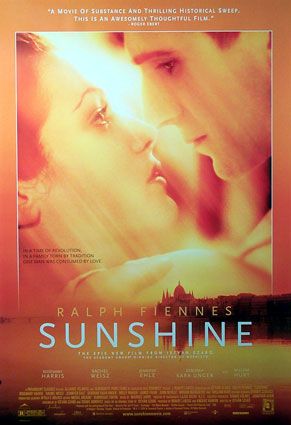
István Szabó’s Sunshine (1999)

I’m in two minds about István Szabó’s epic movie Sunshine. It tells the story of a family of Hungarian Jews, the Sonnenscheins (which means Sunshine in German), from the end of the 19th century until the end of the 20th. While I think it told me a lot about Hungary and the treatment of Jews in Hungary, I was far less thrilled about the length (3hrs) and the choice to have the three main characters, grandfather, father and son played by the very same actor, namely Ralph Fiennes. I would have found this artificial with any actor but given my dislike of Fiennes, it added annoyance. If you do not mind seeing the same actor in three different roles and are fond of Ralph Fiennes, you will probably like this movie a lot. I do not understand why Szabó chose to do it like this, why couldn’t there be three actors? I remember the Archers chose the same approach in The Life and Death of Colonel Blimp in which Deborah Kerr plays three different women but that worked much better.

The Sonnescheins are a modest family but then the patriarch invents a recipe for a tonic which makes them incredibly rich. As a direct result of their social ascendance, the two sons, Gustav and Ignaz, both study and become doctors, of medicine and law respectively. While Ignaz is loyal to the Emperor, Gustav feels more and more alienated by monarchy and becomes a communist. WWI changes not only Hungary but Europe as a whole. The biggest change in the lives of the Sonnenscheins’s however is that they choose to change their name from Sonnenschein to the more Hungarian sounding Sors. Long before WWII breaks out, the Jews are seen as a nuisance and it is very hard for them to integrate.

Ignaz’s and Valerie’s son Adam becomes the Hungarian fencing champion and wins at the Olympics in 1936. After having changed their name, the Sors also change their religion and the family converts to Catholicism. Still, this doesn’t help them, when WWII breaks out, the family first lives in the ghetto, some are killed, some escape and Adam and his son Ivan are sent to a concentration camp where Adam is tortured and killed. His son will never forgive himself that he just stood there and did nothing. After the war he joins the communist party. Anti-Zionist sentiments are spreading. The government changes often and depending on who is in charge, other groups are persecuted but what they all seem to have in common is that anti-Semitism reigns again.

When the end of the communist state has finally come, Ivan realizes that the only way to be really free, is to be true to yourself. He decides to change his name back to Sonnenschein and to be proud of his heritage, no matter what government and changes the future will bring.

While I wasn’t blown away by the movie and would have preferred if the main character had been played by three different actors instead of one, the movie isn’t bad at all. It had a lot of thought-provoking elements. There is the incident in the concentration camp in which three guards control 2000 prisoners. Ivan’s uncle later tells him that it is unforgivable that they didn’t do anything. This is a reproach one hears occasionally. People don’t understand why 2000 wouldn’t fight against 3 or 10 even if those were armed. The movie implies an answer which is interesting. It is obvious that if they had fought back the guards, some of the Jews would have been killed. The majority would have been saved but that would have needed the sacrifice of a few others.

Another interesting element is the fact that Hungarians sent Jews to the camps and not Germans. There were a lot of collaborators among the Hungarians. The movie underlines that the Hungarian society, whether it was during the monarchy or later under communism, was to a large part anti-semitic.

What I really liked is that the movie focusses on one family only and like that manages to give a much better feeling of the incredible changes which took place. To enhance authenticity Szabó included some original footage which in some cases was quite chilling. When Adam takes part in the Olympics of 1936, Szabó included original footage of the opening in which we see Hitler.

Because it’s a very long movie, it’s a very complex movie and I know I didn’t do it justice. There are for example some very troubled love stories which I didn’t mention in my summary but which are quite important. I liked the story between Valerie (Jennifer Ehle) and Ignaz but didn’t care for the love triangle including Adam, Hannah (Molly Parker) and Greta (Rachel Weisz).

I would recommend Sunshine if you like epic films and have an interest in the history of Hungary and the Holocaust from another perspective.

http://www.youtube.com/watch?v=–DgEEmYTm4&feature=player_embedded

The Small Back Room (1949)

In the comments to my recent post on The Archers’ A Matter of Life and Death Guy Savage (Phoenix Cinema) mentioned another of their movies, The Small Back Room based on Nigel Balchin’s eponymous novel. Since I have just read Balchin’s novel on the London Blitz, Darkness Falls From the Air, I was interested in watching The Small Back Room. While I had my problems with A Matter of Life and Death I really liked The Small Back Room a lot. Some say it’s one of the minor movies of Pressburger and Powell. Maybe that is true. It certainly is lesser known but I think that is a shame as it contains many interesting elements. It’s not as exuberant, flashy and over the top as many of the other movies, It’s much darker and thoughtful.

Sammy Rice is an embittered bomb disposal expert, the very best, the British have. He has lost a foot in the war and the constant pain and shame about being not intact make him a cranky fellow. The fact that he is taking heavy medication against the pain which he mixes with strong alcohol doesn’t make things better. Even his very patient girlfriend Susan, who works for the government as well, starts to lose patience. Sammy is part of a research team investigating German booby-traps. They are deadly devices and so far the mechanism isn’t known but it gets more and more urgent to find out what sets them off.

Hi battle with alcoholism, his fear of being alone and his struggles at work put the relationship with Susan under a lot of pressure. Finally she cannot take it any longer and leaves him. While he is on one of his pub crawls, one of the German booby-traps is found on a beach. Sammy needs to clean up as fast as he can and get to the place and deactivate the device.

In many movies set in war-time London we see bombings, people running to air raid shelters. Not in this one. Despite of this it captures the feeling of war-time London perfectly well. The light is dark, many of the shots are rather gloomy, people are dispirited, depressed. The bars are full and everyone seems to indulge in heavy drinking. Sammy may be more extreme than others but I’m sure there was more than one maimed soldier returning from the war, who took it less than gracefully. While Sammy does wallow in self-pity one can still understand him.

I liked the depiction of the relationship a lot. This isn’t a war-time romance but the relationship between two people who seem to have seen a lot, even too much already and whose only consiôlation is their relationship.

One of the best scenes is the bomb disposal scene which is handled in a very interesting way.

This is a very different Archers, it’s sober and dark, not much humor in it. It’s well worth watching though, it has a lot of interesting details and I’m sure it’s even one which will improve when seen a second time.

While I couldn’t find a trailer, I found the whole movie on YouTube.

The Big Parade (1925) A Guest Post by nem baj

Today’s review is a Guest Post by one of my regular visitors, nem baj. It’s a post on one of the great war movie classics. I hope you will enjoy it.

The Big Parade (1925), the mother of all war movies?

The biggest hit of american cinema until Gone With the Wind was a war movie. Its commercial success was a surprise: in 1925, so close to World War I, the subject was still considered to be doomed at the U.S. box-office. King Vidor’s The Big Parade definitely reversed the tide, and its later influence on so many filmmakers makes it a must-see for the readers of this blog (1).

The Big Parade follows Jim, a young American man from an upper-class family who, like many others of different backgrounds, enlists in the Infantry and goes fighting in Europe. He will experience military life and love in the French countryside, then the horrors and glories of the Great War. This simple storyline is a perfect vehicle for a very strong theme in the director’s work: that of the individual at grips with society, the pressure of one’s social circles and the collective passions of the time (from The Crowd to The FountainHead).

Between two ‘book-ends’ sequences about Jim’s (John Gilbert) civilian life, the story is two-fold, almost perfectly symmetrical. The first part looks like a ‘military comedy’, young troopers making buddies and flirting with French women despite the language barrier, getting into rows, coping with the oddities of service… It is nicely shot, funny like only silents can be, and full of Vidoresque traits. For instance the scene when Mélisande (Renée Adorée) watches Jim’s buddy naked under their improvised shower – this was of course pre-code – which will find its clothed replica in The FountainHead; the moment when she rubs on her skin a rose she just picked, in order to smell good, and of course the chewing-gum initiation…

At some point the first time viewer might be tempted to wonder where this is going. After all isn’t this depiction of, well, American sex tourists, while so many others were dying, outrageous? Now, if these idyllic moments got to you by their simple poetry and lust for life, you’re in for a dramatic turn right in the middle of the film. In a masterful eight minutes scene – the departure of Jim’s unit for the front, leaving Mélisande behind – your heart should be wrenched, and you’ll start to feel exactly what humans leave behind when a war starts.

Then comes the second part, with its emblematic shots. The symmetry between the column of rookies riding to the front and the column of ambulances bringing back the wounded (Monicelli’s train scene in La Grande Guerra), the claustrophobia of the shell-holes (Milestone’s All Quiet…, Kubrick’s Paths of Glory), the difference between war and murder (Kobayashi’s Human Condition), the ensemble march in the woods (Kubricks’ Full Metal Jacket final shot), the contrast between disciplined fighting and the rage when your friends are killed (too many to list), etc.

Sure, you’ve seen all this in later movies. But this is the original grammar book, and Vidor is at his best: the cinematography, the editing are amazing, constantly switching between very wide shots and intimate ones to compose a lyrical vision of… hell. For war is undoubtedly a man-made hell in this film. Yet, the tour de force of Vidor’s movie is that it is beyond the pacifist debate: « The Big Parade charts a modern progress through a crazy world. Neither picaro nor pilgrim, [Jim] drifts, marches, stumbles upon a landscape he never made »(2).

The last ‘bookend’ sequence, the return to civilian life, might seem quaint. Yet it does not depart from the lyricism of the work, torn between human despair and hopes. The flashback in the mind of Jim’s mother, the ending between Jim and Mélisande (a soft rehearsal for Duel in the Sun‘s finale?) should please any opera lover, and the ‘lost generation’ gaze of John Gilbert when he rides home with his father is probably the best introduction to Scott Fitzgerald ever filmed…

1) No DVD yet, you may watch clips here (click twice on the “play now” links on the right to avoid the ads).
2) Raymond Durgnat & Scott Simon, King Vidor, American, Berkeley: University of California Press, 1988.

Thanks, nem baj, for a great contribution.