Two Movies on Nordic Resistance: Flame & Citron (2008) and Max Manus (2008)

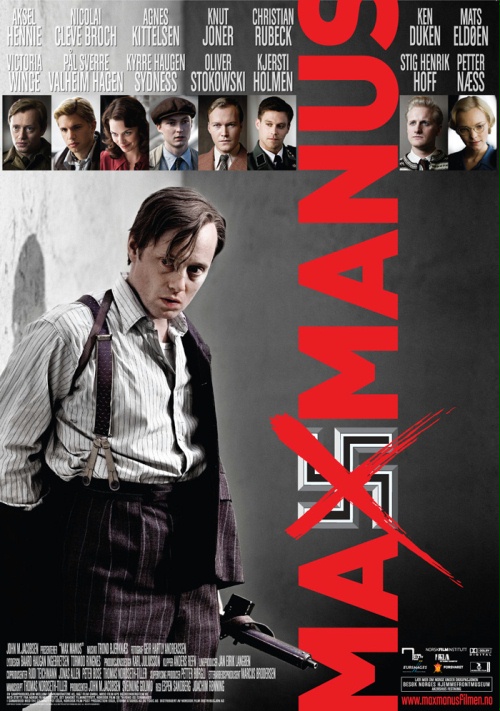
Two movies on the same theme, Nordic Resistance, yet how different their tone. While Max Manus (aka  Frihedskæmperen Max Manus) is a hero story with tragic and uplifting moments, Flame & Citron (aka Flammen & Citronen) is depressing and full of angst. Both movies are based on true stories and illustrate aspects of lesser known WWII history.

Max Manus tells the story of the Norwegian saboteur Max Manus and his resistance group. After having fought in Finland against the Communists he joins the norwegian resistance. They fight the Nazis very effectively by blowing up supply ships, stealing documents and shooting people. They are hunted down by the Germans and many lose their lives, only Max escapes miraculously every time which fills him with survivor’s guilt but at the same time gives him an aura of invulnerability.

Flame & Citron is the story of two very famous Danish Nazi assassins. Where Max attacks mostly buildings and objects, they shoot Nazis and their allies, mostly execution style up-close.Early on it is evident that this weighs heavily on their conscience. Especially Citron has a hard time to kill.

At one time Flame says: “I almost forgot we are not shooting people but Nazis” as if to take the humanity away from the enemy makes the deed easier. Here lies their problem and this is very obviously the source for the depressing heaviness of this film. We watch two good people doing very bad things although for a just cause. After a while they really doubt that what they do is right. But worst of all they can´t trust anyone and see themselves surrounded by double agents and traitors.

Like the more famous Black Book (aka Zwart Boek 2006) these movies show that there was very effective resistance in the Northern European countries, like the Netherlands, Denmark and Norway. It seems as if it took those countries quite a long time to tell their own story. All three movies are in original language with subtitles. They are all convincing.
Black Book ist the most entertaining, Max Manus is thoughtful and uplifting but I liked Flame & Citron best. I found it the most honest. The pictures are very beautiful and apart from that the acting is great. Mads Mikkelsen (King Arthur) as Citron is just brilliant and so is Thure Lindhardt as Flame.

A Soldier´s Story (1984) or Racism in the Military

The worst thing you can do, in this part of the country, is pay too much attention to the death of a negro under mysterious circumstances. (Colonel Nivens)

Norman Jewison´s movie A Soldier´s Story (1984) shows you what great acting can be.

It is one of Denzel Washigton´s first movies. Although he is not the leading actor you can already tell what he´s capable of. What is very obvious, that´he´s not only a movie actor but one hell of a good theater actor as well. The story is based on a theater play and almost the whole cast is from the original ensemble.

The movie takes place in a base in Louisiana during WWII.

Sgt. Waters, a black sergeant, is found dead and an army attorney is sent from Washington to investigate the murder. What no one suspects, least the white commanding officers, is the fact that the attorney is also Afro-American. The base which consists to a great extent of black Americans has never seen a black decorated officer before. They are awed whereas the white officers are outraged. It´s one of the best moments in this movie.

Soon it is obvious what a contradictory character the victim was. However the investigation is hindered by uncooperative officers and fearful soldiers. Bit by bit,shown through flashbacks, the victims true character and the actual events are revealed. The shocking truth is that the killed sergeant though African-American himself was a racist at heart and punished every act that he deemed unworthy of other black people, notably singing and dancing.In his own words:

You know the damage one ignorant Negro can do? We were in France in the first war; we’d won decorations. But the white boys had told all them French gals that we had tails. Then they found this ignorant colored soldier, paid him to tie a tail to his ass and run around half-naked, making monkey sounds. Put him on the big round table in the Cafe Napoleon, put a reed in his hand, crown on his head, blanket on his shoulders, and made him eat *bananas* in front of all them Frenchies. Oh, how the white boys danced that night… passed out leaflets with that boy’s picture on it. Called him Moonshine, King of the Monkeys. And when we slit his throat, you know that fool asked us what he had done wrong?

He was cruel, unjust and unfair. He wasn´t liked by neither white nor black soldiers and officers and really had it coming.

The character portraits in this movie are all extremely convincing, the acting is outstanding, the tale is gripping and it really doesn´t leave you untouched. This is a 100% convincing anti-racism movie and one of the few movies about racism in the military. A must-see.

Dresden (2006) or Was the Bombing of Dresden a War Crime?

Dresden is a quite controversial German movie that has been criticised a lot. Shot for TV it is basically a very corny love story between a German nurse and an English fighter pilot.

I´m not going into any plot details since they are quite boring but still I do think this movie achieved something.

The love story takes place during the days before the bombing of Dresden starting February 13 1945 and ends with a depiction of the bombing.

This end part as well as  all the parts in the English Head Quarters from where the bombing was organised had me glued to the TV screen. The moral conflicts of the British to bomb what they knew to be one of the most beautiful European cities was shown very well. The atrocity of what is still called a war crime nowadays, is symbolised in the collapse of the famous Frauenkirche, one of the town´s landmarks  (reconstructed in 2008 as a symbol of hope and peace). The church withstood two days of bombing and finally collapsed on the second day.

The damage the bombing caused, the heatwaves, the firy wind… I think it is shown rather well however varnished with a lot of corny elements.

The end of the film shows actual footage, the re-inauguration of  the rebuilt Frauenkirche.

This movie, as flawed as it is, offers a lot of food for thought. How justified was it to systematically bomb a city like that, to kill so many and to destroy century old  architectural treasures? How is this different from the bombing of other cities?

Was it unavoidable? Was it a war crime? How did the pilots feel?

Further questions circle around the film makers´ choice to mix a corny romance with historical facts.

Judgement at Nuremberg (1961) or A Truly Outstanding Legal Drama

Judgment at Nuremberg is a brilliant movie by Stanley Kramer. Outstanding actors, great pictures and a gripping story. Spencer Tracy, Burt Lancaster, Richard Widmark, Marlene Dietrich, Montgomery Clift, Judy Garland and Maximilian Schell. They are all good, very good.

The movie´s setting is post-WWII occupied Germany.  It tells the story of the trial of 4 German Nazi judges in an American court. They are accused of being responsible for sterilization and exterminations.

Spencer Tracy stars as Judge Dan Haywood who is conducting the trial, Marlene Dietrich plays Mrs. Bertholt, the widow of an executed Nazi army officer. Burt Lancaster is one of the accused judges, Maximilian Schell his defendant. One of the most convincing performances is given by Montgomery Clift who plays the role of one of the judges´ victims. His  interrogation is so touchingly performed, makes you feel really uneasy.

The film follows Judge Haywood in the court room and outside where he tries to get the full picture by befriending Mrs. Bertholt and talking to his housekeepers, Mr. and Mrs. Halbestadt to find out what the German people  really knew. It seems as if each one´s personal history and concerns overshadowed the things that happened around them. And even though they lived so close to Dachau, Halbestadts pretend to have been ignorant of the camps.

During the trial the testimonies of the witnesses, supported by original footage of the concentration camps and the interrogation of the accused, completes the picture of the past horrors.

Judge Haywood must now establish if, in believing to serve their country, the accused did right or wrong. Do exceptional circumstances permit different moral criteria? Does the conviction to do the right thing exempt  from punishment?

If you want  Judge Haywood´s  answer to these questions and if you like to see  truly outstanding movies and great acting, watch this one  as soon as you can.

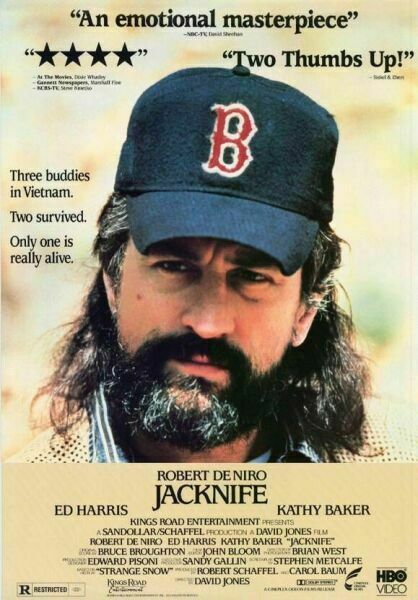
De Niro in Jacknife (1989)Part II

Often when you ask someone  who is their favourite actor especially men tend to name Robert de Niro. Surely his merits are undisputable still he did get on my nerves in several of his films since he´s got the habit of overacting and that way tends to turn into a parody of himself. I thought I´d seen many of his movies and knew that he was at least in two Vietnam related ones, The Deer Hunter and Taxi Driver. Somehow Jacknife sneakily escaped my attention.

I saw it recently and must say, it would have been a pity not to see  it and this for several reasons. (Check out the trailer in an older post).

First, I think, it is one of de Niros´ best performances, second I think it is a very good attempt at showing the theme of the Vietnam vet. Post traumatic stress and so forth.

Megs (de Niro) and Dave (Ed Harris) served in Vietnam together. They hadn´t seen each other for a while when suddenly, out of the blue, Megs invades Dave´s home to take him on a fishing trip. Unfortunately he realises he´s less than welcome. Dave showing every sign of full-blown alcoholism still blames Megs for the death of Bobby, the third guy they went to Vietnam with.

Megs tries everything to cheer up Dave but fails completely. The fact that Megs begins a relationship with  Martha (Kathy Baker), Dave´s sister doesn´t exactly improve anything.

Even though at first it looks as things were not going well at all, Megs´ likeable character, his outgoing, eccentric ways liven up the brother and sister and ultimately transform them profoundly. The story is interwoven with flashbacks that show what went wrong in Vietnam where Megs was by far too gung-ho and shooting way too fast at everything.

Sure, these are personal stories, character studies, no analyzing of the war as such or its political and social impact.

I just adored de Niro in this and understood again why so many think he´s one of the best actors alive.