Machine Gun Preacher (2011)

Machine Gun Preacher is based on a true story, the story of ex Hell’s Angel and bad boy Sam Childers.

At the beginning of the movie Sam gets out of prison. He hasn’t learned anything from that experience and wants to get back to his former life. Drugs, booze, his Harley Davidson and his stripping wife. Unfortunately for him, his wife has found Jesus, works at a mall, doesn’t strip, drink or smoke anymore and goes to church on Sundays. Sam does what he always did, gets drunk and high and ends up fighting with everyone. Then, one night, something really bad happens and wakes him up for good. He joins the church to which his wife belongs, sobers up, sells his bike, gets a decent job.

But that’s not enough for Sam. The way he used to be, lies too heavy on his conscience, he wants more, do more, do better. He builds a church and travels to Africa to see what good the missionaries do there. When he crosses the border into Sudan with a soldier from the Sudanese Liberation Army whom he met in Uganda, he sees things he has never even heard of. Mutilated people, shot women and children, cruelty and violence. He hears about the child soldiers recruited by the LRA (Lords Resistance Army), led by Joseph Kony, sees the many orphans whose parents have been slaughtered. Sam decides that this is his cause. God wants him to help and he will help.

What makes him different from all the social workers down there is that he doesn’t only help and bring money, he also fights. He doesn’t only defend his property, he attacks the aggressors and intimidates them in using the same methods they use. Ultimately he doesn’t mind killing. For him – this is obvious – this is more than just helping, this is fighting a war. A war against oppression, exploitation, violence and cruelty.

If it wasn’t for that, the movie would be average but because of this, it’s a very interesting movie because it seems to state some uncomfortable things and ask interesting questions. Can there be a level of violence which makes it impossible to fight it with non-violence? Could it be dangerous to just try to do good without being prepared to kill and shoot people for the greater good?

I’m not saying I agree with Childers (I personally think we are not meant to intervene everywhere all the time but that’s my opinion. I think if we want to do good, we can start in our own cities, our own neighbourhoods and families.) but I understand his point and found the movie quite interesting.

Machine Gun Preacher reminded me of Lord of War and Blood Diamond and some other movies which make African civil wars and warlords their main topic. While I think it’s a movie which will generate a lot of discussions and I didn’t mind watching it, I still think that movies like Lord of War, Hotel Rwanda and some others were far better. But it’s decent and for Gerard Butler fans certainly a must-see.

The Odd Angry Shot (1979) Australian SAS in Vietnam

A comment on my post Australian War Movies: A List put me in the mood to watch the Australian film  The Odd Angry Shot. The topic is quite unique as for once it doesn’t show Australians during WWI or WWII but Australians in Vietnam. The movie came with such high praise that I was really looking forward to it. However, before watching it, I had a look at Gary Freitas book on war movies and the movie had a rating of 1.5/5. I cannot remember having ever seen such a discrepancy between someone’s recommendation and Freitas’ assessment and was a bit puzzled and keen to find out for myself. The solution to the riddle is, in my opinion, that if you have the wrong expectations you might not like it but if you know what to expect chances are high you will.

The Odd Angry Shot tells the story of a group of Australian SAS soldiers who do a 12 month tour in Vietnam. Long stretches of boredom are broken up by recon and other missions during which there are casualties, some men are severely, others fatally wounded. During the periods in which there isn’t a lot to do, the men drink A LOT of beer, play games, tease each other. It’s an atmosphere of mateship and camaraderie and to watch them is nothing if not funny. Story-wise that’s it.

I don’t think I’ve ever seen a war movie done like this and I can understand that if you think you are going to watch an intense war movie like Hamburger Hill or Platoon you will be very disappointed but that’s because you’re watching it with the wrong expectations. For me this is a war comedy, a movie that wants to show the spirit and the mateship in the Australian troops but still tries to show their sacrifice and achievements just without being graphic or gory. Judging from the reviews of a lot of Australian vets who commented on this movie, this is exactly how the Australians experienced Vietnam. They emphasized that most of the time, they were sitting around, waiting, being debriefed but that intense combat was pretty rare. Most of the time they were sent to capture the one or the other informant. In order to keep their spirits high, they did drink a lot, and try to have fun. A way to cope with the horrors of war.

The only real problem I had was that I still have no clue why the Australians felt they had to be in Vietnam. We hear absolutely nothing about the war as such, only that the majority of the people “back home” were not keen on it.

If you want to watch a gritty and graphic war movie in the vein of Platoon, don’t watch it. If you are interested in Australia and Australian movies, why not? If you look for an enjoyable and entertaining movie, it’s a great choice too. It’s very funny, the characters are extremely likable and Graham Kennedy does a great job. 

Here’s a short scene that captures the spirit very well.

Heaven and Earth (1993) The Third Movie in Oliver Stone’s Vietnam Trilogy

Heaven & Earth is Oliver Stone’s third Vietnam movie. He started his trilogy with the intense infantry combat movie Platoon (1986), followed by the harrowing tale of one soldier’s ordeal Born on the Fourth of July (1989) and then the third part, told from the point of view of a Vietnamese village girl Heaven & Earth (1993). It’s anti-climatic to start a review with a verdict, so let’s just say, Heaven & Earth is the weakest of the three. And the most sentimental.

The movie is based on the true story of Le Ly. It starts in the 1950s, with Le Ly as a little girl of five, living with her family in a beautiful village in Northern Vietnam. In 1953 the village is burnt down by the French. Her father teaches Le Ly that the most important thing is freedom and it’s not surprising that she and her brothers will later actively help the Vietcong. While the younger brother is executed and the older one hidden somewhere, Le Ly is captured and tortured by the Americans first and later raped by the Vietcong.

Le Ly (Hiep Thi Le) leaves her village and tries to make a living in Saigon. She and her mother work for a rich Vietnamese family until Le Ly has an affair with the husband and gets pregnant. They are chased away. Her mother returns to the village, while Le Ly stays in another city, Danang. Most girls from the villages end up as prostitutes but she sells cigarettes and other things, and fights off the advances of the American soldiers.

When her son is about five, she meets an American soldier (Tommy Lee Jones) who falls in love with her. They live together for a while and finally get married. Butler wants to take her back to America and some time later, after their first child is born, they leave for the US. Just in time to escape the chaos that breaks out in Vietnam after the war is over.

The US are a culture shock for Le Ly. But also a pleasant surprise. The way she sees it, this is the land of plenty. There is so much food and abundance everywhere. Everything could be great if her husband didn’t show signs of alcoholism and other issues. Le Ly who was a very independent woman in Vietnam, wants to open a business of her own but her husband is opposed to that. They fight more and more, the marriage is doomed.

In the final part we see Le Ly and her children return to Vietnam. She will forever be a part of both worlds, Vietnam and the US, Heaven and Earth.

I have seen a lot of negative reviews of this movie and while I was watching the first hour or so I didn’t understand why. The initial parts are not only beautifully filmed, they tell an intense and interesting story and the choice to focus on a girl from Northern Vietnam, to illustrate some of the complexities, wasn’t a bad choice. Unfortunately from the moment she meets Butler, the story starts to drift in a lot of different directions and from the story of a girl, exemplary for one nation’s suffering, it turns into the story of one woman and her failed marriage. It just didn’t work for me anymore, was too sentimental and lost its strength.

Heaven and Earth is cinematographically compelling and the first part is well above average. Then, unfortunately, it tumbles down and I don’t think it works well as a third part in Stone’s trilogy. It may however work as the story of one woman who may not have been able to free her country but herself.

Stauffenberg (2004 Germany) and Valkyrie (2008 – US) Compared

After having watched the excellent Valkyrie (here is my review), starring Tom Cruise, I wanted to see how the Germans had treated the very same story just a few years prior to the US production. Stauffenberg is a TV production, starring Sebastian Koch (Black Book, Das Leben der Anderen) as Stauffenberg. Ulrich Tukur (Das Leben der Anderen, The White Ribbon) can be seen in the role of Henning von Tresckow. While Carice van Houten who played Stauffenberg’s wife in Valkyrie looks very different from the real Nina von Stauffenberg, Nina Kunzendorf’s likeness is uncanny.

I don’t think it’s of any use to summarize the movie. Since it’s a true story the plots of the two films are almost identical, however there are some significant differences in the way the story is told which make it worthwhile to compare the two movies.

The title Stauffenberg already indicates that the focus is much less on Operation Valkyrie than on the man Stauffenberg himself. And that’s actually the biggest problem of this TV production. It is quite confusing and for someone not familiar with the story, it isn’t clear what Operation Valkyrie is. I was glad I had seen the US film first or I would have been a bit lost as I wasn’t familiar with the whole story.

While Valkyrie starts with Stauffenberg in Africa, it starts much earlier in this film. We see Stauffenberg first in Berlin, whit his fiancée and future wife Nina, later he is in Poland and only then in Africa. This helps to understand his motivations and his development from someone who believed in Hitler to somebody who was entirely disgusted and ready to kill the man.

What worked far better in this TV production is to make us understand why the assassination failed. The characters in this film are portrayed as determined but they are no sleek robots. There are many mishaps and they are far from perfect. We even get the impression that they were a bit too hasty and that the whole project would have needed more planning. In Valkyrie we don’t really understand why it doesn’t work. Everything seemed so perfect.

What also worked far better here is the human and emotional dimension. These people are scared. They are determined but anxious as well and when they are caught, things do not go well. One of them isn’t even capable of shooting himself, he misses first, tries again, ends up badly wounded and has then to be shot by someone else while in Valkyrie he puts the gun to his head, shoots and is dead right away.

While far from perfect and not as carefully – and one would argue artificially -orchestrated as Valkyrie, Stauffenberg feels emotionally true and is very watchable. If you didn’t like Tom Cruise you might even prefer this smaller scale production.

István Szabó’s Sunshine (1999)

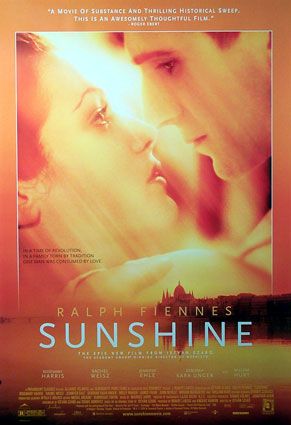
I’m in two minds about István Szabó’s epic movie Sunshine. It tells the story of a family of Hungarian Jews, the Sonnenscheins (which means Sunshine in German), from the end of the 19th century until the end of the 20th. While I think it told me a lot about Hungary and the treatment of Jews in Hungary, I was far less thrilled about the length (3hrs) and the choice to have the three main characters, grandfather, father and son played by the very same actor, namely Ralph Fiennes. I would have found this artificial with any actor but given my dislike of Fiennes, it added annoyance. If you do not mind seeing the same actor in three different roles and are fond of Ralph Fiennes, you will probably like this movie a lot. I do not understand why Szabó chose to do it like this, why couldn’t there be three actors? I remember the Archers chose the same approach in The Life and Death of Colonel Blimp in which Deborah Kerr plays three different women but that worked much better.

The Sonnescheins are a modest family but then the patriarch invents a recipe for a tonic which makes them incredibly rich. As a direct result of their social ascendance, the two sons, Gustav and Ignaz, both study and become doctors, of medicine and law respectively. While Ignaz is loyal to the Emperor, Gustav feels more and more alienated by monarchy and becomes a communist. WWI changes not only Hungary but Europe as a whole. The biggest change in the lives of the Sonnenscheins’s however is that they choose to change their name from Sonnenschein to the more Hungarian sounding Sors. Long before WWII breaks out, the Jews are seen as a nuisance and it is very hard for them to integrate.

Ignaz’s and Valerie’s son Adam becomes the Hungarian fencing champion and wins at the Olympics in 1936. After having changed their name, the Sors also change their religion and the family converts to Catholicism. Still, this doesn’t help them, when WWII breaks out, the family first lives in the ghetto, some are killed, some escape and Adam and his son Ivan are sent to a concentration camp where Adam is tortured and killed. His son will never forgive himself that he just stood there and did nothing. After the war he joins the communist party. Anti-Zionist sentiments are spreading. The government changes often and depending on who is in charge, other groups are persecuted but what they all seem to have in common is that anti-Semitism reigns again.

When the end of the communist state has finally come, Ivan realizes that the only way to be really free, is to be true to yourself. He decides to change his name back to Sonnenschein and to be proud of his heritage, no matter what government and changes the future will bring.

While I wasn’t blown away by the movie and would have preferred if the main character had been played by three different actors instead of one, the movie isn’t bad at all. It had a lot of thought-provoking elements. There is the incident in the concentration camp in which three guards control 2000 prisoners. Ivan’s uncle later tells him that it is unforgivable that they didn’t do anything. This is a reproach one hears occasionally. People don’t understand why 2000 wouldn’t fight against 3 or 10 even if those were armed. The movie implies an answer which is interesting. It is obvious that if they had fought back the guards, some of the Jews would have been killed. The majority would have been saved but that would have needed the sacrifice of a few others.

Another interesting element is the fact that Hungarians sent Jews to the camps and not Germans. There were a lot of collaborators among the Hungarians. The movie underlines that the Hungarian society, whether it was during the monarchy or later under communism, was to a large part anti-semitic.

What I really liked is that the movie focusses on one family only and like that manages to give a much better feeling of the incredible changes which took place. To enhance authenticity Szabó included some original footage which in some cases was quite chilling. When Adam takes part in the Olympics of 1936, Szabó included original footage of the opening in which we see Hitler.

Because it’s a very long movie, it’s a very complex movie and I know I didn’t do it justice. There are for example some very troubled love stories which I didn’t mention in my summary but which are quite important. I liked the story between Valerie (Jennifer Ehle) and Ignaz but didn’t care for the love triangle including Adam, Hannah (Molly Parker) and Greta (Rachel Weisz).

I would recommend Sunshine if you like epic films and have an interest in the history of Hungary and the Holocaust from another perspective.