The Desert Fox (1951) Biopic on Field Marshal Rommel’s Final Years

The Desert Fox

The Desert Fox, starring James Mason as Field Marshal Rommel, is based on the biography of Rommel by Desmond Young. The movie opens with British commandos trying to assassinate Rommel in 1941 and then forwards to 1943 showing Rommel at El Alamein.  Rommel, who is of poor health, is just back on the front line and faces a pretty desperate situation. The German troops are far outnumbered and any reasonable commander would give the order to withdraw. Not so Hitler whose consultants all encourage him to give orders to either win or die. For the first time, the movie tells us, Rommel starts to doubt the Führer’s sanity. It will not be the last time. On the very contrary. The movie tries to show a Rommel who goes from doubt to open criticism and even knows the group around von Stauffenberg will attempt to assassinate Hitler. While not tied to the assassination he’s still found guilty of treason and given a chance to either get a fake trial or to commit suicide in order to assure the future of his wife and son.

I must admit I expected this movie to be far better than it was. The story is interesting, of course, but the way this was filmed was not much better than a B-movie. Mason is good, I wouldn’t say he’s great but he’s good. There is just one problem. He doesn’t look like Rommel. What didn’t work is that most of the movie is either composed of real footage or scenes filmed in the studio which makes the whole movie look like a theater play broken up by documentary material.

The other problem is that we don’t really get to know Rommel. Given that the title of the movie is The Desert Fox and not “Rommel’s Downfall” or some such thing, I expected that we will learn why Rommel was considered to be such a great general. Although he was their enemy, the Allies admired and feared him. The movie only shows us a Rommel who is very realistic, who knows when a battle can’t be won, who makes great suggestions, but isn’t heard. The movie also fals in showing Rommels’ humanity. It seems he was never accused of war crimes. He refused to kill Jewish soldiers, civilians and prisoners.

The best part is that the movie shows how Rommel first doubts the people who consult Hitler before he doubts the man himself. Once he’s understood that his Führer is nothing but a maniac, he speaks his mind openly and confronts him.

I watched the movie Patton two years ago and thought it was outstanding. If anyone knows of a biopic of Rommel which is equally good, please let me know.

I didn’t mind watching The Desert Fox, but it’s certainly not the ultimate movie on Rommel.

Rommel’s son Manfred died last month. It’s interesting to know that he formed a friendship with Patton’s and Montgomer’y sons.

Here’s one of the best scenes in which Rommel confronts Hitler

Peaky Blinders (2013) British Post-WWI Gangster Saga

peaky-blinders-cillian-murphy-600-lg

Sometimes you just have to stretch definitions. I’ve included other movies and TV series which were not exactly “war films” but dealt with the aftermath of war or a post-war era, and that’s why I think it’s fair to include Peaky Blinders. That and because it is fantastic. I really loved it and have to thank my friend Novroz for repeatedly writing about it. Besides it just proves a point. These days a lot of the best visual story telling isn’t shown in cinemas but on TV. And did I mention Nick Cave, Tom Waits and the White Stripes? I’ll come to that later.

Set in Birmingham in 1920, Peaky Blinders tells the story of a family of gangsters. They work pretty much mafia-style. They intimidate people, extort money against protection, fix races, use violence. Arthur Shelby (Paul Anderson) is the oldest brother, Thomas (Cillian Murphy) the second, Jimmy is next and little Fin who is barely 5 years old is the youngest. There is also a sister, Ada, who’s in love with the communist Freddie Thorne. We never hear what happened to the mother, and the father, a thieving, whoring bastard, appears much later in the series. The only parent figure who is around constantly is aunt Polly (Helen McCrory). People assume that Arthur being the oldest is in charge but he’s far too dumb for that. The real boss of the Peaky Blinders is Thomas, assisted by aunt Polly. Thomas is the one with the business ideas, ready to strike, cold and calculating, and never shying away from violence. But he’s also loyal and courageous. Polly can be as cold and calculating as Thomas but she’s also diplomatic and keeps the family together on a more emotional level. Whenever there is conflict between the one or the other, she will reconcile them.

The world the Peaky Blinders live in is rough. It’s a world of poverty, delinquency, alcoholism and prostitution. Most of the money of the Shelby’s comes from bookmaking, contraband trade and robberies. The whole tragic story is set in motion when they steal a truckload of guns by mistake at the beginning of the series.

Winston Churchill sends for an Irish inspector who is an expert in the fight against the IRA. Churchill suspects that the guns are either in the hands of the IRA or the Communists. Both would be equally bad. The inspector is a self-righteous man, of those movie characters one really loves to hate – especially since he’s played by Sam Neill.

Thomas is intelligent and troubled. Like most of the men in the series he served in France and the trenches have changed him. He’s a broken man, who uses opium to fight his demons and distances himself from any feeling. Nightmares and visions of France haunt him like they haunt many others.

Music is very important for this series. The sound track is a mix of songs and original score by Nick Cave, the White Stripes and Tom Waits. Some sequences, notably those showing Thomas on his own or the “battle scenes”  are composed like stylish, gritty music video.

A gang like the Peaky Blinders is bound to have enemies and there are a lot of bloody confrontations with other gangs, bookmakers and the police. The power struggle between the inspector and Thomas makes is very suspenseful.

WWI is present all through this series. Many of the loyalties, the friendships and aversions in the series have a source in whether or not characters have served and whether or not they served together. The war left its mark on the society and on the people. The good and the bad in Thomas comes to a large extent from the war. He knows what courage under fire means. He’s been decorated twice. But he also knows that the war bruises and breaks you and leaves scars all over your body and your soul.

I’m not going to say  much more just this – watch it. I really loved Peaky Blinders and will watch it again. Before ending I should say that the series is a bit of a one man show. It wouldn’t have been as outstanding without Cillian Murphy‘s stellar performance, on the other hand it would be unfair not to mention that all the other actors are really good too.

Phantom (2013) Sub Movie with a Russian Point of View

Phantom

I discovered Phantom thanks to a comment on my post on U571 . Since it’s a new movie and it has been quite a while since I last saw a submarine movie and because I’m very fond of Ed Harris, I thought I’d give it a shot. While it’s maybe not among the top of the range, it was decent and had an unusual angle. This is a Cold War movie told entirely from a Russian perspective. It took some getting used to in the beginning that Ed Harris, David Duchovny and William Fichtner all played Russians, but once I realized there wouldn’t be any American counterparts in this film, it was easier to accept. And I was very thankful that for once there were no fake Russian accents to endure.

The movie is set in 1968. The aging Captain of a submarine, Demi (Ed Harris), is assigned a final mission on an old submarine on which he served decades ago. Why he is assigned and what the mission is, isn’t said. He’s surprised to find out that two people he’s not familiar with will come aboard as well, not telling him why they join the mission.

Once on board strange things happen. A dog which isn’t there attacks the Captain, he sees people who die in a fire. We soon get to know that these are hallucinations and that the Captain suffers from epilepsy due to a head trauma. The backstory will be revealed later on.

Because he has an epileptic fit, things escalate quickly and loyalties are tested. Shortly after that the two strangers show their real faces and the movie turns into a thriller.

I can’t say too much or the movie would be spoilt. It’s based on a true event, the disappearance of a submarine in 1968, but that’s as historical as it gets. Nobody has ever found out what happened to said submarine. This movie just tries to imagine one possibility and the diea is quite chilling.

Phantom is a rather slow movie that takes a lot of time to show interior shots, which capture very well how narrow and claustrophobic it is in a submarine. There are hardly any outside shots as the bulk of the action takes place inside. The enemies, so to speak, are among the crew members, and finding out who is on which side is an important element.

Phantom doesn’t make my top submarine movie list, but it’s watchable, especially when you like Harris and Duchovny.

Ballad of a Soldier – Ballada o soldate (1959)

Ballad of a Soldier

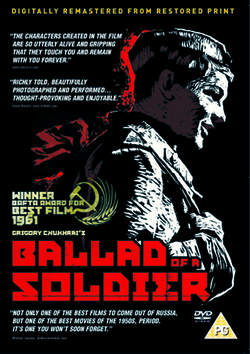
Grigory Chukhray‘s movie Ballad of a Soldier  aka Ballada o Soldate is an iconic Russian war movie, which is often mentioned together with another famous Russian movie of the same time, The Cranes are Flying aka Letyat zhuravli. Both films are excellent and combine heartfelt stories with luminous black and white cinematography.

Ballad of a Soldier begins with a scene showing a woman looking into the distance. The road we see is the only one leading to and from the village in which the woman lives. She doesn’t expect anyone to come. Her son has died during the war and nobody will ever know what would have become of him. The movie then rewinds to a famous scene on the Russian frontline and we see her son, nineteen year-old Alyosha, a young signalman, blowing up two German tanks on his own. This heroic act would bring him a  medal but he’d rather be granted a leave to visit his widowed mother and fix her roof. The general in charge, one of a few kind officers, allows him to take a five-day leave.

Russia is a huge country and travelling by train would always take a long time, but during a war it’s almost impossible. Alyosha’s trip quickly turns into an Odyssey. Because he’s kind and helpful, he misses his train more than once. At first he helps a soldier who has lost his leg, then he assists a young girl and the two young people fall in love. Later he helps people after the train is hit by a bomb. When he finally arrives at home, he has only time to hug his mother, exchange a few words and has to leave again immediately. Since we know that he will die during the war, this scene is all the more poignant.

The movie shows how everyone is affected by war, even those who don’t fight. In focussing on someone as kind as Alyosha, someone who genuinely cares for other people the movie makes a powerful anti-war statement. Much more than his heroic act of the beginning, his humanity and kindness make us sad and we deplore that he will never return to his mother, nor get a chance to find the girl he fell in love with.

Something that struck me was that all of the Russian officers, and most of the soldiers in this movie are depicted in a positive way.

Like in The Cranes Are Flying, many shots focus on the faces of the actors who are very expressive. While the first film sticks more to the point of view of a woman, this is told mostly from the point of view of a young man, which makes them great companion pieces. The scenes between mother and son are short but still I’d say it’s one of the most touching portraits of a mother/son relationship. After all, it’s his love for his mother, that makes Alyosha persevere on his journey.

I’d like to recommend this movie. It stands out and makes a powerful statement.

If you’d like to watch other Russia war movies – here is a list: 12 Russian war movies you must see

Empire of the Sun (1987)

Empire of the Sun

I’ve read J.G. Ballard’s The Drowned World and in his afterword he mentions his childhood in China, which reminded me that I still hadn’t watched Empire of the Sun, which is based on his childhood experiences.

Empire of the Sun is set in Shaghai, in 1941 and tells the story of a young boy. Jim’s (Christian Bale) parents, like so many other of the rich Brits living in Shanghai, didn’t react in time to the aggressions of the Japanese. Many thought that they wouldn’t risk anything as they were not Chinese; they believed they were protected by their status as foreigners and their money. But they were wrong. When the Japanese troops finally invade, it’s too late. Most of them try to flee, leaving behind their houses and all of their possessions.  In the general chaos, Jim loses his parents and has to fend for himself. At first he returns to their beautiful mansion, but the food is soon gone and he starts roaming the streets until he meets Basie (John Malkovitch). Basie is an expat just like Jim’s parents were but he’s a very different kind. A hustler, a thief, someone who lives from hand to mouth. He sees that Jim is from a rich background and decides to look after him. Whether there is some genuine kindness or pure calculation isn’t so clear at first. What is clear is that they get along like a house on fire. Jim is a precocious, extremely intelligent and crafty kid – also terribly annoying – and they complement each other perfectly.

When they are finally arrested by the Japanese and brought to a POW camp, they survive doing what they know best, dealing and stealing, and making money out of everything. The time at the POW camp is one of great liberty for Jim. He’s soon known by everyone and while he’s an obnoxious kid, they also like him and find him very useful.

Despite of the danger and captivity Basie and Jim are doing great for themselves, help each other out, or rather profit from each other. Still, the war leaves traces and when they can finally leave the camp, they are both altered.

I loved the beginning of this film, the cinematography is amazing and the story is fascinating. Basie and Jim are larger-than-life characters, the kind you admire and despise at the same time. At least I did. Christian Bale did an amazing job at portraying Jim. What an annoying kid that was. He talks and talks endlessly and while he’s crafty, he never knows when to stop or give it a rest. Basie is ingenious and maybe, he means well at times, but mostly he’s the type of character who will always be able to make money, preferably even through selling out others and profiting from their misery.

There are a few tense moments, but overall we often get a feeling that this is less a POW camp than a summer camp. I was wondering if that was because Spielberg tried to stay true to the boy’s point of view or whether these camps for civilians were not that bad.

It’s a highly watchable movie and one I will certainly watch again, but unfortunately, the film has a lot of typically cheesy Spielberg moments, which annoyed me. I still think it’s a beautifully filmed movie and a great story. I liked it, but  didn’t love it because I hate it when director’s manipulate us. Spielberg always does that, that’s why I don’t really like Schindler’s List and even think Saving Private Ryan could have been much better than it is.