A War Movie Gone Thriller: The Hurt Locker (2008)

Yes, I had to do it. I had to add something on this ubiquitous film.

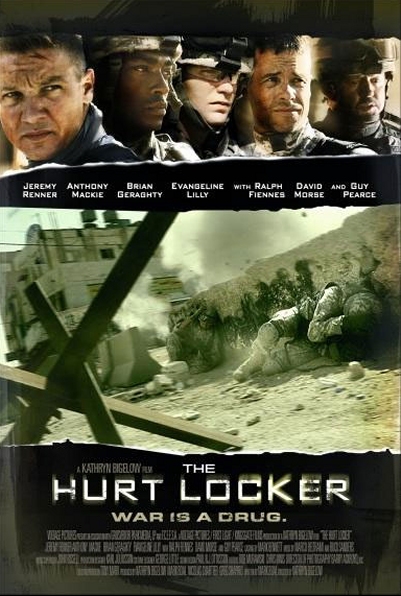
The story of The Hurt Locker should be sufficiently known by now. We are shown a bomb squad on their mission to disarm bombs in Iraq. When a real danger addict is appointed to be the new leader of the squad things get really exciting.

Somehow, when I realized I liked it, I felt a soft tingling feeling of shame that made me wonder.

But the fact that I did enjoy The Hurt Locker doesn´t necessarily mean I think it is a good war movie. There was a whole lot of suspense going on. It was entertaining and it sure felt like a thriller. The possibility of every  bomb or object to prove deadly seemed like a serial killer lurking around in the dark. He sees you, you sense him. Creepy. I stopped breathing every time Sgt. First Class James started to cut those little wires.

While I was watching it I did not for one second question it. I felt just so swept away and liked it. Period. But afterwards I found it kind of problematic. One is almost grateful wars take place and offer us such a great topic of suspense.

I remember that I had very comparable feelings after having seen Apocalypse Now. The anti-war message was just not clear enough for me.

Same here. It´s like saying: yeah well, war is shit, we shouldn´t do it but so what, it´s fun.

Of course that is not what Kathryn Bigelow tried to say but it is what the audience could understand.

This potential to be misunderstood comes from the blending of the genres. Or rather the blending of major techniques of different genres. War movies don´t normally create this type of suspense. It would have been possible to show the same without creating the suspense.

Maybe I should put it that way: The Hurt Locker is one hell of an exciting movie but a dubious war movie. It is especially problematic as it shows a very specific bit of warfare in Iraq. Where every other movie with an attempt at realism (the most extreme example would be Redacted. Come to think of it, Redacted is actually the antithesis of The Hurt Locker. It is so boring it hurts) has often long boring stretches where nothing else happens but watching road blocks, this one shows it as if the war in Iraq had nothing else but moments that got your adrenaline pumping.

Be it as it may it is great filmmaking. Kathryn Bigelow is very good at that. If you want to watch another one of her movies either try Point Break (1991) or Strange Days (1995). Both are highly enjoyable without creating any guilty feelings. Especially the first one is one of the rare movies that I can watch again and again. And, as an additional asset, it will help you understand her technique and where she comes from genre and theme wise.

amazon.com

Is There such a Thing as a Bad War Movie? Part II

I had an entry with almost this title a few weeks back and now, looking at it again, I think it was  totally misleading. I was slagging off Windtalkers because I truly didn´t like it but there are far worse movies out there that probably deserve much more to be called  “bad” than Windtalkers did. But this is actually not the annoying part, the truly annoying part is that I gave away a potentially very good title about a topic that would be worth looking into.

So I decided to take this title up again and  answer the question (as a matter of fact it is the blog entry that is being read most. I´m pretty sure this is not because people are so desperately in need to read something about how bad Windtalkers was, but they want to know: Are there bad war movies?). Rest assured: there a lot of bad war movies but to be totally franc here- I haven´t seen many. I really try to avoid them. But that goes for every movie that I would call bad, only what is bad for one genre is not necessarily bad for another one, right? I mean who blames Koyaanisqatsi for its lack of dialogue?

Now, what is a bad war movie? Anything boring or with a lack of psychologically well-developed character portraits, unrealistic acting etc. Inaccurate rendering of history. All this together is a little bit the problem with Windtalkers. Still as clichéd as it was plus  the bad acting it wasn´t on top of that harmful. There is a combination of gung-ho violence glorifying, macho movies that are not only bad but also harmful. Actually we are talking about movies for which the war theme is just a pretext to show violence. Or romance. Yes actually any drifting off of the message: war is not nice or beautiful or to be wished for and it´s neither a great opportunity to show what a powerful man I am nor the most intense and therefore wished for background to romantic entanglement, any drifting off of those messages is pretty harmful.  Furthermore movies that are totally biased in which the enemy is shown as an anonymous mass short of a wild animal or cartoon-like baddie, would have to be called bad. Propaganda is something else that I would call bad. Idealizing is bad as well (an otherwise good movie like We were soldiers does a lot of that) and I think war movies shouldn´t be corny.

In short – yes I know I repeat myself here – any war movie that is not essentially an anti war movie is bad.

Well… Feel free to comment. Would like to hear your opinion on this.

Women in War Movies

War movies are a genre in which women will rarely if ever play major roles.

However there are a few that come to mind immediately.

Nurses

Mothers

Wives

Girl friends

Resistance fighters

Soldiers

Officers

Victims

The nurse is by far the most common role. In many movies they are very prominent. Especially in the sub genre of the war romance they get more than just small roles. (Yes, Pearl Harbor (2001) comes to mind, but…)

Some fine examples of nurses can be found in The Lighthorsemen (1987), In Love and War (1996), The English Patient (1996).

Mothers, wives, fiancées are often found at the very beginning of a movie, when the soldiers leave their homes like in Dark Blue World aka Tmavomodry svet (2001). We often see them again, reading a letter arriving from the field as in The Thin Red Line (1998).  They serve as a sort of counterpoint to make the contrast between those who fight and those who stayed home even bigger. Then, you may find them once more at the very end, when the soldiers return home. One of the most poignant and touching wives is Madeleine Stowe in We Were Soldiers (2002). The story moves back and forth between the battle field and the home front depicting the agony the soldier´s wives went through when the telegrams arrived telling them one of their husbands had been killed.

Nurses become very often soldiers’ girl-friends which makes the two roles blend into each other. But many of the classic girl friends in movies depicting the second WW are the girls the men encounter in the countries they are shipped to. The American soldiers in The Pacific for example have Australian girl friends.

The role of the resistance fighter is quite a noble one. Not very frequent but appealing. Cate Blanchett as Charlotte Gray (2001) comes to mind. Or the women in Uprising (2001). And definitely Sophie Scholl (2005). The latest example of this kind is Carice van Houten as the jewish woman Rachel Stein who joins the Dutch resistance after having survived a massacre in the brilliant Black Book aka Zwartboek (2006).

Female soldiers that are even involved in combat are not very frequent. The most remarkable one I remember is the Vietnamese sniper in Full Metal Jacket (1987). A further female soldier  is played by Demi Moore in G.I. Jane (1997) where she is said to be the first woman  to have  been granted access to the navy SEALS.

Women as officers is by far more common. Again Demi Moore played a role in the excellent legal drama A Few Good Men (1992). And then there is Meg Ryan as medevac chopper pilot Capt. Karen Walden in Courage under Fire (1996).

Unfortunately some of the above mentioned portraits of women in war movies are quite questionable and have been criticised repeatedly (especially G.I. Jane).

I almost forgot the victims. Inexcusable. There are as innumerable female victims in real wars as there are high numbers in movies. One of the saddest are the victims in Vietnam war movies. I think of  Platoon (1986) and Casualties of War (1989). They are not the only ones. Of course not.

My favourite heroines are Cate Blanchett as Charlotte Gray, the wonderful Juliette Binoche as nurse  in The English Patient and, another nurse, Sandra Bullock in In Love and War, and the outstanding Julia Jentsch as Sophie Scholl. The first two are based on novels, the other two on historical facts. Sandra Bullock plays the nurse Ernest Hemingway fell in love with when he fought in Italy during WWI.

Stop-Loss (2008): The End of Denial or The War that Takes Place in Living rooms

Stop-Loss

“Sand, fleas, flies, heat, boredom. Or you can get shot at. Or blown up. That’s pretty much it. There are sheep on the highway”, says SSgt. Brandon King (a remarkable Ryan Philippe) in Stop-Loss after Steve’s girlfriend tells him that Steve doesn’t talk much about being over there. Brandon doesn’t go into details, he sums it up and turns it into a joke. It’s difficult to talk about it. And not even wanted as his father tells Brandon when he is getting too graphic. There is denial in both camps. Those who stay home do not want to know because they want to believe in their sons/lovers/friends/brothers doing the right thing. To be invulnerable heroes and return as such. Nothing really bad happens over there, right? Soldiers like Steve do not want to talk about it because they simply do not want to think about it. As soon as they start thinking, like Brandon does, the only thing they want is: getting out! And that’s when the trouble begins

Brandon has seen it all. His people dying, being terribly wounded and crippled for life. Dead civilians. The war taking  place in living rooms. He’s done his job. He returns from a completed tour of duty in Iraq a hero and now he wants out. Unfortunately he is stop-lossed. In times of war, when there is no draft and not enough volunteers, the government can stop-loss soldiers, meaning send them back even if they want out.

What begins as a war movie with heavy fighting, interspersed with grunt-video like elements, turns now into a road movie. Brandon wants out and goes AWOL.

He and his best buddies girlfriend Michelle are taking a trip to… A new life with a fake identity or back to where his friends are?

Watch it and you will find out. It should suffice to say that this movie is a character study, a very critical look at what is going on “over there” and a way out of the speechlessness of those involved and those waiting for them. The young men, depicted in this movie are of the kind who rather hit you in the face than voice their uneasiness. They drink, they fight, they like to shoot guns and listen to heavy music. They are self-destructive but loyal friends. They do not have much other professional options but join the army.

The movie’s strength is not only to be highly watchable but to convey a deep feeling of  sadness. Sadness about many things: the loss of naivety,  the governments cheating, the waste of lives and ultimately hope.

When Trumpets Fade (1998)

Eerily beautiful is what comes to mind when speaking about this overlooked war movie gem. I discovered it thanks to Gary Freitas’ book on war movies.

The movie starts with black and white original footage and a voice telling us that it is 1944, just after Paris has been liberated.

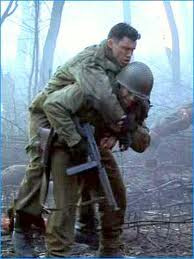
After this introduction we are thrown into action and see one soldier, private Manning (Ron Eldard),  carrying his mortally wounded comrade whom he finally must abandon. All through watching this movie I was reminded of Goethe’s ballad the Erlkoenig in which a father rides with his son through the woods at night. The child keeps on saying it sees the Erlkoenig in the darkness who tries to tempt him and take him away. A very spooky ballad. When the father finally arrives at his destination he finds out that his little son has died in his arms.

Maybe John Irvin, the director, did think of this ballad when he shot this movie. The woods always had a special place in German mythology and references to this can be found in many a movie or book about WWII.

The soldiers in this movie are fighting a senseless battle, one that cost a horribly high amount of lives. The battle of Hurtgen forest is only not spoken about so often since it was shortly followed by the more famous Battle of the Bulge.

When Trumpets Fade tells the story of private Manning the only survivor of his company who is – due to his ability to survive under such circumstances – promoted to sergeant and gets to lead a group of replacements. In a bloody battle where they are to secure a bridge he is again one of the only survivors and gets promoted to lieutenant. Both times he protests. All he wants is to survive and  get out. He’s not the only unhappy soldier. The battle seems sense- and fruitless, casualties are high, soldiers and officers complain and rebel.

Manning is a very interesting character and his development makes this movie one of the rare psychologically interesting of its kind. This and the eerie scenes in the woods where the fog is thick, Germans lurking everywhere and naked, burning trees stand lonely and dark against the background,  makes this a haunting experience to watch.

The final credits are shown over endless rows of dragon’s teeth that are slowly covered in snow to  Bing Crosby singing White Christmas.