The Brylcreem Boys (1998): A WWII Comedy, Drama and Romance in Ireland

The least I can say about this movie is that it is total fun. I did certainly never expect to laugh during a POW movie but that actually happened repeatedly. Admittedly it is not the most refined humor, it’s rather of the burlesque, slapstick kind. But it is never overdone. The movie is just sprinkled with it here and there. The overall tone is often quite serious. Still it is one of the very rare movies you could probably watch with  children (although planes and people get shot down at the beginning and there is some fist fighting as well).

Ireland having lost many of its young men during the Civil War had decided to stay strictly neutral during WWII. This was not much appreciated by the allies. Unlike Switzerland Ireland insisted that every soldier encountered on Irish soil was to be taken prisoner. What was not universally known however was the fact that they put all the prisoners, French, British, American, Canadian and German into the same camp.

The Brylcreem Boys is not based on a true story but on true facts that have been carefully assembled and put together to tell a convincing story. Two fighter pilots, the Canadian Miles Keogh  (Bill Campbell) and the German Rudolph von Stegenbeck (Angus Macfadyen),  shoot each other down over Ireland and are both taken prisoners and brought to the same camp. While on leave they  fall in love with the same girl, the strong-willed Mattie (Jean Butler),  which adds a bit of romance to the whole story. Their rivalry and mutual dislike is very intense in the beginning but over the course of the movie and during many incidents they realize that they are not that different despite being on different sides.

Much of the funny elements of the movie stem from contrasting the Germans and their rigid discipline and total lack of sense of humour with the  more easy-going other prisoners. (Unfortunately there aren’t any German actors in the movie and some of the accents that the cast adopted are a bit laughable.)

Even though they are far away from the war itself, one of the prisoners sort of brings it back with him when he returns from London from his futile attempt at escaping the camp.  His account from his stay in the British capital makes the tragedy of the constant bombing during the Blitz  utterly palpable.

I am a big fan of the Irish actor Gabriel Byrne whose character is the commanding officer of the camp. He also co-produced this movie. Seeing how much fun he exudes playing this role one can easily assume that this was a movie that was very close to his heart.

I am very glad the directors felt compelled to tell this story of this quite exotic camp. It provides an interesting insight into Irish history for which I am glad.

Since this is really a feel good movie but far from being stupid entertainment you might really  enjoy watching it.

The Poet aka Hearts of War (2007) or Don’t Let the Movie’s Poster Trick You

The Poet is a flawed and a much despised movie. Set in Poland in 1939 the central theme is the love story between  a German officer and a Jewish girl. I read comments and reviews that would make me feel ashamed if I had been part of this production. Funny enough people either give it a 1 or 2 star rating or 5 stars. Odd, right? Are they really being fair? What infuriates them so much? That Roy Scheider has only a mini-role even though he is on the movie poster?  I was not enthused but I did not mind watching it. Sure there is  a lack of logic and actors who speak in heavy accents that are not their own is annoying. Still, it is nicely filmed and I found it shows  one of the most beautiful depictions of a mother/son relationship. That the mother on top of that is played by the  beautiful Daryl Hannah does help as well. These two people are really close. They have a very open relationship. Unlike the one they both have with the father, a German general and Nazi. Unlike her husband mother and son are totally opposed to the German politics of the time. The movie has furthermore  some tragic story elements, decent fighting scenes and a female Russian Resistance leader one would not want to mess with.

At the opening we see Oscar, the son, on his mission in Poland. He should infiltrate resistance groups. On a trip to the woods he finds an unconscious girl in the snow and rescues her. What Oscar finds out very soon is the core element for the melodrama that will follow namely the fact that Rachel is  Jewish.

They fall in love at the greatest speed I have ever seen people fall in love in a movie, even though Rachel is already engaged.

They are separated early on, as Rachel has to flee.

If you want to find out whether they will meet again and if so, under what circumstances, you might have to watch it.

Did I mention that Nina Dobrev stars as Rachel? That might actually lead to a more generous viewing of this movie as fans of the Vampire Diaries might want to check out what else the young actress has done before. She is actually quite good in The Poet.

Maybe it is all about the poster. People seem to have felt tricked into buying a movie with Daryl Hannah and Roy Scheider as the main protagonists when in truth they have only minor roles. We resent feeling tricked.

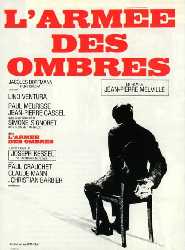
The Army of Shadows aka L´armée des ombres (1969): The Classic Movie on French Resistance

Bad memories, I welcome you nevertheless,  you are my distant youth.

If you are really interested in the topic of French Resistance there is no escaping this movie.  If you are truly interested in film there is no escaping this movie either. Especially not since there has been a recent wave of Resistance movies (Les femmes de l´ombre (Female Agents), L´armée du Crime ( The Army of Crime), Flame and Citron, Black Book, Winter in Wartime, Max Manus) and it is always good to see where they come from, what influences they had.

Jean-Pierre Melvilles´s L´armée des ombres aka The Army of Shadows (or in the Shadows) is a classic and a work of art.

It is beautiful like a foggy autumn evening, like the solitary cawing of a crow, like bare branches of a tree in winter, like the bluish colour of an early nightfall, like bitter sweet music and coffee drunk at midnight in an empty bar. (Would I  have to compare it to a contemporary movie, I think I would choose Shutter Island.  The movie as a whole and particularly the sad song during the end credits, Dinah Washington´s Bitter Earth blended with Max Richter´s On the Nature of Daylight, has a similar dense atmospheric quality.)

Gerbier (Lino Ventura) is captured by the Gestapo early in the movie. He manages to escape but knows he has been betrayed. Only one of his own could have told the Gestapo where this overly careful man was hiding.

Gerbier is head of a Resistance cell that operates between Paris, London, Lyon and Marseille. They always on the look out for people they can trust. They must always be careful, they could be betrayed anytime. They are hunted and on the run continuously. When they are caught by the Germans or the collaborators, they will be tortured mercilessly as the film shows drastically. But the group will risk everything to save one of their own.

The cell kills traitors as well  as people who become too risky. No matter how much they helped them in the past, no matter how much they like them. The group ultimately lives and dies for the cause.

Lino Ventura and Simone Signoret are fabulous in this movie. It is a pleasure to watch such assured actors.

A feeling of abandonment and utter loneliness pervades the whole film. It seems to illustrate the existentialist angst of the times. Melancholy in its purest form.

What impressed me most was the sound. No effects like we know them nowadays but so artfully and sparingly used noises and sounds and just a little bit of music. The rain in the beginning, echoing footsteps in empty streets, the ticking of a pendulum in a room, the distant cry of birds.

It is quite a sad movie and I would not recommend you watch it should you feel very blue. It would not cheer you up. But on days when you feel balanced enough you will admire these brave people and suffer with them when they find out one of them is being tortured but won´t speak, not even when he knows he is going to die.

And, please remember, this is a true story.

Quote from Joseph Kessel´s Account of the French Resistance L´armée des ombres aka The Army of Shadows

The following short quotes are taken from the introduction to Joseph Kessel´s book on the French Resistance L´armée des ombres aka The Army of Shadows. The  introduction written by the author himself in 1943 is a testimony to the difficulty of writing this book. He wanted to stay true to the facts which he had experienced himself during his years in the Resistance and also protect those who appear in these pages.

Jean-Pierre Melville based his beautiful movie L´armée des ombres aka Army of Shadows on Kessel´s account. Seldom has a movie been so true to the haunting atmosphere created by a book.

This book contains no propaganda and it is no work of fiction either. No detail has been forced and none has been invented. (…)

France has no more bread, no more wine, no more fire. But above all she has no more laws. Civil disobedience, individual or organised rebellion have become duties towards the home country. (…)

Never has France been engaged in a more noble or beautiful war than in the one that is fought in cellars where her free newspapers are printed, in the nocturnal terrains and secret rocky coves where she receives her free friends and from where her free children swarm out, in the torture chambers where despite the pliers, the needles reddened by fire and the broken bones, the French die as free men.

Everything you may read in this account has been experienced by French people.

(Translated from the original French by allaboutwarmovies)

Film review and trailer will follow tomorrow.

Ice Cold in Alex (1958) or When did Beer ever Taste this Good?

Picture this: It is a hot summer day. 45°/113° in the shade. The sun is blaring. Water is scarce. You are more than just thirsty. You have to overcome a lot of obstacles to get out of the sweltering heat. But at the end of the day the coldest lager in the Middle East is waiting for you.

What are you going to say: “Worth waiting for”.

Now this is exactly what John Mills´ character Captain Anson says after they finally arrive at Alex. Ice Cold in Alex tells how they get there.

In 1942 a little group of people, two nurses, two British officers and a suspicious South African officer attempt to cross the desert from Tobruk to Alexandria, crossing minefields and enemy territory. They have to fight more than the heat, flat tires and  German attacks. Captain Mills must try and come to terms with his alcohol problem. After his drinking leads to a disaster he swears he will not drink anymore until they are in Alex.

Ice Cold in Alex is a real classic. The black and white makes the actors look twice as expressive as they would have been anyway. It is an adventure story in front of a WWII background.

It is not your ordinary action-driven, combat-flick but a fine piece of British cinema. And the end-scene, when they finally make it to the bar and get their lager is memorable.

Apparently they had to shoot the scene so often that John Mills was really drunk at the end of it.

Another interesting observation: this is probably one of the earliest examples of product placement in a movie.