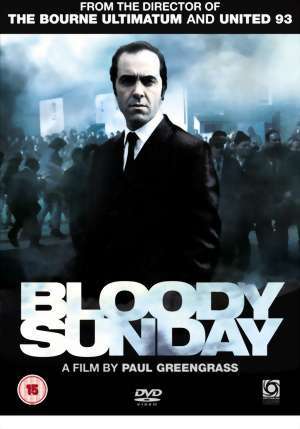
Bloody Sunday (2002) or The Day Innocence Died

Maybe it is debatable whether this is a real war movie in the strict sense of the term (but then, what is that anyway?) but I believe whenever there is armed conflict executed by an army or large group of people, even though not on a global scale we have to speak of war.

On January 30 1972 the British army opened fire on a peaceful Civil Rights March in the city of Londonderry in Northern Ireland. On this day 27 people were shot and 13 of them lost their lives. A further victim died a few months later. This day was from then on called  Bloody Sunday. It was a huge blow to the Civil Rights Movement and ended in countless young men entering the IRA. What followed is a history of bloodshed and terrorism that would not end until the 90´s.

On June 15 2010, after an investigation of 12 years had been conducted and found that the British army had opened fire without  a reason, the British Prime Minister Cameron apologized for this crime.

The so-called Saville Report has cost 230 million Euro. It proved without any doubt  that  the soldiers were at no time shot at. They opened fire on people who tried to flee, take refuge or wanted to help others. Two thirds of the victims were only 17 years old.

When this movie was shot, although largely known, there was no actual evidence as to the truth of these facts. We know them now and thus the movie unfurls vividly before the spectators eyes the whole extent of this tragedy.

Bloody Sunday is not easy to watch and the first two thirds were so annoying that I was tempted to stop it. This is solely due to the technique. It is filmed documentary style with a shaky hand-held camera. We see three complementary points of view. The Civil Rights Movement´s, the Police Headquarter´s and The Army Company´s stationed in the street. The camera fades to black for every scene. During the bits at the Police Headquarters there is a constant ringing of telephones that drove me almost mad. Also at the Civil Rights Movement´s Head Quarters, just before they assemble on the street, phones keep on ringing. The movie basically shows the whole day from early morning until its bloody end. We see the people prepare for the march, the police debating at what point they should stop the march and the soldiers on the street taking position.

It is worthwhile to sit through these annoyances though. The last third, when the march turns into a tragedy, is extremely powerful and the documentary style filming adds to the realism to an almost unbearable extent. What we watch is such a tragedy that we can barely believe it. To shoot at people who shout for help or try to help others looks like an execution.

Saying all this I think the movie shows nevertheless, no matter how misguided the army was or how brutal their reaction, that  they were also under a lot of stress. Some of their own had been killed a few days before, they were constantly attacked, bottles thrown at them.

As so very often it is shown that those on the street (very much like those on the battle field) depend on their command in the Head Quarters who failed them completely. They misjudged everything, thought that sheer force would end it all and boy were they wrong. And, as always, they never pay a price in lives.

At the end of the movie there is a scene when every single victim is named. Every individual anonymous victim seems to become a face.

When watching the end I was surprised at how much this movie got to me.

Rape and Love among Ruins: Anonyma – The Downfall of Berlin aka Anonyma – Eine Frau in Berlin (2008)

I was not sure if it was in good taste to use the title I gave this post but somehow it sums  up the film in a very few words. It is as if I had wanted to find two ways to speak about this movie: With brevity first and later at great length.
The Downfall of  Berlin has two contrasting parts taking place  shortly before and after the war ends. The beginning shows the taking over of Berlin by the Russian Army and the  mass rape that was soon every woman’s daily reality. The second half is dedicated to the love story with a Russian Major and the home-coming of Anonyma’s husband. All this takes place among ruins which accentuates the subliminal theme of the fragility of the depicted relationships.
The movie starts in 1945,  at the end of the war when the  Red Army troops enter the city of Berlin. What the German women had to endure from the moment the Russian Army set foot on the Ground of the city is an unparalleled horror.  Mass rape, brutalities and cruelty are the order of the day. One of these women, Anonyma,  kept a diary in which she carefully noted all the shocking events for her husband who had been sent to the Eastern front.
As the horrors go on she decides to look for a protector who might shield her from being constantly raped and abused by other men.

I have seen a few movies dealing with the German civilian population at the end of the war. There is a common moment in many of those movies. The inhabitants of a village or town hear troops approach and one of them is sent to find out who is coming. When the messenger returns there is this crucial moment when everybody just wonders whether he has spotted  Russian or American troops. Should it be the Soviet Army, the civilians flee in terror, whenever they hear it´s the Americans they are overjoyed.

A lot of the discussions whether this is a good movie circle around the comparison with the book and the liberties that have been taken to turn it into a movie.
First published in English in 1955 it has not been reissued until 2003, after the author’s death,  and this time under the pseudonym Anonyma. The reception of the book in Germany in 1959 was very harsh and aggressive and shocked the author a great deal. Germany was not ready for the  content of this  book.
The author of the diary was a  journalist and well-travelled woman. In  noting the horrible events and describing in great details the daily terrors of the women facing the Red Army she has left us an invaluable first-hand account.
The movie shows that hardly any woman, young or old,  escaped being raped.
There is a brief part in the movie when Anonyma meets a friend that she hasn’t seen in a long time and asks her “How many?” And they both know without any further clarification what they are referring to. Some 2´000´000 German women were raped in this time.  Payback for the massive loss of Russian lives.
It was criticised that the movie was not able to  transmit the whole extent of the horror that the book  shows. And of course the invention of the love affair which does not take place in the book was criticised as well. I  liked this doomed love story a great deal even though I normally do not like it when grim facts are sugar-coated by romance. But as a matter of fact this is a very realistic love story. Not very sugary at all and even though not in the book I think it manages to add another dimension.

Anonyma is a very fine movie, especially since it is in large parts bilingual German/Russian. The Russian cast is absolutely great. I especially liked Yevgeni Sidhikin in the role of Major Andreij Rybkin who becomes Anonyma´s protector and lover. Apparently already well-known in Russia we might see some more of him in the future. I was not too thrilled by the German actors. Apart from Nina Hoss who plays her role with an almost severe dignity, they are a bit too dramatic and wooden at times.

The shocking story of mass rape  is told in a very convincing manner. Evident but not voyeuristic. Without being shown  too explicitly we know what is going on.

I consider this to be an important movie as it shows how much the Germans suffered as well.
From reading German reviews on this movie I see that to this day the feeling of guilt runs so deep in Germany that they still feel uneasy to mourn these events.

And nowhere have I ever seen this called a war crime. Why not? Because the war was almost over? That would be a little bit cynical. Or because the aggressor has no right to complain?

Maybe it is just because no matter how it is called, no one really wants to speak about it. Rape like torture are hard to deal with. For both. Those who commit it and those who endure it.

I would really like to read comments, thoughts and whatever not about this movie from others.

amazon.com  Anonyma – The Movie

amazon.com Anonyma – The Book

Anonyma – The Downfall of Berlin aka Anonyma – Eine Frau in Berlin (2008) Trailer

Anonyma – The Downfall of Berlin is a German movie about a woman living in Berlin at the end of the war in 1945 when the Russian troops enter the city. A story of retribution and shame. Of the winners taking revenge on the weakest among the losers.

Watch the trailer today. The post will follow tomorrow.

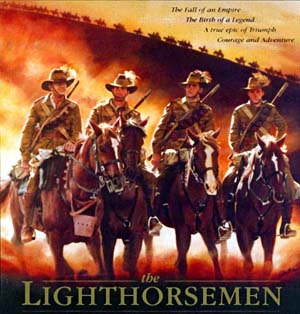
The Lighthorsemen (1987) or One of the Rare Movies on Cavalry Combat

I would say this is one of the lesser known war movies but that says nothing about its quality.

I already mentioned this movie for its portrayal of a soldier who is unable to shoot.

Lighthorsemen is wonderful for many reasons. It tells the true  story of the Australian Cavalry´s participation in WWI in Palestine. British and Australian troops had to confront the German and Turkish forces. The Light Horse had already fought in many battles, among them at Gallipoli. The movie´s realism is convincing. The character portraits are nicely drawn. One soldier is more likable than the other and we slowly get to know each one  in the regiment, and follow them from the early beginning to the battle scenes. This is one of those movies in which you really care about the protagonists. There is even a love story between Dave, the soldier who can´t shoot, and a nurse but it is discreetly kept in the background.

The essential story line of Lighthorsemen follows the 4th Light Horse Brigade in Palestine in 1917 until the battle of  Beersheba where they  achieve what 60000 infantry men could not do. They  break through the entrenched infantry and free the city. This is not an easy endeavor. The heat is scorching, water is scarce and it is a massive strain on the horses.

The battle scenes, especially the final charge,  are really exciting.  We see  the whole regiment  fly along under the line of fire. A fabulous scene.

I am not sure it is a 5 star movie, but it certainly is a solid 4.5.

And, maybe surprising for a war movie involving combat, it has a certain lighthearted quality and cheerfulness stemming from  the fact that those nice lads manage to achieve the impossible.

Was I a bit cryptic? Hope so. Just want to lure you into watching this fine film.

True Blood and The Vietnam Vet

I read a lot. All sorts of things. Classics, literature, prize winners, pure entertainment, crime and thriller, some Fantasy… I am curious when I hear people enthuse about a book. That´s how I got lured into reading the first two in the Southern Vampire Series, Dead Until Dark and Living Dead in Dallas by Charlaine Harris. I do not really want to go into this reading experience here (I do understand why the series is succesful), nor is this the place to analyse women´s obsession with vampires (…. maybe…or,…..no, I don´t even go there…), what caught my attention early on was the character Terry Bellefleur. I felt he was very intense and with very few words Charlaine Harris captured the personality of a truly traumatized person. Without elaborating this character much she added another dimension to the already multi-faceted people swarming these books. Like in many Vampire novels before the Sookie Stackhouse series, one of the major themes is the outsider, someone who has lost contact with the society or was never part of it. And since the Southern Vampire books are populated with so many different types of fictitious and real outsiders like vampires, shape-shifters, homosexuals, Afro-Americans, addicts, the addition of a Vietnam vet seems of almost stringent logic.

I had read the books before even hearing of the series but was very curious to watch it. Six Feet Under will always be my favourite series so it was only logical I would at least have a look at what magic Alan Ball would be weaving  in True Blood. I was not disappointed. This series is just great fun. Very sexy and daring. Great cast, great stories, greatest intro song to any series ever (sure, it is only my humble opinion).

Writers and director took quite a few liberties especially with the cast. Many characters are much more developed than those in the book. Some are totally different, like Tara. Other types of outsiders are added, like alcoholics.

And what about our Vietnam vet? Miraculously transformed into an Iraq veteran to offer identification to the younger audience and to raise the awareness and understanding of and for those returning from Iraq and Afghanistan. This is more or less the explanation given by the producers. Quite nice, only it does not work for me. It does not feel right. I cannot explain it, but to me he is and will always be a Vietnam vet. No matter how much rationalization they put into his “transformation”.

When the actor Todd Lowe, whom many know from Gilmore Girls, was asked how he did prepare for the role, he explained he pictured a Vietnam vet that he had known as a young man. A homeless guy that talked him into giving him his cigarettes.

I wonder if there is not another reason to switch from Vietnam to Iraq. Maybe the age? Would a Vietnam vet not be much older than a guy returning from Iraq and Afghanistan? Of course this is a rhetorical question. Maybe the producers, even though they are extremely inclusive of marginal groups did not want to embrace the elderly? Now, don´t tell me this is not food for thought. Aren´t we living in a society that is ever so obsessed with age? Aren´t the vampires  ageless…always young, always beautiful? There is a certain logic in ostracizing the elderly from a vampire movie, right?

Or – which is not much better – did they think it was too hard to believe that someone could still suffer from PTSD after having come back such a long time ago? If so, what do they know?

I think they should have let this be. And I don´t buy the explanations. I would have preferred Terry Bellefleur to be an elderly Vietnam vet.

What about you?

I have to post the opening credits here for you, they are just too good to be missed and, let´s be honest, when will I ever get another chance to do this in a blog on war movies? Although…Come to think of it… what about a post dedicated to Generation Kill and  Alexander Skarsgard….