Is The Fallen (2004) The Final Sacrifice or Letters from the Dead?

It does happen quite often that I like movies less than most people but not in this case. People either like or hate The Fallen but there seem to be much more who do not like it. I don’t really understand why but I’m not sure I have seen The Fallen. I have watched The Final Sacrifce which can’t even be found on IMDb. An amazon reviewer states that The Final Sacrifice is a remake of The Fallen by the same director with the same actors??? I seem to remember having seen the beginning of the movie a few years back but something stopped me and when I started watching the other day it took quite a while until I got that I was watching The Fallen. Meanwhile I found out that Ari Traub directed and earlier version called Letters from the Dead (2003). Very confusing. Be it as it may, I hope one of my readers knows more. In any case, the movie I have seen, called The Final Sacrifice, was not a bad movie at all. On the very contrary.

It is almost the end of WWII. We are in Northern Italy, in the Alps, in some outpost guarded by Italian and German troops who do not get along well. The movie is trilingual (which might have been a reason for the lack of appreciation) and for once the actors are of the “correct nationality”. No silly American flavored Italian.

The Germans try to defend their line against the attacking Americans. The Italians who should help, are, apart from an aristocratic officer, not that keen on assisting. The people and villages around them are their people, their families. More and more they think it is unjustified that they have been dragged into this war by their government. Many of the farmers around are selling goods on the black market, others join the Resistance.

When the Italian army and Italian Resistance meet, it’s a sad affair. Usually no one shoots and a few soldiers desert but as soon as the Germans turn up, there will be severe punishment for every one.

The Americans seem to be enjoying their stay in Italy. It isn’t as rough as Africa, nor as bloody as France or Belgium. At least not at this point in time. And they know they are winning which helps as well.

The Final Sacrifice of the title is a last desperate attempt of a German officer, who was a real moron all through the movie, to fight off the enemy almost on his own. The orders are to guard the post no matter what. Knowing the order makes no sense and the end is coming, he tries to save at least his men.

Admittedly the American parts were not that perfect, the German point of view was on the sentimental side but, and that’s why this movie gets 3.5 from me, the Italian point of view is extremely well told. It shows how delicate, complicated, desperate their situation was. The movie is also in a clichéd way funny, the difference between the Germans and the Italians leads to one slapstick-like clash after the other.

As I said, I liked it, it isn’t fantastic and will not make a Top 100 but it is a worthy attempt at showing a part of history that hasn’t been explored enough, namely the role of Italy in WWII.

I suggest you watch it and come back and tell me how you liked it.

Deutschland bleiche Mutter – Germany Pale Mother (1980)

The German movie Deutschland bleiche Mutter aka Germany Pale Mother  is a heavy movie. Heavy, tragic and depressing but excellent.  Eva Mattes gives an absolutely outstanding performance.

When the movie begins we hear the deep voice of a woman recite a poem by Bertold Brecht, (you can read it here Germany – Deutschland), in which he calls Germany “a pale mother”. This sets the tone. The movie is literary and symbolic and deeply rooted in German culture. The story is to a certain extent told by Anna, Lene’s daughter. In a voiceover she narrates her beginning, how her parents met in 1939, just before the war, how they got married, how shy and awkward they were, how her father was sent off to the Eastern front and little Anna was born during an air raid.

When their house is bombed, Anna’s mother decides to leave for Berlin. We see her stand in the ruins, before she leaves, she tries to find something, anything but all has been shattered, broken, they don’t have much more than their lives and a few clothes.

In Berlin they live in the empty house of relatives. Hans is on leave and joins them but the stay is very difficult for all of them. Anna is jealous of the father she doesn’t know. Lene feels estranged and wants to be alone with her daughter and Hans is tired, very changed and disappointed.

The movie follows the lives of these three people until after the war when everything seems to be normal again but is not. Her mother contracts a very mysterious illness and a doctor advises to extract all her teeth. She becomes highly depressed and wants to die. Her husband is equally miserable and abandons her emotionally.

In the middle of the movie there is one long impressive scene in which Lene walks with Anna through the woods. She has left Berlin because she is afraid to die in an air raid. On the way she tells the little girl a story. It sounded quite familiar and I had an idea it was a fairy tale of the bothers Grimm.  I managed to find an English translation of it. The Robber Bridegroom is one of the bloodier fairy tales the Grimm’s have collected. There is a lot of symbolism attached to the forest in Germany. This started a long time before WWII but it culminated during the war. The scene of Lene walking through the woods and telling this gruesome tale to her little daughter is very oppressing. And what happens in the woods even more so.

In Germany Pale Mother director Helma Sanders-Brahms told the story of her own parents. It shows how much the life of the Germans was shattered, how they desperately tried to go back to normal which is symbolized by the coffee ritual in the sitting room. What made sense before the war has become some sort of cruel mockery. Things are changed forever.

Germany Pale Mother is German narrative cinema at its best.

I attached an excerpt of the movie. The full movie can be watched on YouTube.

Casablanca (1942)

Cinema doesn’t get much better than this.  Casablanca is one of the truly outstanding movies, a movie to watch and re-watch.

It is not, in the strict sense of the term, a war movie, that’s obvious, it’s a war-time movie or, if you like, a war romance.

It is one of the movies I have seen the most. At least four times. One of the viewings was a mixed bag as it was the Technicolor version. Casablanca is the prototypical black and white movie. The Technicolor version was really outrageous and sacrilegious. So watch out, if you have never seen it, the original Casablanca must be b/w.

Casablanca tells a tragic love story but more than that it’s incredibly atmospherical, it has some of the most famous movie lines, a haunting tune and two great actors, Humphrey Bogart and Ingrid Bergman at their best.

Rick and Ilsa met years ago in Paris, at the beginning of WWII. We see their love story in flashbacks. When Rick decides to leave Paris with Ilsa, she simply doesn’t show up at the train station.

Years later they meet again in unoccupied Morocco. Rick is the hardened and cynical owner of one of the most popular bars in Casablanca. All sorts of people visit or hide in his establishment. Pretty much like all sort of people have come to Morocco for various reasons, most of them however hoping to get a visa for the US. There are also some nasty German characters swarming the premises.

When Ilsa and her husband appear in Rick’s bar, this is a shock for everyone. What happened in Paris, why did she not turn up and what does she want now? Ilsa and her husband try to get to America.
Will Rick help her or not? Will she leave her husband?

It is hard to imagine that anyone hasn’t seen this movie but, just in case, I’m not going to tell anything more.

Rick’s character is one of my favorite movie characters. I like the dialogue in Casablanca a lot. Rick is very cynical but has a point. He also illustrates that while women tend to get depressed, men tend to start drinking when life is too rough. He is one of those great monosyllabic movie characters with a “Don’t-you-dare-to come-too-close” attitude. I think it is precisely Rick’s character and Bogart’s great acting that prevent this movie of an unhappy love triangle to become mushy.

A movie like this would be unthinkable nowadays for many reasons. One can be summed up by the term “esthetic of smoking”. Not that I smoke but smoke rings look good in black and white movies, they add some mystery, just like fog.

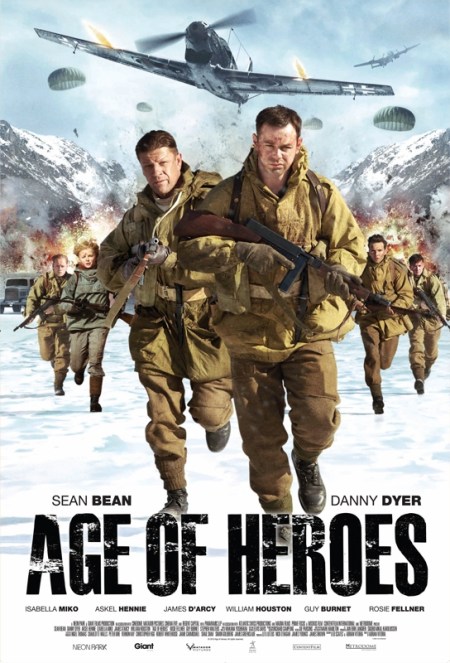
Age of Heroes (2011) Sean Bean Starring in A Movie on the British Commando Unit in WWII

It would be very hard for me not to watch a movie starring Sean Bean and that is why I was looking forward to Age of Heroes a movie based on the true story of Ian Fleming’s Commando Unit. Lucky yesterday wasn’t one of my impatient days or I wouldn’t have finished it. It would have been too bad as the movie improves considerably after the first 15 extremely dodgy minutes are over. But, judging from the ratings on IMDb, people didn’t forgive the movie its beginning…

Age of Heroes follows a British special forces unit on a crucial mission called “Operation Grendel”. The men, being part of Ian Fleming‘s  so-called Commando unit, one of the first special forces units, have undergone a very hard training. They are led by a hard but funny training officer (William Houston) and their highly appreciated leader Major Jones (Sean Bean). Jones is one of the best leaders I’ve seen in a war movie. He is tough but just, clever, courageous and not without kindness. Part of the unit is the Norwegian born American Steinar (Axel Hennie, Max Manus). This makes a lot of sense as the mission takes place behind enemy lines in occupied Norway. The Commando unit will have to drop in Norway and get some German radars in order to analyze them. The whole operation has been planned and is closely supervised by Ian Fleming (James D’Arcy) in London. A lot of what he experienced during the war when he was an assistant of the Director of Naval Intelligence was later used in his James Bond novels.

Needless to say that this was a dangerous suicide mission and, typical for this type of endeavor, many things went wrong and people died. As we get to know the characters well before they go on their mission, we care for them. One of them is introduced early, in the unfortunately weird beginning that takes place in France, and we get to know and like the others in the British training camp.

All in all it was an entertaining movie if somewhat flawed. It is flawed because it reminded me of some recent Resistance movies and lack of originality is a flaw. But it was also flawed because the film makers seem not to have been decided whether they wanted this to be more of an action or more of a war flick. The story is a war story but the movie is told like an action film.

If you like Sean Bean and have never heard of the Commando unit, the precursor of the SAS, you will enjoy watching it and, due to the action twist it is quite gripping.

Europa Europa aka Hitlerjunge Salomon (1990) The Story of a Jewish Boy Hiding Among Nazis

Agnieszka Holland’s movie Europa, Europa is based on the true story of Salomon Perel. It is frequently mentioned as one of the top 100 war movies. It’s a harrowing and quite unbelievable story, still I have to confess that I did not like it.

The Perels are a Jewish family living in Germany at the beginning of the war. When anti-Jewish acts become more and more frequent, they are attacked and the daughter is killed. Salomon’s parents send the young boy and his brother to Poland where he should try to survive at any cost. He looses his brother early in the movie and ends in a Russian communist orphanage. Here he is given a passport and has to undergo some serious communist re-education. When the Germans invade Russia, the orphanage is attacked. They all flee and Salomon gets captured on the way by a Nazi patrol. All the Jews are shot immediately and it is only thanks to an extreme presence of mind that Salomon manages to make them belive that he is a true German and that he can be extremely useful as interpreter since he speaks Russian fluently. The soldiers take him along and he fights with them, helps them as a translator. He has to be super careful that no one sees him naked and this will stay a constant topic throughout the movie. The fact that he is circumcised would give his identity away.

A German officer hears of the young boy and that he is an orphan. He likes the bright boy and thinks of adopting him but first he sends him to one of the Nazi elite schools where he will be educated and trained. Here again, he has to be careful in order to not be found out. There are a few incredible scenes in the school. In one scene a teacher shows that one can see unmistakably, that, despite his dark hair, Salomon is of pure Aryan breed. The pupils are taught to hate the Jews and how to detect them. The absurdity of such scenes is incredible and Nazi madness made apparent.

Salomon is barely 16 years old and falls in love for the first time. Although the girl is willing “to do it”, he has to say no. The danger of being detected is too big.

It is incredible to think that he got away with it for so long. He blended in so perfectly, was such a good actor and so cold-blooded that they never even suspected him to be Jewish.

After the war Salomon finds out that his whole family died in a ghetto in Poland. He leaves Europe and settles in Palestine. At the end of the movie we catch a glimpse of the real Salomon Perel.

It took me a while to figure out why I didn’t like this movie. I didn’t like it because I didn’t like Salomon. I suspect that I found his behaviour cowardly. He isn’t much better than a collaborator. It disgusted me to see him act and talk like a Nazi. Sure, he was only a boy, he wanted to survive, he lost his family… I think sometimes it’s better to die than to sell out. Bit harsh, I know, but surviving is not everything.

I’d be really interested to know what others think of this movie.

Europa, Europa is part of the Children in War Movies List