While waiting for my upcoming post on this movie on the Irish Civil War you may watch a brief interview with Cillian Murphy.
Tag Archives: History
A Bridge Too Far (1977) or A Movie Too Long?

Richard Attenborough’s A Bridge Too Far has, with some reason, been called a movie too long. Yes, I must admit I was tempted not to pause it when I needed to go to the bathroom. But then again… This is not doing it any justice because it has a lot of fine elements. For a start, what I am really enthusiastic about is the re-enacting. Nowadays it is all CGI but when they did A Bridge Too Far they had no choice but have people jump out of planes with their parachutes. And this is so beautiful. The scene where they jump is almost ethereal and all those hundreds of parachutes look like ever so many jellyfish. But there the dwelling on beauty ends, too horrible is the end of those frail looking creatures. Is there anything more helpless than a man hanging from a few ropes being shot at?
Operation Market Garden has been one of the biggest planning mistakes of WWII. What could have been a successful multinational cooperation turned into a farcical disaster. Two generals, one British (Montgomery), the other American (Patton), were so full of themselves that their egos put aside any consideration of a possible failure. Moreover Montgomery totally underestimated the German’s strength. 35000 paratroopers were to land in Holland behind enemy lines. The idea was to secure three bridges, push back the German troops, invade Germany and end the war. While holding the bridges, the troops should have been reinforced by tanks. Unfortunately they forgot to provide supply lines for the paratroopers, the armored troops were held back and died on what was called “Hell’s Highway” and civilians got in between as the operation collapsed.
This movie is probably one of the most famous war movies of all times. It is an all-star cast, like The Longest Day, starring Robert Redford, Ryan O’Neil, Gene Hackman, James Caan, Michael Caine, Sean Connery, Anthony Hopkins, Laurence Olivier, Dirk Bogarde, Maximilian Schell, Hardy Krüger and many more. A Bridge Too Far shows, like The Longest Day, a big operation from different points of view. I was not equally keen on all the actors but was impressed by Anthony Hopkins whose despair at the end is painfully obvious. He plays the role of Lt. Col. Frost whose troops had to defend Arnhem Bridge. The end of the movie is one of the saddest in war movie history. The troops are either defeated, taken prisoners or killed.
A Bridge Too Far is a tragic illustration of what can go wrong when egotism meets bad planning and how the price is ultimately only paid by those who must follow orders.
As I stated before it is a tad long but it will always remain one of the most important epic war movies and you should watch it if you haven’t done so already.
The Truce aka La tregua (1997) or Primo Levi´s Odyssey from Auschwitz back home

The late Italian writer Primo Levi was one of 650 Italian Jews who were deported to Auschwitz. He was one of only five to survive.
All of his life he suffered of survivor´s guilt and feelings of shame remembering how much they were degraded. In 1987 he very probably committed suicide. I say probably since it was not 100% established but everything points to it.
He wrote two famous books about the Holocaust. If this is a man aka Se questo è un uomo about his time in Auschwitz and The Truce aka La tregua about his odyssey back home from Auschwitz to Italy.
Francesco Rosi’s movie The truce aka La tregua is based on the second of those books.
Did you ever wonder what happened to the prisoners of Auschwitz after they had been freed by the Red Army? Being free was one thing but getting back home another one altogether.
Levi´s odyssey brought him first farther away from his home country Italy, to Minsk. You could not just board a train at leisure. The railway lines had mostly been destroyd. And what about food without money in countries whose populations were starving? It takes Primo months until he gets back. He finally arrives after stressful moments of a long and complicated journey, mishaps, dangers but also of joy and rediscovering the beauty of life.
I knew John Turturro from his movies with the Coen brothers where he plays mostly a comical character. This is a very different role but it felt as if it had been created for him. He plays this sad, pensive and gentle intellectual in a very endearing manner.
The last scene shows Primo writing. That’s what he will do from now on, that and working as a chemist. And he will leave two of the most accurate and painful accounts of Auschwitz and the journey home that we have.
People who read the book La tregua criticize the movie relentlessly but I think we should also see it as a homage to a man who had the courage to testify but never really got over the fact to have been one of a very few to survive.
I liked this movie, I really did, probably thanks to Turturro´s soulful acting.
During the last scene of the movie, when we see Primo Levi writing, we hear a voice in the off reading his poem If This is a Man aka Se questo è un uomo.
Please, take a few minutes and read it.
| Voi che vivete sicuri | You who live safe |
| Nelle vostre tiepide case | In your warm houses, |
| voi che trovate tornando a sera | You who find warm food |
| Il cibo caldo e visi amici | And friendly faces when you return home. |
| Considerate se questo è un uomo | Consider if this is a man |
| Che lavora nel fango | Who works in mud, |
| Che non conosce pace | Who knows no peace, |
| Che lotta per mezzo pane | Who fights for a crust of bread, |
| Che muore per un sì o per un no. | Who dies by a yes or a no. |
| Considerate se questa è una donna | Consider if this is a woman |
| Senza capelli e senza nome | Without hair, without name, |
| Senza più forza di ricordare | Without the strength to remember, |
| Vuoti gli occhi e freddo il grembo | Empty are her eyes, cold her womb, |
| Come una rana d’inverno. | Like a frog in winter. |
| Meditate che questo è stato | Never forget that this has happened. |
| Vi comando queste parole. | Remember these words. |
| Scolpitele nel vostro cuore | Engrave them in your hearts, |
| Stando in casa andando per via | When at home or in the street, |
| Coricandovi alzandovi | When lying down, when getting up. |
| Ripetetele ai vostri figli. | Repeat them to your children. |
| O vi si sfaccia la casa | Or may your houses be destroyed, |
| La malattia vi impedisca | May illness strike you down, |
| I vostri nati torcano il viso da voi | May your offspring turn their faces from you. |
Breaker Morant (1980) or An Australian Look at the Second Boer War
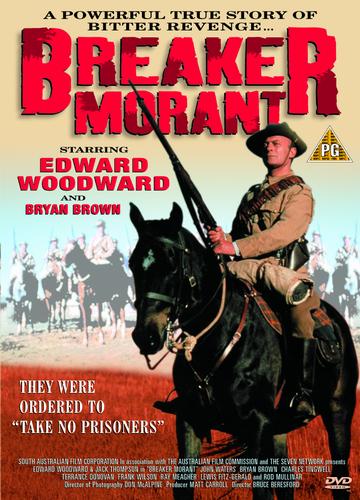
The Australian movie Breaker Morant is one of those movies that leave you thoughtful and pensive for quite a long time. It leaves you feeling helpless and infuriated as well by unmasking the hypocrisy of those in charge. It brilliantly illustrates the absurdity of war and deserves to be named together with the most important anti-war films ever done.
The movie is based on the true story of the court-martial of three Australian officers Lt Harry “Breaker” Morant, Peter Handcock and George Witton by a British court. They were accused of having shot first one, then six POWs and subsequently a German missionary. Their defense attorney Jack Thompson who was inexperienced and soon tried to accuse those in charge of the trial as well.
The movie tells the storiy alternating court-room scenes with flashbacks.
The second Boer war (1899-1902) was by far worse than the first. The Dutch started to fight a guerilla war against the British who then fought back and organized a special troop, The Bushveldt Carabineers, for wich they appointed Australian soldiers. The idea was to fight the Boer with their own means.
Harry Morant volunteered to go to South Africa because he believed in the British Empire. How utterly tragic. In Australia he was famous as a breaker of horses and poet. Edward Woodward plays this proud, upright and poised character with an excellence I have rarely seen. This is such a brilliant actor I wonder why he never made it to more fame.
The longer we watch the trial the more we realise that it is a sham. The British need scape goats to save their reputation. What those officers are ultimately accused of is what they were told to do. Only now no one wants to take responsibility for it. Of course this is also a meditation on what is good or bad during war.
Breaker Morant is interesting for cinema historic reasons as well since it is part of the so-called Australian New Wave, of which Gallipoli and The Lighthorsemen are other great examples.
This is without any doubt a 5 star movie.
Mongol: The Rise to Power of Genghis Khan (2007)

What is the best word to describe this movie? I would say it is enthralling. The cinematography is stunning. The vastness of the Mongolian steppe would leave no one indifferent but captured in such wonderful pictures there is no escaping the enchantment. These amazing views are underlined by one of the most convincing scores I have heard in any movie recently. Chanting monks, female singers, musical parts. Picture wise it did remind me of Urga aka Close to Eden, a gorgeous Mongolian movie I haven seen a few years back. We can easily deduce that material life in the Mongolina steppe has not changed much. People still live in yurts, even the clothes bear a certain resemblance.
The Russian movie Mongol is the first installment of a trilogy on the live of Genghis Khan. It shows his childhood, how he chose his wife Borte (Khulan Chuluun), the great love of his life, how his father is killed and how he later has to fight for his survival until he becomes the unifier of the Mongolian tribes and their leader. He is not yet called Genghis Khan, he is still Temudjin (Tadanobu Asano) a boy from a modest background whose father was one of many Khans.
Life at those times seemed to have been incredibly hard. The tribes were stealing from each other (horses and women), assaulted each other, killed each other. It is hard to imagine a life of greater insecurity than this. Whenever the future Genghis Khan triumphed over someone he was shown as very just and generous. As a consequence of this behaviour people wanted to follow him, they chose him as their leader.
The Genghis Khan we see is someone who inspires pity because of the hardships he has to endure and admiration for the way he treats people, especially his wife to whom he is very attached.
I cannot say much about the historical accuracy. Usually Genghis Khan, who was once the leader of the greatest empire that ever existed, is shown as a merciless cruel despot. There is not much room for beauty in those tales of his life. I tried to find out more and apparently it depends on the sources that are being used whether his portrait is more negative or more positive.
I was fascinated by the spiritual aspects in the movie, the deity that appeared in the form of a wolf. The wolf is very meaningful to the people of the Mongolian steppe. Certainly the depiction of the Mongolian religion is not accurate but I liked this dimension.
I thought the acting was excellent but have read that it has been criticized that a Japanese actor stars as Temudjin. The accents of the actors seem to be painful to Mongolian ears as well. I even read that some actors spoke Mandarin Chinese which was not yet spoken at the time… I don´t speak any of those languages therefore I was not bothered.
I think this is a very special, aesthetic, riveting movie and I am not surprised it was nominated for an Oscar and won many prizes.

 All About War Movies