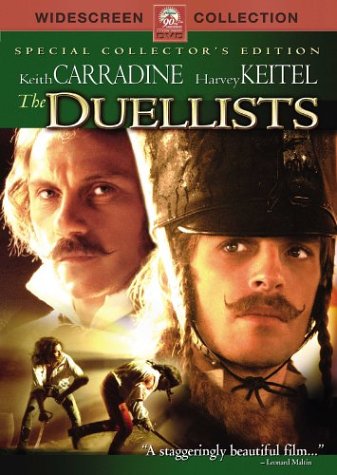
More than anything else Ridley Scott’s directing debut, The Duellists, tells the story of an obsession. I’m glad Guy (Phoenix Cinema) suggested it as I wasn’t aware of the movie and found it oddly captivating and very beautiful too. Plus I find duels fascinating. I can’t really say why.
Based on the short story The Duel by Joseph Conrad The Duellists tells the story of a lifelong enmity. Two officers of Napoleon’s army, d’Hubert (Keith Carradine) and Feraud (Harvey Keitel), pursue each other for years and fight one duel after the other. While the first duel might have made some sense, at least at the time, the following duels are less and less understandable. Although d’Hubert tries to reason with Feraud, the latter becomes more and more obsessed as the years pass by.
The movie has a lot more to offer than a fascinating story and two interesting characters. It’s visually stunning and brilliantly acted. I couldn’t even say which of the two actors I liked better. Carradine as d’Hubert who seems more complex, more humane or Keitel as Feraud who is relentless in his pursuit of d’Hubert. If you like sword fighting you will adore The Duellists anyway as the choreography of the fights, as many reviewers have commented, is excellent.
The movie starts in 1800 and ends around 1815. After almost every duel the men lose sight of each other for a few months or even years as they are often posted in other places. They sometimes meet under quite improbable circumstances, once for example while retreating from Moscow where they fight a group of Cossacks together.
The code of duels was quite complex, I suppose every country had its own set of rules. I felt we learned quite a lot about the rules in France at the time. What made it especially dramatic was the fact that if one of them had been promoted but not the other one it would have become impossible to go on fighting. So every time d’Hubert is promoted he hopes the folly is about to end, only to find out later that Feraud meanwhile has been promoted to the same rank.
The Duellists has been compared to Barry Lyndon but I don’t think they are that similar. Be it as it may, I’ feel more inclined to rewatch The Duellists, I thought it was more captivating. And I really must read the novella soon.
After having watched the excellent Valkyrie (here is my review), starring Tom Cruise, I wanted to see how the Germans had treated the very same story just a few years prior to the US production. Stauffenberg is a TV production, starring Sebastian Koch (Black Book, Das Leben der Anderen) as Stauffenberg. Ulrich Tukur (Das Leben der Anderen, The White Ribbon) can be seen in the role of Henning von Tresckow. While Carice van Houten who played Stauffenberg’s wife in Valkyrie looks very different from the real Nina von Stauffenberg, Nina Kunzendorf’s likeness is uncanny.
I don’t think it’s of any use to summarize the movie. Since it’s a true story the plots of the two films are almost identical, however there are some significant differences in the way the story is told which make it worthwhile to compare the two movies.
The title Stauffenberg already indicates that the focus is much less on Operation Valkyrie than on the man Stauffenberg himself. And that’s actually the biggest problem of this TV production. It is quite confusing and for someone not familiar with the story, it isn’t clear what Operation Valkyrie is. I was glad I had seen the US film first or I would have been a bit lost as I wasn’t familiar with the whole story.
While Valkyrie starts with Stauffenberg in Africa, it starts much earlier in this film. We see Stauffenberg first in Berlin, whit his fiancée and future wife Nina, later he is in Poland and only then in Africa. This helps to understand his motivations and his development from someone who believed in Hitler to somebody who was entirely disgusted and ready to kill the man.
What worked far better in this TV production is to make us understand why the assassination failed. The characters in this film are portrayed as determined but they are no sleek robots. There are many mishaps and they are far from perfect. We even get the impression that they were a bit too hasty and that the whole project would have needed more planning. In Valkyrie we don’t really understand why it doesn’t work. Everything seemed so perfect.
What also worked far better here is the human and emotional dimension. These people are scared. They are determined but anxious as well and when they are caught, things do not go well. One of them isn’t even capable of shooting himself, he misses first, tries again, ends up badly wounded and has then to be shot by someone else while in Valkyrie he puts the gun to his head, shoots and is dead right away.
While far from perfect and not as carefully – and one would argue artificially -orchestrated as Valkyrie, Stauffenberg feels emotionally true and is very watchable. If you didn’t like Tom Cruise you might even prefer this smaller scale production.
Maybe it’s good to watch bad movies in order to be able to appreciate the good ones more? With that premise in mind, I’d say, Red Tails is highly effective. Still I find it deplorable that it couldn’t be any better and at the same time, I don’t know why this had to be remade. The 1995 TV version The Tuskegee Airmen is really good, I liked it a great deal and although it is sentimental in places it’s not as corny as Red Tails. Geroge Lucas’ justification for this remake, according to an interview, was CGI and that the use of it allowed him to show the dog fights like they haven’t been shown before. Maybe but…
The story of Red Tails, unlike the older version of 95, starts only when all-black fighter squadron 332 is already in Italy and waiting for an important assignment. Although highly trained and some of the best fighter pilots the US Army has, they aren’t allowed on important missions. All they do is shoot trains and small targets. The frustration is high and when they are finally given the opportunity to escort a bomber crew they are happy and do an oustanding job.
If you’ve never even heard of the true story of The Tuskegee Airmen, Squadron 332, then you will find it very interesting. Even a notorious moaner like Spike Lee approved of this production which may not be surprising as his Mircale at St. Anna has one of the corniest endings ever.
What’s my problem then? There were many.
Foreboding – It’s handled extremely heavily, no casualty or twist was not foreseeable from the beginning.
Music – This was one of the wost scores ever. Too much, all of the time and in some instances some weird techno type music which may appeal to a CGI crazy generation but is highly unrealistic in a WWII movie.
CGI – Overdone and tacky looking. I didn’t find it convincing at all.
Cast and Characters – Many of the actors did a good performance but not Cuba Gooding Jr. He dragged the movie down and was responsible for more than one unintentionally funny scene. He grimaced his way through this movie, it was painful to watch. His attempts at looking like an authority figure which he tried to achieve smoking a pipe, didn’t work at all.
Back story – There is no back story and I feel that’s really missing. the TV production took much more time and is therefore more efficient in its anti-racism message.
Emotion – As corny as it was, it wasn’t moving. I was very moved when I saw the 1995 version but this one left me cold.
Love Story – An awfully, awfully, trite and forseeable story.
Racism – I felt it only touched on the main topic of racism because, as mentioned above, the back story was cut off. The CGI and the silly love story detracted from it. Furthermore the atmosphere of the military in Italy was also shown better in the TV version.
I won’t deny that roles for African-Americans in war movies – and other movies – are sadly scare and this movie certainly offered a great opportunity. Notably many actors known from TV shows like The Wire got a chance to perform in this. The story of the Tuskegee Airmen is an important story for African-Americans, something to be really proud of. Being excellent and doing your job better than anyone else despite being ridiculed and not taken seriously is no small feat. Still, I can’t help it, I would have preferred if it had been a good movie.
People often think that Gillo Pontecorvo’s movie The Battle of Algiers or La battaglia di Algeri is a French movie but the movie is Italian/Algerian, spoken in French and Arabic. It has been commissioned by the Algerian government. The topic – the war in Algeria – is still controversial in France. While it is meanwhile called “a war” and not only a “pacification intervention” – or whatever euphemism was chosen at the time – many of the aspects of the war are still not spoken about openly. One of them being the “interrogation techniques”. Another euphemism. I suppose this was one of the reasons why Pontecorvo’s movie has not been shown in France until recently. Another one may be that it pretends to be very impartial and realistic and has also said to be exactly that while I feel it is entirely anti-French and one of the most tendentious movies I’ve ever seen. I think it is important to say the truth but it’s equally important to capture complexities.
Many critics think Battle of Algiers is one of the best war movies ever made. It received many prizes and is almost always mentioned on lists. I agree with some of this but I still think it’s a highly problematic and polemic movie.
The movie starts in 1957 with the end of a torture scene. A man has given away information and is now taken along to the hideout of four members of the FLN. From there the movie goes back to 1954 and we see how a young Algerian man Ali La Pointe is arrested. France has been occupying Algeria for far over hundred years now and oppressed the population. Algiers is a divided city with two parts. The Casbah, narrow labyrinthine streets in which the Muslim population lives, and the rest of city in which the French live. Racism and social injustice are habitual.
When Ali gets out of prison he joins the FLN (Front de Libération Nationale) – The National Liberation Front. They are organised in small groups whose identity is unknown to the members. There are only two or three people who know each other.
They start their uprising or revolution with small terrorist acts, shooting individual police men. When the French police start to close off the Casbah with barbed wire and search all the people who enter or exit the perimeter, the tensions rise and new tactics and recruiting methods have to be found. Civilian places like cafés, bars and restaurants are bombed. That’s the time when even women and children join the FLN and plant bombs.
Clearly the police do not have the power to fight the terrorists and that’s when the French Army sends a special unit of paratroopers led by Colonel Mathieu, fresh from Indochina. Mathieu knows that he has to cut off the head of the organisation but since there are only a very few people who know very few others it’s not an easy undertaking. A special “interrogation method” has to be applied. This method consists in torturing systematically every member of the FLN who has been arrested. And probably many others.
At the end of the first wave of uprising, the order is restored but unrest will break out again a few years later until Algeria will be granted independence in 1962.
The movie shows this in gritty black and white pictures which make it look like a documentary. There is no likable character in this whole movie, there is no side that isn’t shown in all of its determined ugliness. Still I found it tendentious because it leaves out that there were a lot of pro-French Algerians in the country, al lot of Algerians in the French army and a lot of pro-Algerian French as well. The so-called pieds noirs, French people, like the writer Camus, born in Algeria, loved their country and were about to lose it. Furthermore by depicting the battle in Algiers only, the film makers avoided to show what was happening in the mountains where all the French soldiers captured by Algerians were tortured and mutilated, Christian nuns were found nailed to crosses and other atrocities were committed.
Now why is this movie considered to be so great? I would say there are two reasons. I was reminded of Rome, Open City when I watched it as it is very close to Italian neo-realism. The way it is filmed is outstanding, We really think we see a documentary and original footage. The faces of the actors are expressive, the torture scenes are very powerful, notably when we see the faces of the men after they have been tortured and see the mixed emotions and shame. The opening scene illustrates this eloquently. What also contributes to the realism is the use of music and sound. Music is used sparingly, we hear drums and ululating sounds made by women which convey a sense of authenticity.
Another reason why I think this movie is so highly rated, especially by US critics, is the topic. I don’t think all that many non-French people are familiar with the war in Algeria. The fact that we see something in this movie with which the US has been confronted on a regular basis since 9/11 may have contributed to the movies’ appreciation. How uncanny to see a movie made in 1966 showing war taking place inside of houses and narrow city streets. An enemy who is hidden among the normal people who uses the attire of religious women, hides guns and bombs under veils. An enemy who recruits even young children and indoctrinates them from an early age on. That’s why the movie has been shown regularly by the Pentagon to officers and experts of the war against terrorism since 2003.
In 2004 a restored version of the movie was shown in US cinema’s and met with a new success. It’s only after this screening that it was also finally shown in France where it was now equally successful. It seems it was never officially forbidden in France but didn’t receive an authorisation to be shown until 1970 and then, through acts of intimidation, cinema owners were kept from showing it.
While the filming reminded me of Rome, Open City, I had to compare it to two much later movies as well. One being Black Hawk Down, the other one Battle for Haditha. I’m sure I will write more about this movie in the future, looking at parallels to other movies and influences.
I think Battle of Algiers is an explosive, topical and very important movie. It’s a must see for people interested in war movies and cinema history. It clearly shows the ugly face of colonialism; the French interrogation techniques which were a breach of Human Rights, as well as the acts of terrorism of the FLN against innocent civilians. Still, I find it’s a biased movie. It had to be, I suppose.
While considered by many to be great, others think that nowadays it’s thought to be great because it can be instrumentalized and used by both parties, terrorists and the army alike.
Just a final word on my ambivalent feelings towards this movie. I am not saying that I think the presence of France in Algeria was justified. I think that colonialism is a plague, an atrocity for which we still pay and will keep on paying. But I think that once a country has been present in another country for many generations it’s not as simple as good versus bad anymore. It’s much more complex than that and those of colonialist origin born in those countries will suffer too, not only the indigenous people. I think this side of the human drama has been left out as well as the human drama of the drafted French soldiers who had to fight in Algeria. Colonel Mathieu who is based on a real life officer, General Jacques Massu was one side of the medal, a right-wing General whose only aim was to keep French territory at any cost. There were many others dragged into this conflict against their will.
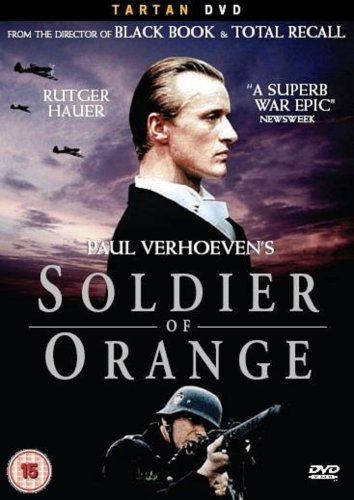
I think it was obooki who first suggested I watch Paul Verhoeven’s Soldier of Orange – Soldaat van Oranje in a comment on my Starship Troopers post. I’m certainly glad he did. It’s like a companion movie to one of Verhoeven’s latest movie Black Boek – Black Book. While I thought Black Book was quite good – although not as good as many other resistance movies – I’d say Soldier of Orange is far superior and deserves to be named among the best.
I have a predilection for the WWII sub genre of resistance movies and I’m aiming at watching them all sooner or later. Most of the really good movies I’ve seen were either French or Nordic in the broadest sense (including Germany and the Netherlands).
Soldier of Orange is based on the autobiographical novel of the Dutch resistance leader Erik Hazelhoff Roezelma. It tells the story of six upper-class university students whose lives are profoundly changed by WWII. While one of them becomes a member of the German-Dutch SS, the others are soon joining the resistance.
The two best friends Erik Lanshof (Rutger Hauer) and Guus Lejeune (Jeroen Krabbé) are the two main characters. While Guus is a resistance leader, Erik is at first reluctant to even join but the longer the Nazi occupation lasts, the more he feels the urge to do his bit.
With the help of their friend Robby and his radio they get into contact with the resistance in England. The first mission they organize goes very wrong. One of their friends is captured, tortured and executed. Erik and Guus manage to escape but from now on they must be extra careful. Erik soon notices that he is followed. It’s obvious that someone has betrayed them and they are quite certain to know who it is. It must be one of their British contacts.
The first part of the movie is set in the Netherlands. It shows how Erik changes. While at first this is only an adventure for him which he doesn’t take too seriously, when he discovers he’s followed, he know he has to make a decision. Although his love interest, Robby’s Jewish fiancée, is in the Netherlands, he decides to escape to Britain and operate from there.
The second part is set almost entirely in the UK. Erik and Guus meet the Dutch Queen Wilhelmina, who is in exile in the UK. She wants to get in contact with the Dutch resistance and establish a connection between the resistance in England and those at home.
Shortly after their arrival in the UK, the two men are sent back again to fetch some of the Dutch resistance leaders.
The movie contains all the typical elements one would expect in any resistance movie; adventure, danger, missions, betrayal inside the own ranks, torture, executions. What makes Soldier of Orange especially good is that it rings so true. The characters are quite complex and so is the Dutch society which is depicted. The movie doesn’t idealize anything, it shows how many traitors and collaborators there were among the Dutch. It is one of the Queen’s biggest concern what she will do with those after the war.
The picture was remarkably fresh and from that perspective the movie could be very recent. The colors are intense and crisp, it’s really enjoyable to watch. The music however is dated. I’d say it’s a typical 70s war movie score.
What surprised me was how cheerful and uplifting the tone was. Most resistance movies are slightly depressing. This one is not. Erik and Guus are both rascals, they enjoy women and adventures and while they would be glad if the war was over, the idea to cheat on the Germans amuses them so much that almost feel it’s all worth it. Their cheerfulness is quite infectious.
All this together would have made me like the movie but what makes me love it is Rutger Hauer. Ever since I watched Blade Runner for the first time some years ago, I thought he was an extraordinary and very charismatic actor.


 All About War Movies