L’Honneur d’un Capitaine – A Captain’s Honor (1982)

What an excellent movie. Even better than I thought it would be. It’s my second Schoendoerffer and it is as good as the more famous Dien Bien Phu.

L’Honneur d’un Capitaine or A Captain’s Honor is part court-room drama, part infantry combat. It is a thought-provoking look at the way France tried to come to terms with the war in Algeria. It shows one nation’s struggle to face the injustice it committed in the name of peace-keeping.

20 years after his death on the battle field Cpt. Caron is publicly accused of having been a torturer and an assassin. The man who accuses him is a famous professor of sociology who claims having known Caron well enough to be sure of the accusation. The accusation happens during a TV show. Some of the guests leave in outrage. It isn’t only about Caron. It is about what really happened in Algeria. To this day there is a rift in France. On one side are those who claim that the French army has tortured in Algeria and on the other are those who say it didn’t.

Caron’s widow decides to drag the incident to court. She wants justice for her husband and his reputation. Her uncle, a famous lawyer and member of the Parisian high-society, advises against it but finally gives in and even wants to help her in court.

Before they go to court, they try to gather information and this part gives the movie another dimension. It links WWII, Indochina and Algeria.

At 17 the future Cpt Caron was part of the French Resistance, he later served in Indochina and was captured by the Vietminh. This is illustrated by original footage, many of it taken in battle and in the prison camps during the liberation. Those French soldiers looked exactly like the Jews in the German camps.

The drama that unfolds in court is very gripping. We really want to know what happened. Did he, or did he not do it? In order to find out, they have convoked former soldiers and officers who served with or under him. They take apart each and every element of the accusation. The film moves back and forth between the court in the 70s and the battlefield in Algeria in the 50s.

During 18 days Cpt. Caron led a special alpine infantry unit. Three of the men of this unit had been captured by the fellaghas (anti-colonialist rebels). This usually meant torture and slow death at the hands of those rebels. The Cpt. tries everything to get the men back. During these 18 days many unpleasant things happen. Algerian informants are tortured, killed and disappear. After a while it becomes apparent that it isn’t so much about whether it has really happened, everything does indeed point into that direction, but whether Caron gave the order.

It is fascinating how they deconstruct the accusations bit by bit, but every time they have proven that it may be a wrong accusation, another one is brought up.

Without giving away too much, I’d like to describe one scene that I found particularly  amazing. Caron and a few of his men are at the foot of a mountain, while the rest of them are somewhere high up. It is said that during this part of the campaign an Algerian prisoner was killed. And indeed, the soldier in the court room states that Caron gave the order. He was up there with the men. Another officer however testified that, no, he hadn’t given the order. He was standing next to Caron during te whole incident. What had happened? Caron told them to bring the prisoner down (descendez-le in French) but they had understood to take him out (also descendez-le in French). Depending on where a person who says “descendez-le” stands, it could either mean “take him out” or “bring him down”.

This is just an example how the movie works, what type of complexities it shows.

It is a movie that makes you feel very uneasy (if you are French). The thing is, if the Cpt, who was such an exemplary officer, is found guilty, one can assume that torture and murder was a fairly common practice. But if he isn’t found guilty, if he is innocent, this does not automatically mean that these atrocities didn’t happened. This is where the movie excels, it it is excellent at showing the psychology of those who want to believe either the one or the other.

I haven’t found a trailer but attached the scene in which Caron’s widow watches the Indochina footage. There are no subtitles but that doesn’t matter as they only speak a few words in the beginning.

ANZACS Part III Ypres and Passchendaele (1985)

It is debatable when watching a series whether you should review each installment individually. I haven’t done it for The Pacific, nor for Hornblower or Sharpe, so why now do it for ANZACS? Because it is so good? Yes, it really is but so are the others. That’s not the reason then, the reason is that I’m in the mood to do it. Not everything needs to make perfect sense in life, occasionally we can do something just because we enjoy it and I enjoy reviewing ANZACS. There are not all that many good movies and series on WWI, it seems justified to re-emphasize that this one exists.

Part three is a s good as the first two parts and leads us even deeper into some of the catastrophic and notorious battles of WWI. Who hasn’t heard of Ypres or Passchendaele, who hasn’t heard how many soldiers died in these two offensives alone?

In this part we see that the British Prime Minister, Lloyd George and General Haig are really not on the same page. Haig is gung-ho, his strategy seems to demand too many losses and Lloyd George doesn’t think it’s justified at all.

Once more we also see how the British and the Australian culture clash when it comes to subordination. Another aspect that is covered in this part is the role of the respective churches. While the Church of England was fully supportive of the war, there were some voices in Australia saying that it might be high time to underline that Australia was independent by now and that the Australian church should adopt another attitude towards the war.

The man on the photo, Jon Blake is one of the main actors in ANZACS. He was also in in The Lighthorsemen. While finishing The Lighthorsemen he had a car accident and sustained severe brain injuries that left him in a near vegetative state. He died on May 29 2011. It’s a very sad story. He was a very promising young actor and many say he would have gone far. We will never know.

Here are the reviews of Part I Gallipoli and Part II The Somme and a List of Australian War Movies.

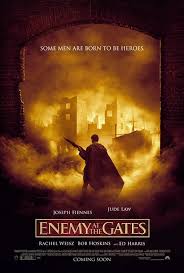
Enemy at the Gates (2001) or The Duel of Two Snipers

It’s interesting how often people mention Enemy at the Gates as one of their favourite war movies, yet I do not see it included very often in more official Best of Lists. I wonder why and can only guess. Maybe because it is too esthetic? Hardly ever have ruins looked this good. Or is it because of the love story? I must admit, I had a problem with it. I don’t mind a love story, although it is mostly a bit tacky in a war movie, but I would have liked this one to be left out. I thought it spoilt an otherwise perfect movie. And I think another cast would have been better as well, apart from an excellent Ed Harris, I didn’t care for the actors. Despite all these reservations, I think it is an excellent movie. The central story is suspenseful and it is one of the most beautifully filmed war movies ever and certainly one of those I will re-watch. And don’t you just love movies about snipers?

Stalingrad 1942. The city is under siege. The German army hopes to win the war and to secure the oil fields near the Caspian Sea. The Russians are well aware if they lose Stalingrad, it is over. The losses are high, morale is low and a little bit of propaganda might do every one a lot of good. That’s why Khrushchev (Bob Hoskins) thinks its high time to fabricate a hero and charges Danilov, an important oficer of the Communist Party, with this mission.

Enemy at the Gates is loosely based on the story of the famous Russian sniper Vassili Zaitsev (Jude Law). Vassili has learned to shoot at an early age, and now, in his early twenties he is the best sniper in the Russian army. Danilov (Joseph Fiennes) decides to pick him, and turn him into the hero Khrushchev is looking for. Vassili gets newspaper coverage and publicity and soon his fame is known far beyond the Russian borders and especially the Germans are well aware what a dangerous enemy he is.

Amidst the rubble and the ruins we see two parallel stories unfold. The first story line, follows a love triangle. Through Danilov Vassili meets the Jewish woman Tania (Rachel Weisz). Both men are in love with her but as it seems Tania has only eyes for Vassili. This love triangle is frankly annoying and disrupts the movie. It isn’t even very plausible.

The second story line revolves around the competition between Major König (Ed Harris), a famous German sniper, and Vassili. König is sent to Stalingrad to take out Vassili. All the parts of this second story line are quite gripping. We see the men hunt each other, we see how they get to know each other, how they try to find out how the other will react, how and from where he will shoot, how they try to ambush each other.

Snipers are endlessly patient. They don’t just shoot wildly, they aim carefully, take their time, observe and shoot only when they are fairly sure of hitting their target. Enemy at the Gates perfectly captures this cat-like hunter quality of the sniper and that’s what makes this film so watchable despite its flaws.

The director Jean-Jacques Annaud is famous for his cinematography. He has made one of the visually most compelling movies The Bear or L’ours . Enemy at the Gates is equally stunning from a cinematographic perspective.

71- Into the Fire aka Pohwasogeuro (2010)

71-Into the Fire is based on the true story of 71 South Korean student soldiers who, in August 1950, fought back the North Korean 766 Commando Brigade. In an incredible act of bravery they held out for 11 hours. Thanks to their courage and commitment the allied forces were capable of holding a bridgehead at the Nakdong River.

This brief paragraph sums up the story pretty much but it will not tell you anything about the way this story is told.

Unlike most Western movies 71-Into the Fire doesn’t start with an introduction of the main characters. It doesn’t show our group of young men in a training or boot camp, nor are we slowly led into the action. No, this movie starts with intense combat scenes and only slows down after having shaken us for a good 15 minutes. In so far it has some similarities with Saving Private Ryan. But that is where the similarity stops. There is a lot of use of slow motion in this movie which I can’t remember having seen in Saving Private Ryan or other war movies that often.

The main character, the first of the students to which we are introduced, is Oh Jung-Bum. He is inexperienced and scared. When he sees how one of the superior officers is shot, he almost breaks down. He can’t even help him or fire a shot, his hands are shaking too much. Still he stays with the man until he dies and for this he is promoted immediately to captain of the newly formed student company.

The 71 young students, or rather 68 students and three young convicts, haven’t had any training before. Most of them have never shot one single bullet in their life. This is far from promising but as the graphic scenes have shown, there is need for desperate measures. The North Korean forces are advancing rapidly and if the Allies cannot defend the bridgehead on the Nakdong River, they will be overrun by the North Korean forces.

Oh Jung-Bum is far from being the leader type and he knows it. Unfortunately the others know it as well and he has a hard time to make them follow his orders. Only after he has proven himself worth and gained respect, will they listen to what he says.

When the North Korean army finally approaches, we get to see an ugly and desperate fight that doesn’t leave a lot of survivors. The boys really give everything and manage the sheer impossible and hold back a well-trained and well-equipped army.

It is a heartbreaking story and I liked some parts of it a lot but the last 15 minutes or so were totally over the top. There was too much dramatic dying for my taste and I found it quite propagandist.

Despite its flaws I would give it a 4/5 because it is really gritty and tells a story that isn’t known much and it is undoubtedly a must-see for people who like the genre. Additionally the filming is quite interesting. However, as said before, I have huge reservations as to the end.

Thanks again to Cine Asia for sending me a review copy of this movie.

Please also check out Novroz’ review of the movie. She was the winner of the DVD Giveaway.

ANZACS Part II The Somme (1985)

ANZACS part two takes us to the battle fields in France where the lads we met in the first part will take part in the battle of the Somme. Before they start to fight in the trenches they undergo a bit of training and are also shown the way the Germans fight.

There are still humourous episodes when old-world hierarchy meets with Australian insubordination but this clash of attitudes is also very unfortunate. General Haig, as this episode shows, was less than thrilled by the Australian’s lack of obedience and thought it best to send them off to one of the bloodiest battle fields. Surprisingly they are doing very well. Where most other companies achieve nothing they manage to capture some terrain and there are also more and more losses among the Germans. The British high command is surprised by this can-do attitude and the ability to fight demoralization however they still refuse to recognize their valor.

At the end of the episode the heavy fighting has taken its toll anyway. The men return extremely weary and it’s hard to imagine that the ordeal only just begun.

In episode I an Australian journalist had an important role in covering up the senselessness of the battle at Gallipoli. We see the same journalist once more. He is the Australian prime-ministers’ spokesman and has to find out whether the Australians are not just sacrificed. He points out that they haven’t really won a lot of terrain so far. He is informed that it isn’t only about winning terrain but about wearing out the Germans.

The trench scenes are very convincing. These are trenches that crumble, they have been under such heavy fire all the time, that they are merely shallow dug outs. Usually the trenches we see in WWI movies are very high. The fact that they had to be reconstructed constantly and did at times hardly give any shelter isn’t shown very often.

Like in part two, the story moves between the battlefields and the home front which adds to the authenticity.

I enjoyed part II even more than part I (see review here).

I attached chapter two from Episode 2 (2/10)