A Soldier´s Story (1984) or Racism in the Military

The worst thing you can do, in this part of the country, is pay too much attention to the death of a negro under mysterious circumstances. (Colonel Nivens)

Norman Jewison´s movie A Soldier´s Story (1984) shows you what great acting can be.

It is one of Denzel Washigton´s first movies. Although he is not the leading actor you can already tell what he´s capable of. What is very obvious, that´he´s not only a movie actor but one hell of a good theater actor as well. The story is based on a theater play and almost the whole cast is from the original ensemble.

The movie takes place in a base in Louisiana during WWII.

Sgt. Waters, a black sergeant, is found dead and an army attorney is sent from Washington to investigate the murder. What no one suspects, least the white commanding officers, is the fact that the attorney is also Afro-American. The base which consists to a great extent of black Americans has never seen a black decorated officer before. They are awed whereas the white officers are outraged. It´s one of the best moments in this movie.

Soon it is obvious what a contradictory character the victim was. However the investigation is hindered by uncooperative officers and fearful soldiers. Bit by bit,shown through flashbacks, the victims true character and the actual events are revealed. The shocking truth is that the killed sergeant though African-American himself was a racist at heart and punished every act that he deemed unworthy of other black people, notably singing and dancing.In his own words:

You know the damage one ignorant Negro can do? We were in France in the first war; we’d won decorations. But the white boys had told all them French gals that we had tails. Then they found this ignorant colored soldier, paid him to tie a tail to his ass and run around half-naked, making monkey sounds. Put him on the big round table in the Cafe Napoleon, put a reed in his hand, crown on his head, blanket on his shoulders, and made him eat *bananas* in front of all them Frenchies. Oh, how the white boys danced that night… passed out leaflets with that boy’s picture on it. Called him Moonshine, King of the Monkeys. And when we slit his throat, you know that fool asked us what he had done wrong?

He was cruel, unjust and unfair. He wasn´t liked by neither white nor black soldiers and officers and really had it coming.

The character portraits in this movie are all extremely convincing, the acting is outstanding, the tale is gripping and it really doesn´t leave you untouched. This is a 100% convincing anti-racism movie and one of the few movies about racism in the military. A must-see.

Dresden (2006) or Was the Bombing of Dresden a War Crime?

Dresden is a quite controversial German movie that has been criticised a lot. Shot for TV it is basically a very corny love story between a German nurse and an English fighter pilot.

I´m not going into any plot details since they are quite boring but still I do think this movie achieved something.

The love story takes place during the days before the bombing of Dresden starting February 13 1945 and ends with a depiction of the bombing.

This end part as well as  all the parts in the English Head Quarters from where the bombing was organised had me glued to the TV screen. The moral conflicts of the British to bomb what they knew to be one of the most beautiful European cities was shown very well. The atrocity of what is still called a war crime nowadays, is symbolised in the collapse of the famous Frauenkirche, one of the town´s landmarks  (reconstructed in 2008 as a symbol of hope and peace). The church withstood two days of bombing and finally collapsed on the second day.

The damage the bombing caused, the heatwaves, the firy wind… I think it is shown rather well however varnished with a lot of corny elements.

The end of the film shows actual footage, the re-inauguration of  the rebuilt Frauenkirche.

This movie, as flawed as it is, offers a lot of food for thought. How justified was it to systematically bomb a city like that, to kill so many and to destroy century old  architectural treasures? How is this different from the bombing of other cities?

Was it unavoidable? Was it a war crime? How did the pilots feel?

Further questions circle around the film makers´ choice to mix a corny romance with historical facts.

Judgement at Nuremberg (1961) or A Truly Outstanding Legal Drama

Judgment at Nuremberg is a brilliant movie by Stanley Kramer. Outstanding actors, great pictures and a gripping story. Spencer Tracy, Burt Lancaster, Richard Widmark, Marlene Dietrich, Montgomery Clift, Judy Garland and Maximilian Schell. They are all good, very good.

The movie´s setting is post-WWII occupied Germany.  It tells the story of the trial of 4 German Nazi judges in an American court. They are accused of being responsible for sterilization and exterminations.

Spencer Tracy stars as Judge Dan Haywood who is conducting the trial, Marlene Dietrich plays Mrs. Bertholt, the widow of an executed Nazi army officer. Burt Lancaster is one of the accused judges, Maximilian Schell his defendant. One of the most convincing performances is given by Montgomery Clift who plays the role of one of the judges´ victims. His  interrogation is so touchingly performed, makes you feel really uneasy.

The film follows Judge Haywood in the court room and outside where he tries to get the full picture by befriending Mrs. Bertholt and talking to his housekeepers, Mr. and Mrs. Halbestadt to find out what the German people  really knew. It seems as if each one´s personal history and concerns overshadowed the things that happened around them. And even though they lived so close to Dachau, Halbestadts pretend to have been ignorant of the camps.

During the trial the testimonies of the witnesses, supported by original footage of the concentration camps and the interrogation of the accused, completes the picture of the past horrors.

Judge Haywood must now establish if, in believing to serve their country, the accused did right or wrong. Do exceptional circumstances permit different moral criteria? Does the conviction to do the right thing exempt  from punishment?

If you want  Judge Haywood´s  answer to these questions and if you like to see  truly outstanding movies and great acting, watch this one  as soon as you can.

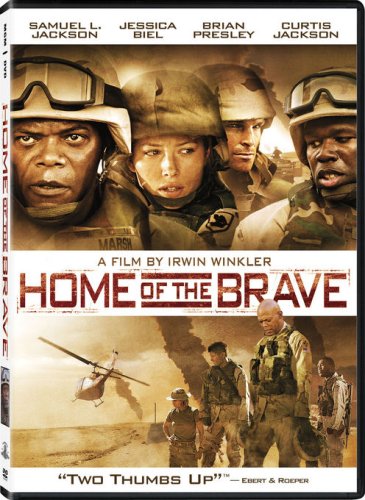
Home of the Brave (2006) or When a movie really fails

Home of the Brave is about a group of soldiers who came under heavy attack shortly before being sent home. After their return they try to cope with what they have been through. They all fail to some extent before they realise they need psychological help.

What a bad, bad, bad movie! I´m embarrassed I watched it. Worst acting ever. Ridiculous dialogue, dragging storyline, wrong cast, pathetic music…

And yet, there are a lot of people who like this movie and say: that´s exactly how it was.

I don´t doubt for one sec, that this is how it was. I don´t doubt for one sec that the returning soldiers need medication, treatment, can´t make their relatives understand, despair, start to drink, get violent, blame everyone including themselves and the government.

Fine. But DO NOT show a message like this in such a way. After a while you start to wonder, why there is not a constant voice in the off telling you: ha…that was impressive, ha…see how horrible, ha….start to blame the government and now ha….

This doesn´t work. It´s like someone telling you a joke and immediately explaining you afterwards why it was funny.

The opening is quite similar to many other opening scenes of movies located in Iraq, be it Battle for Haditha, Stop-Loss or any other. But the similarity is a purely exterior one. The acting is too bad to actually induce feeling. The convoy gets ambushed, people die and get mutilated. And all this happens after we have been told that exactly these people are about to go back home. This is repeated so many times that the thickest moviegoer starts to scratch his head thinking: Are they telling me something here? Fate playing tricks is an old theme in war movies, after all it´s one of life´s themes, but usually it is handled with more subtlety.

Next thing, they are all back home. One has lost his best friend, one (a doctor) had to amputate many limbs, one had her hand amputated and now they start to struggle and stumble and fail like the movie.

Sad. They meant well. They wanted to tell us: This should not happen. America shouldn´t meddle. This is not WWII. We won´t get statues and memorials and see people with tears in their eyes still thanking us years later. No, they hate us, they want us out and if we don´t get it, they shoot us up.

A few final words on the actors.

Jessica Biel: Very bad start but then okish.

Samuel L. Jackson: He can’t really be very bad, can he? No, unless he unconvincingly tries to play a drunk. But he has his moments still.

Brian Presley: Who´s that geek? He´d be good in a movie like My Beautiful Laundrette. But only for the looks. Talentwise it´s rather… well…any bad series. Whatever.

Chad Michael Murray: How to get shot and look ridiculous at it. He should keep on making series like  One Tree Hill (not that I´d watch that) or movies like Cinderella Story.

50Cent:  Mumble, mumble, mumble or How do I act without having the tiniest facial muscle move.

Christina Ricci: What the heck were you thinking accepting this role?

The only good thing was the movie´s attempt at showing that medication is no solution to trauma and consequential sleeplessness. It´s in the end no better than drinking. You can´t ignore the trauma, you can´t block it, you have to accept it and  talk about it.

Women in War Movies

War movies are a genre in which women will rarely if ever play major roles.

However there are a few that come to mind immediately.

Nurses

Mothers

Wives

Girl friends

Resistance fighters

Soldiers

Officers

Victims

The nurse is by far the most common role. In many movies they are very prominent. Especially in the sub genre of the war romance they get more than just small roles. (Yes, Pearl Harbor (2001) comes to mind, but…)

Some fine examples of nurses can be found in The Lighthorsemen (1987), In Love and War (1996), The English Patient (1996).

Mothers, wives, fiancées are often found at the very beginning of a movie, when the soldiers leave their homes like in Dark Blue World aka Tmavomodry svet (2001). We often see them again, reading a letter arriving from the field as in The Thin Red Line (1998).  They serve as a sort of counterpoint to make the contrast between those who fight and those who stayed home even bigger. Then, you may find them once more at the very end, when the soldiers return home. One of the most poignant and touching wives is Madeleine Stowe in We Were Soldiers (2002). The story moves back and forth between the battle field and the home front depicting the agony the soldier´s wives went through when the telegrams arrived telling them one of their husbands had been killed.

Nurses become very often soldiers’ girl-friends which makes the two roles blend into each other. But many of the classic girl friends in movies depicting the second WW are the girls the men encounter in the countries they are shipped to. The American soldiers in The Pacific for example have Australian girl friends.

The role of the resistance fighter is quite a noble one. Not very frequent but appealing. Cate Blanchett as Charlotte Gray (2001) comes to mind. Or the women in Uprising (2001). And definitely Sophie Scholl (2005). The latest example of this kind is Carice van Houten as the jewish woman Rachel Stein who joins the Dutch resistance after having survived a massacre in the brilliant Black Book aka Zwartboek (2006).

Female soldiers that are even involved in combat are not very frequent. The most remarkable one I remember is the Vietnamese sniper in Full Metal Jacket (1987). A further female soldier  is played by Demi Moore in G.I. Jane (1997) where she is said to be the first woman  to have  been granted access to the navy SEALS.

Women as officers is by far more common. Again Demi Moore played a role in the excellent legal drama A Few Good Men (1992). And then there is Meg Ryan as medevac chopper pilot Capt. Karen Walden in Courage under Fire (1996).

Unfortunately some of the above mentioned portraits of women in war movies are quite questionable and have been criticised repeatedly (especially G.I. Jane).

I almost forgot the victims. Inexcusable. There are as innumerable female victims in real wars as there are high numbers in movies. One of the saddest are the victims in Vietnam war movies. I think of  Platoon (1986) and Casualties of War (1989). They are not the only ones. Of course not.

My favourite heroines are Cate Blanchett as Charlotte Gray, the wonderful Juliette Binoche as nurse  in The English Patient and, another nurse, Sandra Bullock in In Love and War, and the outstanding Julia Jentsch as Sophie Scholl. The first two are based on novels, the other two on historical facts. Sandra Bullock plays the nurse Ernest Hemingway fell in love with when he fought in Italy during WWI.