Hitchcock’s Notorious (1946)

Notorious

Sure it is debatable whether or not Hitchcock’s Notorious is a war movie. Let’s say it has a war theme, although a very faint one. I’m fond of Hitchcock movies and since I have a big collection, I thought I’ll re-watch this one.

Alicia Huberman’s (Ingrid Bergman) German father has been convicted for treason which leads to Alicia’s heavy drinking and affairs with various men. FBI agent Devlin (Cary Grant) is sent to recruit her for a delicate job. She’s to fly to Brazil and get access to the house of Alexander Sebastian (Claude Rains) who seems to be the head of a group of suspicious Nazis. Since Sebastian has always been in love with Alicia it should be easy for her to approach him.

At first it isn’t clear how far she will have to go. Not  even Devlin knows that his boss wants Alicia to become Sebastian’s mistress. From the first moment when they meet each other, there is something between Devlin and Alicia and if he trusted her he would fall in love with her. Alicia on her side falls in love with Devlin and tries to convince him that she has changed. No more alcohol, no more affairs. For Devlin the assignment to become Sebastian’s mistress is like a test which Alicia fails.

There are two story lines in this movie. One centers on the classic romance theme of a seemingly insurmountable obstacle between two people, the other story line concerns their spying activities.

When Devlin and Alicia discover  something in Sebastian’s house, it puts her in great danger.

I know I’ve seen this movie before but I could hardly remember it. I thought it wasn’t one of my favourite Hitchcock movies but this second time around, I liked it very much. Ingrid Bergman and Cary Grant are absolutely great in this. I wouldn’t know of many contemporary actresses who can fill a screen with their faces only. It’s captivating to watch all those conflicting emotions on her face. But Cary Grant who tries to fight his attraction and plays in a much more understated way is equally good.

I’m glad I watched it again, I think it’s become one of my favourite Hitchcock movies now. Why it’s on the History Magazine’s 100 Best war movies isn’t entirely clear. Kevin (The War Movie Buff) and I had been discussing this when he reviewed it here. Without his review, I wouldn’t even have considered it as a war movie.  Be it as it may, it’s one of the great black and white movies of the 40s.

Have you seen it? Which are your favourite Hitchcock movies?

Costa-Gavras’ Music Box (1989) A Court Room Drama About War Criminals

Music Box is not a war movie in the strict sense of the term, especially not since it takes place some 40 years after the war. But it is about what happened to war criminals after the war. The one or the other is still caught today. Many tried to hide in distant countries. Some live in South America but there are certainly also a lot in the US. Since I want to watch Der Stellvertreter aka Amen by Costa-Gavras, I thought it might be interesting to re-watch this one before. I remembered that it moved me quite a bit when I saw it for the first time. I found it totally gripping. As much of the suspense comes from the question whether or not the accused committed the crimes I could concentrate on other elements this time.

Just imagine for one second, someone told you, your mother, or your father was a war criminal. He is said to have left the country shortly after the war and gone to the US where he led an exemplary life as a devoted father, able worker and much liked colleague. Imagine the two of you had a very close relationship. You love the stories your father tells you about his childhood and his youth, the horrors of the war and how he managed to flee to a more welcoming country. Your son adores him, your in-laws respect him. But then, one day, the US government accuses him of being a monster and wants to extradite him to Hungary where he would be judged. That is the story of Music Box. Ann Talbot’s (Jessica Lange) father, Viktor Laszlo, a Hungarian immigrant is accused of having committed war crimes. Ann is a successful lawyer and decides, after some initial reluctance, to defend her father. She doesn’t doubt for one second that he is innocent and soon she is able to prove that there have been wrong accusations before, that the Communist countries often try to get at those who fled from them. She is outraged by the injustice that is done to her father and equally shocked by the crimes, the man who is called Mischka, has committed. Torture, executions and rape. But what is the worst he is accused of is the fact that he showed no mercy, compassion or any other signs of empathy. Mischka enjoyed what he did. Much of it took place on the banks of the Danube in Budapest, near the famous Chain Bridge. One of the last parts of this gripping court-room drama takes place in Budapest. A nice addition to the movie. Budapest is a town I am particularly fond of but when I had seen the movie for the first time, I hadn’t been there yet. I didn’t even remember that part of it was filmed there.

Jessica Lange, Armin Mueller-Stahl and Frederic Forrest, the main actors are fantastic. Armin Mueller-Stahl is one of the very great German actors. I have often problems when actors fake an accent but he does it well.

For one reason or the other, I always compare Music Box to Sophie’s Choice. I find them both equally convincing from a psychlogical point of view. Both have outstanding female actresses in main roles. And they both have this typical 80ies feel.

I was wondering how I would rate this movie. It is interesting and gripping, psychlogically accurate but doesn’t deserve 5/5. It is somewhere between 4 and 4.5 because it is a tad too sentimental.

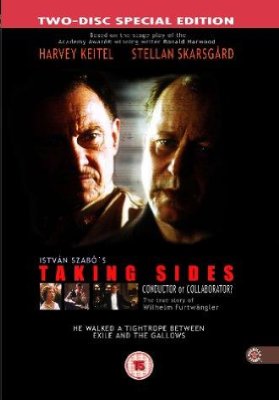
Taking Sides (2001) or The Denazification of a Legend

Istvan Szabo’s Taking Sides tells the story of the so-called Denazification of one of the greatest conductors of the 20th century, Helmut Furtwängler. (As can be read in the Jewish Virtual Library Denazification was the name given to “the efforts made by the Allies to remove active members of the former National Socialist Party from official public office and influential positions in Germany after World War II.”). The events take place in post-war Berlin. Furtwängler was the conductor of the Berlin Philarmonic. Before going to trial he is being questioned by an American investigator, Major Arnold, who shows no mercy and treats him not much different from the way the Gestapo treated people they questioned. Whatever Furtwängler says is taken against him. When he has nothing to say it is taken against him as well. This is a witch-hunt. There is not much action in this movie that’s why the two actors had to be extremely good. And they are. Harvey Keitel as the self-righteous Major who conducts the investigation is excellent. But Stellan Skarsgard starring as Furtwängler is amazing. This is sublime acting. I always liked him but in this movie he proves to be capable of acting far beyond the average.

Furtwängler is accused to have been a member of the Nazi party, to have been friends with Hitler, Himmler and Goebbels. To have known what was going on but to choose to stay anyway. It becomes soon clear that none of this is true and therefore Major Arnold tries to prove him at least morally guilty. Even though he has helped many Jews to escape, Arnold thinks his staying is reproachable. There is a lot of food for thought in this movie. Furtwängler seems to have believed that music and art could better people and that it was his duty to stay. But he was also naïve to an incredible extent. An intellectual living in an ivory tower.

Before starting to question him and during the weeks of the interrogation Arnold watches movies of the concentration camps. The original footage we get to see is one of the most horrible I ever seen. A huge mass of naked emaciated bodies are being shoved away like dirt… This fuels Arnolds’s hatred and lets him lose the right perspective.

One of the best elements of the movie is the clash of these two personalities; the gentle, well-mannered, soft-spoken old-world artist and the aggressive, vulgar and ignorant American major.

The movie does not only take place in the interrogation room. We follow the two young assistants of the major (played by Moritz Bleibtreu and Birgit Minichmayr), both German, one of Jewish origin and just returned from the States, on their outings in the city. This adds a further dimension to the film and we get a feel for post-war Berlin.

Taking Sides has also one of the most beautiful moments I have ever seen in a war movie. In an eerily beautiful scene we see an orchestra play in a ruin in the pouring rain.

As stated before, apart from being interesting, fascinating and underlined by beautiful classical recordings (Beethoven, Bruckner) this movie lives from the actors. The leading actors are outstanding but the supporting actors are very good too.

At times Taking Sides reminded me of Judgement at Nuremberg.

This is a movie for people interested in the post-war era, Denazification, classical music, Furtwängler and moral questions tied to WWII Germany. Is it understandable that Furtwängler stayed? Would it have been worse if all the good people had left? Are we allowed to think of self-preservation when faced with the mass destruction of others?

Instead of a trailer I decided to include a scene from the movie.

Judgement at Nuremberg (1961) or A Truly Outstanding Legal Drama

Judgment at Nuremberg is a brilliant movie by Stanley Kramer. Outstanding actors, great pictures and a gripping story. Spencer Tracy, Burt Lancaster, Richard Widmark, Marlene Dietrich, Montgomery Clift, Judy Garland and Maximilian Schell. They are all good, very good.

The movie´s setting is post-WWII occupied Germany.  It tells the story of the trial of 4 German Nazi judges in an American court. They are accused of being responsible for sterilization and exterminations.

Spencer Tracy stars as Judge Dan Haywood who is conducting the trial, Marlene Dietrich plays Mrs. Bertholt, the widow of an executed Nazi army officer. Burt Lancaster is one of the accused judges, Maximilian Schell his defendant. One of the most convincing performances is given by Montgomery Clift who plays the role of one of the judges´ victims. His  interrogation is so touchingly performed, makes you feel really uneasy.

The film follows Judge Haywood in the court room and outside where he tries to get the full picture by befriending Mrs. Bertholt and talking to his housekeepers, Mr. and Mrs. Halbestadt to find out what the German people  really knew. It seems as if each one´s personal history and concerns overshadowed the things that happened around them. And even though they lived so close to Dachau, Halbestadts pretend to have been ignorant of the camps.

During the trial the testimonies of the witnesses, supported by original footage of the concentration camps and the interrogation of the accused, completes the picture of the past horrors.

Judge Haywood must now establish if, in believing to serve their country, the accused did right or wrong. Do exceptional circumstances permit different moral criteria? Does the conviction to do the right thing exempt  from punishment?

If you want  Judge Haywood´s  answer to these questions and if you like to see  truly outstanding movies and great acting, watch this one  as soon as you can.