Hilde (2009)

Hilde

I owe thanks to Howard who made me aware in a comment that the biopic Hilde, which is based on the life of  the German actress and singer Hildegard Knef, was a valid choice for this blog. Since I like Heike Makatsch who plays Hilde I wanted to watch it anyway. Now that I’ve seen it, I agree, WWII is quite prominent in the movie. What surprised me even more than this fact was to find Dan Stevens of Downton Abbey fame star as Hilde’s second husband David Cameron.

Hildegard Knef was often compared to Marlene Dietrich because they both were from Berlin, both had some success in the US, and they both had very deep, sonorous voices which they used successfully as singers or rather performers, which means they were talking, rather than singing. But that’s about all there is in terms of similarities and that’s one of the aspects that the movie looks into. While Dietrich was born in 1901 and left Germany in the 30s, the far younger Knef, born 1925, not only stayed in Germany but had an affair with an Nazi officer, whom she followed towards the end of the war into battle. She was part of the battle of Berlin, or, to be more precise, took part in the defence of Schmargendorf. She was captured by the Russians and sent to a prison camp.

Germany wasn’t too keen on her as an actress after the war. During the war she starred in a propaganda movie, which was never finished, and the fact that she had an affair with a Nazi officer didn’t help either. She finally left for the US. She was under contract in Hollywood but never got to film and in the end, returned to Germany where she starred in the  notorious  movie Die Sünderin – The Sinner. She played the role of a prostitute and appeared naked, which caused quite a scandal. The movie Hilde shows nicely how much this scandal disgusted her as it was rooted in German double standards. She couldn’t understand how her country that had exterminated so many Jews, could react so hysterically because of her naked breasts.

The later part of the movie focusses on how she discovered that the true Hildegard Knef wasn’t only an actress but a singer/songwriter. Until her death in 2002 she was always equally admired and despised.

While I love Marlene Dietrich as an actress and a singer. I have never seen any of Knef’s movies and her songs, although witty, are not my cup of tea at all. But her life was interesting. The movie focusses only on the early years, until she meets David Cameron, her second husband. I would have liked to see more.

I think the movie is interesting because it doesn’t try to make her any better than she was. She never even questioned the fact that she had an affair with an Nazi officer. She fell in love with a man, and that was that. She also never tried to hide that she wasn’t political and that she, like so many others, just watched passively. It’s not admirable. Far from it. But it’s what it is.

Heike Makatsch does a pretty amazing job in playing her Knef and Dan Stevens was convincing as her second husband. In any case, it’s a movie well worth catching.

For those interested in watching Hilde, Howard told me that there is a Hong Kong version with English subtitles available.

I couldn’t find a trailer with English subtitles, so I’ll leave you with the German one.

Black Book – Zwartboek (2006) Dutch Resistance

Black Book

I watched Paul Verhoeven’s Black Book aka Zwartboek when it came out in 2006 and absolutely loved it. That was four years before I started this blog. If I wanted to review it, I had to rewatch it. It does happen that a movie we liked a lot doesn’t hold up as well when we watch it again. Unfortunately this was the case here. It’s not a bad movie, it’s very entertaining, but I think a resistance movie must be a bit gritty. Black Book most certainly isn’t gritty, it’s so flashy and glossy, it could be an US production. Sure, you’re going to argue, that it’s logical, after all Verhoeven’s not only the director of Soldier of Orange but also of Starship Troopers and Total Recall. Although his first European movie in 20 years, Black Book has written “Hollywood” all over it (apart from the nudity, that wouldn’t go down so well in a US production).

The movie starts in Israel in 1956 and then rewinds to 1944. The main story is set in the Netherlands. The young Jewish woman Rachel Stein (Carice van Houten) is in hiding when a bomb falls on the house of the people who hide her. A policeman who works for the Dutch resistance helps her, her family and a lot of other Jews to escape. The boat on which they should be brought to Belgium is attacked by Nazis, and everyone, except Rachel who manages to escape, is killed and all the money and jewellery is stolen. Rachel watches all this and sees the men responsible for this attack from her hideout.

There isn’t much she can do and so she eventually joins the resistance. During one of her missions she meets Nazi officer Muntze (Sebastian Koch). Under the false identity of Ellis de Vries, she seduces him, becomes his mistress and starts to work at the Nazi headquarters. It’s easy for her to seduce Muntze because she is very pretty and used to be a well-known singer, but that doesn’t mean he’s foolish enough not to see through her disguise.

Unfortunately her disguise is also discovered by others and she’s lured into a trap and henceforth suspected by the Resistance to be a double-agent. Things get even more dramatic when Muntze is arrested as she has developed feelings for him. When the Netherlands are finally liberated, Ellis/Rachel gets a chance to uncover who betrayed her.

Black Book is visually appealing, it’s well structured and well-paced and a really entertaining watch, but overall I didn’t find the anti-war message all that pertinent. It seems Verhoeven wanted to show that there were good and bad people on both sides and that the Dutch, like many other European people had ambiguous feelings.

Black Book is entertaining and worth watching but I think Soldier of Orange is far better and when it comes to other Resistance movies I can think of many better ones. These are just a few, which I have all reviewed here as well:

Army of Shadows,

Roma, Città Aperta-Rome Open City,

The Army of Crime,

Flame and Citron,

Max Manus,

Lucy Aubrac

I’m particularly fond of resistance movies, so if anyone has suggestions, I’d be very glad.

World War Z (2013)

World War Z

Yes, I know I’m stretching the definition of war movies big time including Marc Forster‘s latest film. World War Z is an apocalyptic zombie movie with a very strong military element. It’s based on Max Brooks’ eponymous novel.

The movie begins with an idyllic family scene. Former UN investigator Gerry Lane (Brad Pitt), his wife (Mireille Enos) and two daughters are getting ready for the day. A little later, on their way into town, they see their world turn into chaos. Cars crash into other cars, people scream and run while others turn into savage predators. Gerry and his family narrowly escape this mayhem and hide in a huge building until a UN helicopter comes and gets them out. They are flown to an aircraft carrier where they hear more about what’s happening. It seems as if there was a pandemic that rapidly infects all the inhabitants of every country and turns them into zombies. The illness broke out in Korea and the military want to send a scientist to investigate. Gerry is sent with him as he was the best UN investigator they had.

As was to be expected they can’t find anything in Korea and the next stop is Jerusalem. From Israel we follow Gerry and a female Israeli soldier (Daniella Kertesz) on their trip around the world and see how the pandemic spreads. On this frantic trip Gerry observes that some people are avoided by the zombies. If he can find out why, maybe he could find a cure?

I hated the beginning of this movie big time and almost stopped watching after ten minutes. After the initial family scene it starts with full action and, as strange as this may seem, I found that very boring. Luckily the movie slows down a bit and moves on at a steady pace, which is broken up by more intense scenes. The end is not bad at all.

I’ve seen a few zombie movies and I couldn’t help comparing this to I Am Legend for example. I love I Am Legend, it’s my favourite zombie movie and comparing World War Z to that, was to the latter’s disadvantage. I also like the zombie comedy Shaun of the Dead a lot. Looking back I think that World War Z isn’t even a zombie movie. It’s a disaster movie with a zombie theme. It’s far more like the Day After Tomorrow or Independence Day.

The biggest flaw of World War Z is that I didn’t think it was unique. I felt I’d seen each and every element before in another context. Some in horror movies like The Crazies, others in action films, or movies in which the US or the world are at large are threatened by some sort of evil or aliens. Unfortunately I don’t like Brad Pitt all that much, which didn’t help.

Most of the time when an apocalyptic or post-apocalyptic movie starts with an idyllic family scene I know I’m not going to watch anything superior. I was proven right in this case once more. It had good moments and if you want to see a fast-paced action flick, by all means, watch it, but if you’d like to see something a bit unusual, maybe even controversial, then stay away.

I’m still waiting for a movie which will look into the appeal of the zombie. Why is there such a wave of books and movies since a couple of years?

Do you have a favourite zombie movie?

My favourites are:

I Am Legend

Shaun of the Dead

28 Days Later

Lore (2012)

Lore

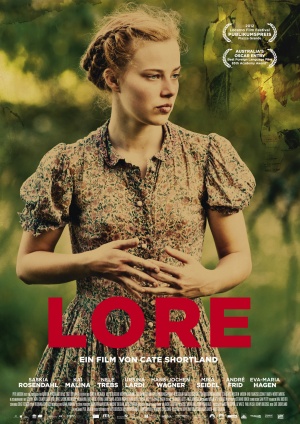
What a pleasant change, I’ve actually watched a movie and really, really  liked it. I’d say it was certainly the best wartime movie I’ve seen in a long while. Lore is a German/Australian/UK co-production. Spoken in German, with German actors and subtitled in English. It’s based on Ruth Seiffert’s highly acclaimed novel The Dark Room. Or, to be more precise, on one of the three interlinked stories in the book.

Lore is the eldest daughter of a prominent Nazi functionary. Indoctrinated with the ideology, she blindly loves her father and the Führer, follows every order without questioning and takes everything she’s ever been taught to be the absolute truth. The movie begins at the end of the war. Her parents are in distress, something has happened but they won’t tell their children. The family flees to a holiday home in the country where people treat them aggressively. Lore has no clue what is going on. She knows her parents are hiding something. The father leaves them, and shortly afterwards the mother leaves too. She is giving herself up and goes to prison unsolicited. Before she leaves she tells Lore that the Führer is dead. Everything is lost. Lore has to take her four siblings, one of them is just a baby, and walk in direction of Hamburg where her mother lives.

The movie follows the children on their difficult journey towards Hamburg. It shows how difficult and dangerous it is for them. They risk starvation, rape, being killed or captured. They have to cross three different sectors, the US, the Russian and the UK sector. Even though they are only children, they are suspected and interrogated. At one point a young man starts to follow them. He carries papers and pretends being their older  brother. This makes all of their lives easier.

Lore is more than a road movie, it delicately portrays the total disenchantment of a young girl. On their journey they are not only confronted with severe deprivations but they learn the truth about their beloved father and the Führer. Everything Lore believed in was built on a lie.

I’ve never seen a movie, which focussed on the children of high Nazi officers. I never wondered what became of them after the war. The movie shows what a long and painful process it was to learn the truth.

The story as such is quite gripping and the way it was told was masterful. I haven’t seen any  of Cate Shortland‘s other movies but she’s a film director I’ll keep in mind. Lore was beautifully filmed and the score, written by Max Richter, enhanced the gloomy atmosphere of the film. The atmosphere and the mood was probably what I liked best: lyrical, melancholic and gloomy.

I’m not surprised Lore has won so many prizes and been nominated for many awards. I’d say it’s the first 5/5 movie I’ve seen this year. Don’t miss it.

Has anyone seen the film?

Roland Joffé’s There Be Dragons (2011) A Movie of the Spanish Civil War? or A Propaganda Piece for Opus Dei?

there_be_dragons_ver3

There Be Dragons is a movie on the Spanish Civil War, focussing heavily on the founder of the Opus Dei José Maria Escrivá. That’s in itself problematic, but the movie has other shortcomings besides reeking of “propaganda”.

There aren’t all that many movies on the Spanish Civil War that’s why I was quite keen on watching this movie. I normally like Dougray Scott and seeing that he’s in this, made me hope it would be good. Unfortunately he’s just a minor character, although the one who gets the ball rolling. Geraldine Chaplin who is also starring in this film has an equally small role.

Roberto Torres (Dougray Scott) is a young journalist researching José Maria Escrivá (Charlie Cox), a priest and founder of the Opus Dei who is a candidate for canonisation. Roberto discovers that his own father from whom he is estranged since years, knew Escrivá. He travels to Madrid, hoping his father will tell him everything he knows about the priest. While Robert’s father Manolo (Wes Bentley) was friends with José Maria when they were kids, they later fought on opposite sides during the war. The movie tells their respective stories in flash backs. They don’t overlap all that often; it’s really the story of José Maria on one side, and the story of Manolo on the other. Only towards the end, they are briefly joined again. A third story line, tied to Manolo, reveals why the relationship between Roberto and Manolo was so difficult. It has something to do with a tragic love story involving Ildiko (Olga Kurylenko).

Due to these different stories, which are only loosely connected, the movie really is a mixed bag. It glorifies the courage and determination of José Maria, his faith, his steadfastness. Although I don’t feel qualified to say much about the Spanish Civil War with which I’m not very familiar and even less about the role of the Catholic Church, I can still say that the depiction was very sentimental and never grabbed me. I was a bit more interested in the frame story between Roberto and Manolo.

Another flaw was the tempo. This was one hell of a slow movie; it never really took off. This is too bad because the cinematography and the score were superior but I felt they were wasted on this film.

I always thought that Roland Joffé was a director who would guarantee a good movie but unfortunately that isn’t the case. I have no clue what drove him to glorify the founder of Opus Dei. Very dubious. I can’t recommend this movie.

I almost forgot to mention that this is another one of those movies in which all the English speaking actors talk in a heavy Spanish accent. Ludicrous.

Have you seen it? Have seen another movie on the Spanish Civil War that you would recommend?