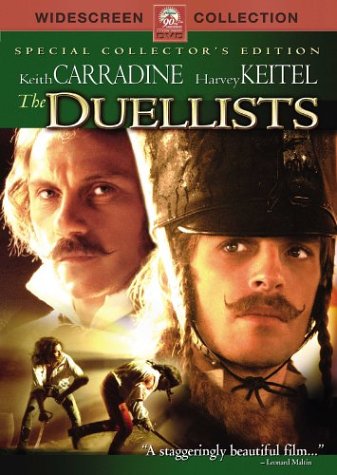
More than anything else Ridley Scott’s directing debut, The Duellists, tells the story of an obsession. I’m glad Guy (Phoenix Cinema) suggested it as I wasn’t aware of the movie and found it oddly captivating and very beautiful too. Plus I find duels fascinating. I can’t really say why.
Based on the short story The Duel by Joseph Conrad The Duellists tells the story of a lifelong enmity. Two officers of Napoleon’s army, d’Hubert (Keith Carradine) and Feraud (Harvey Keitel), pursue each other for years and fight one duel after the other. While the first duel might have made some sense, at least at the time, the following duels are less and less understandable. Although d’Hubert tries to reason with Feraud, the latter becomes more and more obsessed as the years pass by.
The movie has a lot more to offer than a fascinating story and two interesting characters. It’s visually stunning and brilliantly acted. I couldn’t even say which of the two actors I liked better. Carradine as d’Hubert who seems more complex, more humane or Keitel as Feraud who is relentless in his pursuit of d’Hubert. If you like sword fighting you will adore The Duellists anyway as the choreography of the fights, as many reviewers have commented, is excellent.
The movie starts in 1800 and ends around 1815. After almost every duel the men lose sight of each other for a few months or even years as they are often posted in other places. They sometimes meet under quite improbable circumstances, once for example while retreating from Moscow where they fight a group of Cossacks together.
The code of duels was quite complex, I suppose every country had its own set of rules. I felt we learned quite a lot about the rules in France at the time. What made it especially dramatic was the fact that if one of them had been promoted but not the other one it would have become impossible to go on fighting. So every time d’Hubert is promoted he hopes the folly is about to end, only to find out later that Feraud meanwhile has been promoted to the same rank.
The Duellists has been compared to Barry Lyndon but I don’t think they are that similar. Be it as it may, I’ feel more inclined to rewatch The Duellists, I thought it was more captivating. And I really must read the novella soon.
The Lost Battalion is a US made for TV movie based on a true story that happened during the last weeks of WWI. It’s seems to be a remake of the 1919 movie The Lost Battalion. I haven’t seen the film from 1919, so cannot comment on how well it’s been remade.
Set in 1918 The Lost Battalion tells the story of the 77th American division which got caught behind enemy lines in the Argonne Forest, in France. Major Whittlesey is assigned one of those incomprehensible suicide missions of which there were so many during WWI. Together with 500 men he is to attack the German forces in the Argonne Forest. Additional forces are sent out to give support through the flanks but before even arriving on the assigned post, they retreat.
Out of a sense of duty Major Whittlesey and his men hold out despite the fact that they have no food, no water, no ammunition. The siege lasts 5 days and costs the life of 300 men. Most of the men are from New York, they are Irish, Polish, Italian and Jewish immigrants which, according to Whittlesey, contributed to the success as they are known to be reckless fighters.
I know this is a movie that quite a lot of people like but I must honestly say, I found it quite boring. It’s combat intense and seems quite accurate but the story isn’t told in a very suspenseful way. There are no outstanding characters either. It has a few additional flaws which I’ve noticed in other TV productions and which bothered me after a while. The wounds look garish instead of horrible wounds because the color of the blood is an intense orange. The acting was average but not too painful.
Still, I suppose it’s a worthy effort as we don’t see a lot of WWI infantry combat movies from a US perspective and according to the film this battle helped break through the German lines and ultimately was a key factor in ending the war. That certainly deserved to be told. If accuracy is the most important thing for you, don’t miss it. I prefer a well-told or interestingly filmed story.
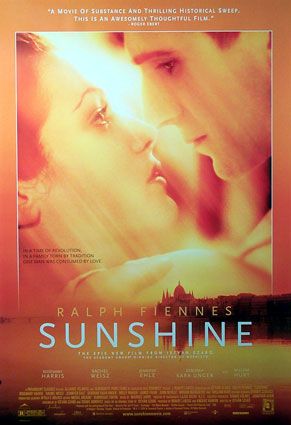
I’m in two minds about István Szabó’s epic movie Sunshine. It tells the story of a family of Hungarian Jews, the Sonnenscheins (which means Sunshine in German), from the end of the 19th century until the end of the 20th. While I think it told me a lot about Hungary and the treatment of Jews in Hungary, I was far less thrilled about the length (3hrs) and the choice to have the three main characters, grandfather, father and son played by the very same actor, namely Ralph Fiennes. I would have found this artificial with any actor but given my dislike of Fiennes, it added annoyance. If you do not mind seeing the same actor in three different roles and are fond of Ralph Fiennes, you will probably like this movie a lot. I do not understand why Szabó chose to do it like this, why couldn’t there be three actors? I remember the Archers chose the same approach in The Life and Death of Colonel Blimp in which Deborah Kerr plays three different women but that worked much better.
The Sonnescheins are a modest family but then the patriarch invents a recipe for a tonic which makes them incredibly rich. As a direct result of their social ascendance, the two sons, Gustav and Ignaz, both study and become doctors, of medicine and law respectively. While Ignaz is loyal to the Emperor, Gustav feels more and more alienated by monarchy and becomes a communist. WWI changes not only Hungary but Europe as a whole. The biggest change in the lives of the Sonnenscheins’s however is that they choose to change their name from Sonnenschein to the more Hungarian sounding Sors. Long before WWII breaks out, the Jews are seen as a nuisance and it is very hard for them to integrate.
Ignaz’s and Valerie’s son Adam becomes the Hungarian fencing champion and wins at the Olympics in 1936. After having changed their name, the Sors also change their religion and the family converts to Catholicism. Still, this doesn’t help them, when WWII breaks out, the family first lives in the ghetto, some are killed, some escape and Adam and his son Ivan are sent to a concentration camp where Adam is tortured and killed. His son will never forgive himself that he just stood there and did nothing. After the war he joins the communist party. Anti-Zionist sentiments are spreading. The government changes often and depending on who is in charge, other groups are persecuted but what they all seem to have in common is that anti-Semitism reigns again.
When the end of the communist state has finally come, Ivan realizes that the only way to be really free, is to be true to yourself. He decides to change his name back to Sonnenschein and to be proud of his heritage, no matter what government and changes the future will bring.
While I wasn’t blown away by the movie and would have preferred if the main character had been played by three different actors instead of one, the movie isn’t bad at all. It had a lot of thought-provoking elements. There is the incident in the concentration camp in which three guards control 2000 prisoners. Ivan’s uncle later tells him that it is unforgivable that they didn’t do anything. This is a reproach one hears occasionally. People don’t understand why 2000 wouldn’t fight against 3 or 10 even if those were armed. The movie implies an answer which is interesting. It is obvious that if they had fought back the guards, some of the Jews would have been killed. The majority would have been saved but that would have needed the sacrifice of a few others.
Another interesting element is the fact that Hungarians sent Jews to the camps and not Germans. There were a lot of collaborators among the Hungarians. The movie underlines that the Hungarian society, whether it was during the monarchy or later under communism, was to a large part anti-semitic.
What I really liked is that the movie focusses on one family only and like that manages to give a much better feeling of the incredible changes which took place. To enhance authenticity Szabó included some original footage which in some cases was quite chilling. When Adam takes part in the Olympics of 1936, Szabó included original footage of the opening in which we see Hitler.
Because it’s a very long movie, it’s a very complex movie and I know I didn’t do it justice. There are for example some very troubled love stories which I didn’t mention in my summary but which are quite important. I liked the story between Valerie (Jennifer Ehle) and Ignaz but didn’t care for the love triangle including Adam, Hannah (Molly Parker) and Greta (Rachel Weisz).
I would recommend Sunshine if you like epic films and have an interest in the history of Hungary and the Holocaust from another perspective.
In the comments to my recent post on The Archers’ A Matter of Life and Death Guy Savage (Phoenix Cinema) mentioned another of their movies, The Small Back Room based on Nigel Balchin’s eponymous novel. Since I have just read Balchin’s novel on the London Blitz, Darkness Falls From the Air, I was interested in watching The Small Back Room. While I had my problems with A Matter of Life and Death I really liked The Small Back Room a lot. Some say it’s one of the minor movies of Pressburger and Powell. Maybe that is true. It certainly is lesser known but I think that is a shame as it contains many interesting elements. It’s not as exuberant, flashy and over the top as many of the other movies, It’s much darker and thoughtful.
Sammy Rice is an embittered bomb disposal expert, the very best, the British have. He has lost a foot in the war and the constant pain and shame about being not intact make him a cranky fellow. The fact that he is taking heavy medication against the pain which he mixes with strong alcohol doesn’t make things better. Even his very patient girlfriend Susan, who works for the government as well, starts to lose patience. Sammy is part of a research team investigating German booby-traps. They are deadly devices and so far the mechanism isn’t known but it gets more and more urgent to find out what sets them off.
Hi battle with alcoholism, his fear of being alone and his struggles at work put the relationship with Susan under a lot of pressure. Finally she cannot take it any longer and leaves him. While he is on one of his pub crawls, one of the German booby-traps is found on a beach. Sammy needs to clean up as fast as he can and get to the place and deactivate the device.
In many movies set in war-time London we see bombings, people running to air raid shelters. Not in this one. Despite of this it captures the feeling of war-time London perfectly well. The light is dark, many of the shots are rather gloomy, people are dispirited, depressed. The bars are full and everyone seems to indulge in heavy drinking. Sammy may be more extreme than others but I’m sure there was more than one maimed soldier returning from the war, who took it less than gracefully. While Sammy does wallow in self-pity one can still understand him.
I liked the depiction of the relationship a lot. This isn’t a war-time romance but the relationship between two people who seem to have seen a lot, even too much already and whose only consiôlation is their relationship.
One of the best scenes is the bomb disposal scene which is handled in a very interesting way.
This is a very different Archers, it’s sober and dark, not much humor in it. It’s well worth watching though, it has a lot of interesting details and I’m sure it’s even one which will improve when seen a second time.
While I couldn’t find a trailer, I found the whole movie on YouTube.
Mention WWI and TV series together and you will get my full attention. I had never heard of the four part BBC series The Monocled Mutineer before ordering another WWI movie and seeing this one mentioned as well. I’m particularly keen on movies on WWI and generally fond of made for TV productions. Plus reading how much controversy this show created, making it the most controversial British show ever, I was even keener on watching it. It has not been shown on TV again since its first and last airing in 1986. Pretty astonishing. Here is a review from IMDb by a user named dunkah.
The reason this drama has not been repeated is that after the first broadcast the BBC came under fire from the government and were banned from screening it again. This was due to the sensitivity of the subject matter, i.e. Percy Toplis and the mutiny at “The Bull Ring”, a harsh British Army training ground in Etaples, France. There is a lot of mist around Percy Toplis who was finally tracked down and killed some years after the end of the war. No one truly knows the events that transpired at the Bull Ring for certain and we won’t know until 2017 when the files on the event will finally be released. Until then all we have is this drama and I think there should be a demand that it should be broadcast again, some 18 years on.
The series starts with the shooting of Toplis that’s why the quote above isn’t a spoiler. It then rewinds and tells his whole story from his childhood, to the trenches and from there to the forest and finally back to England.
Toplis (Paul McGann) comes from a modest background, a mining town. Being a miner is not the type of occupation he sees himself in. From his early childhood on he figures he is better than his working class upbringing. Delinquent at a young age, he spends time in prison and finally when WWI breaks out he joins up. At first he’s doing his bit as cannon fodder but he’s the insubordinate type and gets into trouble more than once. Still he survives several offensives and while not keen on danger and the trenches, he isn’t bothered too much. What bothers him is the way he is treated and the way the officers treat his comrades.
He witnesses executions for no other reason than fear in battle. He observes cruelty and sadistic behaviour. But not only abuse infuriates him, it’s also clear that the British high command makes many bad decisions which cost lives.
Toplis is a tall and very handsome man and he is capable of speaking like and officer. This gives him the opportunity to live the life of an officer in the evenings. With a stolen uniform and pretending to be of high rank, all the doors are open.
When he’s finally had enough, he deserts and lives with a bunch of other deserters from different countries. They instigate a mutiny and create quite a commotion. Although many people are involved in these acts of insubordination it’s finally Toplis who is the most wanted man.
I can understand why there was reluctance to show this series again. Despite the fact that it has very slow moments, it’s excellent and I’ve hardly ever seen a British production in which the officers and high command were criticized like this. Watching this made me really furious more than once. Pair incompetence with arrogance and you will have a total disaster. The way the officers treated the soldiers was appalling. No respect whatsoever for the so-called lower classes.
Toplis is a fascinating character. He isn’t exactly a likable man, he cheats and lies and betrays wherever he can and very probably if he had been born noble he wouldn’t have cared much about those below himself. His character just exemplifies that all it took to pass for an officer was a uniform, manners and a certain size. He is one of those charcaters we usually find in novels. There are many like him in literture, Felix Krull, Bel-Ami, to name but two.
As I said before it has a few slow moments, still it’s highly watchable and interesting.



 All About War Movies