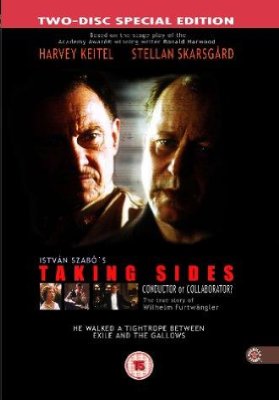
Taking Sides (2001) or The Denazification of a Legend

Istvan Szabo’s Taking Sides tells the story of the so-called Denazification of one of the greatest conductors of the 20th century, Helmut Furtwängler. (As can be read in the Jewish Virtual Library Denazification was the name given to “the efforts made by the Allies to remove active members of the former National Socialist Party from official public office and influential positions in Germany after World War II.”). The events take place in post-war Berlin. Furtwängler was the conductor of the Berlin Philarmonic. Before going to trial he is being questioned by an American investigator, Major Arnold, who shows no mercy and treats him not much different from the way the Gestapo treated people they questioned. Whatever Furtwängler says is taken against him. When he has nothing to say it is taken against him as well. This is a witch-hunt. There is not much action in this movie that’s why the two actors had to be extremely good. And they are. Harvey Keitel as the self-righteous Major who conducts the investigation is excellent. But Stellan Skarsgard starring as Furtwängler is amazing. This is sublime acting. I always liked him but in this movie he proves to be capable of acting far beyond the average.

Furtwängler is accused to have been a member of the Nazi party, to have been friends with Hitler, Himmler and Goebbels. To have known what was going on but to choose to stay anyway. It becomes soon clear that none of this is true and therefore Major Arnold tries to prove him at least morally guilty. Even though he has helped many Jews to escape, Arnold thinks his staying is reproachable. There is a lot of food for thought in this movie. Furtwängler seems to have believed that music and art could better people and that it was his duty to stay. But he was also naïve to an incredible extent. An intellectual living in an ivory tower.

Before starting to question him and during the weeks of the interrogation Arnold watches movies of the concentration camps. The original footage we get to see is one of the most horrible I ever seen. A huge mass of naked emaciated bodies are being shoved away like dirt… This fuels Arnolds’s hatred and lets him lose the right perspective.

One of the best elements of the movie is the clash of these two personalities; the gentle, well-mannered, soft-spoken old-world artist and the aggressive, vulgar and ignorant American major.

The movie does not only take place in the interrogation room. We follow the two young assistants of the major (played by Moritz Bleibtreu and Birgit Minichmayr), both German, one of Jewish origin and just returned from the States, on their outings in the city. This adds a further dimension to the film and we get a feel for post-war Berlin.

Taking Sides has also one of the most beautiful moments I have ever seen in a war movie. In an eerily beautiful scene we see an orchestra play in a ruin in the pouring rain.

As stated before, apart from being interesting, fascinating and underlined by beautiful classical recordings (Beethoven, Bruckner) this movie lives from the actors. The leading actors are outstanding but the supporting actors are very good too.

At times Taking Sides reminded me of Judgement at Nuremberg.

This is a movie for people interested in the post-war era, Denazification, classical music, Furtwängler and moral questions tied to WWII Germany. Is it understandable that Furtwängler stayed? Would it have been worse if all the good people had left? Are we allowed to think of self-preservation when faced with the mass destruction of others?

Instead of a trailer I decided to include a scene from the movie.
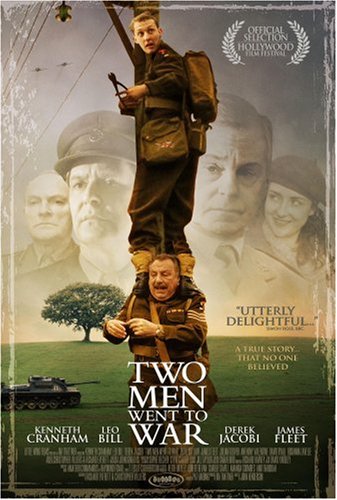
Two Men Went to War (2002) or A Light-hearted War Tale

What a funny little movie. Typically British I would say.  Two Men Went to War is apparently based on a true story  although this is quite hard to believe. One can hardly imagine such naïve and idealistically enthusiastic men existed. Quite eccentric really.

During WWII in Britain two army dentists who are fed up with looking after teeth while others take part in the action decide to take things into their own hands. The older, a dignified character, who has seen action in WWI, convinces the younger one to follow him and invade occupied France on their own. The general idea is to blow up some German ships in the harbor. While sneaking off they send a letter to Churchill informing him of their planned operation.

Once in France they realize that things are not exactly as easy as planned. First there are no ships to blow up and second they seem a bit lost.  So they need to come up with a back-up plan that includes cutting through electrical wires (just barely escaping their own extinction in the process), blowing up railway lines and a lot of other little sabotage acts. Many times they escape by sheer luck and after attempting to blow up a main Operations Room, which goes quite wrong as well, they are forced to flee and escape back home to England. On the way home by ship they are hit by a stray bomb, captured  and promptly arrested for desertion. They are very lucky to avoid being court-martialled as Churchill sends someone  to their help. He did indeed receive their letter and was cheered up a great deal by this picaresque little adventure.

This is a tale of heroism of the comical kind, burlesque but very touching. It is quite a silly but all in all an entertaining, well acted little movie. By the way,  Leo Bill, who stars as the younger dentist, plays Hamish  in Alice in Wonderland.

In the Valley of Elah (2007): A Stunning Anti-Iraq War Movie

This was a surprisingly good movie with a profound anti-war statement. I don’t know why I did not watch it earlier. Somehow it escaped my radar.  I have seen quite a few Iraq war movies and thought I had seen all possible aspects. Well, I was wrong. In the Valley of Elah is a very unusual, interesting look at the war in Iraq and what it does to young soldiers, but it is also a reflection on the changes in values of soldiers. It’s a quite complex movie. To choose the form of a thriller to tell what the director wanted to tell is quite cunning. Even though it’s not a fast movie and  it takes its time to unfold what happened, it is still gripping. The time was needed as it also tries to illustrate a change in perceptions. The father who is looking for his son at the beginning of the movie will not be the same person at the end. There will be no more idealizing the military or the value and honor of soldiers.

Tommy Lee-Jones plays the above mentioned father, the retired military police officer, Hank Deerfield. He did tours in Vietnam and Korea. The military is his life. No wonder both of his sons follow the same career path. The older one became a chopper pilot, the younger, Mike, is a private who served first in Bosnia and then in Iraq.

At the beginning of the movie Hank gets a phone call informing him his son Mike is AWOL. Hank thought he was still in Iraq and doesn’t understand why Mike did not contact him. He immediately drives to the base that is located a few thousand miles away. Being a former military police investigator, he wants  to look for his son on his own. This is not much appreciated by Mike’s superiors. Hank has another reason for wanting to look for Mike. A strange phone call from his son while he was still in Iraq made him very uneasy. Something terrible must have happened there.

Hank does not get much assistance at the beginning. Neither Mike’s superiors nor his comrades are helpful. And when he goes to the police and speak to Detective Emily Sanders (Charlize Theron) he is turned down. The military has to look for its personnel, as she informs him.

Even though she seems to be hardened, Emily has a very soft spot. And when Mike’s´ severely mutilated body is found and she realizes the military wants to cover up the murder she decides to help Hank to find out who did it. They start to  investigate together. The closer they come to the truth, the more Hank has to accept the fact that he did not really know his son and that he has no clue what is going on in Iraq. With the help of a film on Mike’s phone and bits and pieces of information from comrades he understands that this is not Korea or Vietnam and these soldiers are of a different kind. He is disillusioned and shocked about what he finds out. And so is the viewer.

This is a multi-layered, well written and well told  tale that is apparently based on true events. We have a multitude of themes here. Changes in the society and its values that also affect soldiers. What does it mean to be a good father? What values do you teach your children? Will they be able to live according to these values when everything around them falls apart? How do you keep young soldiers sane when they become aware that they are part of something that is pointless and wrong?

It is also interesting to think that a veteran probably does not equal a veteran but that it makes a big diference what war a soldier fought in.

The cast of this movie is very well-chosen. Tommy Lee-Jones looks convincingly tired, disillusioned and world-weary. Susan Sarandon‘s despair is palpable and Charlize Theron manages to play a woman whose life is all but a picnic and still looks perfectly beautiful as ususal. Although not Jason Patric´s best role, he is OK as well.

Overlord: An Overlooked War Movie Masterpiece

The British war movie  Overlord is one of the most original and best war movies I have ever seen.  Since its coming out in 1975 it has mostly been forgotten although it was highly accalimed at the time.  That it is  widely unknown today  is really a pity. It is quite a simple movie, very short as well, only some 70 minutes, but it touches you like not many other. Overlord tells in a very personal way the story of a young man, Tom Beddows, who is going to war. He goes to boot camp, meets a young girl and knows he will be part of a big offensive that will send him to France. He will be part of Operation Overlord which  was the codename of  the invasion of Normandy by the Allied forces in WWII on June 6 1944 ( better known as D-Day). Tom doesn´t really want to be where he is but eventually gets accustomed to his new environment and the idea of going into battle. All through the movie he has dreams where he sees himself dying and he is quite convinced he wont return. Finally we see him being shipped out together with his comrades who are all  afraid of what awaits them.

As such this may not seem very special but the way this is done is just great. The movie was filmed in black and white and the story of  Tom Beddows is interwoven with original footage of bombed cities, planes, bombed trains, the landing itself and many other elements. This is done so well that the alternating parts blend into each other as if they were one movie.

Since it focuses so closely on one person (with just a few exceptions) it is very intimate. You get the feeling that this is not just anyone going to war but a young guy you might know and like since Tom is  gentle and  endearing.

All the original footage, that is very well-chosen, is by far more convincing than many CGI or reenactment parts of other movies.

It’s a perfect little movie that would probably even be appreciated by people who would normally never watch a war movie. Should you ever want to convince someone that the genre deserves its appreciation Overlord could be your choice to prove it.

It might also be great as a way to teach WWII in schools as there is no gratuitous violence.

The Wind that Shakes the Barley (2006) or Two Brothers Torn Apart by the Irish Civil War

The Wind that Shakes the Barley opens on a group of young men joyfully playing a game of hurling. After the game has ended we watch them return home to their modest houses. Some are still standing  together smoking and  talking, when all of a sudden a group of British soldiers approaches out of nowhere confronting them with the fact that they did break the law.  Meetings are strictly forbidden and even a game of hurling is considered to be an assemly and thus a possible act of rebellion. The scene heats up immediately when the young men answer in Gaelic upon being asked their names. The episode ends in a blood bath, one of the young men being beaten to a pulp and dead.

This is shocking. One can hardly believe one’s eyes since this is no invention. The British subjugated the Irish fiercely and anything resembling rebellion from their side ended in severe punishment.

Ken Loach´s movie The Wind that Skakes the Barley (the title is taken from an Irish Ballad)  embraces both moments in Irish history, first The Irish War of Independence and then The Irish Civil War. At the core of the story that is set in county Cork are the two O´Donovan  brothers, Damien (Cillian Murphy) and Teddy (Pádraic Delaney). At the onset of the war Damien is about to leave his native Ireland for  London where a position as a doctor at a hospital is waiting for him. Seeing the brutality and the cruelty his people face and knowing that his brother will be leading a guerilla party, he stays to join them. At that time the British government sent the  so-called “Black and Tans” to brutally reinforce their power. The old IRA started to strike back.

After long months of heavy fighting they were asked to sign a treaty which would guarantee the Irish their own government and established the Irish Free State. However six Northern counties would stay within the United Kingdom as Northern Ireland.  This is the moment when the Civil War erupts and Pro Free State (headed by Michael Collins) troops fought the Anti-treaty forces. In the movie the tragedy unfolds as the brothers go different ways. Teddy accepts and supports the Free State  while Damien wants to fight until all of Ireland is  free. He believes that they have fought in vain if they give up now. It is unbelievable but the Civil War cost finally more lives than the War of Independence.

The Wind that Shakes the Barley was as  hard to watch and as depressing as L´armée des ombres. The methods applied resemble those applied by the French Resistance. They wouldn’t even shy away from killing their own in the event of betrayal. We also see people being shot and people being tortured.

This movie is also hard to watch since it reveals a really ugly aspect of the British Empire. If you are British this will be hard to accept, if you like the British it will be equally hard and if you are Irish this will truly infuriate you. One can simply not understand why the Empire had to make  the already impoverished, famished and sick Irish suffer so much. I read that this part of their history  is not really taught in English schools. I think many English people would be shocked and astonished when they see this and might understand a lot better what was ultimately behind the Troubles.

The Wind that Shakes the Barley is very intense. The pictures of the beautiful, lush green countryside contrast starkly with the brutalities depicted. The story of the two brothers who end up torn apart by their conflicting ideals is very tragic. and both actors do a great job

There is no doubt that this movie deserved the Palme d´ Or it won in 2006. Even though I am sure the movie could not cover all the aspects and the whole complexity of the Wars, it raises the awareness. It´s simply stated a brilliant movie. But it is not entertaining for one second. Harsh but recommended viewing really.