Intimate enemies aka L´ennemi intime (2007) or France, Algeria and the War that was no War

This was one of the hardest movies to watch for me for very personal reasons. All those who have read the About page on this blog, know why. For everyone else here´s a quick explanation. My father fought in this war for almost three years after having been drafted barely aged 18. His stories were as much part of my childhood as were his brooding silences and constant nightmares. I may say that this war is as much part of my life as it is of his. More so due to the nature of it. This is no war to be proud of – most are not but this one especially not. France didn´t even call this a war, they said it was an attempt to reestablish order. But there was a good reason to not call this a war since  Algeria was an integrate part of France, although not with the same rights. There was no real enemy to be fought since the Algerians were French, hence this movie´s title Intimate enemies, meaning the enemy within.

This created an extremely complex situation as this movie attempts to illustrate.

After the war had been won from a military point of view it was lost from a political point of view. De Gaulle decided to let Algeria go. What a waste of lives. In future years it was silenced. One was not to speak about it which weighed heavily on the returning soldiers. No one to turn to, no one to listen. As a psychiatrist once told me, it was the general tragedy for men returning from a war before Vietnam, that they had no one to turn to. Not even psychologists or psychiatrists. Post-traumatic stress was just not cured at the time. Ok, this is not totally correct, it was treated but only insofar as the soldier was meant to go back to fight (one of the major themes of Behind the Lines aka Regeneration) but those for whom the fighting was over were meant to knuckle down and shut it.

Considering that an apparently (haven´t seen it yet) very outspoken movie like The Battle of Algiers aka La Battaglia di Algeri (1966) was banned in France until 1971 we can imagine what it was like for soldiers having participated in a war that a) was no war b) wasn´t to be spoken about and c) didn´t officially happen… And absolutely no one to thank them when they came home.

The whole complexity of the situation is shown in Intimate enemies. Algerians who had already fought during WWII sided with the FLN, the Liberation movement to fight France. Others fought on the side of the French. During the war many changed sides both ways. (The highly acclaimed Days of Glory tells the story of four Algerians who fought during WWII).

One very horrible trait of this war was the intelligence´s use of torture. Funny enough, many of those soldiers who tortured were by far the most traumatized upon returning to France. Since my father was just a simple private he did not have to do it but apparently his brother, some years older and a lieutenant was part of the intelligence unit. I never liked the guy so I never bothered talking to him. Just heard he´s been under medication since the late 80ies on account of serious problems with his conscience.

Does this serve him right? There is an interesting scene in the movie where lieutenant Terrien talks to the intelligence Sgt. and is being told that he will come around and understand these methods.

However not only the French used torture, the Algerians did as well. And terrorism. And cruelty. I remember my father telling me of a march through the desert when they started to see something in the distance and thought it was a Fata Morgana that looked like  dancing crosses. Upon their coming closer to that place they discovered that it was a whole convent of nuns having been tortured, killed and nailed on wooden crosses. There would be other things I could add here but this is not the place to do so.

The main theme of the movie is a somewhat Platoon-like juxtaposition of a very humane, just and friendly lieutenant and some hardened old-time officers and soldiers. Lt. Terrien fights cruelty whenever he can. He refuses to torture or execute. When someone explains that torture has been ordered he says that you shouldn´t follow an order when it is morally unacceptable. What is usually not much spoken about either is the use of napalm during that war. Terrien questions the use of napalm, and unmasks the contradiction of this non-war by quoting the officials who state that napalm is only to be used during a war. “This is no war”, says Sgt Dougnac, ” and we don´t use napalm.”

All in all: a war with a very ugly face.

Now back to the movie. It is  well done and absolutely worth watching. It will definitely broaden the horizon of any war movie aficionado used to mainly watch movies of WWI, WWII and Vietnam. On a scale from 1 to 5 I would easily give it a 4.5.

One of its most outstanding achievements is to show neither side as being worse than the other. And it wants to make us understand that often diplomacy could save us from going to war.

All the Algerians wanted was the same rights as the French. And their independence of course. Is that too much to ask for?

The war ended in 1962 but only in 1999 the French government officially admitted that it had taken place. 2 000 000 mostly young French soldiers had to participate in this war.  I´m sorry for all of them and for their Algerian counter parts. I had the opportunity to see what it does to soldiers.

My father returned to France in 1959. To this day his nightmares haven´t stopped.

What is the worst thing you dream about I asked him once: “All those dead men”, he says “They all come back and haunt me.”

amazon.com

Dresden (2006) or Was the Bombing of Dresden a War Crime?

Dresden is a quite controversial German movie that has been criticised a lot. Shot for TV it is basically a very corny love story between a German nurse and an English fighter pilot.

I´m not going into any plot details since they are quite boring but still I do think this movie achieved something.

The love story takes place during the days before the bombing of Dresden starting February 13 1945 and ends with a depiction of the bombing.

This end part as well as  all the parts in the English Head Quarters from where the bombing was organised had me glued to the TV screen. The moral conflicts of the British to bomb what they knew to be one of the most beautiful European cities was shown very well. The atrocity of what is still called a war crime nowadays, is symbolised in the collapse of the famous Frauenkirche, one of the town´s landmarks  (reconstructed in 2008 as a symbol of hope and peace). The church withstood two days of bombing and finally collapsed on the second day.

The damage the bombing caused, the heatwaves, the firy wind… I think it is shown rather well however varnished with a lot of corny elements.

The end of the film shows actual footage, the re-inauguration of  the rebuilt Frauenkirche.

This movie, as flawed as it is, offers a lot of food for thought. How justified was it to systematically bomb a city like that, to kill so many and to destroy century old  architectural treasures? How is this different from the bombing of other cities?

Was it unavoidable? Was it a war crime? How did the pilots feel?

Further questions circle around the film makers´ choice to mix a corny romance with historical facts.

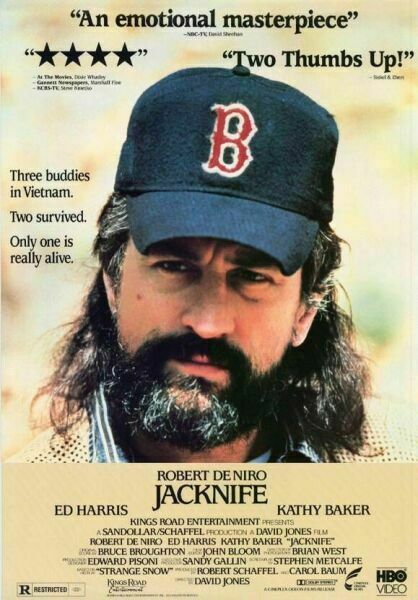
De Niro in Jacknife (1989)Part II

Often when you ask someone  who is their favourite actor especially men tend to name Robert de Niro. Surely his merits are undisputable still he did get on my nerves in several of his films since he´s got the habit of overacting and that way tends to turn into a parody of himself. I thought I´d seen many of his movies and knew that he was at least in two Vietnam related ones, The Deer Hunter and Taxi Driver. Somehow Jacknife sneakily escaped my attention.

I saw it recently and must say, it would have been a pity not to see  it and this for several reasons. (Check out the trailer in an older post).

First, I think, it is one of de Niros´ best performances, second I think it is a very good attempt at showing the theme of the Vietnam vet. Post traumatic stress and so forth.

Megs (de Niro) and Dave (Ed Harris) served in Vietnam together. They hadn´t seen each other for a while when suddenly, out of the blue, Megs invades Dave´s home to take him on a fishing trip. Unfortunately he realises he´s less than welcome. Dave showing every sign of full-blown alcoholism still blames Megs for the death of Bobby, the third guy they went to Vietnam with.

Megs tries everything to cheer up Dave but fails completely. The fact that Megs begins a relationship with  Martha (Kathy Baker), Dave´s sister doesn´t exactly improve anything.

Even though at first it looks as things were not going well at all, Megs´ likeable character, his outgoing, eccentric ways liven up the brother and sister and ultimately transform them profoundly. The story is interwoven with flashbacks that show what went wrong in Vietnam where Megs was by far too gung-ho and shooting way too fast at everything.

Sure, these are personal stories, character studies, no analyzing of the war as such or its political and social impact.

I just adored de Niro in this and understood again why so many think he´s one of the best actors alive.

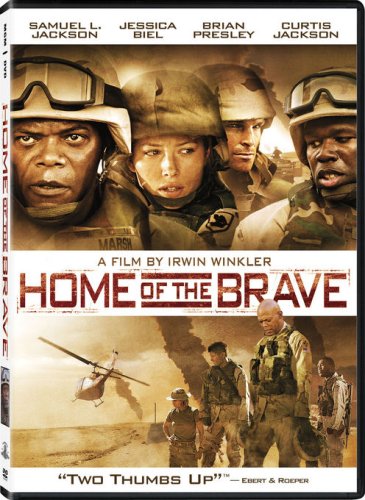
Home of the Brave (2006) or When a movie really fails

Home of the Brave is about a group of soldiers who came under heavy attack shortly before being sent home. After their return they try to cope with what they have been through. They all fail to some extent before they realise they need psychological help.

What a bad, bad, bad movie! I´m embarrassed I watched it. Worst acting ever. Ridiculous dialogue, dragging storyline, wrong cast, pathetic music…

And yet, there are a lot of people who like this movie and say: that´s exactly how it was.

I don´t doubt for one sec, that this is how it was. I don´t doubt for one sec that the returning soldiers need medication, treatment, can´t make their relatives understand, despair, start to drink, get violent, blame everyone including themselves and the government.

Fine. But DO NOT show a message like this in such a way. After a while you start to wonder, why there is not a constant voice in the off telling you: ha…that was impressive, ha…see how horrible, ha….start to blame the government and now ha….

This doesn´t work. It´s like someone telling you a joke and immediately explaining you afterwards why it was funny.

The opening is quite similar to many other opening scenes of movies located in Iraq, be it Battle for Haditha, Stop-Loss or any other. But the similarity is a purely exterior one. The acting is too bad to actually induce feeling. The convoy gets ambushed, people die and get mutilated. And all this happens after we have been told that exactly these people are about to go back home. This is repeated so many times that the thickest moviegoer starts to scratch his head thinking: Are they telling me something here? Fate playing tricks is an old theme in war movies, after all it´s one of life´s themes, but usually it is handled with more subtlety.

Next thing, they are all back home. One has lost his best friend, one (a doctor) had to amputate many limbs, one had her hand amputated and now they start to struggle and stumble and fail like the movie.

Sad. They meant well. They wanted to tell us: This should not happen. America shouldn´t meddle. This is not WWII. We won´t get statues and memorials and see people with tears in their eyes still thanking us years later. No, they hate us, they want us out and if we don´t get it, they shoot us up.

A few final words on the actors.

Jessica Biel: Very bad start but then okish.

Samuel L. Jackson: He can’t really be very bad, can he? No, unless he unconvincingly tries to play a drunk. But he has his moments still.

Brian Presley: Who´s that geek? He´d be good in a movie like My Beautiful Laundrette. But only for the looks. Talentwise it´s rather… well…any bad series. Whatever.

Chad Michael Murray: How to get shot and look ridiculous at it. He should keep on making series like  One Tree Hill (not that I´d watch that) or movies like Cinderella Story.

50Cent:  Mumble, mumble, mumble or How do I act without having the tiniest facial muscle move.

Christina Ricci: What the heck were you thinking accepting this role?

The only good thing was the movie´s attempt at showing that medication is no solution to trauma and consequential sleeplessness. It´s in the end no better than drinking. You can´t ignore the trauma, you can´t block it, you have to accept it and  talk about it.

Stop-Loss (2008): The End of Denial or The War that Takes Place in Living rooms

Stop-Loss

“Sand, fleas, flies, heat, boredom. Or you can get shot at. Or blown up. That’s pretty much it. There are sheep on the highway”, says SSgt. Brandon King (a remarkable Ryan Philippe) in Stop-Loss after Steve’s girlfriend tells him that Steve doesn’t talk much about being over there. Brandon doesn’t go into details, he sums it up and turns it into a joke. It’s difficult to talk about it. And not even wanted as his father tells Brandon when he is getting too graphic. There is denial in both camps. Those who stay home do not want to know because they want to believe in their sons/lovers/friends/brothers doing the right thing. To be invulnerable heroes and return as such. Nothing really bad happens over there, right? Soldiers like Steve do not want to talk about it because they simply do not want to think about it. As soon as they start thinking, like Brandon does, the only thing they want is: getting out! And that’s when the trouble begins

Brandon has seen it all. His people dying, being terribly wounded and crippled for life. Dead civilians. The war taking  place in living rooms. He’s done his job. He returns from a completed tour of duty in Iraq a hero and now he wants out. Unfortunately he is stop-lossed. In times of war, when there is no draft and not enough volunteers, the government can stop-loss soldiers, meaning send them back even if they want out.

What begins as a war movie with heavy fighting, interspersed with grunt-video like elements, turns now into a road movie. Brandon wants out and goes AWOL.

He and his best buddies girlfriend Michelle are taking a trip to… A new life with a fake identity or back to where his friends are?

Watch it and you will find out. It should suffice to say that this movie is a character study, a very critical look at what is going on “over there” and a way out of the speechlessness of those involved and those waiting for them. The young men, depicted in this movie are of the kind who rather hit you in the face than voice their uneasiness. They drink, they fight, they like to shoot guns and listen to heavy music. They are self-destructive but loyal friends. They do not have much other professional options but join the army.

The movie’s strength is not only to be highly watchable but to convey a deep feeling of  sadness. Sadness about many things: the loss of naivety,  the governments cheating, the waste of lives and ultimately hope.