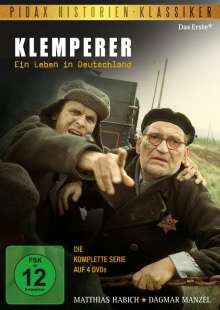
Klemperer – Ein Leben in Deutschland – A Life in Germany (1999) German TV Mini-Series

When Klemperer was first aired on German TV, I watched the first episodes but because I was moving I had to stop after the fourth. I always meant to re-watch the beginning and finally finish the whole series which consists of 12 episodes.

I had really liked the beginning at the time and now that I have finally re-watched those first four episodes I’m glad I still like it, maybe even more and I’m keen on watching the rest. However it’s very depressing. I didn’t remember it to be this upsetting but maybe it’s just me and I’m in a funny mood.

The series is based on Viktor Klemperer’s war diaries, 8 volumes of several thousand pages (here in English Viktor Klemperer’s diaries and in German here). The diaries are a fascinating document. I’ve read the first and it’s breathtaking. Klemperer was a professor of French literature, highly intelligent and with an amazing knowledge which all goes into the diary. He was also Jewish. The amazing thing in the series and the diary is the fact that it shows a man who is incapable of seeing what is going on and that we witness an amazingly intelligent person’s blindness. I find it must have taken a lot of guts to publish this diary because while it is very human it is still such an incredible flaw to be this blind.

To watch the series is eerie. It starts in 1933, just after Hitler was elected. At first there are just a few warning signals. Klemperer isn’t allowed to test non-Jewish students anymore, later he will not be able to publish anymore, they will remove him from certain classes and finally he will be fired. While many of his friends leave Germany very early, he doesn’t want to leave, he always thinks that maybe he will be exempt from the next measures only to find out that he wasn’t. His wife is not Jewish and since he himself isn’t religious, he always thinks they will make an exception for him. They even start to build a house.

Klemperer’s wife is an amazing character as well as she is so flawed and naive. She still moans about not being able to go on holidays when he has already been fired because he is Jewish.

As I already mentioned, the series is quite long. There are 12 parts of 45 minutes each, which means they have taken a lot of time to show the whole story and include a lot of details. I already know that the Klemperers will end up being sent to a camp but survive. Because it spans such a long time, 1933 – 1945, it really feels at times like having been there, having experienced some of it.  It is one of the best TV series I’ve ever seen. It has been very carefully executed and with Matthias Habich and Dagmar Wenzel, they have chosen two of the best German actors. Habich is one of my favourites, and one of the rare I like almost as much as Bruno Ganz.

A far as I know, there is no version with English subtitles available which is a pity. At least the diary is available in English too.

Mephisto (1981)

I wonder what took me so long to watch Mephisto for the first time. István Szabó‘s movie is an absolutely riveting and chilling tale of one man’s betrayal of everything he once believed in and all the many self-deceiving lies he tells himself.  I have always been fond of Klaus Maria Brandauer but this must be one of his very best roles. He is simply astounding.

Mephisto is loosely based on Klaus Mann’s eponymous novel. The story is quickly summarized. Henrik Hoefgen is a famous actor in Hamburg in the early 30s. Hamburg is provincial compared to Berlin and Hoefgen has dreams and hopes and sees himself already as Germany’s most famous actor in the future. While he is most certainly very talented he is equally narcissistic. On the other hand he is full of idealism and flirts with communism. When he plays Mephisto in Goethe’s Faust, he is discovered and receives an invitation to Berlin. Finally his dreams come true. He will be an actor at Germany’s leading theater. In Berlin, as well, it is the role of Mephisto which brings him a lot of admirers, some of which are prominent Nazis. It doesn’t take long and the Nazis try to instrumentalize him. In love with himself and his success he doesn’t see this at first. Soon he becomes the governments pet actor, speaks in its name at openings and supports the government.

While he may be oblivious of the consequences at first, when he starts to realize he has sold out, he begins to lie to himself and pretends it isn’t the artist’s duty to be political. He even goes so far as to pretend that an artist lives outside of everything.

Mephisto is a riveting character portrait and an in-depth analysis of what can become of someone whose conformity and lust for success make him forget that he has a responsibility. The movie looks especially into the responsibility of the artists. While many chose to leave the country as soon as possible, those who stayed often pretended it was their duty not to abandon the country in its hour of need and that those who left were cowards. It’s obvious that the famous actor Gustaf Gründgens, who also worked with Klaus Mann, has served as a model for Hoefgen.

Mephisto is certainly one of the best movies I have seen this year; it’s intelligent and entertaining and the acting is amazing.  So far this is my favourite of István Szabó’s movies. I haven’t seen Colonel Redl yet, – equally starring Klaus Maria Brandauer – but I’m very keen now.

Die Flucht – March of Millions (2007) German TV production about the Flight from East Prussia

This is one of those stories that needed telling. East Prussia, this vast and beautiful region in Germany, was quite peaceful during the war until the Eastern Front collapsed and the Russians started invading Prussia and moved towards Berlin. The people living there had but two choices. Stay and face the Russians who were not exactly going to handle them with care. Or  to flee and leave all their possessions behind. East Prussia was the home of many aristocratic families who lived at ease on huge estates. Theirs was a life of wealth and tradition. Leaving was extremely hard on them and for many it took a long time until they made up their minds. Too long in some cases. For those who had less, it wasn’t any easier. Not only did they have to leave everything behind, they didn’t know where they were going or if they were not going to be outrun by the Russians.

You see, a lot of potential for a great story and all of the above is shown in Die Flucht – March of Millions. Unfortunately even historical events like this need good storytelling and that’s where I’m not happy with this two-part German TV production. While it’s not bad, I would have preferred if they hadn’t decided to turn the second half into a love story.

Lena, countess von Mahlenberg (Maria Furtwängler), leaves Berlin and returns to her family’s estate in East Prussia. Things still look pretty much the same as they did before the war with the exception of French POWs – led by cranky François (Jean-Yves Berteloot) – working on the estate. And there is also a  panicky feeling underneath the surface. Things do not look good for Germany. That they will win the war is not very likely anymore and what this could mean for them, this close to the Eastern front, starts to dawn on a few people.

The von Mahlenberg’s are friends with another aristocratic family, the von Gernstorffs. Lena is going to get married to their older son although she doesn’t really love him. The younger son who is in love with her as well, is one of the only ones to clearly say that Germany will lose the war. He is fighting on the Russian front and scared of dying. When he deserts, the family breaks apart.

Meanwhile Lena wants to flee together with the POWs who have been working for her and with all of the people who live on the estate.

The first part of the movie is dedicated to the time before they flee, the second focusses entirely on that long march.

Many of the elements are interesting and dramatic. The tensions among the Germans, the justified fear of the Russians, the tragedy to lose your home and to be unwelcome wherever you go, is shown quite well.

What I liked too were the pictures. I have never been in East Prussia but those vast landscapes seem very beautiful and they were beautifully filmed. What did not work is the love story. I think this movie could have been dramatic without a love story but on top of that it didn’t seem very realistic.

In any case, a watchable movie but not as good as I had hoped for. I think however this would be successful in the US or the UK as, like Dresden or Anonyma, it shows aspects of German history and suffering we sometimes tend to forget. Of the three movies I liked Anonyma best but I’m fond of Dresden as well, although it has corny elements.

I’m not sure Die Flucht is available in English. I attached the German trailer and for those interested in the history of East Prussia during WWII, a documentary in English which looks quite good.

Heroes (1977) Another Vietnam Vet Tale

Last year I posted on the topic of Most Memorable Vietnam Vets and collected quite a list of movies in which a Vietnam vet is the main character. With the exception of four movies I had seen all of them. Heroes wasn’t on the list because I wasn’t aware of it at the time. I’ve watched it meanwhile and included it in the list. I still think that Jacknife and Taxi Driver, both starring Robert de Niro, are the most memorable ones, still, I would say Heroes is worth watching for many reasons, if only to see the young Sally Field and Harrison Ford in an early role.

Jack Dunne has escaped from a mental hospital. Not for the first time, he has escaped before but this time he is determined to not get caught again. His friends at the hospital have given him money for an unusual business involving earthworms. His plan it to travel to Kansas to meet a former comrade Ken (Harrison Ford) who was in the same unit and then travel on to see other buddies, who all served with him as well. On his journey he meets Carol who is just about to get married but for reasons even unknown to herself she wants to get away for a few days before the wedding and stay on her own for a while.

While she is at first somewhat alienated by Jack’s strange behaviour and the fact that he is chased by the police, she is also intrigued and fascinated by this odd fellow who carries around a box of worms and doesn’t seem to be able to take anything seriously. When they accidentally get into a bar fight and Carol has to pay for the mess Jack has made, she decides to follow him. Jack has promised that Ken will pay her back.

Ken, Jack’s friend, isn’t much better off than Jack. He lives outside of a town in a trailer hoping to make money with car racing. He is part of Jack’s fantastic business plan to make money with earthworms but not only does he not take the idea seriously, he is in no condition to think about business at all.

After having stayed with Ken, Jack and Carol take Ken’s car and go on a trip to visit Jack’s other buddies but nothing turns out as expected. One of them died, a fact Jack new but repressed, another one is hiding somewhere. On top of that the horrible war memories which Jack had tried to repress start to resurface violently.

Heroes is part road movie, part Vietnam vet tale and part love story. Both Carol and Jack have issues, both drift through life, do not belong anywhere and in meeting each other they find for the first time someone with whom a real relationship is possible.

As a road movie and a story about an intense relationship, the movie worked well. I also liked the character of Ken quite a lot. I was not too sure about the veteran part though. Jack suffers from PTSD and there are a few subtle moments (nightmares, flashbacks…) which show this very well, on the other hand, he seems to be a very naive, childlike person and one gets the impression that he must have had problems before he even went to Vietnam. That creates a bit of a mix. He is an interesting character but as a portrait of a vet it didn’t work all that well for me.

Still, Heroes is watchable and entertaining and it was nice to see the very young and pretty Sally Field and Harrison Ford in an early role.

I couldn’t find  a trailer, just this very short scene.

http://www.youtube.com/watch?v=sIe69g2sT-s

Black and White in Color (1976) – A Guest Post by nem baj

I’m still in a movie watching slump and that’s why I’m really grateful to have another guest post from nem baj for you today. His post is dedicated to a movie I haven’t seen yet. In all honesty, I hadn’t even heard of it although I’m familiar with many of Jean Jacques Annaud’s movies. 

In a nutshell: two French and German outposts in 1914’s central Africa, cut away from their respective metropolitan authorities, mimic the European conflict once they have learned its existence – six months after the hostilities have been declared in Europe. Focusing on the French, the movie is a satire of patriotism and the ‘civilizing mission’ of french colonialism.

Director Jean-Jacques Annaud may be known to younger audiences as the craftsman behind international productions such as The Name of the RoseSeven Years in Tibet or Enemy at the Gates, but he started his career in France by directing two little rebellious films, Hot Head (about local sports celebrity and politics) and Black and White in Color, which is a war movie based on an actual event. It is a comedy, cliché-based from the start, the Germans being organized and professionals, whereas the French spend more time speaking, eating and making love than preparing for a fight. Yet the latter are so vain they launch the first offensive, which ends up being a disaster. Now they’re scared and in a defensive mode – which means time has come for a radical change in leadership.

For the main weakness of the French is the way the small community in their outpost envisions exploitation: the locals are not considered as men, crooked shopkeepers and even more crooked missionaries exploit the populations for immediate profit, and the only French soldier, a sergeant (seconded by a handful of tirailleurs, professional Black soldiers), is only a few months from retirement, and has never fought a battle except maybe against the appeal of booze and local women (those battles he seemingly always looses).

However, a young educated geographer, a pacifist and a socialist, decides to take over after the defeat. He engages the village chief, using the antagonism between villagers and bush tribes, to capture fresh cannon fodder from the countryside. Then he appoints the local White bully as a staff trainer, and takes a Black woman, possibly of high rank, as his mistress. The result is a brand new force of African soldiers, which is used to launch a new offensive on ‘German’ soil, this time with better, though inconclusive, results. They start digging trenches similar to those appearing in French magazines… I won’t spoil the ending.

The whole thing is a cruel satire, the story of a ridiculous war fought by Black proxies on account of racist White trash. Whether you’re a French with self-irony or a fan of French-bashing, it will surely please you. But its strength lies in the fact that is quite witty. The role played by language barriers is both symbolic and hilarious. Also, on one hand the Africans are real people, with their own identities, language and distinct approaches to the colonizers – yet on the other hand the recognition of their social existence by the French geographer gives him more exploitative power than his predecessors ever had… which in turn seems to give new strength to the contestation of colonial power. And finally, the intellectual betrays his own pacifist ideals for the pursuit of glory, sending more men into combat… in the name of humanism.

PS: this review refers to the international version of the film, which gained the Foreign film Academy Award in 1976 in the name of Ivory Coast, where it was shot. On first release, the movie received extremely bad reviews in France, then the international version was re-released in France after the Oscar…