Judgement at Nuremberg (1961) or A Truly Outstanding Legal Drama

Judgment at Nuremberg is a brilliant movie by Stanley Kramer. Outstanding actors, great pictures and a gripping story. Spencer Tracy, Burt Lancaster, Richard Widmark, Marlene Dietrich, Montgomery Clift, Judy Garland and Maximilian Schell. They are all good, very good.

The movie´s setting is post-WWII occupied Germany.  It tells the story of the trial of 4 German Nazi judges in an American court. They are accused of being responsible for sterilization and exterminations.

Spencer Tracy stars as Judge Dan Haywood who is conducting the trial, Marlene Dietrich plays Mrs. Bertholt, the widow of an executed Nazi army officer. Burt Lancaster is one of the accused judges, Maximilian Schell his defendant. One of the most convincing performances is given by Montgomery Clift who plays the role of one of the judges´ victims. His  interrogation is so touchingly performed, makes you feel really uneasy.

The film follows Judge Haywood in the court room and outside where he tries to get the full picture by befriending Mrs. Bertholt and talking to his housekeepers, Mr. and Mrs. Halbestadt to find out what the German people  really knew. It seems as if each one´s personal history and concerns overshadowed the things that happened around them. And even though they lived so close to Dachau, Halbestadts pretend to have been ignorant of the camps.

During the trial the testimonies of the witnesses, supported by original footage of the concentration camps and the interrogation of the accused, completes the picture of the past horrors.

Judge Haywood must now establish if, in believing to serve their country, the accused did right or wrong. Do exceptional circumstances permit different moral criteria? Does the conviction to do the right thing exempt  from punishment?

If you want  Judge Haywood´s  answer to these questions and if you like to see  truly outstanding movies and great acting, watch this one  as soon as you can.

My Favourite War Movie Character or The Ultimate Sacrifice

To determine who is your favourite war movie character is a very, very subjective thing. At least for me. No objectivity here. It is neither linked to the fact if I do consider the movie he´s in to be outstanding or average, it doesn´t say anything about the acting in itself, I really only think of the character. And, yeah well maybe it has something to do with the fact that the role is played by one of my favourite actors.

What I loved about this character is his goodness. In all the horror that surrounds him, he stays good. Nothing compromises him, nothing turns him into an inhuman being devoid of feelings or compassion. And in the end he doesn´t shy away from sacrificing himself. He is the ultimate war movie hero, hero through his sacrifice not through his killings.

And yes, I alluded to him in another post (Christ and the War Movie Hero). My favourite character is Sgt. Elias (Willem Dafoe) in Platoon. And yes, I´m sure it´s no coincidence that he was later chosen to play Jesus Christ in The Last Temptation of Christ. He´s been my favourite for many years now and I only wavered once, after having seen When Trumpets Fade where we see another sacrificial hero.

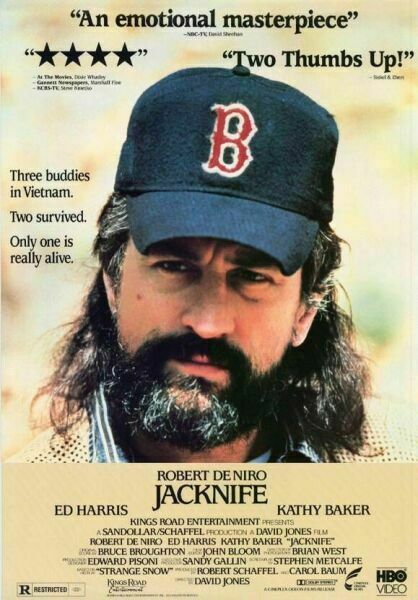
De Niro in Jacknife (1989)Part II

Often when you ask someone  who is their favourite actor especially men tend to name Robert de Niro. Surely his merits are undisputable still he did get on my nerves in several of his films since he´s got the habit of overacting and that way tends to turn into a parody of himself. I thought I´d seen many of his movies and knew that he was at least in two Vietnam related ones, The Deer Hunter and Taxi Driver. Somehow Jacknife sneakily escaped my attention.

I saw it recently and must say, it would have been a pity not to see  it and this for several reasons. (Check out the trailer in an older post).

First, I think, it is one of de Niros´ best performances, second I think it is a very good attempt at showing the theme of the Vietnam vet. Post traumatic stress and so forth.

Megs (de Niro) and Dave (Ed Harris) served in Vietnam together. They hadn´t seen each other for a while when suddenly, out of the blue, Megs invades Dave´s home to take him on a fishing trip. Unfortunately he realises he´s less than welcome. Dave showing every sign of full-blown alcoholism still blames Megs for the death of Bobby, the third guy they went to Vietnam with.

Megs tries everything to cheer up Dave but fails completely. The fact that Megs begins a relationship with  Martha (Kathy Baker), Dave´s sister doesn´t exactly improve anything.

Even though at first it looks as things were not going well at all, Megs´ likeable character, his outgoing, eccentric ways liven up the brother and sister and ultimately transform them profoundly. The story is interwoven with flashbacks that show what went wrong in Vietnam where Megs was by far too gung-ho and shooting way too fast at everything.

Sure, these are personal stories, character studies, no analyzing of the war as such or its political and social impact.

I just adored de Niro in this and understood again why so many think he´s one of the best actors alive.

Women in War Movies

War movies are a genre in which women will rarely if ever play major roles.

However there are a few that come to mind immediately.

Nurses

Mothers

Wives

Girl friends

Resistance fighters

Soldiers

Officers

Victims

The nurse is by far the most common role. In many movies they are very prominent. Especially in the sub genre of the war romance they get more than just small roles. (Yes, Pearl Harbor (2001) comes to mind, but…)

Some fine examples of nurses can be found in The Lighthorsemen (1987), In Love and War (1996), The English Patient (1996).

Mothers, wives, fiancées are often found at the very beginning of a movie, when the soldiers leave their homes like in Dark Blue World aka Tmavomodry svet (2001). We often see them again, reading a letter arriving from the field as in The Thin Red Line (1998).  They serve as a sort of counterpoint to make the contrast between those who fight and those who stayed home even bigger. Then, you may find them once more at the very end, when the soldiers return home. One of the most poignant and touching wives is Madeleine Stowe in We Were Soldiers (2002). The story moves back and forth between the battle field and the home front depicting the agony the soldier´s wives went through when the telegrams arrived telling them one of their husbands had been killed.

Nurses become very often soldiers’ girl-friends which makes the two roles blend into each other. But many of the classic girl friends in movies depicting the second WW are the girls the men encounter in the countries they are shipped to. The American soldiers in The Pacific for example have Australian girl friends.

The role of the resistance fighter is quite a noble one. Not very frequent but appealing. Cate Blanchett as Charlotte Gray (2001) comes to mind. Or the women in Uprising (2001). And definitely Sophie Scholl (2005). The latest example of this kind is Carice van Houten as the jewish woman Rachel Stein who joins the Dutch resistance after having survived a massacre in the brilliant Black Book aka Zwartboek (2006).

Female soldiers that are even involved in combat are not very frequent. The most remarkable one I remember is the Vietnamese sniper in Full Metal Jacket (1987). A further female soldier  is played by Demi Moore in G.I. Jane (1997) where she is said to be the first woman  to have  been granted access to the navy SEALS.

Women as officers is by far more common. Again Demi Moore played a role in the excellent legal drama A Few Good Men (1992). And then there is Meg Ryan as medevac chopper pilot Capt. Karen Walden in Courage under Fire (1996).

Unfortunately some of the above mentioned portraits of women in war movies are quite questionable and have been criticised repeatedly (especially G.I. Jane).

I almost forgot the victims. Inexcusable. There are as innumerable female victims in real wars as there are high numbers in movies. One of the saddest are the victims in Vietnam war movies. I think of  Platoon (1986) and Casualties of War (1989). They are not the only ones. Of course not.

My favourite heroines are Cate Blanchett as Charlotte Gray, the wonderful Juliette Binoche as nurse  in The English Patient and, another nurse, Sandra Bullock in In Love and War, and the outstanding Julia Jentsch as Sophie Scholl. The first two are based on novels, the other two on historical facts. Sandra Bullock plays the nurse Ernest Hemingway fell in love with when he fought in Italy during WWI.