The Round Up – La Rafle (2010) – Operation Spring Breeze or The Round Up of Vel d’Hiv

The French/German/Hungarian co-production, The Round Up – La Rafle, is a powerful and intense movie based on true facts. In the nights of July 16 and 17 13000 Parisian Jews were arrested in a raid in Paris and confined in the Vel d’Hiv (Winter Velodrome) or Drancy internment camp and from there to the extermination camps in Poland. Of the 13000 arrested Jews only 25 survived. Many among them, at least 4000, were children. Not one of them survived. The aim was to round-up 25000 Jews but 10000 escaped and were hidden by the people of Paris. The most shameful part was played by the police who actively contributed to make this happen. French President Jacques Chirac apologized in 1995 for the complicit role that French policemen and civil servants served in the raid.

The movie begins with original black and white footage. We hear Edith Piaf sing “Paris” while we follow Hitler on his tour through the city. That sent shivers down my spine. To think that if the Germans had won the war, Hitler would have made Paris his capital. In the pictures he looked like a guy inspecting real estate, deciding on what walls to knock down, what to keep. Horrifying. Here is an account of Hitler’s tour, written by his pet architect Speer.

After the opening we see people in a Parisian street located in Montmartre. The street scenes show that French and foreign Jews amicably lived together with non-Jewish Parisians. Many French people are friendly towards the Jewish population, but others are openly hostile and hate them. The movie focusses at first on a few Jewish families. It shows how secure they felt. They didn’t think the French government would ever give in. But it did. In exchange for privileges it promised to round-up the Jews and deport them eventually.

After the round-up we see the scenes in the Vel d’Hiv and the point of view changes. A young French nurse, Annette Monnod (Mélanie Laurent), has been sent to help alongside a Jewish doctor (Jean Reno). The doctor and a handful of French nurses are the only health care professionals for 13000 people. There is almost no food, no water, no toilets and the hygiene is abominable. Many of the children are ill. There are doctors willing to come and help but they are not let in. Operation Spring Breeze, as this round-up is called, should be kept a secret. While there are many collaborators among the French, there are many more who are hostile towards the Nazis and willing to risk their lives to save Jews.

Annette becomes very attached to the children and does everything to help them survive. She follows them to camp Beaune where they stay until they are finally deported to Auschwitz. Until the last day many think, they are sent to Poland to work. Rumours that those camps are extermination camps are only spreading very slowly.

I really loved this movie. It moved me, I found it very touching and emotional.  I would say that of all the Holocaust movies I’ve seen, this is my favourite. I liked that it focussed on a few Jewish families with different backgrounds. Some rich French Jews, others immigrants and people who fled from other countries. Those individual stories are more interesting and touching than the story of a mass of deported people. In chosing Annette, a French nurse, we see how far the “good” Parisian people went, risking life and health for others. It’s such a shameful chapter in the history of France, its important to remember that there were courageous people as well.

The only thing I didn’t like so much was the end. It should have been different but I cannot tell you why or I would spoil the movie. Considering how excellent the rest is, this is a minor fault. I added The Round-Up to my Children in War Movies List. It’s an excellent example. Other Holocaust movies can be found here: 13 Holocaust Movies You Should See.
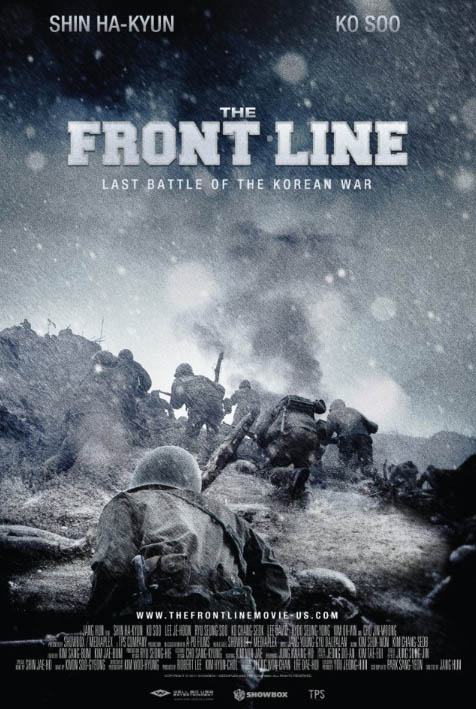
The Front Line aka Go-ji-jeon (2011) A Stunning Korean Movie

The Front Line aka Go-ji-jeon is a stunning movie. I wasn’t all that lucky with Korean war movies before. Something was always off. Either the acting was over dramatic or they were too intense, or lacking a story and appealing characters. But this movie get’s everything right.

The story about the final battle of the Korean war is heartbreaking. One of those utterly pointless we-fight-to-the-last-man battles which didn’t serve anyone. What is more harrowing here even than in other instances is the fact, that the battle took place after the armistice had been signed. For absurd reasons the cease-fire was only to be implemented 12 hours after the signature.

But I’m starting with the end. The final battle takes up less than half an hour. Until we get there the movie has plenty of time to tell back story, side stories and to develop many arresting characters. Some will die, some make it but it’s painful every time, one of them is killed.

In 1953, just before the end of the war, Lt Kang Eun-Pyo (Ha-kyun Shin) is ordered to the Eastern front line to investigate the murder of an officer who has been shot by someone of his own company. The front line lies in the Aerok Hills. The border between the enemies is constantly changing. Some days the border lies more to the north, some days it’s more to the south. Some of the trenches and dugouts are changing occupants every other day. The fighting is intense, the morale is low.

When Kang Eun-Pyo arrives he is surprised and happy to find his old friend Kim Soo-Hyeok (Soo Go). He thought his friend had been killed a long time ago but it seems he isn’t only alive but in charge of things. The commanding officer is a very young guy showing signs of severe trauma and a serious morphine addiction. It’s obvious the heavy fighting has taken its toll. The men have had enough. They don’t even know what they are fighting for anymore. They show signs of insubordination and there are even rumours of contact between the enemy parties.

“Two Seconds”, as they call an enemy sniper, is giving them a particularly hard time. They stand no chance against this incredible and cunning shot. Every time they are on patrol or attacking, “Two Seconds” gets some of them.

The group Kang Eun-Pyo has joined is very composite. There are young recruits who have never fought and battle-hardened older men who already saw combat in WWII. This is quite traditional for war movies but the characters are likable and well-developed.

There is conflict due to the fact that the men are so battle weary and a crime has been committed which needs to be solved. Kang Eun-Pyo is very strict in the beginning, he wants to find the culprit but after a few days and some heavy combat he has to understand that the officer may have been shot as a result of bad leadership. The situation in these hills is so precarious any wrong decision is fatal. On top of that, everybody knows the war is about to end and the men do not understand why they are sacrificed for nothing.

There is another secret to uncover which has nothing to do with the murdered officer. The company which is called “Alligator company”, because they are so great at surviving, has gone through something very horrible in the past. More than one man shows sign of PTSD but nobody tells Kang Eun-Pyo what has happened. He will find out eventually but only after a long time.

The movie combines a great story line with a succession of amazing and surprising scenes. Some of the scenes are quite drastic, there is even one reminiscent of the Omaha Beach landing in Saving Private Ryan. Still, the movie manages to do without the usual Korean gore. It only gets gruesome at the very end.

What I really liked is the fact that this is an intense combat movie that combines action, suspense and emotion, something that you don’t find all that often. The actors are very good, the music is well-chosen and the cinematography is great.

I’m really happy that Show Box Media offered me a review copy of this movie. The Front Line is an exceptionally good movie. A real must-see.

Kingdom of Heaven (2005)

This is the second time I have watched Kingdom of Heaven. The first time I watched it on a tiny TV and thought that may have been the reason why it didn’t work for me. A few years later and with a big screen and a good sound system it still didn’t work. And this despite the fact that it is a Ridley Scott movie, the cinematography is stunning, the music – Hans Zimmer  Harry Gregson-Williams – is good and…. That’s it. … There is nothing else I can add to the plus side. OK, maybe the battle scene towards the end which seems to be one of the Top 10 battle scenes of all time. It’s good, yes, but after 2 straight hours of utter boredom, it’s hard to redevelop some sort of enthusiasm.

Balian (Orlando Bloom), a blacksmith, travels to Jerusalem with his father, Godfrey de Ibelin (Liam Neeson). Ibelin dies on the way but Balian travels on. The movie is set during the reign of Baldwin IV, the so-called leper king (Edward Norton behind a mask). During his reign, Jerusalem is a Kingdom of Heaven in which Christians and Muslims live together in peace. After Baldwin’s death,  the husband of Baldwin’s sister becomes king. He wants Jerusalem to be Christian. He attacks Saladin’s army but loses the battle and Saladin marches towards Jerusalem where Balian heads the army that stayed behind. After the final epic battle is lost, Balian leads the people out of the city while Saladin and his people take over.  This is more or less the core of the story.

It’s ironic really as it is precisely this boring movie, or rather what it stands for, which was the source of the only really controversial and heated discussion on this blog. A while ago I wrote a post on Movies on the Crusades: A List. It is the only post on which people still comment frequently, calling each other names and being extremely emotional. I know I could close the comments section but I don’t want to do that. I’m not a fan of censorship. I usually reply to every comment but I do not do it on that post anymore as the discussion is turning in circles and answering seems pointless. What fuelled the anger is one person’s comment that Kingdom of Heaven wasn’t historically accurate. Whatever. None of this will make me change my mind – I don’t like the Kingdom of Heaven. Here are some reasons why:

  • The story. Why do we need the side story of someone going back to get his illegitimate son and fight along with him? This story part adds at least half an hour to a movie that would have needed some serious cutting plus a main character who totally lacks charisma.
  • The length. It is way too long. I was bored after the first 25 minutes, yet had to suffer through another 2hrs.
  • The actors. Orlando Bloom is not a good actor. No amount of make-up will ever make him one. Eva Green is one of those actresses you see and forget the moment the camera isn’t on her anymore. Not exactly a fascinating couple. While some of the other actors are very good, their combinations makes the choices look very random.
  • The cinematography. It’s stunning, as I said in the beginning, but if that’s the only thing a movie has to offer it becomes annoying. “One more bluish picture and I scream”, was what I was thinking.
  •  The characters. Even if the main character had been played by someone else, it would still have been a very boring character. In his only strong moment, when he frees the slaves and decides to defend the city against all odds, he sounds like a parakeet and mimics his late father. As Orlando Bloom is a bad actor, it sounds as if he was reciting a badly learned text.
  • The history. It isn’t accurate or rather it seems a hodgepodge of historical elements.

All in all it is too bad as the movie had potential. If you would like to see a really great movie on the Crusades, watch Arn – The Knight Templar instead.

Poll Results – Is Black Hawk Down Too Combat Intense?

More than a year ago I asked the question on this blog whether  Black Hawk Down was too combat intense. Someone had made this comment and I was astonished because I thought the intensity of the combat in Black Hawk Down was one of the reasons why it was such an extremely powerful movie. I checked the poll a few times in the beginning and the forgot about it. The other day I had a look and the result is interesting.

26 people have answered the question. 50% think that it isn’t too combat intense, 13% however thought, that yes, indeed it was too intense. Another 20% thought that it should be even more intense and the remaining people didn’t care.

I’m still surprised anyone would think it is too combat intense but maybe we would have to know what they mean. Black Hawk Down depicts the Battle of Mogadishu, an army operation that went seriously wrong. The result of the operation shook everyone who knew about it or who was involved. The special units deployed got under heavy fire and faced an incredible aggression. They weren’t only fighting other soldiers but a huge, armed mob. Depicting something like this as realistically as possible requires intensity.

I would say, that from the point of view of  a soldier who was under heavy fire, I guess, it’s not intense as nothing can equal the real thing. But maybe for someone purely watching it, it could be too intense, meaning, “too intense to watch”.

In any case, I will check back on the poll from time to time and keep you posted.

A little question for you. Do you think there is any other war movie which depicts such intense combat scenes? I think some of the more recent South Korean war movies I watched do but can’t think of an older one as intense as this.

You can find the original post with the poll here. Please vote, if you haven’t done so already.

Waltz with Bashir aka Vals Im Bashir (2008)

The Israeli animated movie Waltz with Bashir aka Vals Im Bashir is this rare thing – a really surprising movie. On top of that it’s well done, original, interesting and has a great score by Max Richter (Shutter Island).

In Waltz with Bashir Ari Folman tells his own story. He was in Lebanon in 1982, fighting with the Israeli army. At the beginning of the movie we see a pack of dogs, running in the night. It’s a very haunting, eerie image and we learn soon that it’s from a nightmare form one of Ari’s friends who was fighting in Lebanon at the same time. Although not capable of shooting people, he had to shoot the dogs who guarded the villages at night. Those dogs have come back, after far more than 20 years and haunt him in his dreams. One evening in a bar he tells Ari about it. They had never spoken about the war before and Ari had never thought of it much. To his great dismay he realizes that he doesn’t even remember anything. It’s as if it had never taken place.

After this conversation with his friend, he dreams of the war for the first time. The pictures seem to be part of a memory that he cannot really place. It looks like he is remembering a massacre in a refugee camp.

The conversation and the subsequent dream are the reason why Ari thinks, he needs to recover his memory, needs to talk to old friends, to comrades and officers. He travels to Holland and many other places, looking for people who were in Lebanon with him. He speaks to psychologists and learns a lot about the way how memory works, about dissociation and how traumatic experiences are suppressed.

It is highly fascinating to watch how he recovers his memory. Fascinating and sad as he finds out so many horrible things. It’s interesting that more than one person recovers their memory or snaps out of a state of dissociation when thinking of dying and killed animals.

What adds further complexity to the story is the fact that Ari Folman’s father was in Auschwitz. It becomes apparent after a while that the horrors his father has described to him are somehow linked to his suppressed meories and  once he recovers the memory of the war he has been in, he remembers everything else as well.

During the last five minutes the movie suddenly turns into a documentary. It is no longer an animated picture but we see original footage of the war in Lebanon.

This is the second animated war movie I have seen (the other one was Grave of the Fireflies) and both were excellent. It’s a medium that works extremely well for this topic. 

Waltz with Bashir is highly recommendable. It contains a moving and profound anti-war statement and a very interesting exploration of memory.