The Killing Fields (1984)

Hard to say why I didn’t like the The Killing Fields despite the fact that War and Journalism is a topic that I find fascinating and that this movie is considered to be one of the best of the genre. One of the problems I had was the length. The other one was the score. That’s such a dated score, it ruined the movie to a large extent.

The Killing Fields is based on a true story and one of the first movies whose topic was the genocide of Cambodian people by Pol Pot. The two journalists Sydney Schanberg and Dith Pran have been covering the war in Cambodia since the early 70s. They are not only dedicated journalists but close friends. Pran serves as interpreter on their missions.

In 1975 when the United States withdraw from the country and the Khmer Rouge, led by Pol Pot, advance on Phnom Penh, Pran, as a US sympathizer is in great danger. There was a moment when he and Syd could have left the country easily but things have developed too fast and now it’s hardly possible for anyone but US and European citizens to leave the country.

Knowing what would happen to Pran if he stayed, Syd and some fellow journalist try to forge a US passport for him. Unfortunately the attempt fails and while his children and his wife have been able to fly out, Pran is left behind when the other journalists leave. Captured by the Khmer Rouge he is brought to a labour camp.

In the second half the movie moves back and forth between a guilt-ridden Syd in the US, and Pran’s ordeal in the Cambodian labour camp. In imaginary letters that he writes to Syd in his head, he tells him what happens, interprets what we see. I’m not sure if this was a problem of my DVD but none of the parts spoken in Khmer have been subtitled.

The parts in the labour camp are very well done. This isn’t only a labour camp. The labourers and especially the children are re-educated and brainwashed. They have to unlearn everything that they knew before. It’s of great danger to have “forbidden” knowledge, like foreign languages or any higher education. The children are easily turned into little fanatics and the grownups who are afraid of being executed try their best to obey.

The Pol Pot regime was a systematic genocide and far over 2 million people were killed. Even though I didn’t particularly like it, I must admit the movie has its merits. And the Cambodian actor, Haing S. Ngor gave a very touching and convincing performance.

Giuseppe Tornatore’s Malèna (2000)

Malèna, set in a little town in Sicily during WWII, combines a coming of age story with a war-time story. The first time I watched it, it stunned me. I still liked it a lot the second time but since the story has a tragic ending, it’s more intense to watch it for the first time.

Malèna (Monica Bellucci) is the most beautiful and seductive woman in the little Sicilian town of Castelcuto. Her husband is somewhere in Africa, fighting for Mussolini, while she is left behind in a very hostile climate in which all the men try to have an affair with her and the women hate her for her looks. All the men see her as an object, with the exception of a young boy who falls in love with her. We see the story through his eyes. He is so besotted with her that he follows her around, sneaks out of his house at night and spies on her.

She is a favourite conversational topic and gossip and rumours follow her wherever she goes. People talk very bad about her behind her back. They call her a whore and say she betrays her husband and has lovers. Only the young Renato knows this isn’t so. But when her husband is reported dead, there isn’t any protection for Malèna anymore. She can’t find a job, she has no money and food is scare and whatever she does, the town, reigned by men, turns on her and finally forces her into prostitution.

When the war is over, the women take revenge on her, not because she sold her body to the Germans but because all their husbands lusted after her.

Tornatore captures the atmosphere and hysteria of an Italian city during WWII very well. How they all cheered Mussolini and pretended to know nothing of it when the Americans arrived. The hypocrisy, the paranoia, the double standards. Malèna has the extreme misfortune of not fitting in. Too stylish, too good-looking, not very sociable nor talkative. This causes the jealousy of the women who have no liberties or power and the hatred of the men who treat women like objects. This society is ruled by fanatic Catholicism and the double standards that go with it.

I don’t want to give away too much but the destiny of Malèna which is extreme is very sad and to a certain extent quite typical for women during that time in Italy. Many women, especially in Italy, were forced into prostitution when their husbands were gone or dead.

Malèna is an extremely esthetic movie, beautiful pictures, matching music, and of course there is Monica Bellucci whose beauty brings Malèna to life. The sexual awakening and infatuation of Renato is touching and extremely funny at the same time. It clashes with his mother’s prudery and his father’s strictness.  The end of the story is tragic and infuriating.

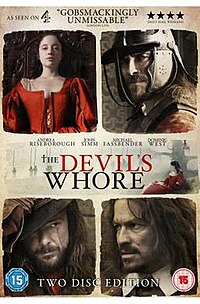
The Devil’s Whore aka The Devil’s Mistress (2008)

What troubled times these were. 17th century England. Thomas Rainsborough. Oliver Cromwell. The English Civil War. The Levellers. The execution of Charles I. Put all this together and use as a central figure a beautiful young woman, married three times, said to have seen the devil, accused of being a whore and surviving her execution and you have the ingredients of a very entertaining mini-series.

The Devil’s Whore or (called The Devil’s Mistress in the US) tells the story of the fictitious Angelica Fanshawe. Related to King Charles I we see her married to one of his relatives who ends up being executed. The English Civil War is seen through her eyes and its troubled history told in a very dramatic way. It makes you want to brush up your history immediately. As the addition of this fictitious noble woman tells us, the filmmakers have taken some considerable liberties, still they mange to convey how chaotic these times were. Cromwell was at the head of the Parliament, together with Thomas Rainsborough, the head of the so-called Levellers. These two men occupy two extreme positions. One wants to gain power over the parliament and have the King listen to them, while the other, as the name of the movement says, want’s all men to be the same. No more aristocracy and hierarchy. The land should be divided among everyone. As much as they are friends in the beginning, they clash and when Rainsborough is killed, it seems likely that Cromwell is responsible.

After the beheading of Charles I Cromwell is the most powerful man in England. He sends the army to Ireland and fights on many different fronts. But the war doesn’t bring peace to the country. Cromwell finally realizes that England sn’t ready yet. If he wants to restore peace there must be a new king.

I love this mini-series and have already watched it twice. Admittedly I didn’t only like it for the historical and political background but because I enjoyed Angelica Fanshawe’s story that is interwoven with the facts. In the beginning of the movie, when she is only a little girl, she sees the devil in a tree. He seems to mock her. But at the same time he transforms her into a woman, far more gutsy than women were at this time. She chooses her husbands, she speaks freely, she disguises as a man when needed and fights like a man as well.

The Devil’s Whore is an entertaining tale and a guilty pleasure set during the English Civil War, starring actors that have become famous with other movies and series. Dominic West (The Wire) plays Oliver Cromwell and Michael Fassbender (300, Inglourious Basterds, Shame, Fish Tank) is Thomas Rainsborough, John Simm (Life on Mars) is Edward Sexby and Angelica Fansahwe is played by Andrea Riseborough.

The only English trailer I found has Portuguese subtitles but that shouldn’t matter too much.

Birdsong (2012) BBC Adaptation of Sebastian Faulk’s Masterful WWI Novel

Finally the long-awaited BBC TV adaptation of Sebastian Faulk’s WWI novel Birdsong is shown on British TV. It’s a two-part adaptation that got a lot of rave preview reviews.

I’m sure all those who loved the novel, would want to watch this and all those who are interested in WWI as well.

I missed part I but they will air it again shortly. As soon as I’ve seen part I and II will post my review.

Defiance (2008) The Bielski Partisans

After having moaned about the accent situation in Defiance (which you can read here) it’s now time to get to the review and I must say, all in all, I didn’t think the movie was all that bad. And we have to bear in mind that it’s based on a true story, the story of the Bielski partisans or Bielski brothers.

After having found that their parents had been killed by the Nazi’s who systematically exterminated Polish Jews, the four Bieski brothers flee to Belorussia and hide in the woods. The two older brothers Tuvia (Daniel Craig) and Zus (Liev Schreiber) have both lost their wives and children as well. While hiding in the forest they are joined by a group of Jews and decide to stay together and try to survive in the forest. After a while, more people seek refuge in the woods and the Bielkis take them up. Tuvia in particular brings back people from every food searching expedition which creates huge tensions between the brothers. It is clear that Tuvia is the leader and this is another source of tension as their leading style is different.

After a few weeks or months the camp in the forest is almost a little village, there are now hundreds of people who need to be fed, who need shelter and protection as the Germans swarm these woods. On the other hand there is strength in the number as they have people with all sorts of professions among them. Nurses, carpenters, teachers. After a few more months the tension between the brothers escalates and Zus leaves the group and joins Russian partisans. This is initially ideal for the group as this means additional and armed protection.

The movie shows how they struggle. The winter is particularly hard for them, many fall ill. It’s incredibly difficult to find food for so many people and they are surrounded by enemies. They have to fight quite often and there are combat situations as well. There are also a few love stories that will lead to relationships that last a life time. We also see them execute different missions, like saving people from the ghetto before they are sent to the camps.

I found the movie interesting and fascinating because it is a true story. In the end the Bielski brothers saved at least 1500 people. That’s quite amazing. I’m quite fond of Daniel Craig and thought he was a good choice for Tuvia.

While I wouldn’t say this is a must-see movie, it’s not bad at all and when you are not familiar with the story, it’s quite interesting. In any case what these brothers achieved is amazing.

Here is a photo of the real partisans

If you want to read about them here are a few articles The Bielski Partisans and Tuvia Bielski and a wikipedia article Bielski partisans.