The Diary of Anne Frank (2009) The BBC mini-series

The Diary of Anne Frank is a BBC mini-series in 5 parts, each of which is half an hour long. There are far over 20 movies or TV series that depict the life of this famous thirteen year old girl. Anne Frank spent two years in hiding, in an annex and the attic of an old house in Amsterdam during the last years of the second world war. Because they were Jewish, her father decided to hide in order to avoid being deported to a concentration camp. They hid there together with family friends, all in all 8 people and a cat, in very close quarters. Anne, a precocious and highly intelligent teenager, kept a diary of this time, the famous Diary of Anne Frank, on which this and any other movie is based.

The incredible tragedy of Anne Frank’s story is the well-known fact, that after hiding for two years successfully, they were still found and deported to various camps where they all died, in some cases just a few months before the end of the war.

The father was the only survivor. And what “survived” as well, was Anne’s diary that she had to leave behind when they were discovered. The lovely Miep, who hid them, and brought them food every day, kept it.

There are different ways to tell Anne’s story I remember one movie also showing her in the concentration camp. That was a very good but very bleak movie. This mini-series is completely different.

I found especially the first parts to be very educational. This could and should be shown in schools and can also be watched with younger children. I found out later that the BBC aimed at this public. In so far it is very well done. The girl Anne and her daily life, her struggles, conflict with the grown-us – in particular the mother – first love and many other things are shown nicely. We also see how stressful it must have been to hide like that and be around the same people day in and day out. They had no privacy, no independence, no freedom.

This cozy feel is a bit of a problem for grown-ups, I would say, it’s a bit too cute. On the other hand, the end is extremely powerful, much more powerful even than the end of the one in the concentration camp. But you really have to watch the whole series to experience this ending. We see nothing graphic, nothing brutal, just the people being led out and the name of the concentration camp and the date of their death. Very moving. All the quarrels, and petty grievances they went through, all the weaknesses we saw, they all of a sudden get another dimension. In retrospect even the most annoying of the characters becomes endearing. It seems so ironic that they were caught so late, after so many years of deprivations, just when they started to rejoice after having listened to the BBC and heard about D-Day…

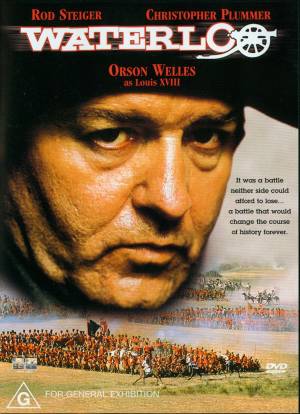
Waterloo (1970) “Next to a battle lost, the saddest thing is a battle won”

Waterloo was more than just a movie for me. Watching it meant jumping head first into childhood memories.

“Waterloo, Waterloo, morne plaine…” No, this isn’t the French version of the AbbA song. I am afraid the words are not bound to tell you much. I can still hear my father’s voice drone this part of  Victor Hugo’s famous poem L’Expiation (an endless poem by the way) on Sunday mornings. I said it in my last post, I went through a bit of an obsession with Napoléon as a child and guess I deserved a little punishment and therefore frequently had to listen to the long and never-ending recitation of that poem. Sorry for this little digression… Back to my review.

I haven’t seen this movie before and I must say it was high time. It is a worthy candidate for a place among my Top 20. I loved every minute of it (with the exception of the animal stunts. Being reminded that this a Russian production and the well-being of horses might not have been high on the agenda did NOT help. It is funny how all of a sudden one likes the idea of CGI. I never thought I would ever write such a sacrilegious thing.)

As the title indicates, this is not a Napoléon biopic. It doesn’t show the great man’s life, only a fatal and tragic part of it, the battle of Waterloo. Maybe the best known of all the French battles (apart from Austerlitz) in France.

The movie starts with what has become in French the synonym for something long, endless and wearisome, namely “Les adieux de Fontainebleau” or “The Goodbyes at Fontainebleau” in which Napoléon, before being exiled to Elba,  says goodbye to his troops. He states in the movie that he deplores that he can not say goodby to each and every one of them still it is said that it took hours. After having been defeated on the battlefield he was forced to abdicate and go into exile to the island of Elba.

Rod Steiger manages masterfully to show how emotional Napoléon was. This man was driven by strong emotions and passions. And it seems that the troops loved him for this display of feelings.

He stayed at Elba some ten moths and then returned to Paris where Louis XVIII (Orson Welles) had taken back the throne. The moment when he meets the troops is another highlight in this movie. He wins them back easily and becomes emperor once more.

After this episode he heads the troops and marches towards Belgium to engage the troops of Wellington.

Before the movie takes us to the battlefield it briefly stops in a ballroom in Belgium where Wellington (Christopher Plummer) and his men are introduced.

Two thirds of this movie are dedicated to the battle of Waterloo. I think it is incredibly well done. I liked those costumes and the way we could see the battle formations. There was such a huge difference whether cavalry charged against cavalry or against infantry. The moment when the French cavalry attacks the British infantry is horrible. The horses are shot down one by one. The square battle formations of the infantry made it impossible to win for the attacking cavalry. Like this the horses could be shot down from every angle.

At moments, while I watched this and saw the tactics the two men applied, how they overlooked the battlefield, sent troops from here to there, removed them from somewhere else, I was reminded of chess.

The two great men, Napoléon and Wellington are shown as complete opposites. Naploéon goes through every possible emotional change while Wellington stays poised and self-possessed. While one is of very humble origins, the other is an aristocrat through and through.

We all know the outcome of the battle and when it is over, not even Wellington is unmoved and he says the famous words:

Next to a battle lost, the saddest thing is a battle won.

I really enjoyed Waterloo. I liked the costumes, the uniforms, the battle formations, Wellington’s poise, Napoléon’s sadness, the composition of the British regiment, the Irish troops with their rosaries and the Scottish with the bagpipes.

I would recommend this movie to every one who is interested in French and British history and the Napoleonic Wars, who likes costumes and has an interest in miltary tactics of the time.

Movies on the Napoleonic Wars (1792-1815): A List

I watched the Hornblower series last year and enjoyed it very much. I re-watched Master & Commander and thought once again that it is really a good movie. Finally I discovered the Sharpe series with Sean Bean and I like it a great deal as well (at least those I have seen so far). Considering that they are all based on the Napoleonic Wars, I thought it might be high time to see what else there is. I found quite a few movies, some I have seen a long time ago, like Abel Gance’s Napoléon, and others that I still would like to watch. I also included movies on the man himself as I figured there will not be many biopics on Napoléon leaving out the wars. When I was a child I went through a bit of a Napoléon obsession and remember contemplating his wax figure at the Musée Grévin in Paris with awe. I should have been awed that even as a ten-year old child I wasn’t that much smaller. There are quite a lot of German and French productions of the topic. I did include them although not all of them have been subtitled.

The movies that I would like to watch soon are Waterloo with Rod Steiger, the mini-series Napoléon and Ridley Scott’s The Duellists.

As ususal any comments, additions or ratings are highly welcome. The Duellists is a movie I wouldn’t have known of, if it hadn’t been for Guy Savage‘s recommendation in a comment.

The Hunt For Red October (1990) A Cold War Submarine Thriller

There are two things that I do not like at all. Spy stories and Cold War stories. Although this isn’t a spy story, it is decidedly a Cold War Thriller. I know that many people like this movie and I am really sorry to say that I found it so boring, that watching it until the end was really, really hard. Plus Sean Connery. I am not too fond of him and I really hate Sam Neill. Still, I can see how one could like it but it was definitely not my cup of tea and I will never ever watch it again.

The Hunt for Red October is based on a novel by Tom Clancy. The basic plot line is the decision of the best Russian sub commander, Cpt Ramius (Sean Connery), to defect with his submarine the Red October (yes, a subtle allusion to the October Revolution and, yes again, the movie is full of such subtleties). The Red October is one huge submarine. The biggest submarine in the world. Additionally it is equipped with a silent jet water propulsion system which enables the sub to evade sonar detection.

Jack Ryan (Alec Baldwin), a sub expert for the CIA, has detected the system and he will be the advisor during this “Cold War goes Speed 3” enthrallment (sorry, I can’t help being sarcastic but I will try to pull myself together from now on). He thinks from the beginning that Ramius might not plan to attack the US as everybody fears but that he might want to defect with a group of his fellow officers.

Things get nasty and complicated when the whole Russian fleet starts to hunt the Red October. The Commander of the Russian fleet is played by Stellan Skarsgrad who is always great to watch even though this is just a very small role.

Tensions are high all through the movie, the chase is action-packed, the acting probably not bad if you like the actors.  But, as said, I am not into Cold War movies. And the language bit was very annoying. First the Russian crew talks Russian – believe it or not – and then they switch to English which doesn’t heighten realism but feels like a parody.

The IMDb rate is 7.6/10. Mine would be overall 1.5/5. Slick, glossy and VERY boring.

Neil Jordan’s Michael Collins (1996) The Irish Fight For Independence

Neil Jordan’s Michael Collins is a UK/US/Ireland co-production. International productions guarantee an international cast which can be nice but in this case, I would say, it did prevent the movie from being great. There is no drama teacher in the world who will achieve to make Julia Roberts or Aidan Quinn sound Irish. Liam Neeson as Michael Collins, Alan Rickman as De Valera and a very young Johnathan Rhys Meyers, striking the fatal blow, are well-chosen.

Michael Collins was probably one of the most controversial and tragic figures of Irish history. A charismatic man who knew how to convince those who followed him. A man who wouldn’t shy away from killing yet didn’t take it lightly.

The movie starts with the Easter Rising in 1916 with Michael Collins rallying the masses against the British occupation. It would take another three years until this initial movement lead to the Irish war of Independence. It is a fierce and bloody war. A the end of the war stands the treaty, something that was unthinkable for 700 years. The British government allowed the Irish Free State but kept the Northern Provinces and wanted the Free State to swear allegiance to the king. Michael Collins considered this to be the best he could achieve and wanted to sign the treaty but the men around the future president de Valera wanted a completely free Ireland and this is where the movement for Independence split into two sections who would fight each other fiercly.

The movie shows us a Michael Collins who is tired of fighting and bloodshed and longs for peace. He is sure, if the treaty isn’t signed the bloodshed will be endless.

An important part of the movie is dedicated to the friendship between Michael Collins and his best friend Harry Boland (Aidan Quinn). For four years they are also caught up in some sort of love triangle as both men love Kitty (Julia Roberts). It takes a while until she confesses that she loves Collins. Her confession is not the only thing that drives the men apart. Politically they are not on the same page anymore. Best friends become enemies.

Michael Collins is shot in 1922 by one of de Valera’s men. This is the beginning of the Irish Civil War.

I liked the movie despite its flaws, one being, as already stated, the choice of American actors, the other being quite a few historical inaccuracies. Apparently Neil Jordan had good reasons for altering the facts. I am not sufficiently familiar with the details to point out what is correct or not. There is one particularly awful scene in which a British tank opens fire on a the players in a sports game. In reality this was much more horrible.

Michael Collins is a fascinating character and I could very well see myself read a biography in the future. He was a leader and an adept fighter. His fighting tactics seem to have inspired quite a few future struggles. The group around him was constantly hunted by British secret agents and policemen. Michael Collins’ tactic was to know more about the agents than they knew about them and then to hunt them down. There are a lot of executions to be seen as they operated according to the dictum “who is not with me is against me”. At times the movie reminded me of movies about the resistance. Torture, execution, changing of sleeping quarters etc.

A while back I reviewed another movie on the Irish War of Independence and the subsequent Civil War, The Wind that Shakes the Barely. Michael Collins is never seen but constantly spoken of in the movie so I was really curious to see this. Comparing the two movies I’m afraid I must say, The Wind that Shakes the Barley feels more authentic, it is a truly outstanding movie.

Despite its flaws Michael Collins being a Neil Jordan film offers a lot and is beautifully filmed. It is as much a character portrait, as the story of a friendship and a romance. I enjoyed it and would recommend it.