Roma, Città Aperta aka Rome, Open City (1945) Roberto Rossellini’s Neorealist Masterpiece

Rome, Open City, which is part of Roberto Rossellini’s War Trilogy, was first meant to be a documentary. It eventually  became a movie which incorporated a lot of original footage, in part due to the shortage of film. The black and white movie Rome, Open City is one of the most important movies of the Italian Neorealist movement. Apart from a famous cast, including Aldo Fabrizi and the great and talented Anna Magnani in one of her best roles, Rossellini hired many people from the streets to enhance the authentic feel.

It’s a fantastic movie and one of the most important movies of European film making. Furthermore it’s another one on my list Children in War Movies as children play an important role.

Roma, città aperta takes place towards the end off WWII. At the core of the story are the Priest Don Pietro Pellegrini, the widow Pina who is about to get married to Franceso, her little son Marcello and Giorgio Manfredi, the head of the resistance. Because Giorgio almost gets caught he hides and the priest and his friend Francesco try to help him and organize his escape. Francesco has a girlfriend, Marina, but he keeps her at arm’s length knowing very well that he is about to leave. Marina, a vain and weak woman, gives away his hiding place to the Gestapo. On the one hand she wants to take revenge, on the other she is venal. Since the war began she regularly sells her body to all sorts of people, also Germans. When bribed by a sleek German commander and his lesbian assistant she gives in. In exchange she gets drugs.

When the Gestapo arrests Giorgio, Pina runs after him into the street and is shot by the Germans. This is an extremely famous scene, one that stays with you for a long time. What follows Giorgio’s and his friends’ arrest is similar to all the other Resistance movies I have seen. The men are tortured. The priest isn’t tortured but also questioned and when he doesn’t say anything, he is executed. The children of the street, among them Pina’s little son, witness the execution of the beloved gentle priest with horror.

Rome, Open City is gritty and realistic. It shows many details of the life in Rome during WWII. How the people lived in close quarters, how they struggled to provide themselves with food. It also shows how many people were active in the Resistance. All the main characters are part of it, also the priest which is an important detail that wants to show how unified the Italians were in their fight against the Germans.

Rome, Open City is a classic. It has many memorable scenes and dialogues. It also analyses the deeper meaning of war and guilt. The priest states more than once that maybe the war happened for a reason. With a central character being a Catholic priest it’s obvious that the movie is saturated by Catholicism. The church  takes an active part in fighting evil.

This movie is a must for cinephiles and people interested in war movies alike. If you need the subtitles it will be a bit difficult to follow this movie. Although I speak Italian I had to watch with subtitles as they can’t be turned off and noticed that far over 50% of the dialogue, which is very fas,t is missing.

Les femmes de l’ombre aka Female Agents (2008) Women in the Resistance

Not every slick-looking movie with good-looking actresses on the French Resistance is a good movie. Unfortunately not or Les femmes de l’ombre would have been great. Don’t get me wrong, it isn’t bad it’s just not great. If you want an entertaining period drama, this is your movie (ok, there are a some torture scenes that dampen the experience a bit but nice clothes and make-up make up for it). It’s a little bit like Black Book aka Zwartboek but less convincing. The theme would have been interesting and worth dedicating a movie to.

Based on true events, it follows the story of Louise Desfontaine (Sophie Marceau), a sniper with the French Resistance. When things heat up in France she leaves for England and joins the SOE. One day she is contacted by an agent who happens to be her brother Pierre (Julien Boisselier) whom she suspected of being a collaborator. He hires her and four other women to rescue a British spy who has been captured in France by the Germans. The Germans aren’t aware of his identity and think he is German. The women will have to team up, two disguised as nurses, two as exotic dancers (yes, you will see them topless, it’s a French movie) and the fifth will place bombs under German cars.

The five women are a composite group, one is an ex-prostitute (Julie Depardieu), one the ex-girlfriend (Marie Gillain) of the Nazi officer (Moritz Bleibtreu) who tries to hunt them down.

What at first looks like a success soon goes awry. Louise’s brother get’s caught and we all know what that means.

The women go back to Paris on another mission and here things goe definitely very wrong as one gets captured and immediately crumbles under torture (one finger nail off and she spits it all out).

I can really not say why exactly I wasn’t too convinced. Because I have seen the brilliant L’armée du crime aka The Army of Crime before? Or some of the movies on Nordic Resistance that are truly good? I think it is in part due to a slightly off-key cast. Every woman wears heavy make-up which is nice, only Sophie Marceau has to look somewhat stony faced and unattractive (she isn’t successful, she’s too beautiful to look unattractive). I think the producers and directors were aware they would be criticized for their choice of too pretty women and tried to balance this out by not showing a heavily made up Sophie Marceau. She is the sniper after all… Why, if they didn’t want her to look her very best, did they not cast another actress? Because she is a great actress? I always suspected her to be far from accomplished, and she really isn’t too good. I would have preferred her to look as beautiful as she can and not try so hard to look efficient. (I’m thinking of Demi Moore as G.I. Jane who was much more convincing.) I think you can actually be cold-blooded without looking it. And I am not a big fan of Moritz Bleibtreu either. At least not in supposedly serious roles (I have seen him in German movies in which I found him very good). Julien Boisselier and the other four actresses are very good, especially Julie Depardieu and Marie Gillain.

Les femmes de l’ombre aka Female Agents is entertaining, just don’t expect to much of it. If you want the real deal, watch L’armée du crime.

Tomorrow We Live (1943) British Black and White Movie on French Resistance

Do NOT mix this up with the US movie with the same title. They are not exactly in the same league. The US movie is very clearly a B-Movie and has absolutely no war theme in it. Tomorrow We Live aka At Dawn We Die is a British movie on the French Resistance. It is unlike anything I have seen before. Apparently the film makers got the support of General de Gaulle. Be it as it may, this is forties cinema at its best. Atmospheric, black and white, gaslight feeling… It seems as if every scene was shot in the studio (and likely was) which makes it look at times like a theater play. It does look artificial but it also has a very special charm because of this. Many of the scenes reminded me of the feel of an Edith Piaf song.

Jean Baptiste, a member of the French Resistance is a fugitive on his way to England. He lands in a little occupied French town swarming with Nazis. A young woman, the daughter of the mayor,  helps him to hide and find a place where he can spend the night. There are quite a few female characters who all have an interest in Jean Baptiste. Some want romance, others see their son in him, and others just want to help him and use him for their plans. The mayor and his daughter are seen by many as collaborators. In fact this is just a cover for them. Unknown to anyone they are the leaders of the town’s resistance and organize many acts of sabotage. Like in any Resistance movie you have some vile and treacherous characters who really collaborate.It’s frankly quite entertaining but what I liked most is that it is so dated. Movies like this are not done anymore. They were probably not even done anymore in the fifties. I would say it has an appeal  for any cinephile and not necessarily for someone interested in war movies only. Some of the characters are great, reminiscent of Fellini. Many are funny eccentrics. And we got some mean and ridiculous Germans too. The way they are treated is quite amusing. They are so full of themselves, it’s easy to annoy them; loud yawning and singing during a broadcast of Hitler at the cinema will suffice, to infuriate them.

Tomorrow We Live is special and entertaining, the right thing to watch during the festive season. I can see how this was supported by de Gaulle. It bestowed a little light on those dark and bleak days of the Vichy Regime.

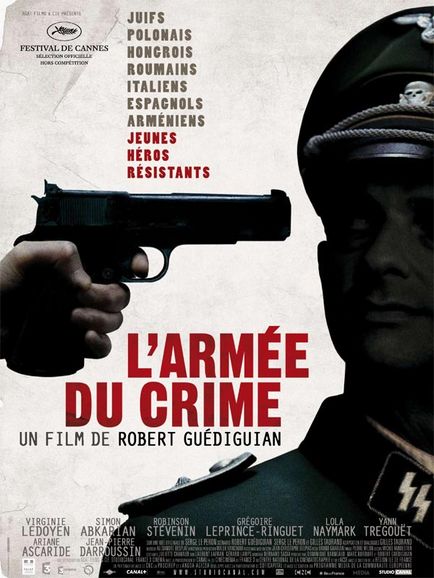
The Army of Crime aka L’Armée du Crime (2009) The Latest Addition to my Top 10 War Movies or A Gut-wrenching Movie on the French Resistance

Robert Guédiguian‘s movie L’armée du Crime or The Army of Crime is one of the best war movies I have ever seen. I already said that it entered my Top 10 immediately. The question that remains: which one I am going to kick out? I’ll have to think about this later. For now let me tell you why I think The Army of Crime is such a brilliant piece of filmmaking. Apart from being based on actual events and being historically very accurate it is beautifully filmed. The actors are outstanding. The protagonists are heroical like not many but at the same time the movie doesn’t shy away to point its fingers not only at the Germans but also at the extremely shameful role the French government played during WWII. We had the heroism of the Resistance and Partisan groups on one side and the cowardly collaborators in the government, the police and among normal people on the other side. Shame on all of them. The movie shows all these aspects, nothing is hidden.  This is the third French movie I have seen in a short period, L’armée des ombres aka The Army of Shadows being the first, The Officers’ Ward aka La chambre des officiers the second.  I must say these movies manage something that not many others achieve. They get under your skin. You don’t only watch these movies, you live them. They don’t let you indifferent. Especially not this one.

1943, Paris, the Armenian poet Missak Manouchian (Simon Abkarian) becomes the leader of a special unit of the French Resistance. His people, men and women, are all very young immigrants. They are Hungarian, Polish and Romanian Jews and Spanish, Italian and Armenian Communists. They decide to form a group and fight for France, the country of the Human Rights, to free and to defend her. They are determined and well-organized and soon will be declared enemies number one. The German occupiers and the French police strike back savagely. They hunt them and use every possible way to capture and destroy them, be it bribery, torture or coercion. In the end they are betrayed and all of them are shot.

The movie tells not only the story of the group and their actions as a whole but shows many intimate portraits of all the individual members. I have hardly ever seen a movie displaying so much diversity. This is underlined by a brilliant score with influences of the music of all the different countries that came together in this fight.

The torture scenes are very graphic. We are not spared anything. The most incredible is that with the exception of one person none betrayed the others. Not even under the worst of torture I have ever herad of. While they were operating in the underground most of their families were being deported to camps. Manouchian is an exemplary man. A larger than life character. He does not use arms lightly unlike some of the other reckless young people. He is a poet, an orphan, a gentle man, married to a beautiful French wife, Melinée (Virginie Ledoyen), whom he loves dearly.

I would like to urge each and every reader to watch this movie as my words will never really manage to convey its utter beauty. It is also worth mentioning that we see a lot of Paris.  The Army of Crime is one of those very rare movies that are, simply put, masterpieces in which every element is perfect.

The following people died for France: (AR = found on the Red Poster or Affiche Rouge):
Celestino Alfonso (AR), Spanish, 27
Olga Bancic, Romanian, 31
Joseph Boczov [József Boczor; Wolff Ferenc] (AR), Hungarian, 38
Georges Cloarec, French, 20
Rino Della Negra, Italian, 19
Thomas Elek [Elek Tamás] (AR), Hungarian, 18
Maurice Fingercwajg (AR), Polish, 19
Spartaco Fontano (AR), Italian, 22
Jonas Geduldig, Polish, 26
Emeric Glasz [Békés (Glass) Imre], Hungarian, 42
Léon Goldberg, Polish, 19
Szlama Grzywacz (AR), Polish, 34
Stanislas Kubacki, Polish, 36
Césare Luccarini, Italian, 22
Missak Manouchian (AR), Armenian, 37
Armenak Arpen Manoukian, Armenian, 44
Marcel Rayman (AR), Polish, 21
Roger Rouxel, French, 18
Antoine Salvadori, Italian, 43
Willy Szapiro, Polish, 29
Amédéo Usséglio, Italian, 32
Wolf Wajsbrot (AR), Polish, 18
Robert Witchitz (AR), French, 19

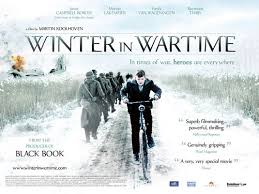
Winter in Wartime aka Oorlogswinter (2008) Resistance in Occupied Holland

Winter in Wartime is a Dutch-Belgian co-production filmed in three languages, German, Dutch and English. The same producers who did the outstanding movie Zwart Boek aka Black Book did also this one. There are some resemblances picture wise but apart from that the two movies are very different. Winter in Wartime is to be classified among the long list of Children in War Movies (please see my post Children in War Movies).

Michiel, a young boy of 14 years, gets drawn into the Dutch Resistance after one of his older friends, an active member of the Resistance, gets shot. Michiel takes it upon himself to help a young RAF pilot who has been shot down in the woods near his village. As young as he is Michiel has a strong sense of right and wrong and despises his father whom he accuses of collaborating with the Germans. He idealizes his uncle Ben who thinks his brother is a coward.

Occupied Holland is swarming with Germans. It is extremely dangerous for Michiel to help the young injured British soldier and he has to let his sister who is a nurse in on his secret. After a German soldier is found shot in the woods the Germans arrest Michiel’s father. Although his uncle says he can help him, the father is shot.

Michiel’s only mission from then on is to save his the young pilot. The ywill attempt to flee several times. Michiel will learn a few important lessons and come out wizened of this experience.

The movie is very beautiful as we see long takes on the snow-covered Dutch countryside. Snow flakes fall softly in many a scene, the whiteness of the woods builds a stark contrast to the dark uniforms of the Germans. Michiel is a wonderful character. Such a young boy with such an incredible idealism and courage. The young actor, Martijn Lakemeier, did a great job. So did  Jamie Campbell Bower as the pilot Jack. I also liked the relationship between the boy and his father or rather how the opinion the boy is change through the events. Apart from that I’m not too sure about this movie. You could watch it with very young people or children to teach them something about the war and values but I think it is too much of a purely invented story and does lack realism. If you watch it you will understand what I mean. There are a few things that just seem extremely farfetched.

Don’t get me wrong, it is watchable. Just not great. If you have never seen a movie on Dutch Resistance, go for Black Book. If you’d like to watch something on Nordic Resistance, try Max Manus or Flame & Citron. All three are great. This one is probably a 3.5-4.