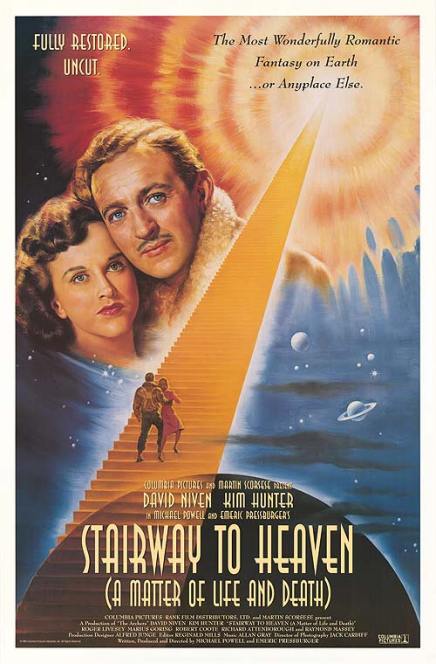
A Matter of Life and Death aka Stairway to Heaven (1946)

After having watched and loved The Archers’ (Michael Powell and Emeric Pressburger) The Life and Death of Colonel Blimp, I decided that I will watch all of their movies sooner or later. I’m not sure I would have taken the same decision if I had seen A Matter of Life and Death aka Stairway to Heaven (the US title) first. It was too… Hmmm… Not sure what word I’m looking for here. It seems it is on position 20 of the BFI’s Top 100 list (yes, another list but one I like). Surprising.

The story is pretty simple. The RAF pilot and squadron leader Peter Carter (David Niven) tries to fly back to England in a burning Lancaster bomber. His crew has bailed out, one of his men is lying dead in the aircraft. Before deciding that he will bail out as well, despite the fact that he has no parachute, he manages to contact June (Kim Hunter), an American radio operator, based in England. They talk for a while and immediately feel a very strong connection.

Lucky for Carter, his Other World guide misses him in the thick English fog and instead of being guided to heaven, Carter wakes up on a beach. He thinks at first he’s dead but then realizes that he has somehow survived and only minutes later he sees a girl on a bicycle riding along the beach. He runs after her and – what a coincidence – finds out it’s June. When it dawns on them that they had been speaking to each other just a while ago and that he should actually be dead, they fall in love immediately.

Although Carter seems unharmed, he has hallucinations in which he meets his guide who wants him to come to heaven with him. Carter refuses and wants to appeal before the superior court in heaven in order to be granted to stay alive. While Carter thinks he is visited by someone from the other world, June asks a friend, Doctor Reeves (Robert Livesey), for help. Reeves thinks that Carter suffers from a rare condition and needs surgery.

I couldn’t help but laugh out loud when our two main characters fall in love so speedily and call each other “darling” only moments after having met. Still, it’s an amusing movie but the appeal for me was not in the story.

I liked that the real life scenes were shot in Technicolor, while the afterlife scenes were shot in black and white (reversing the effect in The Wizard of Oz) . The Archers’ use of color is quite special and I think they did a really great job here.

What was also interesting is the American-British theme. We all know that the British called the American soldiers “overpaid, oversexed and over here” and there was a lot of resentment going hand in hand with this expression. The Americans joined the war late and were fresh and crispy and had a lot of money and managed to seduce quite a lot of British girls, while the Brits had already fought for several years, were tired and worn out. The movie tried to reverse this in choosing to depict an American girl falling in love with a British officer. The heavenly court also plays heavily on this theme.

There is one sequence which is quite funny. The first heavenly jury has to be dismissed as the members are all from countries which had been wronged by the British at some point during history. The prosecutor is an American as well, Abraham Farlan, the first victim of the American Revolutionary war.

If you are a fan of The Archers or interested in British cinema and cinema of the 40s, don’t miss it. I think it’s interesting from the point of view of cinema history and amusing enough but I can’t say it was my cup of tea. As far as war romances go, I’ve seen movies I liked much more.

I couldn’t find  a trailer but you can watch the whole movie on YouTube. Here is Part I
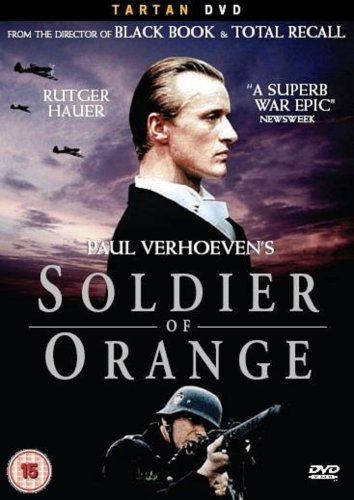
Paul Verhoeven’s Soldier of Orange – Soldaat van Oranje (1977) Dutch Resistance

I think it was obooki who first suggested I watch Paul Verhoeven’s Soldier of Orange – Soldaat van Oranje in a comment on my Starship Troopers post. I’m certainly glad he did. It’s like a companion movie to one of Verhoeven’s latest movie Black Boek – Black Book. While I thought Black Book was quite good – although not as good as many other resistance movies – I’d say Soldier of Orange is far superior and deserves to be named among the best.

I have a predilection for the WWII sub genre of resistance movies and I’m aiming at watching them all sooner or later. Most of the really good movies I’ve seen were either French or Nordic in the broadest sense (including Germany and the Netherlands).

Soldier of Orange is based on the autobiographical novel of the Dutch resistance leader Erik Hazelhoff Roezelma. It tells the story of six upper-class university students whose lives are profoundly changed by WWII. While one of them becomes a member of the German-Dutch SS, the others are soon joining the resistance.

The two best friends Erik Lanshof (Rutger Hauer) and Guus Lejeune (Jeroen Krabbé) are the two main characters. While Guus is a resistance leader, Erik is at first reluctant to even join but the longer the Nazi occupation lasts, the more he feels the urge to do his bit.

With the help of their friend Robby and his radio they get into contact with the resistance in England. The first mission they organize goes very wrong. One of their friends is captured, tortured and executed. Erik and Guus manage to escape but from now on they must be extra careful. Erik soon notices that he is followed. It’s obvious that someone has betrayed them and they are quite certain to know who it is. It must be one of their British contacts.

The first part of the movie is set in the Netherlands. It shows how Erik changes. While at first this is only an adventure for him which he doesn’t take too seriously, when he discovers he’s followed, he know he has to make a decision. Although his love interest, Robby’s Jewish fiancée, is in the Netherlands, he decides to escape to Britain and operate from there.

The second part is set almost entirely in the UK. Erik and Guus meet the Dutch Queen Wilhelmina, who is in exile in the UK. She wants to get in contact with the Dutch resistance and establish a connection between the resistance in England and those at home.

Shortly after their arrival in the UK, the two men are sent back again to fetch some of the Dutch resistance leaders.

The movie contains all the typical elements one would expect in any resistance movie; adventure, danger, missions, betrayal inside the own ranks, torture, executions. What makes Soldier of Orange especially good is that it rings so true. The characters are quite complex and so is the Dutch society which is depicted. The movie doesn’t idealize anything, it shows how many traitors and collaborators there were among the Dutch. It is one of the Queen’s biggest concern what she will do with those after the war.

The picture was remarkably fresh and from that perspective the movie could be very recent. The colors are intense and crisp, it’s really enjoyable to watch. The music however is dated. I’d say it’s a typical 70s war movie score.

What surprised me was how cheerful and uplifting the tone was. Most resistance movies are slightly depressing. This one is not. Erik and Guus are both rascals, they enjoy women and adventures and while they would be glad if the war was over, the idea to cheat on the Germans amuses them so much that almost feel it’s all worth it. Their cheerfulness is quite infectious.

All this together would have made me like the movie but what makes me love it is Rutger Hauer. Ever since I watched Blade Runner for the first time some years ago, I thought he was an extraordinary and very charismatic actor.

From the point of view of the tone, I’d say Soldier of Orange is at the opposite end of  The Army of Shadows – L’armée des ombres and Flame & Citron (Flammen and Citronen) which are both depressing and full of angst. The Army of Crime and Max Manus occupy the middle ground.

Here are the resistance movies I’ve reviewed so far:

Lucie Aubrac – French

Rome, Open City – Roma, città aperta – Italian

Female Agents- les femmes de l’ombre – French

Tomorrow We Live – British

The Army of Crime – L’armée du crime – French

Winter in Wartime –  Oorlogswinter – Dutch

The Army of Shadows – L’armée du crime – French

Max Manus – Frihedskæmperen Max Manus – co-production Norway/Denmark

Flame & Citron – Flammen and Citronen – co-production Norway/Denmark/Sweden…

I have seen many more pre-blogging and will need to rewatch some of those. Do you have any favourites?

Nordwand – North Face (2008)

Maybe the German/Austrian/Swiss co-production Nordwand – North Face isn’t strictly speaking a war movie but it contains one of my favourite subjects, Nazi ideology and propaganda and therefore still qualifies. Plus it’s a stunning movie which had me glued to the screen until the end.

Before I start the summary, let me share a little anecdote. I remember when I was a kid we stayed at the holiday house of my parent’s friends in the Alps. The house was facing the Eiger. I was just 8 years old and scared. I found the mountain to look as if it was looming. I had the feeling it was moving towards me and just about to swallow me. I had no idea at the time that Eiger means ogre. Funny enough, my father, a typical big city person, had a similar reaction. He wasn’t scared but admitted to feeling uncomfortable. My mother who had been living in Switzerland much longer, didn’t mind that much but she didn’t enjoy it either.

When I saw North Face I was catapulted back to this holiday. I’ve hardly ever seen a movie capture how scary those mountains are. The Eiger’s North Face (Nordwand) was called “Mordwand” (murder wall) for a reason.

The movie is set in 1936. Until then nobody had managed to climb the north face of the Swiss massif the Eiger. Athletism was an important pillar of Nazi ideology and propaganda. Athletes incorporated the Nazi ideal to perfection so naturally there was a lot of interest in Germans being the first to manage what nobody else had managed before. At the same time as Germany was about to annex Austria and the Olympics were imminent, a win on the Eiger would be good for the reputation of the Nazis.

Luise Fellner is a young woman trying to become a journalist. She grew up with Toni Kurz and Andi Hinterstoisser who are some of the best climbers at the time. When her boss, an eager journalist, finds out about the connection he sends her to her home village to try to persuade them to climb the North Face and give her the chance to prove herself as a photojournalist. Despite Andi’s efforts to convince his friend, Toni, the more thoughtful of the two, is reluctant. He thinks climbing the Eiger is by far too dangerous. Only when Andi finally decides to do it on his own, he follows him.

Luise and her boss travel to Switzerland and stay at the hotel in front of the Eiger. Meanwhile it has become a real competition. There are climbing teams from Italy, France and Austria. In the end only two teams, the German and the Austrian team, will start the climb.

Nordwand is an amazing movie. The cinematography is stunning. This is as close to climbing as you can get without actually doing it. It’s also a love story and the story of an emancipation as Luise faces a lot of prejudice and sexism in her profession. Furthermore it is a story of a unique friendship and one of the most tragic true stories I’ve ever seen.

The movie also shows nicely how the media contributed to the success of nazism, how people already then were keen on sensationalism, how they were hungry for drama and tragedy without thinking of the human pain and loss this meant. There are some interesting secondary characters who illustrate this well.

Another aspect which certainly contributes to the movie’s success are the actors. They  are outstanding, Ulrich Tukur plays the overeager older journalist, Johanna Wolkalek stars as the young photojournalist and the two mountaineers are played by Benno Fürmann as Toni Kurz and as Florian Lukas as Andi Hinterstoisser.

North Face is one of the best mountaineering movies, certainly a great war themed movie but most of all an incredible and really tragic true story.

http://www.youtube.com/watch?v=Of9fd6smarA&feature=fvst

The Eagle (2011)

I was in the mood for a guilty pleasure and The Eagle is just that. I must admit that I liked it far better than I expected. I even liked it quite a bit. It’s not historically accurate and you have to oversee the way “the barbarians” are depicted, the good versus evil vibe is quite heavy-handed but still, I enjoyed it for various reasons.

First of all The Eagle is visually compelling. The images are beautiful and I liked the atmosphere they created a lot. The other reason why I liked the movie was the main character, Marcus Flavius Aquila (Channing Tatum). Tatum isn’t a very good actor but he does well when he has to play an introverted, wounded man.

In 120 A.D. Flavius Aquila, Marcus Flavius Aquila’s father, led the 9th Legion, 5000 Roman elite soldiers, far into Britannia, beyond the border of the Roman Empire. The Legion never returned and the emblem, the eagle, was stolen.

20 years later Marcus Flavius Aquila is sent to Britannia as Centurion of the remotest outpost near Hadrian’s wall. The soldiers under his command are not very keen on a man whose father disappeared. They think he means trouble but he is doing surprisingly well. We are introduced to a deeply religious man who is a very skilled and courageous soldier and a just commander. Unfortunately he’s gravely wounded in his first battle and sent to his uncle (Donald Sutherland) to recover. He gets an honorable discharge as his wound will not allow him to return to the life of a soldier. This is hard for him as being a soldier is all he knows and on top of that his secret hope was to restore his father’s honour.

When he watches some games with his uncle and sees a slave losing a fight against a gladiator he saves the slave’s life. While Esca, the slave, hates everything Marcus represents he still swears to be loyal. Marcus sees an opportunity to go beyond the wall, guided by someone who comes from there and speaks the language. He hopes to find out what happened to his father and maybe bring back the eagle.

Their quest is taking them far into enemy territory. The task is as difficult as it is dangerous.

A lot has been said about the bromance element in this movie. I’ve never really understood that term anyway. For me this was the story of an adventure and how two unlikely men become close friends. Call it “bromance” if you must.

As I said already, I liked this quite a bit. I thought it was well filmed and suspenseful. I spent two pleasant hours with this movie and wouldn’t mind watching it again. It’s not as good as Gladiator or King Arthur but personally I liked it better than Centurion and much much better than The Last Legion which is really not good. Watch it if you like movies set during the Roman Empire.

If you want to watch more movies set during the Roman Empire here’s my list: War Movies Set During the Roman Empire.

Eichmann (2007)

I was looking forward to watch the British Hungarian co-production Eichmann starring one of my favourite German actors Thomas Kretschmann. If I tell you it was entertaining this should ring a bell right away. A movie based on Adolf Eichmann’s interrogation should not be entertaining. No, it really shouldn’t. If it is, something went wrong. And that’s what happened. I should have known this wouldn’t be a good movie because most reviews are far from appreciative but I was curious and wanted to find out for myself.

The core question, which isn’t really explored as well as I would have wished, is whether someone who follows an order and gives orders, like Eichmann did, is as guilty as those who executed the orders or those who decided they should be given. It’s the same question that lies at the heart of plays like Macbeth. Lady Macbeth tells Macbeth to kill, does that make her less guilty than her husband who did the killing?

Eichmann was one of the highest Nazi functionaries. He had the position of Transportation Administrator of the so-called Final Solution. In this function he was in charge of all the trains that  brought Jews to the death camps in occupied Poland. It is said that he is responsible for the execution of 6.000.000 people. After the war he could escape to Argentina. He was one of a few Nazi criminals not to be sentenced at the Nuremberg Trials because he was in hiding. The State of Israel was established in 1948. Its official intelligence agency, Mossad, was formed one year later. One of Mossad’s principal assigned tasks was to hunt down accused Nazi war criminals. Eichmann was captured in Argentina in 1960 and brought to trial in Jerusalem in 1961. He was executed in 1962.

The movie however isn’t very explicit on all of this but focusses purely on the interrogation. Avner Less, a young Israeli police officer whose father had been on one of the trains sent to Auschwitz by Adolf Eichmann, was the one who interrogated Eichmann. The movie is told from Avner’s point of view. It shows the problems this interrogation brings to his family and to himself, the reaction of the public, how the media hunt him.

The interrogation as such had the aim to make Eichmann confess. Most of the interrogation we see consists of Avner asking and Eichmann denying. Whenever Eichmann lies, the movie shows what really happened in a flashback and that’s where the movie gets entertaining but absurd as we see Eichmann depicted like a gigolo with various lovers. Really weird.

On the other hand, while showing a shallow and silly Eichmann in the flashbacks, the way the people in Israel talk about him in the movie makes it sound as if they thought he was the sole responsible for the murders of so many people. Both are gross exaggerations and make this a really dubious movie.

I don’t understand why this incredible story could not have been done any better. It certainly would have deserved to be told well.

I have bought Hannah Arendt’s book on the Eichmann trial Eichmann in Jerusalem: A Report on the Banality of Evil a while back. I would have done better reading that instead.

One word about the actor. Many reviewers criticized Kretschmann for his wooden acting. I saw documentaries of the trial and think the man Eichmann was very wooden. In any case, it’s not the actor’s fault this isn’t a good movie. I’d say he was actually quite good.

Still, a movie like Eichmann has some value as it may generate an interest in people to find out more about this sinister character and it may trigger conversations about guilt and responsibility. But it’s not a good movie.

http://www.youtube.com/watch?v=5x0qnEZ0nWY