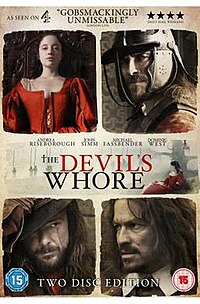
The Devil’s Whore aka The Devil’s Mistress (2008)

What troubled times these were. 17th century England. Thomas Rainsborough. Oliver Cromwell. The English Civil War. The Levellers. The execution of Charles I. Put all this together and use as a central figure a beautiful young woman, married three times, said to have seen the devil, accused of being a whore and surviving her execution and you have the ingredients of a very entertaining mini-series.

The Devil’s Whore or (called The Devil’s Mistress in the US) tells the story of the fictitious Angelica Fanshawe. Related to King Charles I we see her married to one of his relatives who ends up being executed. The English Civil War is seen through her eyes and its troubled history told in a very dramatic way. It makes you want to brush up your history immediately. As the addition of this fictitious noble woman tells us, the filmmakers have taken some considerable liberties, still they mange to convey how chaotic these times were. Cromwell was at the head of the Parliament, together with Thomas Rainsborough, the head of the so-called Levellers. These two men occupy two extreme positions. One wants to gain power over the parliament and have the King listen to them, while the other, as the name of the movement says, want’s all men to be the same. No more aristocracy and hierarchy. The land should be divided among everyone. As much as they are friends in the beginning, they clash and when Rainsborough is killed, it seems likely that Cromwell is responsible.

After the beheading of Charles I Cromwell is the most powerful man in England. He sends the army to Ireland and fights on many different fronts. But the war doesn’t bring peace to the country. Cromwell finally realizes that England sn’t ready yet. If he wants to restore peace there must be a new king.

I love this mini-series and have already watched it twice. Admittedly I didn’t only like it for the historical and political background but because I enjoyed Angelica Fanshawe’s story that is interwoven with the facts. In the beginning of the movie, when she is only a little girl, she sees the devil in a tree. He seems to mock her. But at the same time he transforms her into a woman, far more gutsy than women were at this time. She chooses her husbands, she speaks freely, she disguises as a man when needed and fights like a man as well.

The Devil’s Whore is an entertaining tale and a guilty pleasure set during the English Civil War, starring actors that have become famous with other movies and series. Dominic West (The Wire) plays Oliver Cromwell and Michael Fassbender (300, Inglourious Basterds, Shame, Fish Tank) is Thomas Rainsborough, John Simm (Life on Mars) is Edward Sexby and Angelica Fansahwe is played by Andrea Riseborough.

The only English trailer I found has Portuguese subtitles but that shouldn’t matter too much.

http://www.youtube.com/watch?v=7h0xf4SXoxY

Alejandro Amenábar’s Agora (2009)

I find it surprising that this movie, although not a “real war movie”, didn’t even get the tag “war” despite the fact that civil war is a major topic. I had meant to watch Agora a long time ago although I read many mixed reviews. Now that I have finally seen it I can see why. It is a flawed movie, it is the victim of silly marketing as well as the victim of what I think is a bad and misleading title. All this said I still think it is excellent and how many times do I have nightmares after having watched a movie? And, yes, Agora, woke me, it woke me because the story it tells – and which is a true story – is deeply upsetting for many reasons.

391 A.D. Alexandria. The Roman Empire is in decline. The philosopher, astronomer and mathematician Hypatia is an influential figure in the city. She teaches and does research. One of her main topics is the movement of the planets. She wonders whether the sun is really moving around the earth. Her lectures are lively and interactive. She doesn’t mind being contradicted but she wants to hear reasons, well formulated thoughts. It seems she was an attractive woman and some of her pupils are in love with her. She doesn’t want to get married, her life is dedicated to philosophy and research.

The city of Alexandria is composed of different people, Jews and Christians and of course, the so-called heathens, like Hypatia herself. The Christian movement which is not more than a sect is becoming more and more influential and finally a civil war breaks out during which the famous library of Alexandria is burned down and the Christians, led by their bishops, take over the city.

Hypatia is tolerated but not allowed to teach anymore. The longer the Christians are in charge and when they finally also start to persecute the Jews, she is in danger as well. It isn’t liked that she insists upon the fact that the earth circles around the sun and not the other way around. And worse than that, it’s not tolerated anymore that a woman occupies an influential position. Her end is famous and extremely gruesome. The trailer and some of the movie posters make us believe that we will watch a romance. While there are men in love with Hypatia we do not see any love stories but in order to make her ending more acceptable for sensitive movie goers this aspect plays into it.

Before she is killed, Hypatia is accused of witchcraft and the bishops insist that women are to be subjugated by men. All the reasons for this are taken from the bible and the fact that Jesus had 12 male apostles but no woman serves as another proof.

After having watched this and done a bit of research on Hypatia I must say that she was a truly amazing woman. She had found out with very primitive methods (nicely shown in the movie), that the earth isn’t the center of the universe. We know how long it took until this was rediscovered and how long the Catholic Church fought this discovery.

I think it would have been justified to call this movie Hypatia and not Agora. Yes, it’s about the end of an era but more than that it is about a woman and the war against women that still rages in many countries.

Religious fanaticism, no matter the origin, is something that upsets me and one group of people oppressing another group does upset me as well. The combination of topics in this movie make it topical and many elements are as explosive today as they were then.

I’m not much of a Rachel Weisz fan but she is convincing in this role. I have only seen one other of Amenabár’s movies The Others which I liked but I haven’t seen his highly acclaimed Mar adentro – The Sea Inside. After having watched Agora, I’m keen on watching other movies by him.

I am fascinated by this story and would love to read a book about this period and Hypatia. Does anyone have a suggestion?

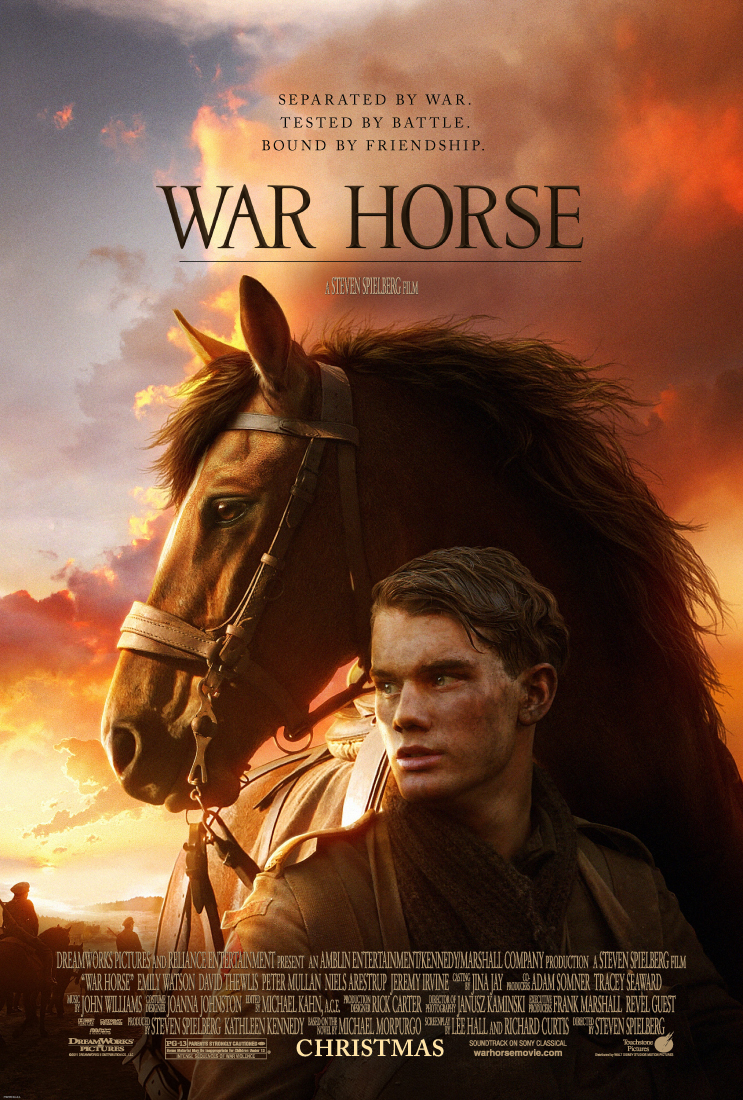
War Horse (2011)

I find it much harder to watch anything depicting cruelty to animals than to humans. I can’t help it. And despite the fact that Steven Spielberg’s War Horse is decidedly tacky at times, it really upset me. Not so much the movie – things are toned down to make it suitable for all ages, I guess, – as to think about what those horses went through in WWI.

Based on Michael Morpurgo’s eponymous novel, War Horse tells of the friendship of a farm boy with a horse. It’s very Black Beauty in the beginning. Out of sheer folly Albert’s father buys an expensive race horse that he can neither afford nor use. Albert manages to save his father’s farm and the horse and trains the animal until it is able to perform the duties of a workhorse. He also teaches him to come when he whistles and many other tricks.

When the war breaks out, Albert’s father sells Joey to a British officer who takes the horse to France. This almost breaks Albert’s heart but the officer, a kind man, promises to take care of Joey. Sadly he is killed in a reckless cavalry attack that goes very wrong. The horse, one of the rare that survives, can escape but is captured by the Germans. After this an odessey begins in which Joey changes hands more than once and more than once faces death.

Albert who has sworn to find his horse wherever it is (a bit of a Last of the Mohicans moment), has heard of the death of the officer and signed up. Soon he finds himself in the trenches in France.

The movie isn’t too graphic, we don’t see wounds and atrocities that you would normally see in a war movie, still it manages to convey the horror. It just does it by focussing on other elements. We see how many horses died in cavalry attacks and how thousands were overworked until they died from exhaustion.

The parts related to the war were, in my opinion, well done. Without being too graphic they illustrated a lot that was typical for WWI like the trenches, the mud, the gas. What was tacky was how the story was told at times and the end which didn’t seem very realistic. On the other hand the scene of Joey who runs down No Man’s Land and gets caught in barbed wire, manages to convey a better anti-war statement than many other movies.

The acting is quite good and in the case of Benedict Cumberbatch, in a very short but effective role as British Major, and Emily Watson, as the mother of Albert, even excellent.

Apart from showing the harrowing destinies of horses in WWI the movie captures the beauty of the bond that can exist between a human being and an animal.

Defiance (2008) The Bielski Partisans

After having moaned about the accent situation in Defiance (which you can read here) it’s now time to get to the review and I must say, all in all, I didn’t think the movie was all that bad. And we have to bear in mind that it’s based on a true story, the story of the Bielski partisans or Bielski brothers.

After having found that their parents had been killed by the Nazi’s who systematically exterminated Polish Jews, the four Bieski brothers flee to Belorussia and hide in the woods. The two older brothers Tuvia (Daniel Craig) and Zus (Liev Schreiber) have both lost their wives and children as well. While hiding in the forest they are joined by a group of Jews and decide to stay together and try to survive in the forest. After a while, more people seek refuge in the woods and the Bielkis take them up. Tuvia in particular brings back people from every food searching expedition which creates huge tensions between the brothers. It is clear that Tuvia is the leader and this is another source of tension as their leading style is different.

After a few weeks or months the camp in the forest is almost a little village, there are now hundreds of people who need to be fed, who need shelter and protection as the Germans swarm these woods. On the other hand there is strength in the number as they have people with all sorts of professions among them. Nurses, carpenters, teachers. After a few more months the tension between the brothers escalates and Zus leaves the group and joins Russian partisans. This is initially ideal for the group as this means additional and armed protection.

The movie shows how they struggle. The winter is particularly hard for them, many fall ill. It’s incredibly difficult to find food for so many people and they are surrounded by enemies. They have to fight quite often and there are combat situations as well. There are also a few love stories that will lead to relationships that last a life time. We also see them execute different missions, like saving people from the ghetto before they are sent to the camps.

I found the movie interesting and fascinating because it is a true story. In the end the Bielski brothers saved at least 1500 people. That’s quite amazing. I’m quite fond of Daniel Craig and thought he was a good choice for Tuvia.

While I wouldn’t say this is a must-see movie, it’s not bad at all and when you are not familiar with the story, it’s quite interesting. In any case what these brothers achieved is amazing.

Here is a photo of the real partisans

If you want to read about them here are a few articles The Bielski Partisans and Tuvia Bielski and a wikipedia article Bielski partisans.

Bertrand Tavernier’s Capitaine Conan – Captain Conan (1996)

Have you seen Capitaine Conan? You haven’t? Well then I’d like to know why you are sitting here, reading this blog when what you should really do, is chase a copy of this unique and brilliant movie? This is one of the best war movies I have seen in a while. I’m doing pretty bad with movies these days and have found my attention span is quite short but this movie had me glued to the screen. WWI movies tend to be a bit repetitive, it’s either the atrocity of the trenches, facial wounds, the analysis of the shortcomings of the high command or the incredible amount of dead and lost soldiers. All of it worthy themes but done a few times and quite brilliantly too. That’s why it was such a surprise that there is hardly any of this in Capitaine Conan. 

Capitaine Conan is based on the largely autobiographical novel Captain Conan by Roger Vercel who won the prestigious Prix Goncourt for the book. Vercel based the main character on one of his comrades.

The most interesting aspect is that the movie (and the book) takes place on the Bulgarian border where French and English troops fought a guerrilla like war against Germans and Bulgarians. There are trenches but a lot of the combat is hand-to-hand combat, man against man.

The lieutenant Capt Conan is an insubordinate, extremely wild and brutal soldier. But also someone who cherishes camaraderie. Instead of eating with the fellow officers, he rather sits somewhere with the men. He leads a group of 50 men that he calls his wolves. They are all equally fearless, brutal and, as it seems, addicted to violence but also a tight-knit group, ready to do anything for each other. There is nothing they like more than fighting man against man and mostly with knives. Because Conan is highly efficient and can turn around the course of hopeless battles, his superiors let him do as he pleases but when the war ends, things go wrong. His bloodthirsty men are too easily bored. They start to commit one crime after the other. Pillaging, raping, robbery. Conan who calls himself a warrior, as opposed to a soldier, isn’t any better and let’s his men get away with everything. Conan has long-lost his sense of right and wrong and all that he cares about are his men. War has turned him into a brute.

Among this violent crowd is a more gentle lieutenant, who wants to become a school teacher in peace time. If it wasn’t for him, who is appointed as prosecutor, Conan and his men would be court-martialled. The friendship between these two men grows slowly but once it’s established, it is indestructible.

It’s quite difficult to do this movie justice as it is very complex and quite fast-paced. Conan is a fascinating character and the way Tavernier depicts him we can’t help but admire him. In the world of WWI, in which there are so many officers who never dirty their hands but make the most important decisions without having a clue, someone like Conan, with a sense of honour and dignity, despite the brutality, becomes admirable. He is ruthless but he has a sense of loyalty and justice. The problem is, that men like him cannot go back to a normal life, once the war is over. They have gone too far.

After the war has ended, they are boarding a train and sent around without really knowing where they go. They stop in Sofia for a long time and are finally sent to the Russian border to fight the Bolsheviks. The scene in which the general informs them of the Armistice is one of the greatest scenes in any war movie ever. It’s so absurd. We see the guy talk about victory and glory, while the rain is pouring down, half of the men are running away because of diarrhea and the highly decimated band plays an off-key Marseillaise and looks like a bunch of flea-infested hobos.

I really hope I could give a halfway good impression of this wonderful movie and how rich it is. It’s very witty with super fast dialogue that I hope is well captured in the subtitles. I have a French DVD so I turned them off. It’s one of the huge problems of French cinema in translation. French cinema does live to a large extent from the dialogue which is usually fast and a lot of it isn’t translated. This isn’t a comedy but it has a lot of funny elements because it shows how absurd war is and because it juxtaposes many different levels of French society and different French regions.

As I said, the movie is available with English subtitles but the only trailer I found is a French one with Spanish subtitles. It still gives a good impression of the movie.