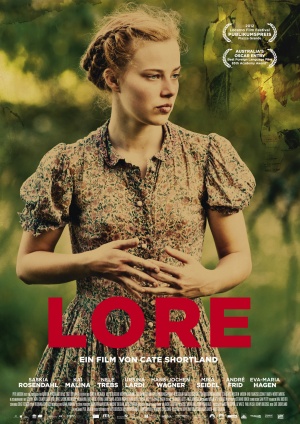
Lore (2012)

Lore

What a pleasant change, I’ve actually watched a movie and really, really  liked it. I’d say it was certainly the best wartime movie I’ve seen in a long while. Lore is a German/Australian/UK co-production. Spoken in German, with German actors and subtitled in English. It’s based on Ruth Seiffert’s highly acclaimed novel The Dark Room. Or, to be more precise, on one of the three interlinked stories in the book.

Lore is the eldest daughter of a prominent Nazi functionary. Indoctrinated with the ideology, she blindly loves her father and the Führer, follows every order without questioning and takes everything she’s ever been taught to be the absolute truth. The movie begins at the end of the war. Her parents are in distress, something has happened but they won’t tell their children. The family flees to a holiday home in the country where people treat them aggressively. Lore has no clue what is going on. She knows her parents are hiding something. The father leaves them, and shortly afterwards the mother leaves too. She is giving herself up and goes to prison unsolicited. Before she leaves she tells Lore that the Führer is dead. Everything is lost. Lore has to take her four siblings, one of them is just a baby, and walk in direction of Hamburg where her mother lives.

The movie follows the children on their difficult journey towards Hamburg. It shows how difficult and dangerous it is for them. They risk starvation, rape, being killed or captured. They have to cross three different sectors, the US, the Russian and the UK sector. Even though they are only children, they are suspected and interrogated. At one point a young man starts to follow them. He carries papers and pretends being their older  brother. This makes all of their lives easier.

Lore is more than a road movie, it delicately portrays the total disenchantment of a young girl. On their journey they are not only confronted with severe deprivations but they learn the truth about their beloved father and the Führer. Everything Lore believed in was built on a lie.

I’ve never seen a movie, which focussed on the children of high Nazi officers. I never wondered what became of them after the war. The movie shows what a long and painful process it was to learn the truth.

The story as such is quite gripping and the way it was told was masterful. I haven’t seen any  of Cate Shortland‘s other movies but she’s a film director I’ll keep in mind. Lore was beautifully filmed and the score, written by Max Richter, enhanced the gloomy atmosphere of the film. The atmosphere and the mood was probably what I liked best: lyrical, melancholic and gloomy.

I’m not surprised Lore has won so many prizes and been nominated for many awards. I’d say it’s the first 5/5 movie I’ve seen this year. Don’t miss it.

Has anyone seen the film?

Roland Joffé’s There Be Dragons (2011) A Movie of the Spanish Civil War? or A Propaganda Piece for Opus Dei?

there_be_dragons_ver3

There Be Dragons is a movie on the Spanish Civil War, focussing heavily on the founder of the Opus Dei José Maria Escrivá. That’s in itself problematic, but the movie has other shortcomings besides reeking of “propaganda”.

There aren’t all that many movies on the Spanish Civil War that’s why I was quite keen on watching this movie. I normally like Dougray Scott and seeing that he’s in this, made me hope it would be good. Unfortunately he’s just a minor character, although the one who gets the ball rolling. Geraldine Chaplin who is also starring in this film has an equally small role.

Roberto Torres (Dougray Scott) is a young journalist researching José Maria Escrivá (Charlie Cox), a priest and founder of the Opus Dei who is a candidate for canonisation. Roberto discovers that his own father from whom he is estranged since years, knew Escrivá. He travels to Madrid, hoping his father will tell him everything he knows about the priest. While Robert’s father Manolo (Wes Bentley) was friends with José Maria when they were kids, they later fought on opposite sides during the war. The movie tells their respective stories in flash backs. They don’t overlap all that often; it’s really the story of José Maria on one side, and the story of Manolo on the other. Only towards the end, they are briefly joined again. A third story line, tied to Manolo, reveals why the relationship between Roberto and Manolo was so difficult. It has something to do with a tragic love story involving Ildiko (Olga Kurylenko).

Due to these different stories, which are only loosely connected, the movie really is a mixed bag. It glorifies the courage and determination of José Maria, his faith, his steadfastness. Although I don’t feel qualified to say much about the Spanish Civil War with which I’m not very familiar and even less about the role of the Catholic Church, I can still say that the depiction was very sentimental and never grabbed me. I was a bit more interested in the frame story between Roberto and Manolo.

Another flaw was the tempo. This was one hell of a slow movie; it never really took off. This is too bad because the cinematography and the score were superior but I felt they were wasted on this film.

I always thought that Roland Joffé was a director who would guarantee a good movie but unfortunately that isn’t the case. I have no clue what drove him to glorify the founder of Opus Dei. Very dubious. I can’t recommend this movie.

I almost forgot to mention that this is another one of those movies in which all the English speaking actors talk in a heavy Spanish accent. Ludicrous.

Have you seen it? Have seen another movie on the Spanish Civil War that you would recommend?

https://www.youtube.com/watch?v=z17OEqbrOOQ

A Very Long Engagement – Un long dimanche de fiançailles (2004)

Very Long Engagement

It’s entirely the fault of movies like A Very Long Engagement that this blog lies dormant most of the time. Who wants to write about a film like this?

There are movies that I call “darlings” of the public. Everyone goes “oh” and “ah” and “oh so wonderful” just upon hearing the title. Jean-Pierre Jeunet’s Améelie is one of them, and – not surprisingly starring the same actress, Audrey Taoutou – Un long dimanche de fiançailles is another of those “darlings”. The fact is that most of the time these are precisely the movies I cannot stand. I watched Un long dimanche de fiançailles for the second time, hoping I’d succumb to its charm – but that didn’t happen. On the very contrary. I liked it even less. Why though? I’m not sure. It’s particularly sad because there aren’t all that many WWI movies.

A Very Long Engagament tells the story of two young lovers separated by WWI. Mathilde and Manech fall in love just before the war breaks out. They are still almost children. Both are outsiders. She because she is limping, he because he seems to be a bit simple-minded.

When he doesn’t return from the war, Mathilde swears to find him. It is said that he was court-martialled together with four others. The five men shot themselves in order to be sent home.

Mathilde acts a bit like a PI, interrogating people, following every lead. Although everyone tells her that Manech has been shot, she is convinced that he is still alive. Their connection is strong, she would feel it, if he was dead.

A Very Long Engagement is a typical Jean-Pierre Jeunet movie. His films often look like old sepia-colored photos and have a vintage feel. The trench scenes are not bad and from a purely cinematic point of view it’s a beautiful film but I always have a problem with his characters and find many of them off putting. I would still like to read the book by Japrisot.

Has anyone seen it? Did you like it and if so why?

http://www.youtube.com/watch?v=B-He8XWlRL8

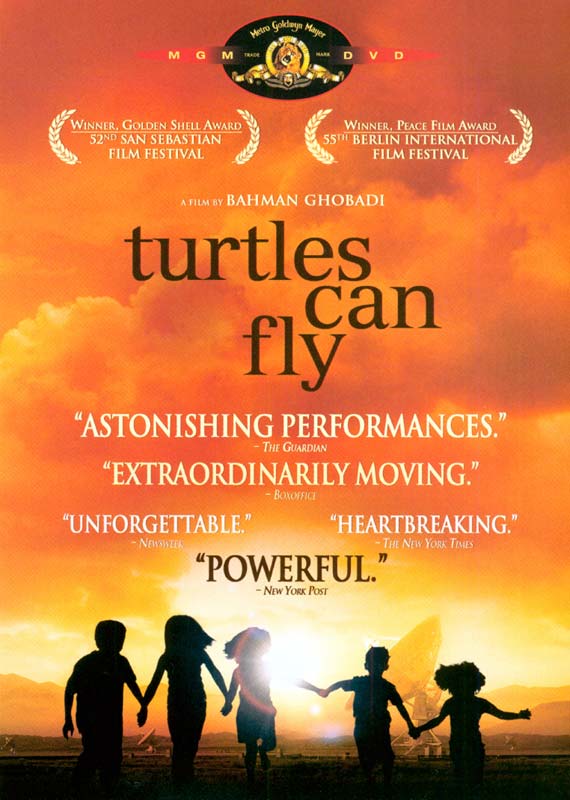
Turtles Can Fly aka Lakposhtha parvaz mikonand (2004) Iraqi – Iranian Movie on Children During Wartime

turtles-can-fly-2004-lakposhtha-parvaz-mikonand

Occasionally I’m tempted to stop watching war movies. After all, it’s hardly ever cheerful. But there is a huge difference between “not cheerful” and “utterly depressing”. And while combat movie’s are rarely cheerful, they are often not utterly depressing. On the other hand movies focussing on the way common people, and especially children, are affected by war, are often extremely depressing. Among all these depressing movies on the fate of the civilians the Iraqi-Iranian movie Turtles Can Fly, might be the saddest I’ve ever seen. While it’s an excellent film, it’s almost unbearably bleak.

The film starts with a small girl committing suicide. She jumps from a cliff. The story then rewinds and we get to know why she did it.

Somewhere near the Turkish border, just before the war in Iraq breaks out, a group of people live in some houses close to a refugee camp. The elders of the village hire a young boy to buy and install a satellite dish. They want to know if war is coming. The boy is funny, entrepreneurial, and clearly relishes being the only one who knows something about technology and a few English words. He’s maybe 12 or 14 years old (sorry I’m bad at judging the age of children) and runs many small businesses. One of them consists in having other children collect mines which he then sells on the local markets. The whole area is a huge minefield and collecting them is vital because as long as they are on the fields, the farmers cannot work.

Many of these children who collect mines are missing limbs from the one or the other unlucky encounter. The film maker used only children with real deformities and missing limbs which adds authenticity and makes watching it even more harrowing.

“Satellite”, as they call the young boy, falls in love with one of the refugee girls. A very pretty girl who is there without parents but with her older brother who has lost both arms and a small child who has a problem with his eyes. She is the girl who will commit suicide and to learn her story was almost too much.

While there are some funny scenes dedicated to “Satellite” and his business, I’ve rarely seen such a bleak movie. The poverty of these people is extreme. They live in the cold and the rain, there are hardly any trees or buildings, just some huts and tents and a lot of mud. Their situation has a lot to do with former wars. They are surrounded by danger and helpless. Without a proper system of information they are at the mercy of everyone. They never know what hits them or why.

I wasn’t enjoying watching Turtles Can Fly but I was glad I did. This movie is bleak, depressing and heartbreaking but at the same time, it’s very good. The young actors are astonishing, the message is eloquently anti-war.

Here’s the trailer

And the full movie

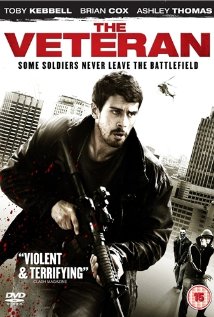
The Veteran (2011)

Veteran

The British movie The Veteran is asking a few interesting questions but the story as such isn’t  very convincing. Too bad. It had potential.

What happens with all those young veterans coming home from wars like Afghanistan or Iraq? Their tours are finished and when they return they have to face the bitter truth that it will be hard for them to find a job and that people really don’t care about them.

Rob is just a guy like that. When he returns from Afghanistan all he finds is an ugly apartment in one of the areas of London were the less privileged live. Drug wars and gang feuds are common. Unemployment is high.

One of his comrades approaches him and tells him his brother offers them a job. The job they are offered is pretty typical for veterans. Surveillance. They are told they have to follow potential terrorists and find out if one of the informants they are using is really trustworthy.

Rob gets beaten up pretty bad during some of his missions and after a while it dawns on him that something is dodgy. Too late.

I’m not going to reveal more of the plot as it’s pretty thin. The movie is still watchable as it depicts a lot of the problems the UK are facing. Not only regarding their veterans but also regarding the many young and  unemployed people.

It’s an interesting companion movie to Harry Brown and also to the US series Homeland. The acting is pretty good but the story a bit too thin. And the message? I have no clue. That’s probably what bothered me the most.

Before I end this post I just want to let know that I will not be online during the next two weeks. I’m travelling.