Under Fire: A Century of War Movies, edited by Jay Slater (2009)

Under Fire is simply a must-have for people seriously interested in war movies or even movies in general.

It contains a collection of essays on all sorts of topics regarding war movies, from WWI to the wars in Afghanistan and Iraq. Many different people have contributed to this very dense work. Well-known film critics and academics alike.

This is really something to sink your teeth into. Quite demanding reading but extremely insightful.

For example did you know how important YouTube´s influence was on contemporary Iraq movies (yes, I even started to understand Redacted)? Or how Vietnam changed the war movies? Do you know a lot about British propaganda movies of WWII? Did you consider to interpret Starship Troopers as WWII and Nazi satire?

These are only a few topics of many that are analysed in these very thoroughly researched essays.

Sure, this is no movie guide as such. It is not recommending or rating anything. Under Fire provides criticism and analysis for those who like to interpret not only the apparent but also the subtext.

This book is really worth having and I am quite excited about this find that manages so well to show the variety, the depth and the virtuosity of war movies.

Here you find the link to the publishing house. It contains an interview with the editor and interesting additional chapters.

Barnes and Noble

amazon.com

amazon co.uk

Katyn (2007) or The Crime and the Lie about a Gruesome Massacre on Polish Officers

This is an outstanding movie. Truly outstanding from every possible point of view. Narrative style, cinematography, actors, story, technical aspects. Absolutely great.

The Polish movie Katyn is about the massacre of some 22000 Polish officers by the Russian army and the subsequent  disposal of their bodies in the Katyn forest in 1940. Once the mass grave is found in 1943 the so-called Katyn list is established.  After having waited anxiously for the return of their fathers, husbands, sons and brothers the families are now informed if or if not their loved ones have been among the victims. However not all the victims are on the list. Many more a still missing and may or may not have been murdered. Many wives still wait for their husbands in 1945.

The movie focuses on two families. One is the family of a Polish General, the other the family of a Polish officer. The story is told in two sequences. The first half tells the story until the massacre, the second tells the story of the lie and ends again with the massacre but this time shown much more explicitly (The way these murders were executed…How can people do this to people?). After the first half we think the story should be over but in reality it only just begins. Seeing it first from the point of view of the victims, we are then guided towards the point of view of the families who wait for them. Their ordeal is a different but very cruel one. Even though everybody knows who killed those officers, officially it is said to have been a massacre committed by the Germans. To say otherwise would be very dangerous. The political climate of the time that made it impossible to even mention a critical view of this incident until 1989 is palpable in all its atrocity.

On my DVD of this movie is an interview with the Polish filmmaker Andrzej Wajda. He tells the interviewer how difficult it was to make this movie. He didn´t know how to tell the story. Should he tell his father´s story, who had been among those officers, or his mother´s who was one of those who did not give up hope until 1945. He decided eventually to tell both stories, juxtapose them, have one mirror the other. This is very skillfully done. Wajda belongs to the so-called Polish Film School and has made many movies, two of his better known earlier ones also deal with WWII:  A Generation aka Pokolenie (1955) and Kanal (1957) about the Uprising in the Warsaw Ghetto.

This film is truly the work of a master, of someone who does not just deliver a story but who weaves it carefully, adding symbolism and criticism alike. And  still it is highly watchable.

Is Passchendaele (2008) the new Pearl Harbor (2001)?

“The British couldn´t do it, the French couldn´t do it. It´s  only us, the Canadian corps” (quote from the movie).

I was  tempted to write: “Once we had Pearl Harbor now we have Passchendaele” and leave it at that. But that won´t do. I´m afraid I must say, that this would have been an easy escape in terms of criticism for Passchendaele. And extremely unfair to Pearl Harbor. This coming from someone who thinks that Pearl Harbor does not even deserve the label “war movie”.

The story in a few words: As the war went on Canadians were getting more and more involved. Being only a little nation at the time, the participation of 600000 was enormous. 1 out of 10 did not come back. At Passchendaele alone 4 000 Canadians died and 12 000 were wounded. This unspeakable tragedy is meant to be shown. To illustrate this we see the exemplary story of one Sgt. who comes back after having fought at Ypern, on Vimy ridge etc. He’s a decorated war hero but shell-shocked. He has done something unspeakable and cannot forgive himself (apparently this bit is taken from Paul Gross´grandfather´s story of his participation in WWI). He is really bad off and won´t have to return. But, as some sort of love sacrifice (not going into details here I leave all the enjoyment of watching this movie and discover a piece of subtle sophisticated filmmaking to you. YES… I´m being sarcastic.), he goes back and ends up fighting at Passchendaele. This is one of the biggest and most notorious battles off WWI. Initially a success for the Canadians and their allies, in the end a failure due to the fact that a few months later Passchendaele was lost again to the Germans.

Watching Passchendaele I was feeling extremely stupid. Why did it escape my attention that this was again a hero + nurse + absurd conflict romance disguised as war movie? Unfortunately the romance part is nowhere near as good as the one from Pearl Harbor (Yes, I think Pearl Harbor is a very entertaining romance, well done). And the war parts? They are odd to say the least. We do see quite a bit of fighting. Between town ruins and in moors and muddy trenches. The odd bits reminded me of  Windtalkers (so watch out all you who liked Windtalkers). Many explosions, one unconvincing “in the trench of the enemy scene” plus, this was quite original, people keep on flying like puppets. Oh and… I almost forgot this…the way the Canadians are depicted is priceless. What a jolly crowd. Jolly, jolly, jolly. They never stop laughing not even when they are torn apart or their comrades come flying over their heads. Why? What in the name of everything does this mean? One last word: the conversations are among the worst ever heard. In the trench Sgt Dunne actually says to his lover´s young brother, explaining the war : “Forests burn cos they have to, oceans go up and down cos they have to…and I don´t think we are that different…(…) this is something we do cos we are good at it…” Forests burn cos they have to, eh? The inherent nature of the forest is to burn? Very deep. Abysmal.

You know what? Even though many Canadians appreciated this movie (probably purely because at last their heroic participation was brought to our awareness. NO. I´m not being sarcastic now.). … I think they would have deserved better. To be really blunt: I think this movie is shit.

Be it as it may, there is one good bit related to the death of the nurse´s father – no I won´t tell what it is – and I am sure: this movie has and will have its fans.

If I had watched the trailer before buying the DVD I would at least have known about the romance bit. Can´t judge a film by its cover, can we ? (Liked this one too much for my own good).

Welcome to Sarajevo (1997) or What would I have done?

I´m not normally sitting there watching a movie and asking myself constantly: What would I have done but I did while watching this film. Michael Winterbottom´s movie Welcome to Sarajevo is one of the very highly acclaimed war movies. It is based on a true story, Michael Henderson´s account of his stay as a war reporter in Sarajevo. Sure, war and journalism is a theme that is likely to be explored and Winterbottom is of course not the only filmmaker to have done so (The Killing Fields, We Were Soldiers, Full Metal Jacket, Generation Kill, Das Boot to name but a few,  deal with it to some extent). His second theme, war and children, has also been the center of many movies (Hope and Glory, Empire of the SunLa vita è bella aka Life is beautiful ). His major theme however is involvement. How much should we get involved? And in this specific context: Can a reporter only watch and stay outside?

Still somehow I didn´t like this much praised work and was glad when reading a comment on imbd from a person who lived through the siege of Sarajevo that he did not really like it since he found the setting unrealistic or rather the filmmakers had taken too many liberties with the setting. Funny enough that is exactly what I sensed and it spoiled a lot for me.

Winterbottom filmed shortly after the war, on site. We see a lot of destroyed buildings.  So much destruction is utterly depressing. Journalists live in abandoned hotels, meet in the evening in bars and discuss the days events and filming. Some pictures are really awful and the journalists  voyeuristic approaching of wounded, dead and dying people is shown in all its tastelessness. Intrusion without involvement.

The British reporter Michael Henderson (Stephane Dillane convincingly disenchanted and thoughtful) and the American Flynn (Woody Harrelson a bit of a sicko role as usual) were two of those vulture like creatures running to every scene whenever they heard a gunshot, firing, a bomb or screams. While Flynn appreciates the adventure quality of it all, Michael gets more and more weary. When they discover an orphanage that is located in one of the most dangerous zones of the city and he realises, even when he films the most realistic documentaries, the world just doesn´t give a damn, he´s had it. All through the movie we see original footage of the world´s then presidents. What they say combined with what we see would make great material for war satire.

Seeing those children, little babies, abandoned toddlers and older children Michael knows he can´t stay out of all of this. He wants to help and he does help. The journey he undertakes together with an American aid worker (Marisa Tomei – she´s such an endearing actress too bad her role is much too short) is the best part of the movie. Together with a few children and especially one girl whom Michael has promised a better life in England the escape the besieged city and try to get to Italy or England respectively. It´s an extremely dangerous and hazardous journey and you wish the whole time that they will make it. People like Michael truly make a difference.

Oh, by the way, what would you have done?

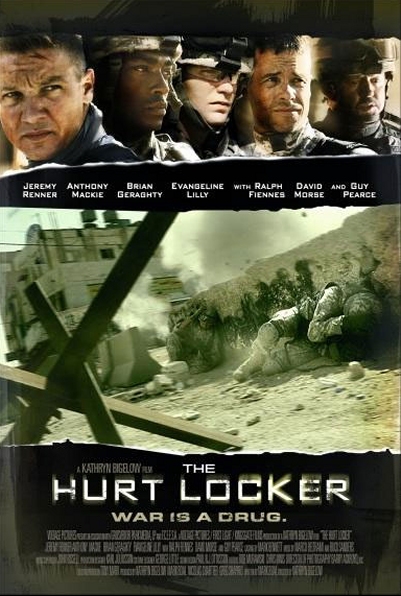
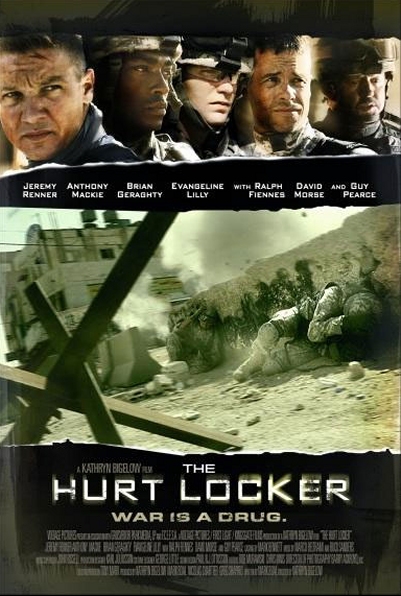
A War Movie Gone Thriller: The Hurt Locker (2008)

Yes, I had to do it. I had to add something on this ubiquitous film.

The story of The Hurt Locker should be sufficiently known by now. We are shown a bomb squad on their mission to disarm bombs in Iraq. When a real danger addict is appointed to be the new leader of the squad things get really exciting.

Somehow, when I realized I liked it, I felt a soft tingling feeling of shame that made me wonder.

But the fact that I did enjoy The Hurt Locker doesn´t necessarily mean I think it is a good war movie. There was a whole lot of suspense going on. It was entertaining and it sure felt like a thriller. The possibility of every  bomb or object to prove deadly seemed like a serial killer lurking around in the dark. He sees you, you sense him. Creepy. I stopped breathing every time Sgt. First Class James started to cut those little wires.

While I was watching it I did not for one second question it. I felt just so swept away and liked it. Period. But afterwards I found it kind of problematic. One is almost grateful wars take place and offer us such a great topic of suspense.

I remember that I had very comparable feelings after having seen Apocalypse Now. The anti-war message was just not clear enough for me.

Same here. It´s like saying: yeah well, war is shit, we shouldn´t do it but so what, it´s fun.

Of course that is not what Kathryn Bigelow tried to say but it is what the audience could understand.

This potential to be misunderstood comes from the blending of the genres. Or rather the blending of major techniques of different genres. War movies don´t normally create this type of suspense. It would have been possible to show the same without creating the suspense.

Maybe I should put it that way: The Hurt Locker is one hell of an exciting movie but a dubious war movie. It is especially problematic as it shows a very specific bit of warfare in Iraq. Where every other movie with an attempt at realism (the most extreme example would be Redacted. Come to think of it, Redacted is actually the antithesis of The Hurt Locker. It is so boring it hurts) has often long boring stretches where nothing else happens but watching road blocks, this one shows it as if the war in Iraq had nothing else but moments that got your adrenaline pumping.

Be it as it may it is great filmmaking. Kathryn Bigelow is very good at that. If you want to watch another one of her movies either try Point Break (1991) or Strange Days (1995). Both are highly enjoyable without creating any guilty feelings. Especially the first one is one of the rare movies that I can watch again and again. And, as an additional asset, it will help you understand her technique and where she comes from genre and theme wise.

amazon.com