The Round Up – La Rafle (2010) – Operation Spring Breeze or The Round Up of Vel d’Hiv

The French/German/Hungarian co-production, The Round Up – La Rafle, is a powerful and intense movie based on true facts. In the nights of July 16 and 17 13000 Parisian Jews were arrested in a raid in Paris and confined in the Vel d’Hiv (Winter Velodrome) or Drancy internment camp and from there to the extermination camps in Poland. Of the 13000 arrested Jews only 25 survived. Many among them, at least 4000, were children. Not one of them survived. The aim was to round-up 25000 Jews but 10000 escaped and were hidden by the people of Paris. The most shameful part was played by the police who actively contributed to make this happen. French President Jacques Chirac apologized in 1995 for the complicit role that French policemen and civil servants served in the raid.

The movie begins with original black and white footage. We hear Edith Piaf sing “Paris” while we follow Hitler on his tour through the city. That sent shivers down my spine. To think that if the Germans had won the war, Hitler would have made Paris his capital. In the pictures he looked like a guy inspecting real estate, deciding on what walls to knock down, what to keep. Horrifying. Here is an account of Hitler’s tour, written by his pet architect Speer.

After the opening we see people in a Parisian street located in Montmartre. The street scenes show that French and foreign Jews amicably lived together with non-Jewish Parisians. Many French people are friendly towards the Jewish population, but others are openly hostile and hate them. The movie focusses at first on a few Jewish families. It shows how secure they felt. They didn’t think the French government would ever give in. But it did. In exchange for privileges it promised to round-up the Jews and deport them eventually.

After the round-up we see the scenes in the Vel d’Hiv and the point of view changes. A young French nurse, Annette Monnod (Mélanie Laurent), has been sent to help alongside a Jewish doctor (Jean Reno). The doctor and a handful of French nurses are the only health care professionals for 13000 people. There is almost no food, no water, no toilets and the hygiene is abominable. Many of the children are ill. There are doctors willing to come and help but they are not let in. Operation Spring Breeze, as this round-up is called, should be kept a secret. While there are many collaborators among the French, there are many more who are hostile towards the Nazis and willing to risk their lives to save Jews.

Annette becomes very attached to the children and does everything to help them survive. She follows them to camp Beaune where they stay until they are finally deported to Auschwitz. Until the last day many think, they are sent to Poland to work. Rumours that those camps are extermination camps are only spreading very slowly.

I really loved this movie. It moved me, I found it very touching and emotional.  I would say that of all the Holocaust movies I’ve seen, this is my favourite. I liked that it focussed on a few Jewish families with different backgrounds. Some rich French Jews, others immigrants and people who fled from other countries. Those individual stories are more interesting and touching than the story of a mass of deported people. In chosing Annette, a French nurse, we see how far the “good” Parisian people went, risking life and health for others. It’s such a shameful chapter in the history of France, its important to remember that there were courageous people as well.

The only thing I didn’t like so much was the end. It should have been different but I cannot tell you why or I would spoil the movie. Considering how excellent the rest is, this is a minor fault. I added The Round-Up to my Children in War Movies List. It’s an excellent example. Other Holocaust movies can be found here: 13 Holocaust Movies You Should See.
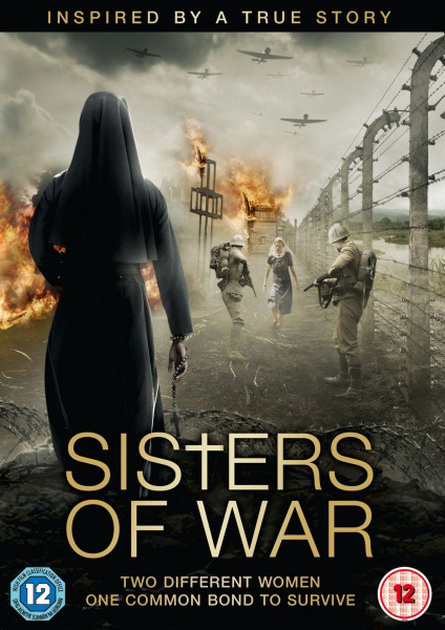
Sisters of War (2010 TV) The True Story of the Australian POW Nurses and Nuns

Sisters of War is an Australian TV movie based on the true story of Lorna Whyte and Berenice Twohill, a nurse and a nun who were held captive for several years by the Japanese during WWII. The film looks a bit “made for TV” but other than that I liked it. There are so many of these forgotten stories and it’s great when a director decides to bring them to our attention.

1942, Vunapope, Papua New Guinea, an Australian hospital camp and mission. Nurses and nuns help the wounded alongside the army doctors. When the troops withdraw, the doctors follow them to help them and, to everyone’s dismay, decide to abandon the nurses, nuns and the wounded. Some of the troops remain hidden in the surrounding forest.

The remaining sisters scan the horizon daily, hoping for the Americans to come to their rescue. When they see boats land they are at first extremely happy until they realize their mistake. The landing troops are Japanese and their mission is soon turned into a prison camp. In this mess and confusion two women, the nurse Lorna whose fiancé is among the troops hidden in the forest and the devoted sister Berenice become close friends and are a moral support for each other.

The months that follow are hard. The American bombard the mission thinking it is Japanese, while the Japanese rule with a fierce hand, punishing everyone who doesn’t comply and torturing and executing all the soldiers they capture. It’s particularly harrowing for Lorna when they capture her fiancé.

The food is scarce and the few buildings they have are constantly bombed. The mission has to be abandoned in the end. Bishop Scharmach decides to send the nurses away. They suspect that they have been sold as “comfort women” to the Japanese. This isn’t true but the plans the Bishop had, to have them exchanged against Japanese prisoners of war, doesn’t work and the nurses are sent to a labour camp in Japan.

I thought the movie was quite well done, not too sentimental and managed to show a forgotten story and is also a testimony to the great strength and courage of those nurses and sisters. As we are told in the closing credits, those nurses, as they were mostly not military nurses, didn’t get any recognition until quite recently.

It’s a nice touch that we see the real Lorna Whyte and Berenice Twohill, now elderly, sit together on a bench and chat at the end of the movie.

I really wonder how this could have happened, that the whole military, especially the doctors, just left those women on their own. They knew so well how the Japanese treated prisoners. At first I thought that the depiction of the Japanese soldiers was overly negative but towards the end, the portrayal is balanced.

The only instances in which you can see that it must have been a low-budget production is the make-up. They all look pretty odd but if you can forgive that, it’s a highly watchable movie, quite tragic but suspenseful and fascinating too.

The African Queen (1951)

The African Queen is one of those classics that many people like. Surprisingly I’ve never even seen it on TV although Hollywood classics are regularly shown on Sunday afternoons. I didn’t expect anything because other than that it’s set in Africa during WWI I knew nothing about it. After having seen it, I know that it is rather a screwball comedy than a war movie as such. Nevertheless I enjoyed watching it. It is entertaining and the actors are excellent. Being a bit of a Humphrey Bogart fan I had to watch it sooner or later.

September 1914, German Eastern Africa. Missionary Reverend Samuel Sayer and his prudish sister Rose (Katharine Hepburn) live on a farm isolated from any other colonists. They are regularly visited by Charlie Allnut who owns a crummy boat, the “African Queen” and travels up and down the river, bringing the mail and other things. He is boorish and has very obviously an alcohol problem.

When the war in Europe breaks out, the colonies are drawn into it as well. German troops burn down the mission and the Reverend dies soon afterwards. Allnut passes by on his boat and helps Rose to bury her brother and takes her with him on the African Queen. They face a very long, difficult and dangerous journey down the river and on top of that Rose is determined to help the war effort. She suggests, Allnut should construct a torpedo and that they should then attempt to sink a German warship, the Luisa.

As is to be expected their trip down the river is more than adventurous. Torrential rains, rapids, mosquitoes and German posts make the journey very daunting. What is worse for Allnut is the fact that Rose supervises him and throws away his brandy. She wants him to behave and at first they bicker and quarrel constantly. After several days on the boat and many dangerous adventures they get closer and end up falling in love.

What an unlikely couple they make. What I liked is the fact that Rose is the inventive and courageous one. Although she doesn’t exactly look like an adventurer, in her long skirts, hat and with her prissy little manners, she is quite gutsy after all. Something else that makes this movie memorable is the fact that it reminds us that the Germans used to have a few colonies as well. One tends to forget that as they lost them all during WWI.

It’s an adventure story and a very amusing tale in which two very different people on a shabby little boat, fall in love and successfully fight a whole crew of a warship. It certainly is an early version of adventure romances like Romancing the Stone.

The Killing Fields (1984)

Hard to say why I didn’t like the The Killing Fields despite the fact that War and Journalism is a topic that I find fascinating and that this movie is considered to be one of the best of the genre. One of the problems I had was the length. The other one was the score. That’s such a dated score, it ruined the movie to a large extent.

The Killing Fields is based on a true story and one of the first movies whose topic was the genocide of Cambodian people by Pol Pot. The two journalists Sydney Schanberg and Dith Pran have been covering the war in Cambodia since the early 70s. They are not only dedicated journalists but close friends. Pran serves as interpreter on their missions.

In 1975 when the United States withdraw from the country and the Khmer Rouge, led by Pol Pot, advance on Phnom Penh, Pran, as a US sympathizer is in great danger. There was a moment when he and Syd could have left the country easily but things have developed too fast and now it’s hardly possible for anyone but US and European citizens to leave the country.

Knowing what would happen to Pran if he stayed, Syd and some fellow journalist try to forge a US passport for him. Unfortunately the attempt fails and while his children and his wife have been able to fly out, Pran is left behind when the other journalists leave. Captured by the Khmer Rouge he is brought to a labour camp.

In the second half the movie moves back and forth between a guilt-ridden Syd in the US, and Pran’s ordeal in the Cambodian labour camp. In imaginary letters that he writes to Syd in his head, he tells him what happens, interprets what we see. I’m not sure if this was a problem of my DVD but none of the parts spoken in Khmer have been subtitled.

The parts in the labour camp are very well done. This isn’t only a labour camp. The labourers and especially the children are re-educated and brainwashed. They have to unlearn everything that they knew before. It’s of great danger to have “forbidden” knowledge, like foreign languages or any higher education. The children are easily turned into little fanatics and the grownups who are afraid of being executed try their best to obey.

The Pol Pot regime was a systematic genocide and far over 2 million people were killed. Even though I didn’t particularly like it, I must admit the movie has its merits. And the Cambodian actor, Haing S. Ngor gave a very touching and convincing performance.

Giuseppe Tornatore’s Malèna (2000)

Malèna, set in a little town in Sicily during WWII, combines a coming of age story with a war-time story. The first time I watched it, it stunned me. I still liked it a lot the second time but since the story has a tragic ending, it’s more intense to watch it for the first time.

Malèna (Monica Bellucci) is the most beautiful and seductive woman in the little Sicilian town of Castelcuto. Her husband is somewhere in Africa, fighting for Mussolini, while she is left behind in a very hostile climate in which all the men try to have an affair with her and the women hate her for her looks. All the men see her as an object, with the exception of a young boy who falls in love with her. We see the story through his eyes. He is so besotted with her that he follows her around, sneaks out of his house at night and spies on her.

She is a favourite conversational topic and gossip and rumours follow her wherever she goes. People talk very bad about her behind her back. They call her a whore and say she betrays her husband and has lovers. Only the young Renato knows this isn’t so. But when her husband is reported dead, there isn’t any protection for Malèna anymore. She can’t find a job, she has no money and food is scare and whatever she does, the town, reigned by men, turns on her and finally forces her into prostitution.

When the war is over, the women take revenge on her, not because she sold her body to the Germans but because all their husbands lusted after her.

Tornatore captures the atmosphere and hysteria of an Italian city during WWII very well. How they all cheered Mussolini and pretended to know nothing of it when the Americans arrived. The hypocrisy, the paranoia, the double standards. Malèna has the extreme misfortune of not fitting in. Too stylish, too good-looking, not very sociable nor talkative. This causes the jealousy of the women who have no liberties or power and the hatred of the men who treat women like objects. This society is ruled by fanatic Catholicism and the double standards that go with it.

I don’t want to give away too much but the destiny of Malèna which is extreme is very sad and to a certain extent quite typical for women during that time in Italy. Many women, especially in Italy, were forced into prostitution when their husbands were gone or dead.

Malèna is an extremely esthetic movie, beautiful pictures, matching music, and of course there is Monica Bellucci whose beauty brings Malèna to life. The sexual awakening and infatuation of Renato is touching and extremely funny at the same time. It clashes with his mother’s prudery and his father’s strictness.  The end of the story is tragic and infuriating.