Where Eagles Dare (1968) War Themed Action

I’ve never seen Where Eagles Dare before and must say I was pleasantly surprised. It’s entertaining and cinematographically stunning.

It’s a fabulously scenic film with some pictures that would even look good in a vampire movie. Plus we get to see two great actors, Clint Eastwood and  Richard Burton who, teamed up, give this movie a special something that I found very appealing.

The story is the tale of a suicide mission. A group of mountaineering soldiers, led by British Major Smith (Richard Burton) and American Lt. Schaffer (Clint Eastwood) are sent to free an American officer captured by the Germans and held in a castle in the mountain, called Eagle’s Nest.

From the moment they parachute out of the plane it’s obvious that the mission they are on is a fake one. What they really need to do, is uncover double-agents.

From the moment they land in the snow-covered woods, until they climb into the castle, the action and tension is relentless and is even intensified, when they have to escape from the castle again.

It’s quite a violent movie, with loads of explosions and a great deal of merciless killings. But it is also very suspenseful, there is plenty of action reminiscent of a modern-day movie. (It seems as if this was Quentin Tarantino’s favourite war movie and that he wanted to do a remake. I hope he will not and that the similarities one can find in Inglourious Basterds is all there will be.)

It was a pleasant surprise to find a female agent who has quite a great role, and fights and shoots just like the men.

I loved the cinematography, the steep mountains, covered in snow and the castle, nested on the top of a hill, gave the movie a Gothic feel.

The fact that I always feel uneasy in cable-cars made watching this movie quite impressive as some of the most gripping scenes take place on the top of a cable-car.

Apparently the movie has been criticized for not being anti-war. I think, that there are for sure movies with a clearer anti-war statement, which is one of the reasons why I think this is more of an action movie with a war theme than a real war movie.

In any case,  I found it very entertaining and I loved Clint Eastwood in this.

I’ve heard that Where Eagles Dare is one of a pair, the other one being The Guns of Navarone. There is a certain likeness, logically, they have both been written by Alistair MacLean. I couldn’t say which one I prefer, I think they both have a lot to offer.

Which one do you prefer?

Ken Loach’s Land and Freedom (1995) A Story of the Spanish Civil War

At the beginning of Ken Loach’s movie Land and Freedom, we see a young woman sorting out the things her late grandfather has left behind. She finds a suitcase full of black and white photos, newspaper articles and letters that show her a hidden part in her grandfather’s life. Little had she known that he had fought in the Spanish Civil War and loved a Spanish woman.

In 1936 David Carr (Ian Hart) is an unemployed miner and member of the British Communist Party. When someone from the Spanish Communist Party shows up and tells them about the Civil War in Spain in which the people fight against General Franco’s Army and the rich landowners, David spontaneously decides to go to Spain and fight for the rights of the people.

On his train journey he meets people from the Spanish militia, part of the POUM, a communist group that fights independently of the International Stalinist Brigades. He has no particular place to be and decides to join them. The people in the little group he is fighting with are all idealists. They come from all over the world, the US, Germany, Italy, Ireland, the UK. They want to fight for the rights of the peasants and the poor and not join the Stalinist Brigades which they consider to be corrupt and only interested in their own cause.

David who at first seems to think he is living some kind of adventure, soon faces the harsh reality. Not only is the fighting often heavy and there are casualties but they are badly trained and equipped and the Stalinists keep the weapons from them. When one of those faulty guns explodes, David is injured and sent to the hospital. Blanca, one of the group visits him in Barcelona, after he has come out of the hospital. They spend a night together but she leaves disgusted when she finds out that David has decided to join the Stalinists.

David will regret his decision soon enough and return to his old POUM group. The movie ends tragically and on a note of utter disillusionment.

Land and Freedom was absolutely not what I had expected and I assume that is exactly what Ken Loach was aiming for. We all have our ideas about the Spanish Civil War, some very romantic ones mostly. We know that Hemingway fought in Spain and so many other writers, painters… It seemed to have been one of the very rare wars with a justified cause to fight for. Ken Loach destroys all our romantic ideas and that is why the movie is good and annoying at the same time. He tries to show how it must have been. The fights and differences within the Communist Party and their subgroups, the endless talking and theorizations. The middle part of the movie is one long annoying and boring conversation and dispute about collectivism.

An aspect I wasn’t familiar with is the fact that women were only allowed to fight alongside the men at the beginning of the war. Later it was decided that they had to do “womanly” things like cooking or being nurses. I thought that women fought all through this war. Another shattered illusion.

Loach has earned a lot of praise and got also a lot of scolding for this movie. Some think that finally someone told it as it was, others think he dirtied the memory of the Spanish Civil War.

I am a fan of Ken Loach‘s movies, he has done quite a few that I liked a lot, although I wouldn’t go as far as saying that I liked Land and Freedom, I must say, I appreciated it. I felt somewhat stupid for having to realize that my idea of the Spanish Civil War had maybe been a tad too romantic as well.

Unfortunately there was no trailer of Land and Freedom, only the first part of the movie.

Europa Europa aka Hitlerjunge Salomon (1990) The Story of a Jewish Boy Hiding Among Nazis

Agnieszka Holland’s movie Europa, Europa is based on the true story of Salomon Perel. It is frequently mentioned as one of the top 100 war movies. It’s a harrowing and quite unbelievable story, still I have to confess that I did not like it.

The Perels are a Jewish family living in Germany at the beginning of the war. When anti-Jewish acts become more and more frequent, they are attacked and the daughter is killed. Salomon’s parents send the young boy and his brother to Poland where he should try to survive at any cost. He looses his brother early in the movie and ends in a Russian communist orphanage. Here he is given a passport and has to undergo some serious communist re-education. When the Germans invade Russia, the orphanage is attacked. They all flee and Salomon gets captured on the way by a Nazi patrol. All the Jews are shot immediately and it is only thanks to an extreme presence of mind that Salomon manages to make them belive that he is a true German and that he can be extremely useful as interpreter since he speaks Russian fluently. The soldiers take him along and he fights with them, helps them as a translator. He has to be super careful that no one sees him naked and this will stay a constant topic throughout the movie. The fact that he is circumcised would give his identity away.

A German officer hears of the young boy and that he is an orphan. He likes the bright boy and thinks of adopting him but first he sends him to one of the Nazi elite schools where he will be educated and trained. Here again, he has to be careful in order to not be found out. There are a few incredible scenes in the school. In one scene a teacher shows that one can see unmistakably, that, despite his dark hair, Salomon is of pure Aryan breed. The pupils are taught to hate the Jews and how to detect them. The absurdity of such scenes is incredible and Nazi madness made apparent.

Salomon is barely 16 years old and falls in love for the first time. Although the girl is willing “to do it”, he has to say no. The danger of being detected is too big.

It is incredible to think that he got away with it for so long. He blended in so perfectly, was such a good actor and so cold-blooded that they never even suspected him to be Jewish.

After the war Salomon finds out that his whole family died in a ghetto in Poland. He leaves Europe and settles in Palestine. At the end of the movie we catch a glimpse of the real Salomon Perel.

It took me a while to figure out why I didn’t like this movie. I didn’t like it because I didn’t like Salomon. I suspect that I found his behaviour cowardly. He isn’t much better than a collaborator. It disgusted me to see him act and talk like a Nazi. Sure, he was only a boy, he wanted to survive, he lost his family… I think sometimes it’s better to die than to sell out. Bit harsh, I know, but surviving is not everything.

I’d be really interested to know what others think of this movie.

Europa, Europa is part of the Children in War Movies List

First Light (2010 TV) A TV Movie Based on the Memoir of a Spitfire Pilot

Geoffrey Wellum was only 18 when he joined the 92 squadron of the RAF in May 1940. He was one of the youngest pilots. He flew over 50 missions during 18 months, all through the Battle of Britain and beyond. After a forced break of several months he flew again but finally had a nervous breakdown and stopped for good. A while back he published his memoirs First Light on which this TV movie is based.

First Light is a treat for everyone interested in Spitfires, their pilots and the Battle of Britain. In between scenes we see and hear Wellum talk about his experiences. I think that hardly any pilot flew over such a long period and this many missions as he did. The strain and  stress of being a Spitfire pilot is really palpable.

When he arrived at the base no one thought he would make it as far more experienced pilots were shot down. The other pilots were a bit reluctant at first to accept him as he was so young. The RAF was in desperate need of pilots and couldn’t really be too choosy. Soon the other pilots realized that he was a good pilot and a fine man and they accepted him. During the day they flew their missions, sometimes even in the pouring rain, in the evenings they came together to sing, drink and dance with girls.

There are many moments typical for air combat movies. The moment when they fly back to the base and everyone is anxious to see if anyone is missing. The love stories, the drinking, the friendships. The older men who feel protective of the younger ones. The sadness when one of their friends dies.

Maybe First Light wouldn’t be so special as a movie if we didn’t know that it ‘s a true story. But the fact that it is a true story and the presence of Wellum himself make this worth watching.

Instead of a trailer I attached a mini-documentary. Hope you will like it.

Enemy at the Gates (2001) or The Duel of Two Snipers

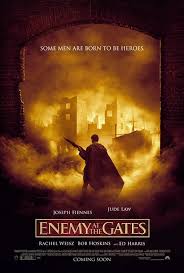
It’s interesting how often people mention Enemy at the Gates as one of their favourite war movies, yet I do not see it included very often in more official Best of Lists. I wonder why and can only guess. Maybe because it is too esthetic? Hardly ever have ruins looked this good. Or is it because of the love story? I must admit, I had a problem with it. I don’t mind a love story, although it is mostly a bit tacky in a war movie, but I would have liked this one to be left out. I thought it spoilt an otherwise perfect movie. And I think another cast would have been better as well, apart from an excellent Ed Harris, I didn’t care for the actors. Despite all these reservations, I think it is an excellent movie. The central story is suspenseful and it is one of the most beautifully filmed war movies ever and certainly one of those I will re-watch. And don’t you just love movies about snipers?

Stalingrad 1942. The city is under siege. The German army hopes to win the war and to secure the oil fields near the Caspian Sea. The Russians are well aware if they lose Stalingrad, it is over. The losses are high, morale is low and a little bit of propaganda might do every one a lot of good. That’s why Khrushchev (Bob Hoskins) thinks its high time to fabricate a hero and charges Danilov, an important oficer of the Communist Party, with this mission.

Enemy at the Gates is loosely based on the story of the famous Russian sniper Vassili Zaitsev (Jude Law). Vassili has learned to shoot at an early age, and now, in his early twenties he is the best sniper in the Russian army. Danilov (Joseph Fiennes) decides to pick him, and turn him into the hero Khrushchev is looking for. Vassili gets newspaper coverage and publicity and soon his fame is known far beyond the Russian borders and especially the Germans are well aware what a dangerous enemy he is.

Amidst the rubble and the ruins we see two parallel stories unfold. The first story line, follows a love triangle. Through Danilov Vassili meets the Jewish woman Tania (Rachel Weisz). Both men are in love with her but as it seems Tania has only eyes for Vassili. This love triangle is frankly annoying and disrupts the movie. It isn’t even very plausible.

The second story line revolves around the competition between Major König (Ed Harris), a famous German sniper, and Vassili. König is sent to Stalingrad to take out Vassili. All the parts of this second story line are quite gripping. We see the men hunt each other, we see how they get to know each other, how they try to find out how the other will react, how and from where he will shoot, how they try to ambush each other.

Snipers are endlessly patient. They don’t just shoot wildly, they aim carefully, take their time, observe and shoot only when they are fairly sure of hitting their target. Enemy at the Gates perfectly captures this cat-like hunter quality of the sniper and that’s what makes this film so watchable despite its flaws.

The director Jean-Jacques Annaud is famous for his cinematography. He has made one of the visually most compelling movies The Bear or L’ours . Enemy at the Gates is equally stunning from a cinematographic perspective.