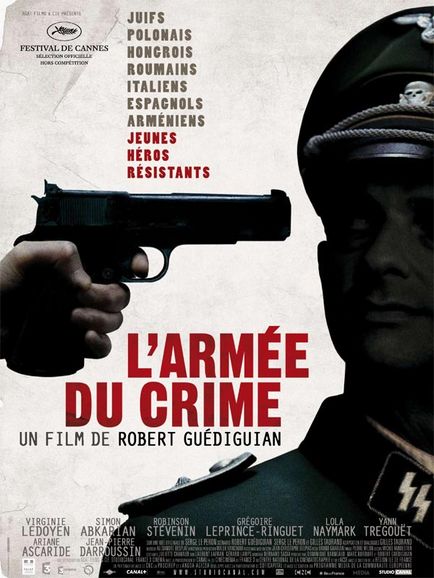
The Army of Crime aka L’Armée du Crime (2009) The Latest Addition to my Top 10 War Movies or A Gut-wrenching Movie on the French Resistance

Robert Guédiguian‘s movie L’armée du Crime or The Army of Crime is one of the best war movies I have ever seen. I already said that it entered my Top 10 immediately. The question that remains: which one I am going to kick out? I’ll have to think about this later. For now let me tell you why I think The Army of Crime is such a brilliant piece of filmmaking. Apart from being based on actual events and being historically very accurate it is beautifully filmed. The actors are outstanding. The protagonists are heroical like not many but at the same time the movie doesn’t shy away to point its fingers not only at the Germans but also at the extremely shameful role the French government played during WWII. We had the heroism of the Resistance and Partisan groups on one side and the cowardly collaborators in the government, the police and among normal people on the other side. Shame on all of them. The movie shows all these aspects, nothing is hidden.  This is the third French movie I have seen in a short period, L’armée des ombres aka The Army of Shadows being the first, The Officers’ Ward aka La chambre des officiers the second.  I must say these movies manage something that not many others achieve. They get under your skin. You don’t only watch these movies, you live them. They don’t let you indifferent. Especially not this one.

1943, Paris, the Armenian poet Missak Manouchian (Simon Abkarian) becomes the leader of a special unit of the French Resistance. His people, men and women, are all very young immigrants. They are Hungarian, Polish and Romanian Jews and Spanish, Italian and Armenian Communists. They decide to form a group and fight for France, the country of the Human Rights, to free and to defend her. They are determined and well-organized and soon will be declared enemies number one. The German occupiers and the French police strike back savagely. They hunt them and use every possible way to capture and destroy them, be it bribery, torture or coercion. In the end they are betrayed and all of them are shot.

The movie tells not only the story of the group and their actions as a whole but shows many intimate portraits of all the individual members. I have hardly ever seen a movie displaying so much diversity. This is underlined by a brilliant score with influences of the music of all the different countries that came together in this fight.

The torture scenes are very graphic. We are not spared anything. The most incredible is that with the exception of one person none betrayed the others. Not even under the worst of torture I have ever herad of. While they were operating in the underground most of their families were being deported to camps. Manouchian is an exemplary man. A larger than life character. He does not use arms lightly unlike some of the other reckless young people. He is a poet, an orphan, a gentle man, married to a beautiful French wife, Melinée (Virginie Ledoyen), whom he loves dearly.

I would like to urge each and every reader to watch this movie as my words will never really manage to convey its utter beauty. It is also worth mentioning that we see a lot of Paris.  The Army of Crime is one of those very rare movies that are, simply put, masterpieces in which every element is perfect.

The following people died for France: (AR = found on the Red Poster or Affiche Rouge):
Celestino Alfonso (AR), Spanish, 27
Olga Bancic, Romanian, 31
Joseph Boczov [József Boczor; Wolff Ferenc] (AR), Hungarian, 38
Georges Cloarec, French, 20
Rino Della Negra, Italian, 19
Thomas Elek [Elek Tamás] (AR), Hungarian, 18
Maurice Fingercwajg (AR), Polish, 19
Spartaco Fontano (AR), Italian, 22
Jonas Geduldig, Polish, 26
Emeric Glasz [Békés (Glass) Imre], Hungarian, 42
Léon Goldberg, Polish, 19
Szlama Grzywacz (AR), Polish, 34
Stanislas Kubacki, Polish, 36
Césare Luccarini, Italian, 22
Missak Manouchian (AR), Armenian, 37
Armenak Arpen Manoukian, Armenian, 44
Marcel Rayman (AR), Polish, 21
Roger Rouxel, French, 18
Antoine Salvadori, Italian, 43
Willy Szapiro, Polish, 29
Amédéo Usséglio, Italian, 32
Wolf Wajsbrot (AR), Polish, 18
Robert Witchitz (AR), French, 19
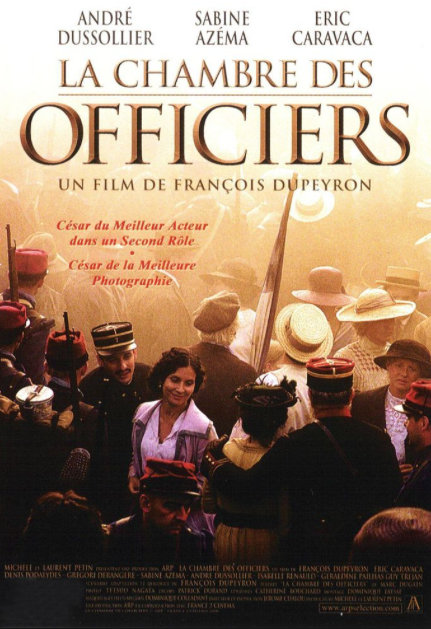
La chambre des officiers aka The Officers’ Ward (2001) France, WWI and the Nightmare of Facial Mutilation

La chambre des officiers

The French movie La chambre des officiers aka The Officers’ Ward may very well be one of the most moving and shocking war movies I have ever seen. I felt sick twice, I cringed endlessly and it made me really sad. It is  a masterpiece. An absolutely brilliant anti-war movie. If you thought Born on the 4th of July was horrible then you haven’t seen this one.

The movie is based on Marc Dugain’s novel La chambre des officiers aka The officers’ ward and tells the story of the young lieutenant Adrien. At the beginning of WWI Adrien is a very handsome young officer. A piece of shrapnel rips half his jaw off. He will spend the rest of the war, a full five years, at the Val-de-Grâce Hospital in Paris. At this hospital they only cure men with facial wounds, burns etc. It is like a freak show only these are human beings.

During the beginning of the movie we never see Adrien. We only see the reaction of those around him. The doctors’, nurses’ and patients’. The profound pity in these faces says more than actually seeing him. Since he cannot talk anymore, we hear his thoughts. The moment when he realises that his face is a gaping hole is so awful…

During the five years at the hospital he fights great pain, despair, horror, suicidal thoughts. Together with the other mutilated officers they try to stay alive and become human beings again.

The music is very intense (Arvo Pärt and Wagner, admittedly the second is a bit strange) and underlines the atmosphere of this saddest of war movies. Funny enough there is also beauty. The beauty in the relationships between the wounded. And the beauty between Adrien and a very gentle and loving nurse. There is also a brothel scene towards the end that is not only lighter in tone but even in a melancholic way funny.

This is a very thought-provoking, must-see, 5/5 star movie.

I only found the French trailer, I’m sorry.

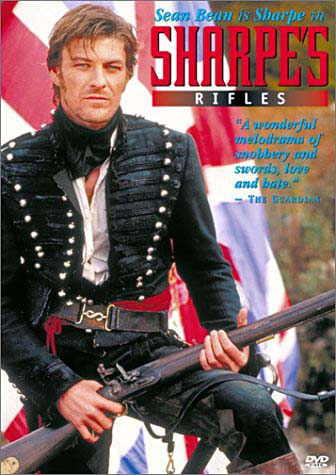
Sharpe’s Rifles (1993) First of a Series of 14 British TV Movies on the Napoleonic Wars

If America only knew how good this was, it would be the highest rated Made-For-TV movie series of all time (hard to believe there are more people out there that would rather watch “The Columbo Mysteries” than Bernard Cornwell’s Sharpe Chronicles- that just goes to show the power of major network name-brand advertising. (Comment from a US IMBD reviewer)

The British TV movie Sharpe´s Rifles is the first of 14 installments focussing on the fictional character Lt.Sharpe. Bernard Cornwell’s novels are the source for this series. There are certain parallels to the Hornblower series (see Hornblower post) with the difference that Sharpe shows the Napoleonic wars on land. Unlike the Hornblower sequences these are full-length movies, each 110 minutes long.

I started to watch it on the last weekend and am really quite taken by it. This enthusiasm is certainly also due to Sean Bean´s starring as Sharpe. He is an excellent choice for this rough but likable maverick and daredevil.

In the first movie we get to know Sharpe and the motley crew of Chosen Men (snipers riflemen) that is very unwillingly under his command. Sharpe who is a sergeant is promoted to lieutenant because he saves General Wellesley´s life. Promoting someone from the ranks who is, like Sharpe, not a gentleman, proves to be somewhat problematic. The other officers don´t accept him because he is not one of them, the soldiers do not accept him because he is one of them. He really has a hard time proving himself and on top of that they are at war.

Sharpe´s Rifles takes place in 1809 in Portugal. Spain and Britain are supposedly allies against France but it seems as if Spain is not 100% decided on which side they want to fight.

Sharpe and his men, together with a company of officers and soldiers, are sent on a secret mission to find a banker that has disappeared and are attacked by a group of French soldiers. Apart from Sharpe and his men everybody gets killed.

In this movie Sharpe also meets Teresa or “El comandante Teresa” for the first time. Having survived rape and the butchering of her family by the French she holds  a bit of a grudge against the French and men in general. Even so, love at first sight strikes them both. The whole love story part did actually remind me a lot of the one in The Last of the Mohicans. Teresa is a strong woman, the leader of her men and a very capable fighter herself.

After they have met, the main story line follows Sharpe, his men and Teresa on their way to a little Spanish town where they must raise the Spanish flag. Ok, this is not a gripping idea but it is excusalbele as this was the first movie in a long series and its main goal is to introduce us to the characters.

From the reviews I read I can deduce that there are much better installments still to come. As a first part this was very, very promising and I am looking forward to watch more of it.

No worries, I am not going to review them all. I´ll probabaly do some sort of final assessment once if have seen the others. For the time being I just wanted to share my discovery.

Below you find the beginning of part I. I think this should help you decide if you want to go for it.

10 German War Movies You Must See Before You Die

In the last years Germany has made quite a few very good war movies but there are also some older ones that have stood the test of time. I am sure I have forgotten some and left out many that are co-productions with the exception of Joyeux Noël aka Merry Christmas because it is one of my Top 10. I will very probably mention it again when I will make a post on 10 French war movies you must see before you die.

Let´s stick to Germany for the time being.

Die Brücke aka The Bridge (1959): WWII, Germany. One of the best anti-war films ever. Shows how senseless some orders are. Young people fight for a bridge although the war can´t be won anymore. It is one of the movies on my list Children in War Movies.

Hunde, wollt ihr ewig leben aka Dogs, do you want to live forever – Stalingrad (1959): WWII, Russia. A German classic. A grim look at the battle in Stalingrad.

Das Boot (1981): THE U-Boot movie. Conveys brilliantly what it is like to be helpless under water. Claustrophobic feel. Superb acting. Marvellous cast. Especially noteworthy the singer Herbert Grönemeyer.

Stalingrad (1993): WWII, grim infantry combat. German POV. One of the best war movies  ever, one of my Top 10 as well. The setting, the character portraits, the acting, the combat, the snow, the cold, the despair. A fabulous movie that gives an insight in one of the worst chapters of WWII. Another marvellous cast. Thomas Kretschmann (King Kong, Resident Evil, The Downfall, The Young Victoria) is in it. He is one of those German actors that are known far beyond Germany and Europe. (see my post on Stalingrad)

NaPolA aka Before the Fall (2004): WWII, Germany. Interesting look at the Hitler Youth. How they recruited their elite, how they brainwashed them. Poisonous Pedagogy. See my review for more details. This movie is also on the Children in War Movies list.

Der Untergang aka The Downfall (2004): WWII, Berlin. The final days of Hitler. Astonishing acting from the very great Bruno Ganz. A fascinating portrait. Eerie. Creepy.  An outstanding movie and a must see even for those who don’t watch war movies. (see my post on The Downfall)

Joyeux Noël aka Merry Christmas (2005): WWI, France. Especially noteworthy as it is about WWI. The movie depicts the so-called “Little peace”. It is Christmas and something strange is happening. The war stands still. The enemy soldiers prefer football over fighting and get to know and like each other. Based on a true story. You get a good feel for the differences of the trenches and the characteristics of the parties involved.

Sophie Scholl – Die letzten Tage aka Sophie Scholl (2005): WWII, Germany. German Resistance. One of the leaders of The White Rose, Sophie Scholl´s final days. I have hardly ever seen a movie like this. After watching it I did solemnly swear to become a better person (I am not too successful yet. It is an ongoing process. A work in progress). No, honestly, this woman or girl´s guts… So much selfless idealism and courage. I was awed.

Anonyma – Eine Frau n Berlin aka Anonyma – The Downfall of Berlin (2008) : WWII, Berlin. One of the movies I reviewed recently. I included it as it tackles a lesser known and very painful subject. The mass rape of German women by the Red Army. See my post of Anonyma.

Der rote Baron aka The Red Baron (2008): WWI, Germany. The romanticized story of Baron von Richthofen the famous German fighter pilot. Beautifully filmed, good-looking cast, very intense air combat. See my post of the Red Baron.

Any movies you would add?

As I think Sophie Scholl is not known enough I added the trailer for you.

Cross of Iron aka Steiner – Das eiserne Kreuz (1977) or Showdown on the Eastern Front

…Peckinpah successfully stripped the combat of the patriotic heroism and glory that usually accrue to it in war films (Stephen Prince quoted in Under Fire p. 52)

Sam Peckinpah´s only war movie, Cross of Iron, is a UK/German co-production and probably one of the best war movies you can possibly see. It is based loosely on the battle of Krymskaya that took place during the German retreat in 1943. The original source is Willi Heinrich´s Das geduldige Fleisch aka The Willing Flesh. Heinrich fought himself on the Eastern Front. It contains quite a lot of  graphic infantry combat scenes. Steiner is one of my top favourite characters, right after Sgt. Elias, however much more cynical but a good man at heart. I have read reviews of this movie that were not favourable and I admit, it could be misunderstood. If you do not pay very close attention and take into account the opening and final credits, you might simply not see the profundity of the anti-war statement.

Cross of Iron opens on a cheerful children´s tune Hänschen Klein ging allein, in die weite Welt hinein, Stock und Hut, stehn ihm gut… While we hear this tune we see black and white footage of grim content interspersed with pictures and stills of Hitler Youth to show us the slow ideological infiltration of the German youth.

The movie tells us a story from the point of view of a German platoon on the Eastern Front in 1943. At the heart of the story is the antagonism between Sgt. Steiner (James Coburn) a much admired veteran who has already earned two Crosses of Iron and Captain Stransky (Maximilian Schell) an arrogant, conceited Prussian officer whose only goal is to be awarded such a cross. When tensions intensify Stransky does not inform Steiner and his platoon of their retreat and the men are left stranded behind enemy lines. They barely make it back and Stransky let´s his men open fire on them. We get to see a scene that resembles many a Western showdown.

The final credits are quite different from the opening ones. The statement  clearly is: war is pure madness. We hear a hysterically laughing Steiner, the annoying children´s song of the beginning and see black and white photos. Those photos are interesting, the first shows the execution of young Soviet partisans (see more info in B Hellqvists comment below) followed by the pictures of children in different wars, Vietnam, somewhere in Africa…

This movie wouldn’t be the controversial movie it is if there were not other extremely important elements that have not so much to do with the core story. Steiner has an affair with a nurse (Senta Berger) after being wounded. This scene, that has been criticized, is meant to emphasize his cynicism and, I believe, should be seen paired with the other female roles in this movie, namely the female Russian soldiers Steiner´s troop encounters on the retreat. It is rare that you see female soldiers in war movies unless they are Russian. Running out of men and considering women – due to their assumed patience – to be better snipers Russia recruited a lot of women towards the end of the war. There are a few Russian movies dedicated solely to female soldiers (I will review them in due time). But let’s get back to Cross of Iron. The encounter of those female soldiers and Steiner´s men gives us one of the most graphic scenes I have ever seen in a war movie. Not for the fainthearted.

All in all, apart from the central story of hatred between two men from different social classes, the movie is complex and composite. It certainly gains by being watched twice. The actors are all very good. James Coburn is fantastic.  Maximilian Schell is very good and so are James Mason, David Warner and Senta Berger.

What I liked a lot is how daring Cross of Iron is. It does not shy away from touching topics that are normally left out, it goes beyond what we are used to see and stays in your mind long after you watched it.

I must admit that personally and for reasons that elude me, I was always extremely fascinated by the tales of the Eastern front. This dates back to my childhood when I found a book in my grandmother´s library called “Letters home from Stalingrad” (it is as good as Letters home from Vietnam and not less tragic). Thinking that without the British and the Americans the outcome of the war between these two countries would have determined all of Europe´s fate gives me the creeps…

“What will we do when we have lost the war?”

“Prepare for the next one.” (Cross of Iron)

Cross of Iron is among my Top 20, that is for sure.