The Guns of Navarone (1961): A Great War Adventure Movie

Some movies age well. Others don´t. The Guns of Navarone,  a splendid UK/US co-production, is one of the first kind. Almost 50 years old but still fresh like on the day it came out. This is thanks to a  lot of things. A gripping story, a great cast (Gregory Peck, David Niven, Anthony Quinn, Irene Papas, Stanley Baker, Anthony Quayle), wonderful cinematography, a nice score. What more do you want from a good war adventure yarn? I hadn’t  seen it before (yes, yes, shame on me) and was really surprised how good it is. And very esthetic. It is one of the most esthetic movies I have ever seen.

The year is 1943. Greece is occupied by Germany.  The Germans who feel they are losing on the Eastern Front try to force Turkey to join them. The Guns of Navarone tells us how a group of men tries to secretly enter a Greek island, meet with the Greek resistance and with their help sneak into a fortress to destroy two powerful German guns that threaten British soldiers who are marooned on another island. The mission is extremely dangerous and no one actually thinks they might accomplish it.

The story, from the beginning to the end, is one gripping sequence after the other. Each one of them could almost stand alone like some sort of short story. First they fight the elements on a boat during a storm. Then they have to climb an impossibly steep rock. Every place they find themselves in is swarming with Germans so they have to hide often.  In one episode one of them gets wounded and they need to decide if they take him along or shoot him. One of them betrays them and they need to decide whether or not to shoot the person. They get captured by the Germans but escape. Many things go wrong and not all of them make it. The best scenes for me are in the fortress. We hear a German song in the background and see this bunker with its typical Nazi esthetics.

It is also a funny movie at times as the German´s really get their asses kicked. In one scene the group is hiding and a German guard hears them. To distract  him they throw something and he runs off like a dog.

There is also some humorous dialogue mostly coming from the stiff-upperlipped British major played by David Niven.

The characters are well drawn, interesting and complex. Major Mallory (Peck) is a mountaineer whose expertise is needed for the mission. Miller (Niven) is an expert in explosives. Stanley Barker plays a trained killer who has problems with his conscience. I was quite surprised to see Irene Papas, the Greek singer, in one of the roles. I didn’t even know she acted. She plays a Greek resistance fighter. Quite a fierce character. Gia Scala´s role Anna is interesting and what happened to her illustrates once more the idea of the absurdity of war.

This movie made me quite nostalgic. You don’t find many movies like this anymore. And no actors like these either.
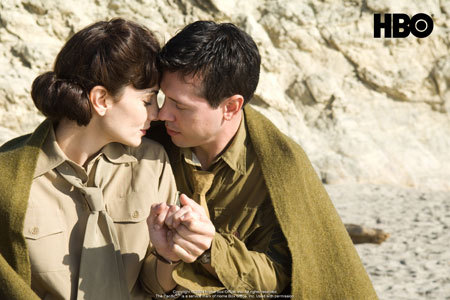
Do Women prefer The Pacific to Band of Brothers?

In an interview Dale Dye, a military advisor for many war  movies, was asked why The Pacific had many female viewers and here is his explanation for that fact.

“By telling a story that reflects the thousands of whirlwind wartime romances that happened during World War II. There’s this great desperation element—I might get killed in the next six weeks, we’ve got to get married now—and females really identify with that. They get it.” (Dale Dye in The Atlantic)

He also believes that the love story between the two soldiers John Basilone and Lena Riggi made women like it.

Aha? So it is only the romance that makes women appreciate The Pacific? Could it not be that it has more to do with the fact that there are simply more women in The Pacific than in Band of Brothers?And that there is a whole psychological dimension in The Pacific, with all its tales of post-traumatic stress, that might appeal to women?

I would love some comments. Do women like The Pacific? Do they prefer it to Band of  Brothers? Or did they even like both?

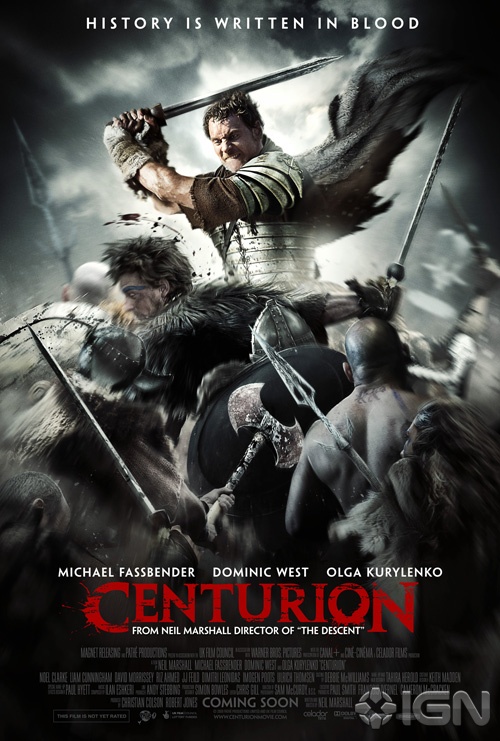
Centurion (2010): A little bit of Gladiator, King Arthur and 300

When I started this blog I wanted to stick to war movies in the strict sense of the term only but now I feel I am in the mood for more liberties. A few months back I would not have included Centurion but now I do. I would not have mentioned Gladiator, King Arthur or 300 either. (If I did, King Arthur would be high up in my Top 10, probaly even making Black Hawk Down step down.)

Be it as it may, to compare Centurion (a British movie by the way) to those above mentioned movies is very unfortunate for it because it is not up to the comparison, I’m afraid. Nevertheless it is  entertaining. However, compared to the three others, Centurion is super gory. And there are a lot of very combative warrior women in it. By the way, Dominic West, from The Wire,  is in this one too but he is not the main character. He stars as General Vilnius. Michael Fassbender has the leading role as the Centurion Quintus Dias. The German actor Fassbender could already be seen in 300, Inglourious Basterds and The Devil’s Whore, to name but a few of his movies.

The year is 117 AD. The Roman Empire stretches from Spain to Egypt and as far as the Black Sea in the East. Only Britain is fighting off its invaders. The Empire is stopped by the savagely fierce Picts.  Centurion Quintus Dias is the only survivor of a Pictish raid. He joins the legendary Ninth Legion of General Vilnius who is on a mission to erase the Picts and their leader Gorlacon from the face of the earth. When they are ambushed and the general is captured Quintus Dias is left alone with a small platoon far behind enemy lines. They first attempt to free their general and after this the real hunt begins. Led by a female warrior tracker (Olga Kurylenko), surnamed she-wolf, who has been mutilated by Romans in her youth and sworn to destroy each and every one of them, the Picts hunt them relentlessly. Without the help of a Pictish outcast, said to be a witch, they would not stand a chance but even so, they are soon highly decimated and in great trouble.

As said before, Centurion is really gory. It reminded me of Gladiator because of the battles in the woods. Of King Arthur because of the way they flee and are hunted,  because of the scenerey, mountains and snow and  also because of the female warriors. Same for 300. A little group outnumbered by a fierce enemy. The end however is quite different from the other three.

As I already said, it is not as good as the other three mentioned movies, since it is not  heavy on psychology and the Picts are shown as savages whereas we are led to believe the Romans were faultless,  but it is an  entertaining watch with loads of  battle and fighting scenes.

For a change the trailer is quite true to the movie.

The Poet aka Hearts of War (2007) or Don’t Let the Movie’s Poster Trick You

The Poet is a flawed and a much despised movie. Set in Poland in 1939 the central theme is the love story between  a German officer and a Jewish girl. I read comments and reviews that would make me feel ashamed if I had been part of this production. Funny enough people either give it a 1 or 2 star rating or 5 stars. Odd, right? Are they really being fair? What infuriates them so much? That Roy Scheider has only a mini-role even though he is on the movie poster?  I was not enthused but I did not mind watching it. Sure there is  a lack of logic and actors who speak in heavy accents that are not their own is annoying. Still, it is nicely filmed and I found it shows  one of the most beautiful depictions of a mother/son relationship. That the mother on top of that is played by the  beautiful Daryl Hannah does help as well. These two people are really close. They have a very open relationship. Unlike the one they both have with the father, a German general and Nazi. Unlike her husband mother and son are totally opposed to the German politics of the time. The movie has furthermore  some tragic story elements, decent fighting scenes and a female Russian Resistance leader one would not want to mess with.

At the opening we see Oscar, the son, on his mission in Poland. He should infiltrate resistance groups. On a trip to the woods he finds an unconscious girl in the snow and rescues her. What Oscar finds out very soon is the core element for the melodrama that will follow namely the fact that Rachel is  Jewish.

They fall in love at the greatest speed I have ever seen people fall in love in a movie, even though Rachel is already engaged.

They are separated early on, as Rachel has to flee.

If you want to find out whether they will meet again and if so, under what circumstances, you might have to watch it.

Did I mention that Nina Dobrev stars as Rachel? That might actually lead to a more generous viewing of this movie as fans of the Vampire Diaries might want to check out what else the young actress has done before. She is actually quite good in The Poet.

Maybe it is all about the poster. People seem to have felt tricked into buying a movie with Daryl Hannah and Roy Scheider as the main protagonists when in truth they have only minor roles. We resent feeling tricked.

Women in War Movies

War movies are a genre in which women will rarely if ever play major roles.

However there are a few that come to mind immediately.

Nurses

Mothers

Wives

Girl friends

Resistance fighters

Soldiers

Officers

Victims

The nurse is by far the most common role. In many movies they are very prominent. Especially in the sub genre of the war romance they get more than just small roles. (Yes, Pearl Harbor (2001) comes to mind, but…)

Some fine examples of nurses can be found in The Lighthorsemen (1987), In Love and War (1996), The English Patient (1996).

Mothers, wives, fiancées are often found at the very beginning of a movie, when the soldiers leave their homes like in Dark Blue World aka Tmavomodry svet (2001). We often see them again, reading a letter arriving from the field as in The Thin Red Line (1998).  They serve as a sort of counterpoint to make the contrast between those who fight and those who stayed home even bigger. Then, you may find them once more at the very end, when the soldiers return home. One of the most poignant and touching wives is Madeleine Stowe in We Were Soldiers (2002). The story moves back and forth between the battle field and the home front depicting the agony the soldier´s wives went through when the telegrams arrived telling them one of their husbands had been killed.

Nurses become very often soldiers’ girl-friends which makes the two roles blend into each other. But many of the classic girl friends in movies depicting the second WW are the girls the men encounter in the countries they are shipped to. The American soldiers in The Pacific for example have Australian girl friends.

The role of the resistance fighter is quite a noble one. Not very frequent but appealing. Cate Blanchett as Charlotte Gray (2001) comes to mind. Or the women in Uprising (2001). And definitely Sophie Scholl (2005). The latest example of this kind is Carice van Houten as the jewish woman Rachel Stein who joins the Dutch resistance after having survived a massacre in the brilliant Black Book aka Zwartboek (2006).

Female soldiers that are even involved in combat are not very frequent. The most remarkable one I remember is the Vietnamese sniper in Full Metal Jacket (1987). A further female soldier  is played by Demi Moore in G.I. Jane (1997) where she is said to be the first woman  to have  been granted access to the navy SEALS.

Women as officers is by far more common. Again Demi Moore played a role in the excellent legal drama A Few Good Men (1992). And then there is Meg Ryan as medevac chopper pilot Capt. Karen Walden in Courage under Fire (1996).

Unfortunately some of the above mentioned portraits of women in war movies are quite questionable and have been criticised repeatedly (especially G.I. Jane).

I almost forgot the victims. Inexcusable. There are as innumerable female victims in real wars as there are high numbers in movies. One of the saddest are the victims in Vietnam war movies. I think of  Platoon (1986) and Casualties of War (1989). They are not the only ones. Of course not.

My favourite heroines are Cate Blanchett as Charlotte Gray, the wonderful Juliette Binoche as nurse  in The English Patient and, another nurse, Sandra Bullock in In Love and War, and the outstanding Julia Jentsch as Sophie Scholl. The first two are based on novels, the other two on historical facts. Sandra Bullock plays the nurse Ernest Hemingway fell in love with when he fought in Italy during WWI.