The Diary of Anne Frank (2009) The BBC mini-series

The Diary of Anne Frank is a BBC mini-series in 5 parts, each of which is half an hour long. There are far over 20 movies or TV series that depict the life of this famous thirteen year old girl. Anne Frank spent two years in hiding, in an annex and the attic of an old house in Amsterdam during the last years of the second world war. Because they were Jewish, her father decided to hide in order to avoid being deported to a concentration camp. They hid there together with family friends, all in all 8 people and a cat, in very close quarters. Anne, a precocious and highly intelligent teenager, kept a diary of this time, the famous Diary of Anne Frank, on which this and any other movie is based.

The incredible tragedy of Anne Frank’s story is the well-known fact, that after hiding for two years successfully, they were still found and deported to various camps where they all died, in some cases just a few months before the end of the war.

The father was the only survivor. And what “survived” as well, was Anne’s diary that she had to leave behind when they were discovered. The lovely Miep, who hid them, and brought them food every day, kept it.

There are different ways to tell Anne’s story I remember one movie also showing her in the concentration camp. That was a very good but very bleak movie. This mini-series is completely different.

I found especially the first parts to be very educational. This could and should be shown in schools and can also be watched with younger children. I found out later that the BBC aimed at this public. In so far it is very well done. The girl Anne and her daily life, her struggles, conflict with the grown-us – in particular the mother – first love and many other things are shown nicely. We also see how stressful it must have been to hide like that and be around the same people day in and day out. They had no privacy, no independence, no freedom.

This cozy feel is a bit of a problem for grown-ups, I would say, it’s a bit too cute. On the other hand, the end is extremely powerful, much more powerful even than the end of the one in the concentration camp. But you really have to watch the whole series to experience this ending. We see nothing graphic, nothing brutal, just the people being led out and the name of the concentration camp and the date of their death. Very moving. All the quarrels, and petty grievances they went through, all the weaknesses we saw, they all of a sudden get another dimension. In retrospect even the most annoying of the characters becomes endearing. It seems so ironic that they were caught so late, after so many years of deprivations, just when they started to rejoice after having listened to the BBC and heard about D-Day…

Neil Jordan’s Michael Collins (1996) The Irish Fight For Independence

Neil Jordan’s Michael Collins is a UK/US/Ireland co-production. International productions guarantee an international cast which can be nice but in this case, I would say, it did prevent the movie from being great. There is no drama teacher in the world who will achieve to make Julia Roberts or Aidan Quinn sound Irish. Liam Neeson as Michael Collins, Alan Rickman as De Valera and a very young Johnathan Rhys Meyers, striking the fatal blow, are well-chosen.

Michael Collins was probably one of the most controversial and tragic figures of Irish history. A charismatic man who knew how to convince those who followed him. A man who wouldn’t shy away from killing yet didn’t take it lightly.

The movie starts with the Easter Rising in 1916 with Michael Collins rallying the masses against the British occupation. It would take another three years until this initial movement lead to the Irish war of Independence. It is a fierce and bloody war. A the end of the war stands the treaty, something that was unthinkable for 700 years. The British government allowed the Irish Free State but kept the Northern Provinces and wanted the Free State to swear allegiance to the king. Michael Collins considered this to be the best he could achieve and wanted to sign the treaty but the men around the future president de Valera wanted a completely free Ireland and this is where the movement for Independence split into two sections who would fight each other fiercly.

The movie shows us a Michael Collins who is tired of fighting and bloodshed and longs for peace. He is sure, if the treaty isn’t signed the bloodshed will be endless.

An important part of the movie is dedicated to the friendship between Michael Collins and his best friend Harry Boland (Aidan Quinn). For four years they are also caught up in some sort of love triangle as both men love Kitty (Julia Roberts). It takes a while until she confesses that she loves Collins. Her confession is not the only thing that drives the men apart. Politically they are not on the same page anymore. Best friends become enemies.

Michael Collins is shot in 1922 by one of de Valera’s men. This is the beginning of the Irish Civil War.

I liked the movie despite its flaws, one being, as already stated, the choice of American actors, the other being quite a few historical inaccuracies. Apparently Neil Jordan had good reasons for altering the facts. I am not sufficiently familiar with the details to point out what is correct or not. There is one particularly awful scene in which a British tank opens fire on a the players in a sports game. In reality this was much more horrible.

Michael Collins is a fascinating character and I could very well see myself read a biography in the future. He was a leader and an adept fighter. His fighting tactics seem to have inspired quite a few future struggles. The group around him was constantly hunted by British secret agents and policemen. Michael Collins’ tactic was to know more about the agents than they knew about them and then to hunt them down. There are a lot of executions to be seen as they operated according to the dictum “who is not with me is against me”. At times the movie reminded me of movies about the resistance. Torture, execution, changing of sleeping quarters etc.

A while back I reviewed another movie on the Irish War of Independence and the subsequent Civil War, The Wind that Shakes the Barely. Michael Collins is never seen but constantly spoken of in the movie so I was really curious to see this. Comparing the two movies I’m afraid I must say, The Wind that Shakes the Barley feels more authentic, it is a truly outstanding movie.

Despite its flaws Michael Collins being a Neil Jordan film offers a lot and is beautifully filmed. It is as much a character portrait, as the story of a friendship and a romance. I enjoyed it and would recommend it.

Shooting Dogs aka Beyond the Gates (2005) An Unspairing Look at the Genocide in Rwanda


What a shocking movie. Incredibly good but so sad. I have seen the outstanding Hotel Rwanda a few years back but Shooting Dogs, that is less flawless from a cinematographic point of view, is even better. It is a UK/German co-production starring German, British and African actors.

The story, that is based on true events, takes place in a school compound in 1994. A young British teacher (Hugh Dancy) and an elderly British priest, father Christopher, (John Hurt), are responsible for the school. It is a school to which as well Hutu as Tutsi children come. Early on arrives a troop of UN soldiers who also stay inside the school gates while outside the world as they know it falls apart.

The beginning of the movie is slow and shows with great detail the almost idyllic, if somewhat chaotic life in the city of Kigali, in Rwanda. The moment the Hutu president is killed, the situation changes drastically. The Hutu majority fears that the Tutsi minority wants to overthrow their government and be in charge of Rwanda again. Out of fear and wanting to control a situation that gets out of hands they start what can only be called a genocide. They systematically kill every Tutsi that they can find. To say they “kill” them is an understatement and gives the wrong impressions of the atrocities that happened in Rwanda. The people are not only killed, they are butchered with machetes. Old people, young people, men, women, children and even babies are literally chopped up.

The courageous priest opens up the gate and lets a few thousand Tutsi find refuge inside of the school gates. They are guarded by the UN who are only spectators in what becomes more and more atrocious. They have a very strict mandate which states that they are not allowed to intervene. They watch the butchery without doing anything. Only if they were shot at, would they be allowed to act. The commanding officer (Dominique Horwitz who has an outstanding role in Stalingrad) is helpless and ashamed but there is nothing he can do. The irony is, if the events would be called “genocide”, he would be free of his mandate and could intervene. But no one officially calls it a genocide.

In the beginning we do not see many of the horrible acts but towards the end the movie gets more and more graphic and I could feel the fear that these hordes must have instilled in those threatened by them. They seem so mindless. A mass of violent men, slaughtering, raping and butchering innocent people. And no one helped the Tutsi.

There is a scene that I found particularly profound in which a journalist, talking to the teacher, compares her reaction to the horrors in Bosnia with her reaction to those she sees here. She explains that she cried all the time in Bosnia when she saw dead people but that she was somewhat unfazed by the dead in Rwanda. The young teacher argues that she is probably numbed but she admits that it is more awful than that. “No,” she says. ” It is worse than that. I constantly think, they are only dead Africans.” This is such a shocking confession but how true. I wonder how often Europeans and Americans did think like that during the war. “It’s only Africans”.

When things get worse, the French Army sends soldiers to get the Europeans out of the compound and to the airport. The priest and the young teacher stay until the UN troops get the order to leave as well. At that moment the teacher leaves but father Christopher stays.

This movie is really highly watchable. It is sad and moving and the most touching is that the people who took part in the making, the people in charge of costumes and the settings, the electricians and carpenters, were all Rwandans who lost most of their familiy members in this genocide in which far over 800 000 people were killed.

This is one of the saddest chapters in the history of the 20th century. It should not be forgotten. There is no such thing as “only Africans”.

This movie saddened me a great deal and left me speechless for a long while.

Beaufort (2007) The First Israeli War Movie

The Israeli movie Beaufort is an extremely strange movie. I guess it is by far one of the strangest movies I have ever seen. I can whether say if it was good or bad I just found it interesting but hard to watch as it is unfortunately a bit boring. The movie is based on Ron Leshem’s eponymous novel Beaufort. Both are based on true events. I have a feeling that the book is much better. It won Israel’s top literary award and a prize for military literature. The movie was an Academy Award Nominee for Best Foreign Language Picture in 2008 and won a prize in Berlin as well.

The Fortress Beaufort was occupied since the last war between Israel and Lebanon in 1982. In 2000 it is still an outpost of the Israeli Army. They want to abandon it but constant shelling by the Hezbollah makes this very difficult. A handful of soldiers is still defending this outpost, waiting for orders to withdraw. The Hezbollah hope to kill as many of the soldiers still posted on the fortress in order to make it look as if the Israeli Army was forced to retreat and was actually fleeing.

The tensions are pretty high. Insubordination, fits of anger and sheer helplessness make the situation hard to handle. The men start to cry easily or get annoyed for no reason. When a guy from the bomb squad gets blown up, the morale sinks below zero.

All this doesn’t make this a strange movie. What is strange is how slow it is. The slowness does make you feel how claustrophobic it must have been in this bunker to which they added layers and layers of concrete ever year. It’s like a labyrinth.

The music which is almost nonexistent and very sparse contributes to this claustrophobic ambience.

The strangest however is that this movie rather feels like a theater play. There are so many indoor scenes in which one or two characters slowly discuss things that they could easily make a play out of it.

At moments I was reminded of Dino Buzzati’s Il deserto dei tartari aka The Tartar Steppe (which I love) or even Waiting for Godot. There is a senselessness and futility in the endeavor to guard a meaningless fortress that gives this movie an existential feel.

I found a trailer but the music has nothing to do with the movie. Most scenes are totally silent or featuring a somewhat horror movie like soundtrack. Still it gives you an idea. As said, it is absolutely not bad, just not my cup of tea.

633 Squadron (1964) British Air Combat Movie that Would Make a Great Remake

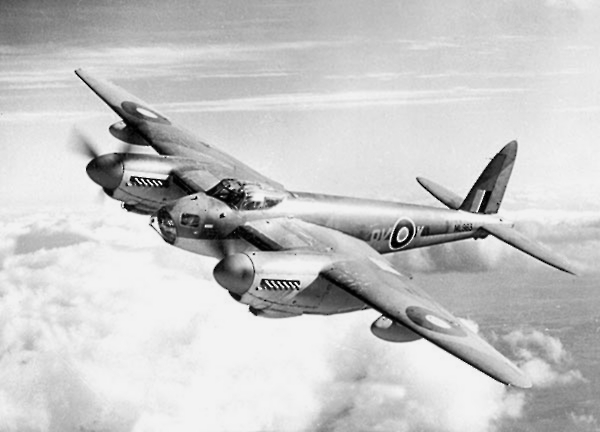
The British movie 633 Squadron is an entertaining air combat movie. It has a little bit of everything in it. It is part adventure story, war movie , suicide mission and romance. Although it is not great it has a lot of potential and would be a great choice for a remake. None of the actors is remarkable, exchanging them wouldn’t do any harm and the special effects could do with some revamping as well. Still if you have a special interest in aircraft you might want to watch it as it gives you the possibility of seeing a real Mosquito (as far as I know only one is the real thing, the others were remade). The Mosquito was a funny, enduring little plane and is one of the rare made of wood. When it entered production in was one of the fastest operating aircraft.

“In 1940 I could at least fly as far as Glasgow in most of my aircraft, but not now! It makes me furious when I see the Mosquito. I turn green and yellow with envy. The British, who can afford aluminium better than we can, knock together a beautiful wooden aircraft that every piano factory over there is building, and they give it a speed which they have now increased yet again…” (Hermann Göring)

File:Mosquito 600pix.jpg

The story of 633 Squadron resembles the story of the much better movie The Dam Busters. A group of pilots has to go on a secret mission and drop bombs on a German rocket fuel factory that is based in Norway. The Norwegian resistance does also play a part in it and the squadron leader falls in love with the sister of one of their members. The squadron is a typical war movie squadron that pushes diversity to the limits. We see British, Irish, Scottish, Australian and Indian members. The accents are quite enjoyable if you go for that kind of detail. The mission itself is quite gripping and suspenseful. The losses were, as could be expected, extremely high.

633 Squadron is loosely based on a true story which makes it interesting to watch, still I would say if you want to see two really great British WWII air combat movies, go for The Battle of Britain or the aforementioned The Dam Busters.