Les femmes de l’ombre aka Female Agents (2008) Women in the Resistance

Not every slick-looking movie with good-looking actresses on the French Resistance is a good movie. Unfortunately not or Les femmes de l’ombre would have been great. Don’t get me wrong, it isn’t bad it’s just not great. If you want an entertaining period drama, this is your movie (ok, there are a some torture scenes that dampen the experience a bit but nice clothes and make-up make up for it). It’s a little bit like Black Book aka Zwartboek but less convincing. The theme would have been interesting and worth dedicating a movie to.

Based on true events, it follows the story of Louise Desfontaine (Sophie Marceau), a sniper with the French Resistance. When things heat up in France she leaves for England and joins the SOE. One day she is contacted by an agent who happens to be her brother Pierre (Julien Boisselier) whom she suspected of being a collaborator. He hires her and four other women to rescue a British spy who has been captured in France by the Germans. The Germans aren’t aware of his identity and think he is German. The women will have to team up, two disguised as nurses, two as exotic dancers (yes, you will see them topless, it’s a French movie) and the fifth will place bombs under German cars.

The five women are a composite group, one is an ex-prostitute (Julie Depardieu), one the ex-girlfriend (Marie Gillain) of the Nazi officer (Moritz Bleibtreu) who tries to hunt them down.

What at first looks like a success soon goes awry. Louise’s brother get’s caught and we all know what that means.

The women go back to Paris on another mission and here things goe definitely very wrong as one gets captured and immediately crumbles under torture (one finger nail off and she spits it all out).

I can really not say why exactly I wasn’t too convinced. Because I have seen the brilliant L’armée du crime aka The Army of Crime before? Or some of the movies on Nordic Resistance that are truly good? I think it is in part due to a slightly off-key cast. Every woman wears heavy make-up which is nice, only Sophie Marceau has to look somewhat stony faced and unattractive (she isn’t successful, she’s too beautiful to look unattractive). I think the producers and directors were aware they would be criticized for their choice of too pretty women and tried to balance this out by not showing a heavily made up Sophie Marceau. She is the sniper after all… Why, if they didn’t want her to look her very best, did they not cast another actress? Because she is a great actress? I always suspected her to be far from accomplished, and she really isn’t too good. I would have preferred her to look as beautiful as she can and not try so hard to look efficient. (I’m thinking of Demi Moore as G.I. Jane who was much more convincing.) I think you can actually be cold-blooded without looking it. And I am not a big fan of Moritz Bleibtreu either. At least not in supposedly serious roles (I have seen him in German movies in which I found him very good). Julien Boisselier and the other four actresses are very good, especially Julie Depardieu and Marie Gillain.

Les femmes de l’ombre aka Female Agents is entertaining, just don’t expect to much of it. If you want the real deal, watch L’armée du crime.
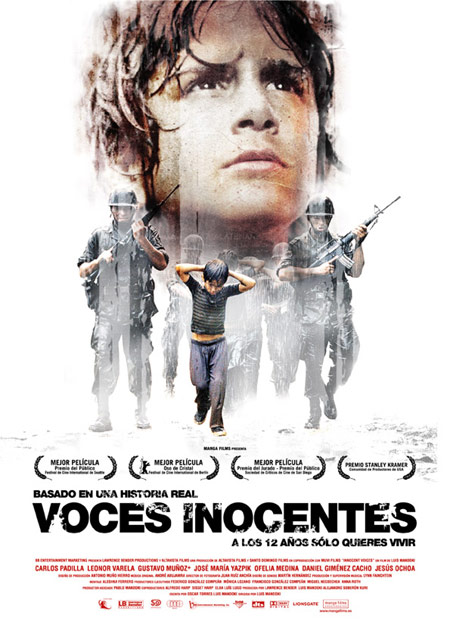
Voces Inocentes aka Innocent Voices (2004) Children as Soldiers in the Civil War in El Salvador

Based on a true story, Luis Mandoki’s Voces Inocentes aka Innocent Voices is going directly on my list of all time favourites, regardless of the genre. This Mexico/US/Puerto Rico co-production is an astonishingly beautiful movie despite the atrocities it depicts. It is simply awesome and as good as Army of Crime about which I raved last year. It is one of the movies on my Children in War Movies List and a s such worth watching in any case.

What makes this movie so incredible is the fact that it works on many levels. It is as much the story of a childhood and a little boy, as an in-depth look at a way of life we are less than familiar with and a civil war we have almost forgotten about. Last but not least it shows the portrait of a mother (Leonor Varela) whose spirited fight and love for her children makes her one of the most memorable and dignified characters I have seen in any movie.

The war, that started in 1980 and lasted 12 years, was initially a conflict between the army and the campesinos, the land owners, over land rights. When they didn’t come to an arrangement the campesinos formed a guerilla, the FMLN, to defend their rights. The war escalated into a bloody civil war. On top of that the US felt the urge to provide the Army with weapons and heir assisstance, fearing that the guerrilleros would be supported by the USSR. The war cost 75’000 lives and over 1 Mio people fled the country. Lacking men, the Army recruited young boys who were barely 12 years old. Oscar Torres, who wrote the script, is the model for Chava, the little boy, whose story we see.

The movie starts with soldiers escorting little boys holding their hands over their heads, to an execution place. They walk in the pouring rain and we hear Chava’s voice in the off. It’s a beautifully filmed scene that immediately sets the tone for the whole movie. We will see many scenes that take place in the pouring rain and are of great beauty despite the fact that they show horrors.

Chava (Carlos Padilla) lives alone with his mother and his little brother and sister. The father has fled the country and gone to the US. Chava’s young and beautiful mother, Kella, is truly a memorable character. Tender and fierce at the same time, she defends her children and fights for their survival. These are the poorest of the poor, their houses are only shacks with cardboard roofs. Kella tries to make a living as a seamstress. Imagine living in a shack when at night there is fighting in the roads. Bullets easily enter the walls of the houses and come flying past your head, there is hardly any cover apart from mattresses that are build up against those thinnest of walls. It is hard to imagine that people not only lived in such poverty but had to endure a war like this that threatened their lives on a daily basis. Many got killed like this, in their own house.

Young Chava is a cheerful and funny little boy. Despite the war, he plays with his friends, falls in love with a little girl, fights with his mother, finds a means to earn money. Even though they have nothing, live precariously, his childhood seems almost enchanted. The tiniest things amuse him, he lives with great intensity, knows no boredom.

The main theme of the movie is the threat that the soldiers will come and get Chava and his friends. We see many scenes in which little boys are recruited by force. The procedures are quite upsetting. Some of the boys around Chava finally decide to join the guerilla in order to avoid the military. And that is what little Chava does in the end as well. The final scene of the movie brings us back to the beginning. Chava and his friends have joined the guerilla and were caught by the Army. Unless they get help, they will most probably be executed.

The actors are amazing, especially the children. They are really awesome. The movie is full of beautiful scenes that allow us to have a look at these precarious lives in poverty. They convey a melancholic beauty that is quite special. There are a few songs that are important in the movie. They had been forbidden by the army but were listened to anyway.

The movie manages to mix a lot of different tones. At times it is sad and melancholic, at times it is thoughtful almost meditative, then again it’s funny or just downright tragic. Innocent voices is a gem, a must-see.

One final word: the people from El Salvador were apparently not entirely happy about this movie because none of the actors is from El Salvador and it has been filmed in Mexico.

Under Fire (1983) War and Journalism or Whose Side Are You On?

I don’t take sides, I take pictures (Nick Nolte as Russel Price in Under Fire)

The least you can say about Under Fire is that is an extremely interesting movie with four fascinating character portraits played by four outstanding actors.

Under Fire belongs to the war movie subgenre of War and Journalism. There are quite a lot of movies in this sub-genre and a great many are from the 80s. The Year of Living Dangerously, Circle of Deceit, The Killing Fields, Salvador, Missing and later movies like Welcome to Sarajevo (see my post).

The movie opens in Tchad. The photographer Russel Price (Nick Nolte) and the mercenary Oates (Ed Harris) meet and discuss their work. Oates points out that Price isn’t much better. He is profiting as much from every war there is as Oates is. None of them is more interested in politics than the other. When they part we know that they will meet again.

Before Price departs to the latest war zone, Nicaragua, we are introduced to two other journalists, Claire (Joanna Cassidy) and Alex Gazier (Gene Hackman). Claire and Alex are a couple but she breaks up with him before leaving to Nicaragua and we already sense she will be romantically involved with Russell.

At first when arriving in Nicaragua, Price isn’t interested in background information. He wants to know if the beer is good and what the food is like. Fortunately the movie nevertheless fills us in on the basics. We hear that the revolutionaries, headed by a guy named Rafael, fight the government of president Somoza who is supported by the US and a few other details. Claire and Price meet the French agent Jazy (Jean-Louis Trintignant), a dubious character, that seems to be in favour of the rebels, they also meet the president and his press officer.

While they are in Nicaragua – falling in love, getting to know the country – something happens to Price. He meets Oates again and sees him kill one of the revolutionaries in cold blood. This makes Price understand his own actions and how cynical they are.  He becomes aware that he cannot stay out of this anymore. It bdawns on him, that the Sandinistas are right, that the government is corrupt and supported by the US who are afraid of a communist Nicaragua. In order to support the revolution, he takes a fake picture. He serves the rebels but triggers a flood of violence during which Alex is killed by the president’s soldiers (this is based on a true story). He takes a picture of this as well and triggers a reaction in the US…

What I really liked about this movie is how subtle it portrays the different people. Nolte, Hackman and Harris are very convincing, each takes another position, stays for another point of view. The cynic mercenary Oates is probably the most stringent character, the one who will make you the most uneasy, although Jazy isn’t a bad example of double standards either. Claire was the least convincing character, she rather served as a enhancer for the others.

Apparently the movie has been considered to be problematic in the US because it openly takes position for the Nicaraguan revolution. I think this is great and daring. It is an ugly chapter in US politics and many efforts have been made to forget about it as soon as possible (Noam Chomsky has written quite eloquently about this).

The movie is visually extremely convincing. John Alcott, Kubrick’s cameraman, has filmed it documentary-style.

The topic of War and Journalism always makes me uneasy. I think we should be informed but I cannot understand how people can take pictures like vultures of dying and dead people and stay uninvolved. Maybe it is not so much journalism as photo journalism that I find problematic. I am really glad for movies like Under Fire. They are valuable and important and illustrate how everything is linked, how one deed leads to another.

There is a trailer on iMDB.

Here is just a video with scenes from the movie and the original soundtrack by Jerry Goldsmith.

The Gathering Storm (2002) HBO’s Excellent Churchill Biopic

When Gretchen Rubin started to work on her biography on Winston Churchill, she first read extensively everything that was available. Every biographer would do the same, especially when the person he wants to write about is already dead and the possibility for an interview non-existent.

This isn’t really remarkable as such, remarkable is what she came up with after having read so much about Churchill. She realized she couldn’t write the type of biography you would normally write and decided to call her book 4o Ways to Look at Winston Churchill: A Brief Account of  a Long Life instead. In her book she names 40 elements of Churchill’s life and has a look at them. She also shows contradictions in naming Churchill’s positive aspects in one chapter followed by the negative ones in the next. For every character trait one biographer came up with, another one named the exact opposite. If you want to really understand Churchill and the range of his complexity you have to take into account all the contradictions as well. Rubin doesn’t say her approach is a definite one (although she used the same approach again in her biography of Kennedy) but it is certainly clever and thought-provoking.

The Biopic The Gathering Storm goes a completely different way. It shows Churchill just before WWII, during a very difficult period in his life and focuses on his depression and his marriage. We see a very private Churchill, one that not many got to see. I enjoyed The Gathering Storm a lot but I know it isn’t everybody’s cup of tea. The two actors Vanessa Redgrave and Albert Finney are fantastic. The title of the movie is taken from Churchill’s book  on WWII called The Gathering Storm.

If you like great acting, are interested in the private side of one of history’s most important men, enjoy character portraits and biopics and a beautifully filmed movie, then you shouldn’t miss this.

Unfortunately I couldn’t find a trailer so I posted part one of the movie here. You will notice that Ridley Scott was one of the executive producers.

Paths of Glory (1957) Kubrick’s WWI Anti-War Masterpiece

Paths of Glory was forbidden in the UK and in Switzerland until the 70s. French troops disturbed the opening in West Berlin. The movie was forbidden in American cinemas for soldiers. It was forbidden in France during the war in Algeria. It was shown in Paris for the first time in 1975. What’s that telling us? That this is a radical anti-war statement that openly criticizes high command. It is powerful and thought-provoking and absolutely unambiguous as to its goal. I felt a bit uneasy that Kubrick chose to criticize French command. Didn’t he have plenty of opportunities to criticize American command? Be it as it may, Paths of Glory, which is based on a true account, is a great achievement.

The movie opens  with the Marseillaise and a voice telling the horrors of  WWI, the numbers of soldiers that get killed daily to no avail. The incident on which the movie centers took place in 1916 in France. The movie moves back and forth between the trenches and the high command residing in an elegant Château.

An ambitious general asks of the equally ambitious general Mireau to take a hill, held by German troops, the so-called “Ant Hill”. A highly symbolical name if there ever was one as people are treated no better than ants and wiped out with one simple gesture. When general Mireau informs colonel Dax (Kirk Douglas) of the order to attack the ant-hill, he is met with incredulity. Dax tells him that it is impossible and will cost an incredible amount of lives. The answer is a sarcastic calculation. 65% of the men will not survive and the outcome is not even sure. Dax wants to refuse the order but is threatened to be replaced.

The futility of the attack becomes obvious right away. Dax fights in the front line with his men who die one after the other. He and many others retreat after seeing that they can’t make it. Many stayed in the trenches, knowing damn well they would be killed and nothing could be won. Seeing the men’s reluctance to run into certain death, general Mireau orders to open fire on them but the officer who receives the order refuses.

The frustrated general then orders a court-martial. Three men are chosen in lieu of all the others and accused of cowardice. Colonel Dax, a lawyer in civilian life, takes up their defence. Like the court-martial in Breaker Morant, this is a pure sham.

Kubrick’s movie has a lot of interesting elements. Colonel Dax is one of the great war movie characters. A officer of high moral standards, free of carrerism and ambition, a just and human being. Kirk Douglas was very well-chosen for this role. He is very believable and gives a great performance.

The contrasts between the high command who is far from the action and thinks they can mock simple soldiers who are afraid, slap those who show signs of shell-shock and judge others that refuse to run into certain death, is fantastic. Paths of Glory is one of those movies that has scenes that will stay with you forever because they are emotionally true and powerful. The utter cynicism of the high command, the way they calculate losses without giving further thought to the fact that each number equals a human being, will make you cringe.

It is a movie that belongs to two sub-categories. The court-martial movies like Breaker Morant and the “Taking a hill movies” like Hamburger Hill, Pork Chop Hill, Gallipoli and The Thin Red Line.

Apparently there is a more recent French TV film Le Pantalon (1996) that quotes Paths of Glory in its major parts.

As much good as I may have said, I had my reservations. I did not understand the use of black and white. The movie doesn’t work so well from a cinematographic point of view. There are not so many contrasts and shadows as there normally are in black and white movies. Even Pork Chop Hill (far less good as a whole) looks much better. Kubrick is famous for the use of colours in his movies… I don’t see it as entirely logical that he didn’t shoot this in color. But that is the only flaw I could find. It still deserves a solid 4.5/5.