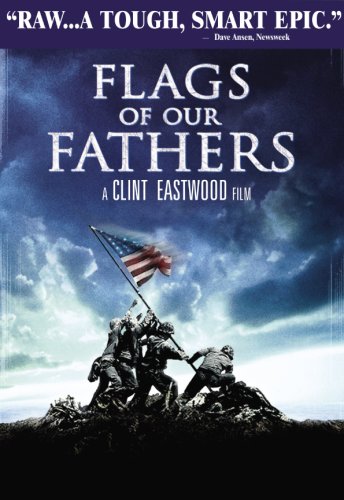
Flags of Our Fathers (2006)

Flags of Our Fathers

 “The right picture can win or lose a war.”

I remember watching Clint Eastwood’s Flags of Our Fathers shortly after it was in the cinemas and feeling less than enthusiastic about it. I’d been watching my way through the best infantry combat movies at the time, so, obviously, Flags of Our Fathers fell short. After re-watching it yesterday I must say, it’s not bad at all. Quite the contrary. Sure, it has some corny Hollywood moments, but overall it’s a very interesting movie about topics that are still relevant today: the power of images and the making of heroes.

Flags of our Fathers tells the story of the iconic picture that rekindled the American war effort. Looking at the photo below I would say it’s extremely powerful. I’m not surprised it had such an effect.

APTOPIX OBIT ROSENTHAL

The movie starts with two elderly men reminiscing and telling their story to the son of one of them. The son knows his father took part in the battle of Iwo Jima and that he’s on the famous picture but he doesn’t know much more. His father never spoke about the war. From this initial moment the movie is composed mostly of flash back sections, some of which showing what happened on Iwo Jima, some telling about what came after the picture was shot.

Iwo Jima – or Sulfur Island – was a strategic point. Taking the hill meant that the US might after all have a chance to win the war. When the troops land, the island looks bleak, dark, forlorn and empty. It’s quite a creepy moment, which is enhanced through a change in point of view. We first see the troops land and slowly walk towards the hill, scanning the landscape and then we get the point of view of the hidden Japanese who observe the troops from their fox holes. Needless to say that this first wave of US soldiers is quickly heavily decimated. Still, many make it to the top and that’s when they plant the flag. A senior officer later demands this flag and the commanding officer decides to exchange it and to let him have another one. Both flag raisings are photographed but it’s the second, which is the better picture, that makes it into the newspapers.

Three of the men who raise the flag survive. However, inadvertently, one of the first six is named as the sixth of the second group, which will cause a lot of heartbreak.

The three survivors are sent back to the States where they are touring the country and trying to convince people to help the war effort and buy bonds.

The three men who haven’t done anything more heroic than holding a heavy pole, feel uncomfortable about being called heroes. One of them, an American Indian, is especially uncomfortable. He feels like a cheat. Not only because he doesn’t feel heroic but because they were not even part of the initial flag raising. It feels like he’s deceiving people. The mix up of the sixth soldier makes it even worse.

The movie is sleek and visually compelling. The combat scenes on the island are shot in gritty almost black and white pictures, which form a contrast to the colorful home front scenes.

The actors, notably Adam Beach and Ryan Philippe, are very good. The score is discreet and well-chosen. It stays mostly in the background.

I thought Flags of Our Fathers was really watchable. More than that actually. It’s very good. It shouldn’t be seen as a combat movie but more as a movie about the impact of pictures, an exploration of the true nature of heroism and the way society treats heroes when they aren’t needed anymore. It was sobering to see their treatment. At no point were they seen as soldiers and men but merely as a possibility for propaganda. This became even clearer after the war when people lost all interest in them.

Lone Survivor (2013)

Lone Survivor

I decided to watch Lone Survivor after having read a positive review on The War Movie Buff’s blog (here). I did not regret it, although I have some reservations.

Talk about a doomed operation. Lone Survivor is based on a true story – Operation Red Wing – which went horribly wrong. Given how the movie starts and its title, it’s not a spoiler to mention that the operation only had one survivor played by Mark Wahlberg. 

The movie is set in Afghanistan in 2005. Marcus Luttrell (Mark Wahlberg) and three other Navy Seals are sent on a mission to capture or kill al Qaeda leader Ahmad Shahd. While hiding in the mountains goatherds literally stumble over them. The four men have a heated discussion about what they should do with them. Two want them dead, one wants to tie them and only Luttrell wants to let them go. Unfortunately their communication systems don’t work and they cannot reach their commander (Eric Bana) and ask for advice. Finally they let them go as that is in line with their rules of engagement. It’s clear that while this is the right thing to do, nothing good can come of it. And indeed, one of the herders runs down to the village and alerts the men surrounding Ahmad Shadh. What follows is an intense two hours of flight and fight.

First I’d like to say that the movie is well done. The pacing is good, there is some nice cinematography (stunning sunsets), the music works well, the action scenes are extremely realistic. The characters aren’t fully rounded, but that would be absurd in a movie like this. Last, but not least it’s very suspenseful, although we know there’s only one survivor.

I thought that in choosing this title and beginning of the film, which clearly shows that only Wahlberg’s character survived, the director stayed away from sentimentality and melodrama, which is so often annoying in movies of this type.

I’ve seen this compared to Black Hawk Down but I can’t see any similarity. I was reminded of Bravo Two Zero, in which the failing communication also played a major role. Lone Survivor has elements of both Act of Valor and the French Forces Spécilales, but I would say it’s better.

I’ve seen a lot of very harsh reviews of this movie. I think it’s not as bad as some say, but as is often the case with movies, which also find the approval of the military, there’s a mix up in the reception. One thing is the movie as such, and one can really not find a lot of flaws in that, the other thing is the reason that this movie was made in the first place. It depicts a true story and if you are against the way the US handle their war against terrorism, then you are probably inclined to be against this film. But that’s really mixing up two things. I thought that this movie stayed away from a lot of the glorifying we usually see in movies like this. It depicts  highly trained men on a mission that goes wrong. Sure, the characters want to kill as many Afghanis as they can, and they don’t try to apply a lot of empathy, but I’d like to see what all the liberal thinkers who criticized this film would do in a similar situation. Would they still try to understand and speak in a politically correct way about people who are trying to kill them?

I liked this film and the way it was done. I’m not keen on the US strategies against terrorism, but there is no denying that they exist. And there is no denying that the US military has some admirably well-trained soldiers who would do anything for each other.

Watch it if you like watching an action-driven movie inspired by a true story, leave it out if you expect criticism of the US military.

The Desert Fox (1951) Biopic on Field Marshal Rommel’s Final Years

The Desert Fox

The Desert Fox, starring James Mason as Field Marshal Rommel, is based on the biography of Rommel by Desmond Young. The movie opens with British commandos trying to assassinate Rommel in 1941 and then forwards to 1943 showing Rommel at El Alamein.  Rommel, who is of poor health, is just back on the front line and faces a pretty desperate situation. The German troops are far outnumbered and any reasonable commander would give the order to withdraw. Not so Hitler whose consultants all encourage him to give orders to either win or die. For the first time, the movie tells us, Rommel starts to doubt the Führer’s sanity. It will not be the last time. On the very contrary. The movie tries to show a Rommel who goes from doubt to open criticism and even knows the group around von Stauffenberg will attempt to assassinate Hitler. While not tied to the assassination he’s still found guilty of treason and given a chance to either get a fake trial or to commit suicide in order to assure the future of his wife and son.

I must admit I expected this movie to be far better than it was. The story is interesting, of course, but the way this was filmed was not much better than a B-movie. Mason is good, I wouldn’t say he’s great but he’s good. There is just one problem. He doesn’t look like Rommel. What didn’t work is that most of the movie is either composed of real footage or scenes filmed in the studio which makes the whole movie look like a theater play broken up by documentary material.

The other problem is that we don’t really get to know Rommel. Given that the title of the movie is The Desert Fox and not “Rommel’s Downfall” or some such thing, I expected that we will learn why Rommel was considered to be such a great general. Although he was their enemy, the Allies admired and feared him. The movie only shows us a Rommel who is very realistic, who knows when a battle can’t be won, who makes great suggestions, but isn’t heard. The movie also fals in showing Rommels’ humanity. It seems he was never accused of war crimes. He refused to kill Jewish soldiers, civilians and prisoners.

The best part is that the movie shows how Rommel first doubts the people who consult Hitler before he doubts the man himself. Once he’s understood that his Führer is nothing but a maniac, he speaks his mind openly and confronts him.

I watched the movie Patton two years ago and thought it was outstanding. If anyone knows of a biopic of Rommel which is equally good, please let me know.

I didn’t mind watching The Desert Fox, but it’s certainly not the ultimate movie on Rommel.

Rommel’s son Manfred died last month. It’s interesting to know that he formed a friendship with Patton’s and Montgomer’y sons.

Here’s one of the best scenes in which Rommel confronts Hitler

They Were Not Divided (1950)

THEY WERE NOT DIVIDED

I’m usually quite lucky in my choices of older British movies. Some I’ve watched in the past make my extended best of list. However, They Were Not Divided will not be on that list. It’s not a bad movie but it felt at times as if the director had intended to make a war movie – based on true events (!) – which is suitable for the whole family. The result is a bit too cute for my taste.

At the core of the movie is the friendship between a British, an American and an Irish soldier. Especially the Englishman Philip Hamilton and the American David Morgan are very close. After having undergone intense training which we are shown in a long boot camp sequence, which reminded me a bit of Full Metal Jacket, the three men are promoted and assigned to serve in the tank company of the Welsh Guards.  Two thirds of the film are taken up by the boot camp and further tank training episodes, occasionally interrupted by leaves which they spend at Philip’s home. During one of those leaves, David meets an English girl and falls in love with her.

There is a lot of emphasis on the relationships in the movie. The marriage between Philip and his wife is explored as well as the relationship between David and his future fiancée.

The last part of the film, could finally be called the real war movie part. The three main characters land at Normandy weeks after D-Day as part of the Welsh Guard’s Armoured Division. They quickly see combat and have to cope with fighting a war in another country, far from their wives and girl friends. The film then picks up speed and we see many of the crucial moments of WWII: Operation Market Garden, The Battle of the Bulge. We see how the Welsh Guards join American paratroopers at the Grave bridge before moving to Nijmegen during Operation Market Garden. The film ends with the Ardennes Offensive and the Guards’ unknown operations around the east side of the river Meuse. I suppose it isn’t spoiling the movie too much if I mention that not everyone survives.

I think They Were Not Divided isn’t exactly a must see but I’ve seen far worse. It’s an ok movie, it just doesn’t really have anything that stands out with the exception of some quite humorous scenes during the boot camp sequence. It’s safe to say that even the very squeamish can watch this. If you’re looking for a WWII film to watch with the whole family, this could be your choice.

b00tgdkn_640_360

Kathryn Bigelow’s Zero Dark Thirty (2012) The Hunt for Osama Bin Laden

I knew I was going to watch Kathryn Bigelow’s next movie, no matter what it would be about but I would have wished she had chosen another topic.

Zero Dark Thirty is an almost 3 hour-long movie on the hunt for Bin Laden. It starts on 9/11 … with voices of victims recorded during the attacks. Next thing we’re in a detention center in Pakistan witnessing CIA agents torturing a man. A male agent is torturing while a female CIA agent, Maya, is watching. Maya is new, recruited fresh from college, and assigned to one of the most important tasks in CIA history – the hunt for Bin Laden.

While she only watches the interrogations at first, she will later lead them and become the most important agent in this assignment. As early as 2002 0r 2003 she starts to follow a lead, a man she believes to be in contact with Bin Laden himself, a courier. Unfortunately the guy is very elusive, the captured and tortured men contradict each other, his name seems only a nick name, his true identity cannot be found. Eventually he is even said to be dead.

Maya is considered to be obsessed and her superiors start to doubt that what she is pursuing is real. But she won’t give up and is proven right in the end. The rest is history.

I felt very uncomfortable watching this movie. The torture scenes are unpleasant and the fact that the US, who always denied that they use torture, are shown doing it even more so.

Does the outcome justify this? The movie is showing the story as it was. Or is it not? That’s the big question. What we see are scenes showing a group of CIA agents trying to find a man, using every possible way, alternating with scenes from terrorist attacks. Islamabad, London, New York…. While the CIA hunts Bin Laden, the terrorists don’t sleep.

The movie takes a lot of time to tell the story and the first 2 hours are long. I couldn’t help finding the last action-packed sequence interesting. They show the final moments, when the special troops invade the compound where Bin Laden was hiding and how they kill him.

The movie is OK but certainly not a must-see. I’m clueless why anyone would want to make a movie about this. If you are not familiar with the details, it’s interesting to watch but it still left a very bad taste. It is like a documentary and never questions anything, never accuses. It seems to say that without torture, Bin Laden would never have been captured. That’s quite possible but does that make torture acceptable? On the other hand, terrorism is despicable…

I was wondering why Bigelow chose this topic. Because a woman found him? Since I’m not watching the news very often, I don’t know how much was known about the CIA’s interrogation techniques. Is the movie meant to get rid of the general public’s naivety about torture?

I don’t think I’ve seen Jessica Chastain who plays Maya before and couldn’t help comparing her to Claire Danes in Homeland. I’m afraid I like Danes much better. Not only as an actress but I also like her character better. She seems a tad more conflicted about what she is doing. Other actors worth mentioning are Jennifer Ehle, Jason Clarke and Joel Edgerton.

As I’ve just said above, this isn’t a must-see. I’m truly disappointed in Kathryn Bigelow.

Have you seen the movie? Did you like it?