
Reach For The Sky (1956) Biopic of a Famous RAF Bomber Pilot

Reach for the Sky

If Reach for the Sky wasn’t a true story it would be one of those movies which you’d just shrug off as way over the top but since it is based on a true story it leaves you astonished.

Reach for The Sky is the story of one man’s love for flying which was so intense that it made him  overcome one of the worst things that can happen to a man and later turned him into a legend.

Douglas Bader is a passionate and reckless young RAF pilot when in 1931, while showing off his talents in front of other pilots, he has a terrible accident which costs him both legs.

Determined and optimistic as he is, he makes the impossible possible and soon learns to walk on tin legs, without help or a crutch. Shortly after leaving the hospital, still on crutches during that time, he meets his future wife and love of his life Thelma.

The only bitter moment comes for him when they don’t accept him as a pilot anymore and he has to do desk duty.

If it wasn’t for WWII he may never have flown again but when war breaks out he undergoes tests and is judged fit for service.

The story which is already quite remarkable until that point, gets truly astonishing now. Not only does he fly one mission after the other, survives the Battle of Britain but he becomes one of the best-loved wing commanders until he is shot down in 1941.

He survives and is captured by the Germans. As a POW he shows the same determination as earlier in his life and escapes several times from different camps until he’s finally sent to Colditz castle where he remains until the end of the war.

Douglas Bader’s story is truly amazing. It would have been so easy to just fall into a deep depression and withdraw from life but Bader was a fighter and nothing, absolutely nothing, could put that man down or stop him. And he was a passionate pilot. As much as he loved his wife, we get the impression that he loved flying even more.

A story like this is quite inspiring but that wouldn’t make this a great movie. What makes it great is the way it is told. While the first half focusses on Bader, his accident and how he learned to walk again, the second half focusses on WWII, the Battle of Britain, the dog fights… It’s quite suspenseful and interesting. It’s not easy for Bader to be accepted at first. The young pilots are a bit taken aback when they find out their wing commander has no legs.

I wasn’t familiar with the main actors Kenneth Moore and the lovely Muriel Pavlow but they were both really good.

It’s certainly a movie I would recommend to anyone interested in WWII, the Battle of Britain and true stories about resilience and overcoming a tragedy.

Machine Gun Preacher (2011)

Machine Gun Preacher is based on a true story, the story of ex Hell’s Angel and bad boy Sam Childers.

At the beginning of the movie Sam gets out of prison. He hasn’t learned anything from that experience and wants to get back to his former life. Drugs, booze, his Harley Davidson and his stripping wife. Unfortunately for him, his wife has found Jesus, works at a mall, doesn’t strip, drink or smoke anymore and goes to church on Sundays. Sam does what he always did, gets drunk and high and ends up fighting with everyone. Then, one night, something really bad happens and wakes him up for good. He joins the church to which his wife belongs, sobers up, sells his bike, gets a decent job.

But that’s not enough for Sam. The way he used to be, lies too heavy on his conscience, he wants more, do more, do better. He builds a church and travels to Africa to see what good the missionaries do there. When he crosses the border into Sudan with a soldier from the Sudanese Liberation Army whom he met in Uganda, he sees things he has never even heard of. Mutilated people, shot women and children, cruelty and violence. He hears about the child soldiers recruited by the LRA (Lords Resistance Army), led by Joseph Kony, sees the many orphans whose parents have been slaughtered. Sam decides that this is his cause. God wants him to help and he will help.

What makes him different from all the social workers down there is that he doesn’t only help and bring money, he also fights. He doesn’t only defend his property, he attacks the aggressors and intimidates them in using the same methods they use. Ultimately he doesn’t mind killing. For him – this is obvious – this is more than just helping, this is fighting a war. A war against oppression, exploitation, violence and cruelty.

If it wasn’t for that, the movie would be average but because of this, it’s a very interesting movie because it seems to state some uncomfortable things and ask interesting questions. Can there be a level of violence which makes it impossible to fight it with non-violence? Could it be dangerous to just try to do good without being prepared to kill and shoot people for the greater good?

I’m not saying I agree with Childers (I personally think we are not meant to intervene everywhere all the time but that’s my opinion. I think if we want to do good, we can start in our own cities, our own neighbourhoods and families.) but I understand his point and found the movie quite interesting.

Machine Gun Preacher reminded me of Lord of War and Blood Diamond and some other movies which make African civil wars and warlords their main topic. While I think it’s a movie which will generate a lot of discussions and I didn’t mind watching it, I still think that movies like Lord of War, Hotel Rwanda and some others were far better. But it’s decent and for Gerard Butler fans certainly a must-see.

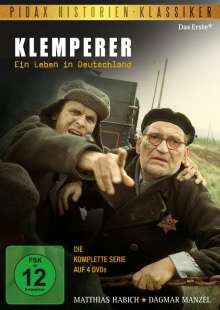
Klemperer – Ein Leben in Deutschland – A Life in Germany (1999) German TV Mini-Series

When Klemperer was first aired on German TV, I watched the first episodes but because I was moving I had to stop after the fourth. I always meant to re-watch the beginning and finally finish the whole series which consists of 12 episodes.

I had really liked the beginning at the time and now that I have finally re-watched those first four episodes I’m glad I still like it, maybe even more and I’m keen on watching the rest. However it’s very depressing. I didn’t remember it to be this upsetting but maybe it’s just me and I’m in a funny mood.

The series is based on Viktor Klemperer’s war diaries, 8 volumes of several thousand pages (here in English Viktor Klemperer’s diaries and in German here). The diaries are a fascinating document. I’ve read the first and it’s breathtaking. Klemperer was a professor of French literature, highly intelligent and with an amazing knowledge which all goes into the diary. He was also Jewish. The amazing thing in the series and the diary is the fact that it shows a man who is incapable of seeing what is going on and that we witness an amazingly intelligent person’s blindness. I find it must have taken a lot of guts to publish this diary because while it is very human it is still such an incredible flaw to be this blind.

To watch the series is eerie. It starts in 1933, just after Hitler was elected. At first there are just a few warning signals. Klemperer isn’t allowed to test non-Jewish students anymore, later he will not be able to publish anymore, they will remove him from certain classes and finally he will be fired. While many of his friends leave Germany very early, he doesn’t want to leave, he always thinks that maybe he will be exempt from the next measures only to find out that he wasn’t. His wife is not Jewish and since he himself isn’t religious, he always thinks they will make an exception for him. They even start to build a house.

Klemperer’s wife is an amazing character as well as she is so flawed and naive. She still moans about not being able to go on holidays when he has already been fired because he is Jewish.

As I already mentioned, the series is quite long. There are 12 parts of 45 minutes each, which means they have taken a lot of time to show the whole story and include a lot of details. I already know that the Klemperers will end up being sent to a camp but survive. Because it spans such a long time, 1933 – 1945, it really feels at times like having been there, having experienced some of it.  It is one of the best TV series I’ve ever seen. It has been very carefully executed and with Matthias Habich and Dagmar Wenzel, they have chosen two of the best German actors. Habich is one of my favourites, and one of the rare I like almost as much as Bruno Ganz.

A far as I know, there is no version with English subtitles available which is a pity. At least the diary is available in English too.

Heaven and Earth (1993) The Third Movie in Oliver Stone’s Vietnam Trilogy

Heaven & Earth is Oliver Stone’s third Vietnam movie. He started his trilogy with the intense infantry combat movie Platoon (1986), followed by the harrowing tale of one soldier’s ordeal Born on the Fourth of July (1989) and then the third part, told from the point of view of a Vietnamese village girl Heaven & Earth (1993). It’s anti-climatic to start a review with a verdict, so let’s just say, Heaven & Earth is the weakest of the three. And the most sentimental.

The movie is based on the true story of Le Ly. It starts in the 1950s, with Le Ly as a little girl of five, living with her family in a beautiful village in Northern Vietnam. In 1953 the village is burnt down by the French. Her father teaches Le Ly that the most important thing is freedom and it’s not surprising that she and her brothers will later actively help the Vietcong. While the younger brother is executed and the older one hidden somewhere, Le Ly is captured and tortured by the Americans first and later raped by the Vietcong.

Le Ly (Hiep Thi Le) leaves her village and tries to make a living in Saigon. She and her mother work for a rich Vietnamese family until Le Ly has an affair with the husband and gets pregnant. They are chased away. Her mother returns to the village, while Le Ly stays in another city, Danang. Most girls from the villages end up as prostitutes but she sells cigarettes and other things, and fights off the advances of the American soldiers.

When her son is about five, she meets an American soldier (Tommy Lee Jones) who falls in love with her. They live together for a while and finally get married. Butler wants to take her back to America and some time later, after their first child is born, they leave for the US. Just in time to escape the chaos that breaks out in Vietnam after the war is over.

The US are a culture shock for Le Ly. But also a pleasant surprise. The way she sees it, this is the land of plenty. There is so much food and abundance everywhere. Everything could be great if her husband didn’t show signs of alcoholism and other issues. Le Ly who was a very independent woman in Vietnam, wants to open a business of her own but her husband is opposed to that. They fight more and more, the marriage is doomed.

In the final part we see Le Ly and her children return to Vietnam. She will forever be a part of both worlds, Vietnam and the US, Heaven and Earth.

I have seen a lot of negative reviews of this movie and while I was watching the first hour or so I didn’t understand why. The initial parts are not only beautifully filmed, they tell an intense and interesting story and the choice to focus on a girl from Northern Vietnam, to illustrate some of the complexities, wasn’t a bad choice. Unfortunately from the moment she meets Butler, the story starts to drift in a lot of different directions and from the story of a girl, exemplary for one nation’s suffering, it turns into the story of one woman and her failed marriage. It just didn’t work for me anymore, was too sentimental and lost its strength.

Heaven and Earth is cinematographically compelling and the first part is well above average. Then, unfortunately, it tumbles down and I don’t think it works well as a third part in Stone’s trilogy. It may however work as the story of one woman who may not have been able to free her country but herself.

Habermann (2010)

The German/Czech/Austrian co production Habermann tells a chapter of German history which is easily forgotten. The movie is based on a true story and tries to exemplify the destiny of the Germans living in Sudetenland. This is one of those movies which touch on a historical fact which is so painfully absurd in its arbitrariness one can hardly believe it.

Habermann is a rich mill owner in Sudetenland. The tragedy of the Sudetenland was that it belonged to Czechoslovakia before the war but almost 90% of the people living there were Germans. When Germany decided to annex the Sudetenland in 1938 this posed a huge problem to people like Habermann who lived peacefully with the Czechs. Habermann’s best friend is a Czech (Karel Roden), many of his mill workers, his accountant and other people in important positions are Czechs. Being so friendly with the Czechs makes him look suspicious to the German authorities who take up residence in the small village in which he lives. When the despotic and sadistic Sturmbannführer Karl Koslowski (Ben Becker) arrives in the village, things go from bad to worse. He wants Habermann to get rid of the Czech workers, spies on him and the Czechs, bullies and controls him.

But the worst isn’t even known to Habermann and his wife yet. Although she grew up as an orphan and was  brought up by Catholic nuns, her father was a Jew. When Koslowski finds out, the tragedy cannot be averted.

Another dramatic story line circles around Habermann’s young brother you joins the Nazi’s.

There were a lot of things I liked about this movie and the story of the Sudeten Germans is a story which needed telling. The real tragedy for most only started after Germany lost the war and the Czechs turned against them. This drama is shown well but what I didn’t find too good is that there is too much emphasis on the character of Koslowski. Ben Becker is one of my favourite actors and I watch every movie he’s in. I think he is simply brilliant but he is also the type of character who just crushes everyone around him. He is often chosen to play a nasty Nazi villain and does that well, only giving him this role, putting so much emphasis on this characters, almost makes you think that the whole tragedy was linked to this one man while this was a collective tragedy and not just related to one sadistic character.

Still overall I think Habermann is well done, not one of the best but a very watchable movie and the actors, Ben Becker, Karl Roden, Mark Waschke as Habermann, Hannah Herzsprung as his wife, are really good.