Ingmar Bergman’s Shame – Skammen (1968)

Ingmar Bergman is one of those film directors I always meant to return to. I have always been impressed by his work. It’s not easy and often a bit depressing but always fascinating. Shame – Skammen is one out of three movies that form a trilogy always starring the same two actors Liv Ullmann and Max von Sydow. If you know Bergman well you know that Liv Ullmann was probably his favourite actress. The other two movies that are part of the trilogy are Vargtimmen -Hour of the Wolf and En passion – The Passion of Anna.

Shame is the only one of the three that you can call a war movie. Bergman is famous for his psychological portraits. He is far less interested in story than in character and Shame is no exception. The movie explores what happens to people during a war. How do they react? How far will they go to save themselves? Is there anything human left in them? The war depicted in Shame never took place but it is inspired by many that did.

Jan and Eva Rosenberg are two artists who live far away from anyone else on a farm. A civil war rages in the country they live in and that’s the reason why the left the city. They are completely apolitical and have no clue what is going on but are still deeply affected. Especially Jan is afraid. He is very nervous. When the war intensifies and comes closer he gets panicky. The country is threatened to be invaded by another country that will try to free the people and when it finally happens, the Rosenbergs are forced to give a fake interview that it is later used against them. They are lucky, Eva is an attractive woman and an officer takes an interest in her. If this hadn’t happened they would both have been tortured and executed. Despite this narrow escape, the war shows its effect anyway. Their relationship is getting worse every day, they fight and scream all the time.

I found the first half of Shame extremely interesting because the atmosphere and the type of war depicted didn’t seem typical for Western European countries and to see Jan and Eva entangled in it made for uncomfortable viewing. This is the type of almost dystopian setting we see in very modern movies, only stripped from any type of heroism. The people in this movie become smaller and meaner, the longer the war lasts. Nobody fights against the oppressor and most certainly nobody fights for anyone lese. It’s a very depressing depiction of humanity.

If you are interested in Bergman, it’s a must-see. If you are more used to American movies and movies with an emphasis on story over character, then it’s rather not for you. I can’t say I liked it (not like the Hour of the Wolf which I loved) because I didn’t like the two main characters but I did appreciate it.
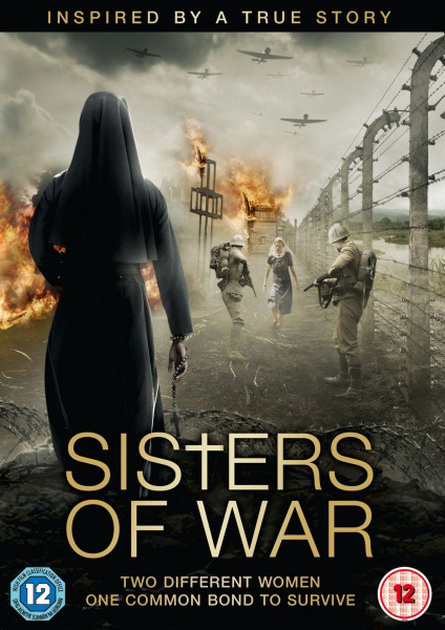
Sisters of War (2010 TV) The True Story of the Australian POW Nurses and Nuns

Sisters of War is an Australian TV movie based on the true story of Lorna Whyte and Berenice Twohill, a nurse and a nun who were held captive for several years by the Japanese during WWII. The film looks a bit “made for TV” but other than that I liked it. There are so many of these forgotten stories and it’s great when a director decides to bring them to our attention.

1942, Vunapope, Papua New Guinea, an Australian hospital camp and mission. Nurses and nuns help the wounded alongside the army doctors. When the troops withdraw, the doctors follow them to help them and, to everyone’s dismay, decide to abandon the nurses, nuns and the wounded. Some of the troops remain hidden in the surrounding forest.

The remaining sisters scan the horizon daily, hoping for the Americans to come to their rescue. When they see boats land they are at first extremely happy until they realize their mistake. The landing troops are Japanese and their mission is soon turned into a prison camp. In this mess and confusion two women, the nurse Lorna whose fiancé is among the troops hidden in the forest and the devoted sister Berenice become close friends and are a moral support for each other.

The months that follow are hard. The American bombard the mission thinking it is Japanese, while the Japanese rule with a fierce hand, punishing everyone who doesn’t comply and torturing and executing all the soldiers they capture. It’s particularly harrowing for Lorna when they capture her fiancé.

The food is scarce and the few buildings they have are constantly bombed. The mission has to be abandoned in the end. Bishop Scharmach decides to send the nurses away. They suspect that they have been sold as “comfort women” to the Japanese. This isn’t true but the plans the Bishop had, to have them exchanged against Japanese prisoners of war, doesn’t work and the nurses are sent to a labour camp in Japan.

I thought the movie was quite well done, not too sentimental and managed to show a forgotten story and is also a testimony to the great strength and courage of those nurses and sisters. As we are told in the closing credits, those nurses, as they were mostly not military nurses, didn’t get any recognition until quite recently.

It’s a nice touch that we see the real Lorna Whyte and Berenice Twohill, now elderly, sit together on a bench and chat at the end of the movie.

I really wonder how this could have happened, that the whole military, especially the doctors, just left those women on their own. They knew so well how the Japanese treated prisoners. At first I thought that the depiction of the Japanese soldiers was overly negative but towards the end, the portrayal is balanced.

The only instances in which you can see that it must have been a low-budget production is the make-up. They all look pretty odd but if you can forgive that, it’s a highly watchable movie, quite tragic but suspenseful and fascinating too.

Dunkirk (1958)

The British movie Dunkirk, starring John Mills, was one of those movies I was really looking forward to. I’m not sure what I expected but certainly nothing as boring as this. Those 135 minutes felt like a mini series. That’s too bad as the story of Dunkirk has a lot of potential or someone like Hugh Sebag-Montefiore wouldn’t have been able to dedicate a 700 pages tome to this story only. As boring as it was at times, it’s not a bad movie but it has the wrong title. It isn’t really about Dunkirk.

Dunkirk tells two parallel story lines and that’s where it fails. One part of the story follows the men around Corporal Tubby Bins (John Mills) who is involuntarily in charge of a group of men cut off from the rest of the army, somewhere behind enemy lines. The other story line focusses on the British civilians who slowly begin to understand that they may no longer be able to stay out of the war and that each and every little contribution is valuable. The stories converge on the beaches of Dunkirk where hundred thousands of British and French soldiers are trapped and waiting to be rescued. This was one of the biggest rescue missions of any war ever. And many of those who courageously helped save others lost their lives.

By dividing the story in two and showing the tragedy of the trapped soldiers only in the last 15 minutes, the movie failed to give an accurate picture. Although Atonement is certainly not a war movie, I thought it captured Dunkirk far better (I attached the scene under the Dunkirk trailer for those who are interested). It’s more sentimental but for my taste Dunkirk was too sober.

Something I liked in the movie Dunkirk was the way they showed how the civilians got dragged into the war. All the scenes on the British home front are far more convincing. I think, if they had called it “Operation Dynamo“, as the rescue mission was called, and if they had considerably cut the John Mills’s scenes, it would have worked better.

It seems that there is a very good TV mini series called Dunkirk as well. I’m going to watch it soon and will let you know if it is any better.

http://www.youtube.com/watch?v=BB8tVQ_pWFA&feature=related

Giuseppe Tornatore’s Malèna (2000)

Malèna, set in a little town in Sicily during WWII, combines a coming of age story with a war-time story. The first time I watched it, it stunned me. I still liked it a lot the second time but since the story has a tragic ending, it’s more intense to watch it for the first time.

Malèna (Monica Bellucci) is the most beautiful and seductive woman in the little Sicilian town of Castelcuto. Her husband is somewhere in Africa, fighting for Mussolini, while she is left behind in a very hostile climate in which all the men try to have an affair with her and the women hate her for her looks. All the men see her as an object, with the exception of a young boy who falls in love with her. We see the story through his eyes. He is so besotted with her that he follows her around, sneaks out of his house at night and spies on her.

She is a favourite conversational topic and gossip and rumours follow her wherever she goes. People talk very bad about her behind her back. They call her a whore and say she betrays her husband and has lovers. Only the young Renato knows this isn’t so. But when her husband is reported dead, there isn’t any protection for Malèna anymore. She can’t find a job, she has no money and food is scare and whatever she does, the town, reigned by men, turns on her and finally forces her into prostitution.

When the war is over, the women take revenge on her, not because she sold her body to the Germans but because all their husbands lusted after her.

Tornatore captures the atmosphere and hysteria of an Italian city during WWII very well. How they all cheered Mussolini and pretended to know nothing of it when the Americans arrived. The hypocrisy, the paranoia, the double standards. Malèna has the extreme misfortune of not fitting in. Too stylish, too good-looking, not very sociable nor talkative. This causes the jealousy of the women who have no liberties or power and the hatred of the men who treat women like objects. This society is ruled by fanatic Catholicism and the double standards that go with it.

I don’t want to give away too much but the destiny of Malèna which is extreme is very sad and to a certain extent quite typical for women during that time in Italy. Many women, especially in Italy, were forced into prostitution when their husbands were gone or dead.

Malèna is an extremely esthetic movie, beautiful pictures, matching music, and of course there is Monica Bellucci whose beauty brings Malèna to life. The sexual awakening and infatuation of Renato is touching and extremely funny at the same time. It clashes with his mother’s prudery and his father’s strictness.  The end of the story is tragic and infuriating.

http://www.youtube.com/watch?v=fQOTylertEY

Defiance (2008) The Bielski Partisans

After having moaned about the accent situation in Defiance (which you can read here) it’s now time to get to the review and I must say, all in all, I didn’t think the movie was all that bad. And we have to bear in mind that it’s based on a true story, the story of the Bielski partisans or Bielski brothers.

After having found that their parents had been killed by the Nazi’s who systematically exterminated Polish Jews, the four Bieski brothers flee to Belorussia and hide in the woods. The two older brothers Tuvia (Daniel Craig) and Zus (Liev Schreiber) have both lost their wives and children as well. While hiding in the forest they are joined by a group of Jews and decide to stay together and try to survive in the forest. After a while, more people seek refuge in the woods and the Bielkis take them up. Tuvia in particular brings back people from every food searching expedition which creates huge tensions between the brothers. It is clear that Tuvia is the leader and this is another source of tension as their leading style is different.

After a few weeks or months the camp in the forest is almost a little village, there are now hundreds of people who need to be fed, who need shelter and protection as the Germans swarm these woods. On the other hand there is strength in the number as they have people with all sorts of professions among them. Nurses, carpenters, teachers. After a few more months the tension between the brothers escalates and Zus leaves the group and joins Russian partisans. This is initially ideal for the group as this means additional and armed protection.

The movie shows how they struggle. The winter is particularly hard for them, many fall ill. It’s incredibly difficult to find food for so many people and they are surrounded by enemies. They have to fight quite often and there are combat situations as well. There are also a few love stories that will lead to relationships that last a life time. We also see them execute different missions, like saving people from the ghetto before they are sent to the camps.

I found the movie interesting and fascinating because it is a true story. In the end the Bielski brothers saved at least 1500 people. That’s quite amazing. I’m quite fond of Daniel Craig and thought he was a good choice for Tuvia.

While I wouldn’t say this is a must-see movie, it’s not bad at all and when you are not familiar with the story, it’s quite interesting. In any case what these brothers achieved is amazing.

Here is a photo of the real partisans

If you want to read about them here are a few articles The Bielski Partisans and Tuvia Bielski and a wikipedia article Bielski partisans.