Roma, Città Aperta aka Rome, Open City (1945) Roberto Rossellini’s Neorealist Masterpiece

Rome, Open City, which is part of Roberto Rossellini’s War Trilogy, was first meant to be a documentary. It eventually  became a movie which incorporated a lot of original footage, in part due to the shortage of film. The black and white movie Rome, Open City is one of the most important movies of the Italian Neorealist movement. Apart from a famous cast, including Aldo Fabrizi and the great and talented Anna Magnani in one of her best roles, Rossellini hired many people from the streets to enhance the authentic feel.

It’s a fantastic movie and one of the most important movies of European film making. Furthermore it’s another one on my list Children in War Movies as children play an important role.

Roma, città aperta takes place towards the end off WWII. At the core of the story are the Priest Don Pietro Pellegrini, the widow Pina who is about to get married to Franceso, her little son Marcello and Giorgio Manfredi, the head of the resistance. Because Giorgio almost gets caught he hides and the priest and his friend Francesco try to help him and organize his escape. Francesco has a girlfriend, Marina, but he keeps her at arm’s length knowing very well that he is about to leave. Marina, a vain and weak woman, gives away his hiding place to the Gestapo. On the one hand she wants to take revenge, on the other she is venal. Since the war began she regularly sells her body to all sorts of people, also Germans. When bribed by a sleek German commander and his lesbian assistant she gives in. In exchange she gets drugs.

When the Gestapo arrests Giorgio, Pina runs after him into the street and is shot by the Germans. This is an extremely famous scene, one that stays with you for a long time. What follows Giorgio’s and his friends’ arrest is similar to all the other Resistance movies I have seen. The men are tortured. The priest isn’t tortured but also questioned and when he doesn’t say anything, he is executed. The children of the street, among them Pina’s little son, witness the execution of the beloved gentle priest with horror.

Rome, Open City is gritty and realistic. It shows many details of the life in Rome during WWII. How the people lived in close quarters, how they struggled to provide themselves with food. It also shows how many people were active in the Resistance. All the main characters are part of it, also the priest which is an important detail that wants to show how unified the Italians were in their fight against the Germans.

Rome, Open City is a classic. It has many memorable scenes and dialogues. It also analyses the deeper meaning of war and guilt. The priest states more than once that maybe the war happened for a reason. With a central character being a Catholic priest it’s obvious that the movie is saturated by Catholicism. The church  takes an active part in fighting evil.

This movie is a must for cinephiles and people interested in war movies alike. If you need the subtitles it will be a bit difficult to follow this movie. Although I speak Italian I had to watch with subtitles as they can’t be turned off and noticed that far over 50% of the dialogue, which is very fas,t is missing.

The Diary of Anne Frank (2009) The BBC mini-series

The Diary of Anne Frank is a BBC mini-series in 5 parts, each of which is half an hour long. There are far over 20 movies or TV series that depict the life of this famous thirteen year old girl. Anne Frank spent two years in hiding, in an annex and the attic of an old house in Amsterdam during the last years of the second world war. Because they were Jewish, her father decided to hide in order to avoid being deported to a concentration camp. They hid there together with family friends, all in all 8 people and a cat, in very close quarters. Anne, a precocious and highly intelligent teenager, kept a diary of this time, the famous Diary of Anne Frank, on which this and any other movie is based.

The incredible tragedy of Anne Frank’s story is the well-known fact, that after hiding for two years successfully, they were still found and deported to various camps where they all died, in some cases just a few months before the end of the war.

The father was the only survivor. And what “survived” as well, was Anne’s diary that she had to leave behind when they were discovered. The lovely Miep, who hid them, and brought them food every day, kept it.

There are different ways to tell Anne’s story I remember one movie also showing her in the concentration camp. That was a very good but very bleak movie. This mini-series is completely different.

I found especially the first parts to be very educational. This could and should be shown in schools and can also be watched with younger children. I found out later that the BBC aimed at this public. In so far it is very well done. The girl Anne and her daily life, her struggles, conflict with the grown-us – in particular the mother – first love and many other things are shown nicely. We also see how stressful it must have been to hide like that and be around the same people day in and day out. They had no privacy, no independence, no freedom.

This cozy feel is a bit of a problem for grown-ups, I would say, it’s a bit too cute. On the other hand, the end is extremely powerful, much more powerful even than the end of the one in the concentration camp. But you really have to watch the whole series to experience this ending. We see nothing graphic, nothing brutal, just the people being led out and the name of the concentration camp and the date of their death. Very moving. All the quarrels, and petty grievances they went through, all the weaknesses we saw, they all of a sudden get another dimension. In retrospect even the most annoying of the characters becomes endearing. It seems so ironic that they were caught so late, after so many years of deprivations, just when they started to rejoice after having listened to the BBC and heard about D-Day…

633 Squadron (1964) British Air Combat Movie that Would Make a Great Remake

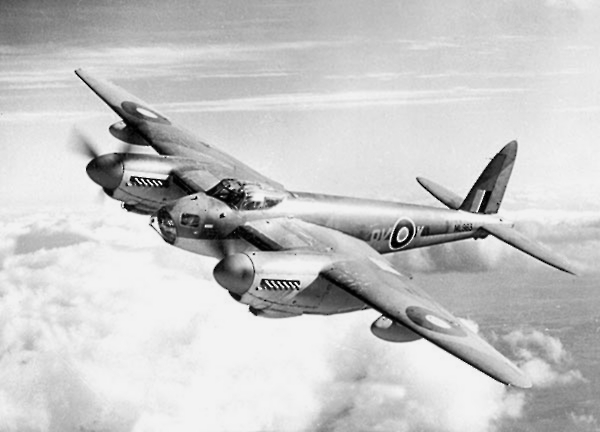
The British movie 633 Squadron is an entertaining air combat movie. It has a little bit of everything in it. It is part adventure story, war movie , suicide mission and romance. Although it is not great it has a lot of potential and would be a great choice for a remake. None of the actors is remarkable, exchanging them wouldn’t do any harm and the special effects could do with some revamping as well. Still if you have a special interest in aircraft you might want to watch it as it gives you the possibility of seeing a real Mosquito (as far as I know only one is the real thing, the others were remade). The Mosquito was a funny, enduring little plane and is one of the rare made of wood. When it entered production in was one of the fastest operating aircraft.

“In 1940 I could at least fly as far as Glasgow in most of my aircraft, but not now! It makes me furious when I see the Mosquito. I turn green and yellow with envy. The British, who can afford aluminium better than we can, knock together a beautiful wooden aircraft that every piano factory over there is building, and they give it a speed which they have now increased yet again…” (Hermann Göring)

File:Mosquito 600pix.jpg

The story of 633 Squadron resembles the story of the much better movie The Dam Busters. A group of pilots has to go on a secret mission and drop bombs on a German rocket fuel factory that is based in Norway. The Norwegian resistance does also play a part in it and the squadron leader falls in love with the sister of one of their members. The squadron is a typical war movie squadron that pushes diversity to the limits. We see British, Irish, Scottish, Australian and Indian members. The accents are quite enjoyable if you go for that kind of detail. The mission itself is quite gripping and suspenseful. The losses were, as could be expected, extremely high.

633 Squadron is loosely based on a true story which makes it interesting to watch, still I would say if you want to see two really great British WWII air combat movies, go for The Battle of Britain or the aforementioned The Dam Busters.

Les femmes de l’ombre aka Female Agents (2008) Women in the Resistance

Not every slick-looking movie with good-looking actresses on the French Resistance is a good movie. Unfortunately not or Les femmes de l’ombre would have been great. Don’t get me wrong, it isn’t bad it’s just not great. If you want an entertaining period drama, this is your movie (ok, there are a some torture scenes that dampen the experience a bit but nice clothes and make-up make up for it). It’s a little bit like Black Book aka Zwartboek but less convincing. The theme would have been interesting and worth dedicating a movie to.

Based on true events, it follows the story of Louise Desfontaine (Sophie Marceau), a sniper with the French Resistance. When things heat up in France she leaves for England and joins the SOE. One day she is contacted by an agent who happens to be her brother Pierre (Julien Boisselier) whom she suspected of being a collaborator. He hires her and four other women to rescue a British spy who has been captured in France by the Germans. The Germans aren’t aware of his identity and think he is German. The women will have to team up, two disguised as nurses, two as exotic dancers (yes, you will see them topless, it’s a French movie) and the fifth will place bombs under German cars.

The five women are a composite group, one is an ex-prostitute (Julie Depardieu), one the ex-girlfriend (Marie Gillain) of the Nazi officer (Moritz Bleibtreu) who tries to hunt them down.

What at first looks like a success soon goes awry. Louise’s brother get’s caught and we all know what that means.

The women go back to Paris on another mission and here things goe definitely very wrong as one gets captured and immediately crumbles under torture (one finger nail off and she spits it all out).

I can really not say why exactly I wasn’t too convinced. Because I have seen the brilliant L’armée du crime aka The Army of Crime before? Or some of the movies on Nordic Resistance that are truly good? I think it is in part due to a slightly off-key cast. Every woman wears heavy make-up which is nice, only Sophie Marceau has to look somewhat stony faced and unattractive (she isn’t successful, she’s too beautiful to look unattractive). I think the producers and directors were aware they would be criticized for their choice of too pretty women and tried to balance this out by not showing a heavily made up Sophie Marceau. She is the sniper after all… Why, if they didn’t want her to look her very best, did they not cast another actress? Because she is a great actress? I always suspected her to be far from accomplished, and she really isn’t too good. I would have preferred her to look as beautiful as she can and not try so hard to look efficient. (I’m thinking of Demi Moore as G.I. Jane who was much more convincing.) I think you can actually be cold-blooded without looking it. And I am not a big fan of Moritz Bleibtreu either. At least not in supposedly serious roles (I have seen him in German movies in which I found him very good). Julien Boisselier and the other four actresses are very good, especially Julie Depardieu and Marie Gillain.

Les femmes de l’ombre aka Female Agents is entertaining, just don’t expect to much of it. If you want the real deal, watch L’armée du crime.

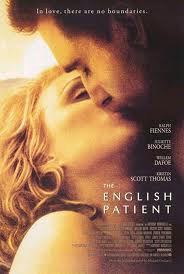
Anthony Minghella’s The English Patient (1996)

Rarely did a movie deserve the Academy Awards as much as The English Patient. It is one of the most beautiful war romances that I have ever seen. Or, to be accurate, two of the most beautiful romances as the movie tells two parallel stories. Based on Michael Ondaatje’s wonderful eponymous novel, The English Patient combines everything that an accomplished movie needs. Beautiful pictures, a touching story, an intriguing plotline, wonderful music, great characters  and outstanding actors. This is one of the movies that I have watched at least three times and every time I discovered another layer. It is surprisingly rich and, I would argue, flawless.

They call him “The English Patient” (Ralph Fiennes), the mysterious man, they rescued from a shot down airplane in the desert during WWII. He is heavily burned, will probably not survive. They bring him to Italy and a young nurse, Hana (Juliette Binoche), volunteers to stay back and take care of him. She moves with him into an abandoned villa. He doesn’t know his identity but Hana finds a notebook and with its help the memory returns slowly and the story unfolds in flashbacks.

They are not alone for long, Kip (Naveen Andrews), a young Sikh and the thief David Caravaggio (Willem Dafoe) join her. Kip is part of a bomb disposal unit and the growing love between Hana and him is the second love story in this movie. It is beautiful but by far less tragic than that between the English patient and his lover. Caravaggio adds even another story line to the already rich plot. He is someone who thinks he knows who the badly burned man is. In fact he is sure that the patient is someone who wronged him once.

The flashbacks show us the mysterious patient, the Hungarian Count Almásy, 1930 in the Sahara desert. He is a mapmaker of the Royal Geographical Society. At the beginning of WWII he is still in the Sahara where he meets the British agent Geoffrey Clifton (Colin Firth) and his beautiful wife Catherine  (Kristin Scott Thomas). Despite their fighting the attraction, they fall in love. They have an affair that ends abruptly when Catherine breaks it off. They meet again later and the following events make this probably one of the most tragic movie romances of all time.

The figure of Count Almásy is actually based on a real person, only his story was a different one.

The nurse Hana is certainly one of the most appealing nurses in any war movie. The gentleness and devotion with which she takes care of the dying man is touching. I am sure that there were many nurses like her in different wars and they deserve an homage.  I have a great deal of admiration for these courageous, disinterested women.

The intensity of the interwoven stories, the mysteries, the wonderful settings (the desert, Italy during the war, the Italian villa), the gripping part of the bomb defusing, all this together make this an absolute must-see.  Last but not least I’d like to mention the beautiful score by Gabriel Yared (you can listen to it here).