Rape and Love among Ruins: Anonyma – The Downfall of Berlin aka Anonyma – Eine Frau in Berlin (2008)

I was not sure if it was in good taste to use the title I gave this post but somehow it sums  up the film in a very few words. It is as if I had wanted to find two ways to speak about this movie: With brevity first and later at great length.
The Downfall of  Berlin has two contrasting parts taking place  shortly before and after the war ends. The beginning shows the taking over of Berlin by the Russian Army and the  mass rape that was soon every woman’s daily reality. The second half is dedicated to the love story with a Russian Major and the home-coming of Anonyma’s husband. All this takes place among ruins which accentuates the subliminal theme of the fragility of the depicted relationships.
The movie starts in 1945,  at the end of the war when the  Red Army troops enter the city of Berlin. What the German women had to endure from the moment the Russian Army set foot on the Ground of the city is an unparalleled horror.  Mass rape, brutalities and cruelty are the order of the day. One of these women, Anonyma,  kept a diary in which she carefully noted all the shocking events for her husband who had been sent to the Eastern front.
As the horrors go on she decides to look for a protector who might shield her from being constantly raped and abused by other men.

I have seen a few movies dealing with the German civilian population at the end of the war. There is a common moment in many of those movies. The inhabitants of a village or town hear troops approach and one of them is sent to find out who is coming. When the messenger returns there is this crucial moment when everybody just wonders whether he has spotted  Russian or American troops. Should it be the Soviet Army, the civilians flee in terror, whenever they hear it´s the Americans they are overjoyed.

A lot of the discussions whether this is a good movie circle around the comparison with the book and the liberties that have been taken to turn it into a movie.
First published in English in 1955 it has not been reissued until 2003, after the author’s death,  and this time under the pseudonym Anonyma. The reception of the book in Germany in 1959 was very harsh and aggressive and shocked the author a great deal. Germany was not ready for the  content of this  book.
The author of the diary was a  journalist and well-travelled woman. In  noting the horrible events and describing in great details the daily terrors of the women facing the Red Army she has left us an invaluable first-hand account.
The movie shows that hardly any woman, young or old,  escaped being raped.
There is a brief part in the movie when Anonyma meets a friend that she hasn’t seen in a long time and asks her “How many?” And they both know without any further clarification what they are referring to. Some 2´000´000 German women were raped in this time.  Payback for the massive loss of Russian lives.
It was criticised that the movie was not able to  transmit the whole extent of the horror that the book  shows. And of course the invention of the love affair which does not take place in the book was criticised as well. I  liked this doomed love story a great deal even though I normally do not like it when grim facts are sugar-coated by romance. But as a matter of fact this is a very realistic love story. Not very sugary at all and even though not in the book I think it manages to add another dimension.

Anonyma is a very fine movie, especially since it is in large parts bilingual German/Russian. The Russian cast is absolutely great. I especially liked Yevgeni Sidhikin in the role of Major Andreij Rybkin who becomes Anonyma´s protector and lover. Apparently already well-known in Russia we might see some more of him in the future. I was not too thrilled by the German actors. Apart from Nina Hoss who plays her role with an almost severe dignity, they are a bit too dramatic and wooden at times.

The shocking story of mass rape  is told in a very convincing manner. Evident but not voyeuristic. Without being shown  too explicitly we know what is going on.

I consider this to be an important movie as it shows how much the Germans suffered as well.
From reading German reviews on this movie I see that to this day the feeling of guilt runs so deep in Germany that they still feel uneasy to mourn these events.

And nowhere have I ever seen this called a war crime. Why not? Because the war was almost over? That would be a little bit cynical. Or because the aggressor has no right to complain?

Maybe it is just because no matter how it is called, no one really wants to speak about it. Rape like torture are hard to deal with. For both. Those who commit it and those who endure it.

I would really like to read comments, thoughts and whatever not about this movie from others.

amazon.com  Anonyma – The Movie

amazon.com Anonyma – The Book

Anonyma – The Downfall of Berlin aka Anonyma – Eine Frau in Berlin (2008) Trailer

Anonyma – The Downfall of Berlin is a German movie about a woman living in Berlin at the end of the war in 1945 when the Russian troops enter the city. A story of retribution and shame. Of the winners taking revenge on the weakest among the losers.

Watch the trailer today. The post will follow tomorrow.

Everyman´s War (2009) is retelling The Battle of the Bulge

I don´t really know what to say about this movie. Basically I think it is a missed chance. It contains too many flaws to be really good but still has quite a few touching moments. One would like to grab the filmmaker and give him a good shaking because it would not have needed much to be satisfying.

Everyman´s War is based on the story of Thad Smith´s, the film director´s father. Sgt. Don Smith was part of the 94th Infantry Division fighting for Nennig, a small town in Germany during the Battle of the Bulge. The Battle of the Bulge was one of those notorious big battles that had to show up with an enormous cost in lives. Being one of the decisive battles, the last big Nazi offensive, it overshadows other battles like the one at Hurtgen Forest that was so skillfully depicted in When Trumpets Fade. The battle of  Bastogne Forest that we saw in Band of Brothers is also part of the Battle of the Bulge. Smith lands in Europe around Christmas 1944, just when the offensive begins and stays in Europe until the end of the war.

The tragedy of the battle is well shown in Everyman´s War. The Army command misjudging the German´s will to fight thought they would never attack during ice-cold weather, snow and temperatures below zero. But they did.

Sgt. Smith´s courageous fight, the love for his comrades and his despair about losing them is well shown. So are the battle scenes. As long as there is no music all is fine. Sadly the choice of music is bad and ostentatiously corny. And so is the background story, the home front bits  (think the end of Saving Private Ryan and dip it in sirup).

This is frustrating as the main theme, alluded to in the title, is nicely executed. This was everyman´s war. Everybody was in it. The French, the English, the Americans, but also the Germans and the German Jews. Moments where the film achieves to make us feel sorry for everyman involved are truly good.

One last word on the use of language that will only annoy people who understand German. 90% of the actors impersonating German´s are not Germans and have bad accents and an unintentionally funny way of pronouncing the German words. However this will not bother speakers of other languages. Apart from that the portrait of Germans is quite just.

Having said all this I just think it is a pity. This could have been a good film but now we are left with a 3 (out of 5) star achievement.

Katyn (2007) or The Crime and the Lie about a Gruesome Massacre on Polish Officers

This is an outstanding movie. Truly outstanding from every possible point of view. Narrative style, cinematography, actors, story, technical aspects. Absolutely great.

The Polish movie Katyn is about the massacre of some 22000 Polish officers by the Russian army and the subsequent  disposal of their bodies in the Katyn forest in 1940. Once the mass grave is found in 1943 the so-called Katyn list is established.  After having waited anxiously for the return of their fathers, husbands, sons and brothers the families are now informed if or if not their loved ones have been among the victims. However not all the victims are on the list. Many more a still missing and may or may not have been murdered. Many wives still wait for their husbands in 1945.

The movie focuses on two families. One is the family of a Polish General, the other the family of a Polish officer. The story is told in two sequences. The first half tells the story until the massacre, the second tells the story of the lie and ends again with the massacre but this time shown much more explicitly (The way these murders were executed…How can people do this to people?). After the first half we think the story should be over but in reality it only just begins. Seeing it first from the point of view of the victims, we are then guided towards the point of view of the families who wait for them. Their ordeal is a different but very cruel one. Even though everybody knows who killed those officers, officially it is said to have been a massacre committed by the Germans. To say otherwise would be very dangerous. The political climate of the time that made it impossible to even mention a critical view of this incident until 1989 is palpable in all its atrocity.

On my DVD of this movie is an interview with the Polish filmmaker Andrzej Wajda. He tells the interviewer how difficult it was to make this movie. He didn´t know how to tell the story. Should he tell his father´s story, who had been among those officers, or his mother´s who was one of those who did not give up hope until 1945. He decided eventually to tell both stories, juxtapose them, have one mirror the other. This is very skillfully done. Wajda belongs to the so-called Polish Film School and has made many movies, two of his better known earlier ones also deal with WWII:  A Generation aka Pokolenie (1955) and Kanal (1957) about the Uprising in the Warsaw Ghetto.

This film is truly the work of a master, of someone who does not just deliver a story but who weaves it carefully, adding symbolism and criticism alike. And  still it is highly watchable.

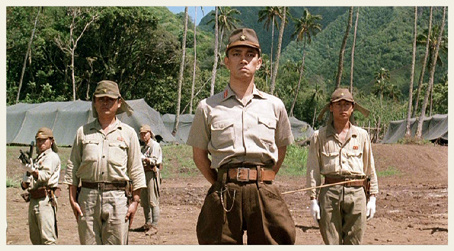
10 Reasons Why you should (re) discover Merry Christmas Mr. Lawrence (1983)

I am probably going to review this movie at length in a few days. It is worth to look into some cultural elements.  Here, as a starter, 10 reasons why you should watch Merry Christmas Mr. Lawrence.

  1. Highly original. Really not your everyday material.
  2. It is not sufficiently known or almost forgotten.
  3. POW movie that is by many people believed to be better than Bridge on the River Kwai.
  4. The main title, Forbidden colors, is very haunting (there are two versions, the instrumental one by Ryuichi Sakamoto and the vocal one by Sakamoto and David Sylvian).
  5. Beautifully filmed.
  6. Japanese culture and esthetics (Samurai, hara-kiri, honor, belief in demons and what not).
  7. Not your average war movie theme. Captain Yonoi is tragically attracted to Maj Celliers.
  8. Nagisha Oshima has directed it (he is famous for his very sensuous and erotic movies, albeit bordering the sadomasochistic. Undertones are clearly present here.)
  9. Great acting. Not only by the two singers Ryuichi Sakamoto and David Bowie but also by Tom Conti and Takeshi Kitano.
  10. Very impressive. Once you have seen it, you will never forget it.