Help Needed – We Are Looking For a War Movie

the-war-is-over

It’s been a while since I posted the last request like this. Since we have managed to find movies before, I thought it’s worth a try.

The person who wrote me this e-mail has seen this movie as a boy on TV. Some 35 – 40 years ago. It was a black and white movie, very probably British (maybe French). The main characters name could have been something like Oresti.

Here’s the very detailed description.

The film was black and white and I can’t tell you whether it was set in WWI or WWII, but I am fairly sure it was about the Belgian Resistance.
A male member of the resistance is being pursued by the Germans and hides on the balcony of a young female who he persuades to help him.
At some point, we see the young lady with a fortune teller who is predicting her getting married.
This is a dramatic scene because the psychic becomes agitated when trying to tell her about the wedding because she sees something disturbing. She sees a wedding dress which is scarlet, or red. She then becomes too upset to continue.

The young lady falls in love with the resistance guy and joins their work.
On the day of their wedding, the church is sprayed with bullets and her beautiful white wedding dress becomes covered in blood – the scarlet dress of the psychics predictions.

They are sent on a mission, separately, but the mission of the male is a rather cruel but necessary one.
Unknown to him, he is given misinformation about a military operation and then sent into the field with the deliberate intention of being caught, tortured and revealing the wrong info.
However, he was much tougher than they had anticipated and didn’t reveal anything under torture.
He escapes.
His wife finds out about his mission and goes to find him.
She is captured and sentence to death by firing squad.
Her husband rescues her at the last moment, the whole firing squad being resistance fighters, and he dressed as a German officer.

After he rescues her, he lifts her in his arms and they celebrate.
Unfortunately, some snipers, hiding in bushes, see them.
Because he is still wearing German uniform, they believe him to be the enemy and shoot them both as they are embracing. The tumble and fall of the steps of what looks like a disused amphitheatre.
They manage to hold hands as they die.

This is one of the most detailed descriptions I have received so far and I’m pretty sure, if someone has seen it, he/she will remember even if some things might have been different.

Any ideas and suggestions are very welcome.

The Haunted Airman (2006) BBC TV Drama

The Haunted Airman, starring Julian Sands, Robert Pattison and Rachel Stirling is a 70 minutes BBC TV production based on a novel by Dennis Wheatley (The Haunting of Toby Jugg). I thought it was a great choice for this time of the year as it is quite eerie; a mix between psychological drama and horror story.

A young RAF bomber pilot is shot down. His wounds are considerable and he becomes a paraplegic in a wheel chair. His aunt Julia, a widow, decides to bring him to an asylum where the mysterious Dr. Hal Burns treats soldiers with post-traumatic stress disorder. The asylum is located in one of those huge English country houses.

Toby suffers from different symptoms of post-traumatic stress. Nightmares, hallucinations, visions, phobias. He sees burning cities and dead civilians, relives the night in which he is shot down, imagines being attacked by giant spiders.

Julia is his aunt by marriage. She is gentle and beautiful and Toby is clearly very much in love with her and dreams of marrying her. He writes to her frequently but she never replies. One day he finds out that the sinister doctor has kept back all the letters.

From then on tragic and dramatic things happen. The end is a bit weird and mysterious.

I didn’t mind watching this, it had a gothic, haunted house feel, the images were quite beautiful and Pattison and Sands act quite well. Still, I didn’t really know what to make of it all and didn’t get the end. I went to IMDb and saw that the reviews were extremely mixed. Either 8-10 or 1-2 stars.

I’d say it’s a movie you either love or hate. Being a Robert Pattison fan would certainly influence the reaction.

I don’t like rating movies this much, but in this case, I’ll try to. I’d give it 4 stars for the actors and the cinematography and 1.5 stars for the story. Whether it is OK to turn PTSD into entertainment…

Senso (1954) – A Guest Post by nem baj

https://i0.wp.com/static.omdb.si/posters/active/298217.jpg

Let’s face it, my self-imposed “One Month of Watching German War Movies” was a bit of a failure. The problem was, I wasn’t in the mood for the movies I had here. Instead of watching other war movies I stayed clear of the genre altogether and that’s why – once again – I’m grateful that nem baj stepped in with a review of a Visconti movie. I’ve seen a lot of Visconti’s movies, he used to be one of my favourite directors. However I haven’t seen Senso yet but I think I should watch it. I have a feeling I would like ti very much. 

In a nutshell: on the eve of the third Italian war of independence, in the Austrian-occupied city of Venice, the Contessa Serpieri (Alida Valli), a married Italian aristocrat, falls hopelessely in love with a younger Austrian lieutenant (Farley Granger), a notorious seducer. For him, she will betray both her social position and her beliefs in Italian independence, while he will exploit her love, and in turn betray his own career and country, up to a tragic ending.

Had it not been for the censorship, Luchino Visconti’s movie would have been called Custoza, after the second battle of Custoza, near Verona, where the Italian independence army was defeated by the Austro-Hungarian forces in 1866. Fortunately for the Italians, their opponent’s defeat at Königgrätz against Prussia prevented them for pushing their advantage and keep the Venetia region. However, in spite of its name reverting to that of its (loosely adpted) source short story, Senso certainly remains a war movie.

Of course, it is also a melodrama, an operatic portrait of the desperate, nefarious, masochistic love of an educated woman for an adventurer. I will not insist upon this aspect here. Yet, although there isn’t much combat to be seen, in part due to the censors, war is everywhere. War, in Senso, is at the same time the driving force of its protagonists’ lives, and the telltale device which reveals their character. And on a historical level, war is at the same time the developing bath and the accelerator of global changes.

As Renoir’s Grand Illusion demonstrated, a war movie isn’t always about those who fight. In this case, it’s about those who choose not to – those who, confronted with a crisis which reveals that their world is crumbling down (a theme dear to Visconti), choose not to join either side, and instead pursue their self-centered interests, their passions. Here, the battle of Custoza is a defeat for both sides. For Italy, it is the defeat of idealists betrayed by the aristocracy. For Austria, it is the beginning of the end of a decaying empire.

Visconti’s images of the battle of Custoza remind me a lot of the way many cinematographers chose to render the American Civil War. There’s a strongly suggested state of confusion, which brings the idea that the opponents belong to the same culture. It’s not so much a war beetween foreign and domestic as it is a conflict beetween the old and the new. Here, the new is a nation-state in the making, forged by ideals: Italy. While the old is a multi-cultural empire held by social allegiances, bent for dissolve: Austria-Hungary.

Senso might not be as achieved as The Leopard, as it is sometimes difficult for the viewer not to give priority to one of its two main streams (the love story and the historical statement) over the other. However, the narrative use of tracking shots is wellesian. The settings, composition and costumes are magnificent, well in line with what we know of the director’s personal background, knowledge, and career in the opera and theatre. Yet the camera never indulges in sheer production show-off: these elements constantly add meaning to what’s going on – and in the interior scenes, the games with the mirrors, paintings and doors are quite devilish. Last but not least for European music lovers, the double use of Verdi (for politics) and Brückner (for love) should make for an unforgettable experience.

PS: Blu-Ray restored edition recommended. You may have a peek at the results here

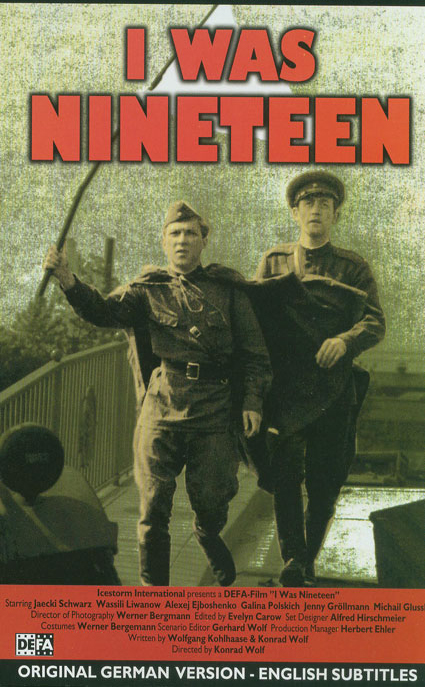
I Was Nineteen – Ich war neunzehn (1968) East German WWII Movie

The East German movie I Was Nineteen – Ich war neunzehn is based on the film director Konrad Wolf’s war diaries. Set in April 1945, it is an episodic movie which tells the story of 19 year-old Gregor Hecker who moves with a Red Army  scouting team towards Berlin.

Hecker is of German origin, he left Germany with his parents at the age of 8 and has lived in Russia ever since. Returning to his home country is peculiar for him. He speaks fluently German and Russian but feels much closer to the Russians.

The movie shows a vast panorama of German society. People who have lost everything and despair, those who believe the war can still be won, some who are afraid of the Russians, others who threaten them. Gregor and his group try to persuade all the German soldiers and officers they meet to surrender; some follow the suggestions, some keep on fighting although the war is almost over.

As I said, the movie is episodic, more than a coherent story line we have a lot of short stories which illustrate the different reactions to the end of the war.

The Russians are also depicted in their variety, peasants and people with higher education, people from all sorts of social and ethnic backgrounds are shown.

I liked the movie, the characters are likable and the approach was interesting however I don’t think it’s a very realistic movie. Sure, it accurately depicts how estranged someone like Gregor would have felt, how different he was from the other Germans but that’s how far realism goes. What I didn’t find realistic is how peacefully they behaved. The Russians in this movie were all good-natured, mostly gentle, protective of women and children. I don’t think that was the case, there are too many horrible stories which tell otherwise.

The movie isn’t a German but an East German movie which may explain why the Russians were depicted in such a positive light.

There is only one instance in which it is shown how much they must have hated the Germans for what they had done to them. When a German woman asks Gregor whether she can sleep in the house he and his fellow soldiers have occupied a female soldier shouts at her in Russian and Gregor translates. She tells her that it serves her right to be afraid and that what the Germans did to the Russians was so horrible and painful that it deserved punishment.

Despite these reservations I’m very glad I watched this. The movie is available with English subtitles I just couldn’t find a corresponding trailer.

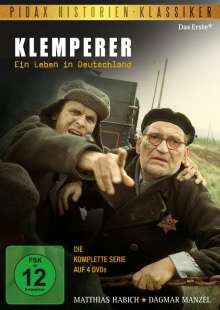
Klemperer – Ein Leben in Deutschland – A Life in Germany (1999) German TV Mini-Series

When Klemperer was first aired on German TV, I watched the first episodes but because I was moving I had to stop after the fourth. I always meant to re-watch the beginning and finally finish the whole series which consists of 12 episodes.

I had really liked the beginning at the time and now that I have finally re-watched those first four episodes I’m glad I still like it, maybe even more and I’m keen on watching the rest. However it’s very depressing. I didn’t remember it to be this upsetting but maybe it’s just me and I’m in a funny mood.

The series is based on Viktor Klemperer’s war diaries, 8 volumes of several thousand pages (here in English Viktor Klemperer’s diaries and in German here). The diaries are a fascinating document. I’ve read the first and it’s breathtaking. Klemperer was a professor of French literature, highly intelligent and with an amazing knowledge which all goes into the diary. He was also Jewish. The amazing thing in the series and the diary is the fact that it shows a man who is incapable of seeing what is going on and that we witness an amazingly intelligent person’s blindness. I find it must have taken a lot of guts to publish this diary because while it is very human it is still such an incredible flaw to be this blind.

To watch the series is eerie. It starts in 1933, just after Hitler was elected. At first there are just a few warning signals. Klemperer isn’t allowed to test non-Jewish students anymore, later he will not be able to publish anymore, they will remove him from certain classes and finally he will be fired. While many of his friends leave Germany very early, he doesn’t want to leave, he always thinks that maybe he will be exempt from the next measures only to find out that he wasn’t. His wife is not Jewish and since he himself isn’t religious, he always thinks they will make an exception for him. They even start to build a house.

Klemperer’s wife is an amazing character as well as she is so flawed and naive. She still moans about not being able to go on holidays when he has already been fired because he is Jewish.

As I already mentioned, the series is quite long. There are 12 parts of 45 minutes each, which means they have taken a lot of time to show the whole story and include a lot of details. I already know that the Klemperers will end up being sent to a camp but survive. Because it spans such a long time, 1933 – 1945, it really feels at times like having been there, having experienced some of it.  It is one of the best TV series I’ve ever seen. It has been very carefully executed and with Matthias Habich and Dagmar Wenzel, they have chosen two of the best German actors. Habich is one of my favourites, and one of the rare I like almost as much as Bruno Ganz.

A far as I know, there is no version with English subtitles available which is a pity. At least the diary is available in English too.