To Remake or Not to Remake: e.g. All Quiet on the Western Front, Psycho, Dangerous Liaisons

We have been flooded by a recent wave of remakes (Fame, Predators, …) some of which seem redundant to say the least. I do not think it does make any sense to remake a movie that is fairly recent and to re-do it just the way it was, only exchanging the actors to attract a younger crowd of spectators.

However, some movies  like theater plays (e.g. Hamlet, hence the title of this post) make interesting material for reinterpretation.

I remember that when I heard Hitchcock´s Psycho had been remade by Gus Van Sant I thought it was pointless but when I saw it  I found that it had its charm. Adding color and playing with this gave it a totally new feel. If you want to get a bit of an impression watch this YouTube movie someone did to compare both versions.

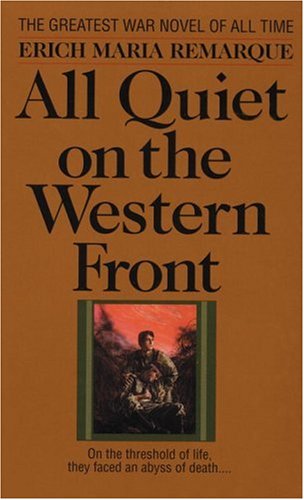
All Quiet on the Western Front is one of those movies that can do with a remake. I know it is a classic and one of the most important war movies of all times and many a reader will think it hateful to encourage such a thing. Still I believe it would benefit from it. (I know that it has already been done for TV).  All Quiet on the Western Front is really old. We are talking 1930. The acting has still the feel of  the silent movie era that only just ended in 1927. The acting is over dramatic. A lot of  the facial expressions are exaggerated (not as bad as in the real silent movies more like on the stage).  The whole pictorial language of the acting, so to speak, is hard for us to understand. To enjoy a movie like this nowadays you have to know a lot about film history and be interested in it.

What works very well in the original All Quiet on the Western Front is the depiction of the atrocities of war. Whenever the focus is not on the actors it is fabulous. Hands that are gripping barbed wire but are no longer attached to a body… Those very nuanced shots in black and white accentuate the horror and give a more realistic impression. Black blood looks somehow more like the real blood than overly red blood does.

All this will be a challenge for the film director of the upcoming 2012 version.

Furthermore let´s not forget that the movie is also already a reinterpretation since it is based on the novel by Erich Maria Remarque.  And like with plays where no one takes offense when another director takes it up again, one could claim that this is not really a remake of the movie but a reinterpretation of the book. (I can think of another literary phenomenon that has been turned into a movie at least three times and all of the versions I have seen are extremely interesting and well done. I´m thinking of Les liaisons dangereuses aka Dangerous liaisons the novel by Choderlos de Laclos. First there was the French movie by Vadim (1959), then the Stephen Frear´s remake (1988) with Michelle Pfeiffer, Glenn Close and John Malkovich and last but not least Cruel Intentions (1999) with Ryan Phillippe, Reese Witherspoon and Sarah Michelle Gellar.)

I have uttered my reservations as to the cast of the new All Quiet on the Western Front (see my post on My Boy Jack and Daniel Radcliffe) but apart from that I´m curious to see if they will do the book (and not so much the film) justice.

Remarques´s book is one of the best anti-war books of all times. It is so good that when I had finished  it and read that it had been translated into 50 languages and sold over 20 million times I could not believe that anyone anywhere in this world could have ever wanted to start a war again.

Unfortunately literature is not as powerful as that.
Under Fire: A Century of War Movies, edited by Jay Slater (2009)

Under Fire is simply a must-have for people seriously interested in war movies or even movies in general.

It contains a collection of essays on all sorts of topics regarding war movies, from WWI to the wars in Afghanistan and Iraq. Many different people have contributed to this very dense work. Well-known film critics and academics alike.

This is really something to sink your teeth into. Quite demanding reading but extremely insightful.

For example did you know how important YouTube´s influence was on contemporary Iraq movies (yes, I even started to understand Redacted)? Or how Vietnam changed the war movies? Do you know a lot about British propaganda movies of WWII? Did you consider to interpret Starship Troopers as WWII and Nazi satire?

These are only a few topics of many that are analysed in these very thoroughly researched essays.

Sure, this is no movie guide as such. It is not recommending or rating anything. Under Fire provides criticism and analysis for those who like to interpret not only the apparent but also the subtext.

This book is really worth having and I am quite excited about this find that manages so well to show the variety, the depth and the virtuosity of war movies.

Here you find the link to the publishing house. It contains an interview with the editor and interesting additional chapters.

Barnes and Noble

amazon.com

amazon co.uk

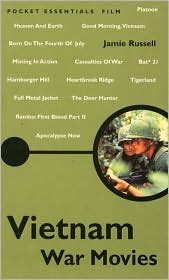
Vietnam War Movies by Jamie Russell (2002)

This useful little book is one of the pocketessential film series books.

It´s dedicated to Vietnam War Movies only.

The movies are ordered by themes:

Combat Movie The Green Berets, The Boys in Company C, Go Tell the Spartans, Platoon, Hamburger Hill, Full Metal Jacket, BAT21, Saigon, 84 Charlie MoPic, Casualties of War, Tigerland

Vet Movie Billy Jack, The Visitors, Taxi Driver, The Deer Hunter, The Exterminator, First Blood, Gardens of Stone, Jacknife, Distant Thunder, Born on the 4th of July, In Country

Drugs and Surrealism Tracks, Apocalypse Now, Apocalypse Now Redux, Good Morning Vietnam, Air America, Jacob´s Ladder

Counter-culture and protest movement The Activist, Letter to Jane, Hearts and Minds, Coming Home, Running on Empty, Rude Awakening, Dogfight, Forrest Gump

1980s return to Nam Good Guys Wear Black, Uncommon Valor, Missing in Action, Rambo: First Blood Part II, Eye of the Eagle

Telling a different story Heroes Shed no Tears, Dear America: Letters home from Vietnam, Bullet in the Head, Turtle Beach, Heaven & Earth, Cyclo

Each movie is summarized, cast and crew are named, some background and sub-text information is given and the movie is rated as well.

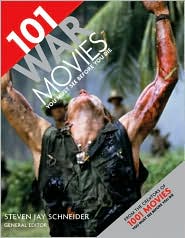
101 War Movies You Must See Before You Die (2009)

101 War Movies You Must See Before You Die (2009)  is a very nicely done reference book, part of a whole series of 101 or 1001 movies you must see before you die books. Picture books actually.

It’s ordered chronologically and contains colour photographs of the movie posters, naming of Cast & Crew, followed by a detailed description of the movie and some words on its importance. Additionally there is a colour photo of a scene depicting one or the other crucial moment of the movie with its description.

It is very nice to look at especially for those enthusiastic about movie posters. The entries are not very critical but this seems only normal since the aim was to choose 101 must-see  movies so one can safely assume the authors rated them all as outstanding.

From a purist’s point of view I think that the editors chose to include a lot of movies that are normally part of subgenres that the die-hard war movie fan would exclude. They therefore added  movies like Schindler’s List (1993) that you could rather call a wartime movie or Last of The Mohicans (1992)which is more of a War/Action Romance film.

Looking at their choices I think one of their main criteria was the esthetics of a movie and to a certain extent it’s blockbuster value, meaning how much of a story beyond the pure historical facts was told (totally contrary to Gary Freitas who would choose accuracy and history over story). This is why Platoon was included but neither Hamburger Hill (1987) nor 84 Charlie MoPic (1989) that are on many levels better.

Since I do not tend to be as strict as many, and would maybe even include Casablanca (1942) (which they didn’t include) I don’t mind their approach.

But what really does it for me are the pictures. I just love those posters. They are an art form in their own right.

On Death and Dying or Why War Movies Teach us a Buddhist Lesson

Without any doubt there will be death and dying in a war movie. As a cultural anthropologist it often struck me how different other cultures handle death. In a society like ours,  in which death is a taboo (there seems to be an even greater taboo when it comes to dying) the war movie is one of the rare places where it is shown with such frequency. When it comes to movies in general  there is only the action and thriller/crime genre where you can count on death with the same certainty only not in such abundance.  Else you are left with rare films about illness, very rarely you’d see an old person dying or, more likely, already dead. A few deal with accidents or rather their consequences  like Atom Egoyan does in The Sweet Hereafter.

I did often wonder where my interest in war movies came from, besides from the urge to understand what happened, why it happened and how it felt for those involved. I think that they teach us a lesson in non-attachment. You see characters that you get to know and like and you know that for sure some of them are going to die. And death seems, for our human eye,  not to choose very carefully in whom he spares and whom not. In the war movie we see death and dying in a magnified overdrawn way. There is everything you could see in daily life: quick death, painful death, slow and agonising dying. Nothing is left out. If you go one step further it makes you contemplate your own perishability. A further lesson in non-attachment.

In the Tibetan Book of Living and Dying Sogyal Rinpoche teaches that it is a good exercise to picture ones own death on a daily basis. It is maybe the most fundamental aim in life to have a good death.

I think it is not arbitrary that the late great American journalist Studs Terkel did as well a book on The Good War: An Oral History of World War II as on Death, Will the Circle be Unbroken: Reflections on Death, Rebirth and Hunger for  a Faith.

For anyone who would like to pursue his/her own reflections on this topic a few more or less random reading suggestions:

The Tibetan Book of Living and Dying Sogyal Rinpoche, 1992

The Pagan Book of Living and Dying Starhawk, 1997

On Death and Dying Elisabeth Kuebler Ross, 1997

R.I.P. – The complete book of death and dying Constance Jones, 1997

Dancing on the Grave: Encounters with Death Nigel Barley, 1995

Tuesdays with Morrie: An Old Man, a Young Man, and Life’s Greatest Lesson Mitch Albom, 1997

Will the Circle be Unbroken: Reflections on Death, Rebirth and Hunger for a Faith Studs Terkel, 2001

Swimming in a Sea of Death: A Son’s Memoir David Rieff, 2008

Staring at the Sun: Overcoming the Terror of Death Irvin D. Yalom, 2008

The Year of Magical Thinking Joan Didion, 2005

Noch eine Runde auf dem Karussel: Vom Leben und Sterben Tiziano Terzani, 2007

Das Ende ist mein Anfang: Ein Vater, ein Sohn und die grosse Reise des Lebens Tiziano Terzani, 2006

Der Tod meiner Mutter Georg Diez, 2009

Das westliche Totenbuch Irene Dalichow, 2001