9th Company aka 9 Rota (2005) or “No one has ever managed to conquer Afghanistan”

Many have called 9th Company a Russian Platoon. I think it would be more accurate to call it a mix of Full Metal Jacket and Hamburger Hill. I compare it with Full Metal Jacket because of the first part, that is taking place in the boot camp, and with Hamburger Hill because the second part is also based on a true infantry combat story that consisted of the holding of a hill. But be it as it may, it is easily understood what it means  that this movie deserves to be named among the very best of its kind: It is extremely good. And in some respects (e.g. character development, emotions) it is even better than the aforementioned.

We watch the 9th Company from their early days in boot camp in Uzbekistan until they are finally flown to Afghanistan. The boot camp part is one of the best I have ever seen. And its end, the night before they depart to Afghanistan, is unique. This scene shows the whole difference between this Russian movie and any American infantry combat movie I have ever seen. The soldiers show emotions, even those of fear and sadness and speak about them openly. They also talk about why they volunteered to go to Afghanistan and one of them, a painter says: “War is only life and death, nothing unneccessary”, meaning he thinks it is utterly beautiful. Of course he is immediately contradicted by others.

The long boot camp sequence and the following early days in Afghanistan are heavy and foreboding. It is a slow and effective build-up until the final intense combat part.

The 9th company was among the last to leave Afghanistan. Their last mission was to hold Hill 3234. A group of only 36 soldiers fought against the superior number of 400 Afghan rebels. We see many of those that we got to know and like during the movie get killed. There is a moment when those who survived go completely mental so that in the end they are victorious however highly decimated. But this battle is historical for other reasons as well. It was the last battle in the last war the crumbling Soviet union was ever to fight.

The key message is delivered early on, when the recruits learn about the culture and the land they are going to invade. The instructor who teaches them says literallay : “In all of history, no one has ever managed to conquer Afghanistan. No one. Ever”

The movie is gripping from beginning to end. And the characters are remarkably interesting. Even the instructor at the boot camp, an apparently mean and sadistic brute, is shown in all his complexity and we understand him in the end. What I liked best is the inside look at the Afghan terrain. I had a feeling to understand why nobody except those who lived there for centuries was ever capable of mastering this terrain. Those mountains with their tunnel systems are not unlike the Vietnamese  jungle. An abundance of hiding places; the enemy could be anywhere at any time.

This movie gets 5/5 stars. Watch it!

The Brylcreem Boys (1998): A WWII Comedy, Drama and Romance in Ireland

The least I can say about this movie is that it is total fun. I did certainly never expect to laugh during a POW movie but that actually happened repeatedly. Admittedly it is not the most refined humor, it’s rather of the burlesque, slapstick kind. But it is never overdone. The movie is just sprinkled with it here and there. The overall tone is often quite serious. Still it is one of the very rare movies you could probably watch with  children (although planes and people get shot down at the beginning and there is some fist fighting as well).

Ireland having lost many of its young men during the Civil War had decided to stay strictly neutral during WWII. This was not much appreciated by the allies. Unlike Switzerland Ireland insisted that every soldier encountered on Irish soil was to be taken prisoner. What was not universally known however was the fact that they put all the prisoners, French, British, American, Canadian and German into the same camp.

The Brylcreem Boys is not based on a true story but on true facts that have been carefully assembled and put together to tell a convincing story. Two fighter pilots, the Canadian Miles Keogh  (Bill Campbell) and the German Rudolph von Stegenbeck (Angus Macfadyen),  shoot each other down over Ireland and are both taken prisoners and brought to the same camp. While on leave they  fall in love with the same girl, the strong-willed Mattie (Jean Butler),  which adds a bit of romance to the whole story. Their rivalry and mutual dislike is very intense in the beginning but over the course of the movie and during many incidents they realize that they are not that different despite being on different sides.

Much of the funny elements of the movie stem from contrasting the Germans and their rigid discipline and total lack of sense of humour with the  more easy-going other prisoners. (Unfortunately there aren’t any German actors in the movie and some of the accents that the cast adopted are a bit laughable.)

Even though they are far away from the war itself, one of the prisoners sort of brings it back with him when he returns from London from his futile attempt at escaping the camp.  His account from his stay in the British capital makes the tragedy of the constant bombing during the Blitz  utterly palpable.

I am a big fan of the Irish actor Gabriel Byrne whose character is the commanding officer of the camp. He also co-produced this movie. Seeing how much fun he exudes playing this role one can easily assume that this was a movie that was very close to his heart.

I am very glad the directors felt compelled to tell this story of this quite exotic camp. It provides an interesting insight into Irish history for which I am glad.

Since this is really a feel good movie but far from being stupid entertainment you might really  enjoy watching it.

All The King´s Men (1999): The Company That Was Said To Have Been Swallowed by a Cloud

Whatever happened to Sandringham company at Gallipoli in 1915?

Were they really swallowed up by a giant cloud? Was there really a mist so dense that they could have disappeared in it? Did angels lead them to more heavenly grounds? Many tales like these are reported from many a battle field. Angels descending, mists forming, whatever not.

This is a true story. The Sandringham company did disappear. One of the versions that is  told in  All The King´s Men of the vanishing of over a hundred men is quite spooky. It has been for a very long time the preferred version and was definitely the one that the king was meant to believe. I really do not want to spoil this movie for you and will therefore not even hint at the true explanation. It should suffice to say that it was far more tragic than miraculous.

Sandringahm was one of the residences the Royal Family liked to stay at in summer. The 150 men that formed the company were headed by the king´s  Estate Manager Capt. Beck. They were servants, grooms and gardeners. The idyllic setting of Sandringham was referred to as paradise. What a stark contrast to the burning hot plains of Turkey.

The moment the company sets foot on Turkish ground it is obvious what an ill-fated campaign this is. The maps are wrong, the terrain is too hard to handle, the enemy has been totally underestimated. With hindsight historians say that Gallipoli was one of the most futile battles of WWI that was full of senseless battles.

WWI cost over 1 million of British and Commonwealth soldier´s lives. Half of them never got a proper grave. Compared to that the disappearance of some 150 men seems little. But to the estate and the little village who lost all their young men in one moment this was a catastrophe.

The BBC has done a good job with this movie. The actors, in particular David Jason and Maggie Smith, are excellent. The first parts achieve to create a very spooky atmosphere that only vanishes when the true reasons are revealed.

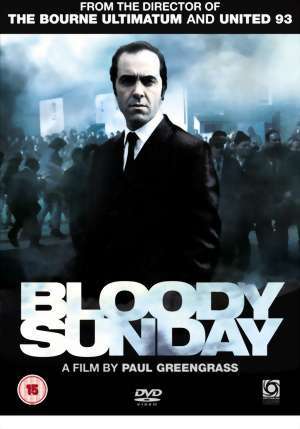
Bloody Sunday (2002) or The Day Innocence Died

Maybe it is debatable whether this is a real war movie in the strict sense of the term (but then, what is that anyway?) but I believe whenever there is armed conflict executed by an army or large group of people, even though not on a global scale we have to speak of war.

On January 30 1972 the British army opened fire on a peaceful Civil Rights March in the city of Londonderry in Northern Ireland. On this day 27 people were shot and 13 of them lost their lives. A further victim died a few months later. This day was from then on called  Bloody Sunday. It was a huge blow to the Civil Rights Movement and ended in countless young men entering the IRA. What followed is a history of bloodshed and terrorism that would not end until the 90´s.

On June 15 2010, after an investigation of 12 years had been conducted and found that the British army had opened fire without  a reason, the British Prime Minister Cameron apologized for this crime.

The so-called Saville Report has cost 230 million Euro. It proved without any doubt  that  the soldiers were at no time shot at. They opened fire on people who tried to flee, take refuge or wanted to help others. Two thirds of the victims were only 17 years old.

When this movie was shot, although largely known, there was no actual evidence as to the truth of these facts. We know them now and thus the movie unfurls vividly before the spectators eyes the whole extent of this tragedy.

Bloody Sunday is not easy to watch and the first two thirds were so annoying that I was tempted to stop it. This is solely due to the technique. It is filmed documentary style with a shaky hand-held camera. We see three complementary points of view. The Civil Rights Movement´s, the Police Headquarter´s and The Army Company´s stationed in the street. The camera fades to black for every scene. During the bits at the Police Headquarters there is a constant ringing of telephones that drove me almost mad. Also at the Civil Rights Movement´s Head Quarters, just before they assemble on the street, phones keep on ringing. The movie basically shows the whole day from early morning until its bloody end. We see the people prepare for the march, the police debating at what point they should stop the march and the soldiers on the street taking position.

It is worthwhile to sit through these annoyances though. The last third, when the march turns into a tragedy, is extremely powerful and the documentary style filming adds to the realism to an almost unbearable extent. What we watch is such a tragedy that we can barely believe it. To shoot at people who shout for help or try to help others looks like an execution.

Saying all this I think the movie shows nevertheless, no matter how misguided the army was or how brutal their reaction, that  they were also under a lot of stress. Some of their own had been killed a few days before, they were constantly attacked, bottles thrown at them.

As so very often it is shown that those on the street (very much like those on the battle field) depend on their command in the Head Quarters who failed them completely. They misjudged everything, thought that sheer force would end it all and boy were they wrong. And, as always, they never pay a price in lives.

At the end of the movie there is a scene when every single victim is named. Every individual anonymous victim seems to become a face.

When watching the end I was surprised at how much this movie got to me.

The Pacific 4 (2010): Rain on Cape Gloucester or The Weather in War Movies

Since I saw Stalingrad in which soldiers die in the snow or the episode Bastogne in Band of Brothers I consider the weather to be one of the key elements not only in the actual war but also in transmitting a sense of reality to the audience of war movies.

I have only seen five episodes of  The Pacific so far. Episode 4 was the first to really grip me. It’s raining and raining endlessly. The morale of the soldiers gets lower and lower. There is no escaping this torrential downpour. Whoever has been in the tropics knows that this is not the kind of rain we Europeans or Americans are used to. There is the humidity, the violence and the noise. Yes, this kind of rain is as noisy as a constant shower open at full blast and as violent. If you are in a solid house maybe you could ignore it but in a hut or a tent…No way.

Incredible somehow that after all the heavy fighting the soldiers have been through at Guadalcanal it is the rain that finishes some of them off.

Rain on Cape Gloucester

With all the natural disasters and extreme weather conditions that have always been taking their toll  it is amazing we humans are not more humble. Or is this one of our well-kept secrets that fighting each other and subduing one another helps us fool ourselves into believing we are stronger than we are.