Lore (2012)

Lore

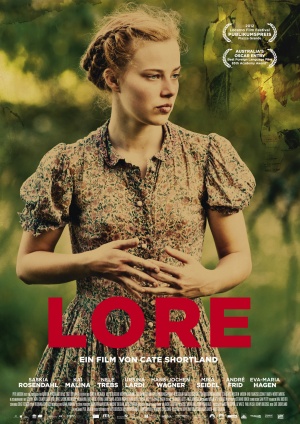
What a pleasant change, I’ve actually watched a movie and really, really  liked it. I’d say it was certainly the best wartime movie I’ve seen in a long while. Lore is a German/Australian/UK co-production. Spoken in German, with German actors and subtitled in English. It’s based on Ruth Seiffert’s highly acclaimed novel The Dark Room. Or, to be more precise, on one of the three interlinked stories in the book.

Lore is the eldest daughter of a prominent Nazi functionary. Indoctrinated with the ideology, she blindly loves her father and the Führer, follows every order without questioning and takes everything she’s ever been taught to be the absolute truth. The movie begins at the end of the war. Her parents are in distress, something has happened but they won’t tell their children. The family flees to a holiday home in the country where people treat them aggressively. Lore has no clue what is going on. She knows her parents are hiding something. The father leaves them, and shortly afterwards the mother leaves too. She is giving herself up and goes to prison unsolicited. Before she leaves she tells Lore that the Führer is dead. Everything is lost. Lore has to take her four siblings, one of them is just a baby, and walk in direction of Hamburg where her mother lives.

The movie follows the children on their difficult journey towards Hamburg. It shows how difficult and dangerous it is for them. They risk starvation, rape, being killed or captured. They have to cross three different sectors, the US, the Russian and the UK sector. Even though they are only children, they are suspected and interrogated. At one point a young man starts to follow them. He carries papers and pretends being their older  brother. This makes all of their lives easier.

Lore is more than a road movie, it delicately portrays the total disenchantment of a young girl. On their journey they are not only confronted with severe deprivations but they learn the truth about their beloved father and the Führer. Everything Lore believed in was built on a lie.

I’ve never seen a movie, which focussed on the children of high Nazi officers. I never wondered what became of them after the war. The movie shows what a long and painful process it was to learn the truth.

The story as such is quite gripping and the way it was told was masterful. I haven’t seen any  of Cate Shortland‘s other movies but she’s a film director I’ll keep in mind. Lore was beautifully filmed and the score, written by Max Richter, enhanced the gloomy atmosphere of the film. The atmosphere and the mood was probably what I liked best: lyrical, melancholic and gloomy.

I’m not surprised Lore has won so many prizes and been nominated for many awards. I’d say it’s the first 5/5 movie I’ve seen this year. Don’t miss it.

Has anyone seen the film?

El Alamein – The Line of Fire aka El Alamein – La linea del fuoco (2002) An Italian War Movie

El Alamein

Italian movies on WWII are rare, so when I saw El Alamein – The Line of Fire aka  El Alamein La linea del fuoco in a DVD shop I had to buy it right away. Thankfully it was well worth buying as I will certainly watch it again. Sure, the year is still young but I think it’s safe to say that this one will be on my Best of 2013 List. I liked it a great deal.

El Alamein is told from the point of view of philosophy student Serra. Serra has volunteered in 1942 after hearing that the Italian troops were in urgent need of reinforcements. Following the point of view of a young, naive and inexperienced private is common in war movies but in this case it works particularly well as Serra is the philosophical, introspective type. Seeing through his eyes gives the movie a lyrical feel that is underlined through a beautiful score.

Serra expects to see action right away but the Pavia Division, located on the southern line in Egypt, is more like an outpost. Boredom, inertia, heat, hunger, thirst and endless days of waiting for an enemy they cannot see but who bombards them frequently is the daily fare. This allows the men, to get to know each other, to experience the desert fully; its harsh beauty and the dangers it brings.

When they go on reconnaissance they have to fear for their lives as the terrain around the outpost is covered in mines and walking about is dangerous.

The situation is also very absurd. What are they doing there? What are they guarding? Nothing much is happening. I felt reminded of Dino Buzzati’s excellent novel The Tartar Steppe (Il deserto dei tartari).

When the British finally attack, the Italians do not stand a chance. There are twice as many British troops, they are better equipped, better fed, their morale is much higher. The Italians are demoralized for many reasons. The Germans don’t take their ally seriously, they let them do the dirty work. As it was so often the case, the high command of the Italain’s proves to be clueless. In one scene it is shown that while there is no food or water, truckloads of shoe creme are sent through the desert for a parade.

After the attack during which almost the whole of the Pavia and other Divisions died, the troops flee in confusion, not knowing where to go and what will happen next. Serra, Sgt Rizzo and Lt Fiori end up on their own and try to get through the desert with hardly any food or water.

While the first half of this movie is very quiet and takes a lot of time to give us a feel for the situation the Italians faced and to introduce the characters, the second half is action driven.

The funny thing is that while watching this, you soon forget that the Italians were fighting on the wrong side. The characters are so likable and they seem such helpless victims of their government that you can only feel pity.

I liked the many intimate moments, the discussions between the soldiers, the mood, the atmosphere. At times the movie felt like a combination of All Quite on the Western Front and Ice Cold in Alex.

I highly recommend this wonderful movie to anyone interested in war movies and WWII.

I couldn’t find a trailer, let alone with English subtitles, but here’s the full movie – in Italian.

http://www.youtube.com/watch?v=iTprjxwjz8M

Kathryn Bigelow’s Zero Dark Thirty (2012) The Hunt for Osama Bin Laden

I knew I was going to watch Kathryn Bigelow’s next movie, no matter what it would be about but I would have wished she had chosen another topic.

Zero Dark Thirty is an almost 3 hour-long movie on the hunt for Bin Laden. It starts on 9/11 … with voices of victims recorded during the attacks. Next thing we’re in a detention center in Pakistan witnessing CIA agents torturing a man. A male agent is torturing while a female CIA agent, Maya, is watching. Maya is new, recruited fresh from college, and assigned to one of the most important tasks in CIA history – the hunt for Bin Laden.

While she only watches the interrogations at first, she will later lead them and become the most important agent in this assignment. As early as 2002 0r 2003 she starts to follow a lead, a man she believes to be in contact with Bin Laden himself, a courier. Unfortunately the guy is very elusive, the captured and tortured men contradict each other, his name seems only a nick name, his true identity cannot be found. Eventually he is even said to be dead.

Maya is considered to be obsessed and her superiors start to doubt that what she is pursuing is real. But she won’t give up and is proven right in the end. The rest is history.

I felt very uncomfortable watching this movie. The torture scenes are unpleasant and the fact that the US, who always denied that they use torture, are shown doing it even more so.

Does the outcome justify this? The movie is showing the story as it was. Or is it not? That’s the big question. What we see are scenes showing a group of CIA agents trying to find a man, using every possible way, alternating with scenes from terrorist attacks. Islamabad, London, New York…. While the CIA hunts Bin Laden, the terrorists don’t sleep.

The movie takes a lot of time to tell the story and the first 2 hours are long. I couldn’t help finding the last action-packed sequence interesting. They show the final moments, when the special troops invade the compound where Bin Laden was hiding and how they kill him.

The movie is OK but certainly not a must-see. I’m clueless why anyone would want to make a movie about this. If you are not familiar with the details, it’s interesting to watch but it still left a very bad taste. It is like a documentary and never questions anything, never accuses. It seems to say that without torture, Bin Laden would never have been captured. That’s quite possible but does that make torture acceptable? On the other hand, terrorism is despicable…

I was wondering why Bigelow chose this topic. Because a woman found him? Since I’m not watching the news very often, I don’t know how much was known about the CIA’s interrogation techniques. Is the movie meant to get rid of the general public’s naivety about torture?

I don’t think I’ve seen Jessica Chastain who plays Maya before and couldn’t help comparing her to Claire Danes in Homeland. I’m afraid I like Danes much better. Not only as an actress but I also like her character better. She seems a tad more conflicted about what she is doing. Other actors worth mentioning are Jennifer Ehle, Jason Clarke and Joel Edgerton.

As I’ve just said above, this isn’t a must-see. I’m truly disappointed in Kathryn Bigelow.

Have you seen the movie? Did you like it?

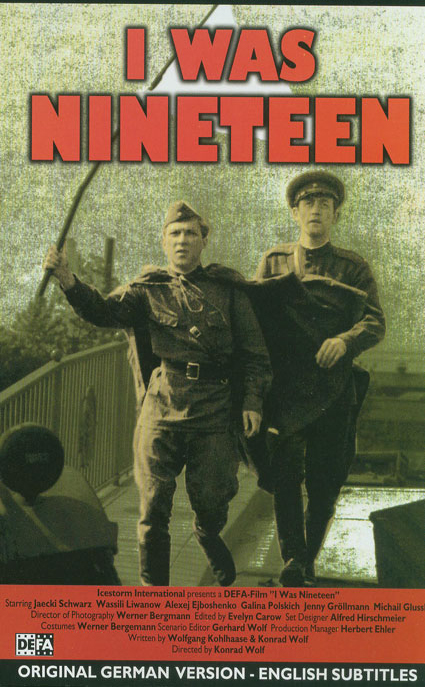
I Was Nineteen – Ich war neunzehn (1968) East German WWII Movie

The East German movie I Was Nineteen – Ich war neunzehn is based on the film director Konrad Wolf’s war diaries. Set in April 1945, it is an episodic movie which tells the story of 19 year-old Gregor Hecker who moves with a Red Army  scouting team towards Berlin.

Hecker is of German origin, he left Germany with his parents at the age of 8 and has lived in Russia ever since. Returning to his home country is peculiar for him. He speaks fluently German and Russian but feels much closer to the Russians.

The movie shows a vast panorama of German society. People who have lost everything and despair, those who believe the war can still be won, some who are afraid of the Russians, others who threaten them. Gregor and his group try to persuade all the German soldiers and officers they meet to surrender; some follow the suggestions, some keep on fighting although the war is almost over.

As I said, the movie is episodic, more than a coherent story line we have a lot of short stories which illustrate the different reactions to the end of the war.

The Russians are also depicted in their variety, peasants and people with higher education, people from all sorts of social and ethnic backgrounds are shown.

I liked the movie, the characters are likable and the approach was interesting however I don’t think it’s a very realistic movie. Sure, it accurately depicts how estranged someone like Gregor would have felt, how different he was from the other Germans but that’s how far realism goes. What I didn’t find realistic is how peacefully they behaved. The Russians in this movie were all good-natured, mostly gentle, protective of women and children. I don’t think that was the case, there are too many horrible stories which tell otherwise.

The movie isn’t a German but an East German movie which may explain why the Russians were depicted in such a positive light.

There is only one instance in which it is shown how much they must have hated the Germans for what they had done to them. When a German woman asks Gregor whether she can sleep in the house he and his fellow soldiers have occupied a female soldier shouts at her in Russian and Gregor translates. She tells her that it serves her right to be afraid and that what the Germans did to the Russians was so horrible and painful that it deserved punishment.

Despite these reservations I’m very glad I watched this. The movie is available with English subtitles I just couldn’t find a corresponding trailer.

Die Flucht – March of Millions (2007) German TV production about the Flight from East Prussia

This is one of those stories that needed telling. East Prussia, this vast and beautiful region in Germany, was quite peaceful during the war until the Eastern Front collapsed and the Russians started invading Prussia and moved towards Berlin. The people living there had but two choices. Stay and face the Russians who were not exactly going to handle them with care. Or  to flee and leave all their possessions behind. East Prussia was the home of many aristocratic families who lived at ease on huge estates. Theirs was a life of wealth and tradition. Leaving was extremely hard on them and for many it took a long time until they made up their minds. Too long in some cases. For those who had less, it wasn’t any easier. Not only did they have to leave everything behind, they didn’t know where they were going or if they were not going to be outrun by the Russians.

You see, a lot of potential for a great story and all of the above is shown in Die Flucht – March of Millions. Unfortunately even historical events like this need good storytelling and that’s where I’m not happy with this two-part German TV production. While it’s not bad, I would have preferred if they hadn’t decided to turn the second half into a love story.

Lena, countess von Mahlenberg (Maria Furtwängler), leaves Berlin and returns to her family’s estate in East Prussia. Things still look pretty much the same as they did before the war with the exception of French POWs – led by cranky François (Jean-Yves Berteloot) – working on the estate. And there is also a  panicky feeling underneath the surface. Things do not look good for Germany. That they will win the war is not very likely anymore and what this could mean for them, this close to the Eastern front, starts to dawn on a few people.

The von Mahlenberg’s are friends with another aristocratic family, the von Gernstorffs. Lena is going to get married to their older son although she doesn’t really love him. The younger son who is in love with her as well, is one of the only ones to clearly say that Germany will lose the war. He is fighting on the Russian front and scared of dying. When he deserts, the family breaks apart.

Meanwhile Lena wants to flee together with the POWs who have been working for her and with all of the people who live on the estate.

The first part of the movie is dedicated to the time before they flee, the second focusses entirely on that long march.

Many of the elements are interesting and dramatic. The tensions among the Germans, the justified fear of the Russians, the tragedy to lose your home and to be unwelcome wherever you go, is shown quite well.

What I liked too were the pictures. I have never been in East Prussia but those vast landscapes seem very beautiful and they were beautifully filmed. What did not work is the love story. I think this movie could have been dramatic without a love story but on top of that it didn’t seem very realistic.

In any case, a watchable movie but not as good as I had hoped for. I think however this would be successful in the US or the UK as, like Dresden or Anonyma, it shows aspects of German history and suffering we sometimes tend to forget. Of the three movies I liked Anonyma best but I’m fond of Dresden as well, although it has corny elements.

I’m not sure Die Flucht is available in English. I attached the German trailer and for those interested in the history of East Prussia during WWII, a documentary in English which looks quite good.