La vita è bella aka Life is Beautiful (1997) A Thought-Provoking Italian Holocaust Movie

, w

La vita è bella is a very unusual movie that you will hardly ever forget should you watch it. It is touching, at times funny, tragic and sentimental. It shows one man’s attempt to protect his child from the horrors of the concentration camp and how he fails in the end. It is one of the movies on my Children in War Movies List.

Roberto Benigni, the Italian main actor, writer  and director of La vita è bella is mainly known as a comedian. People were quite surprised when they heard he had done a movie on the Holocaust. I remember that I had mixed feelings but was really surprised how well this combination works. Other critics however felt offended as they stated it was in poor taste to attempt to combine a comedy with the topic of the Holocaust. But the comedy pretty much stops when the war begins. The movie has really two parts that are strikingly different which was obviously wanted. The beautiful before and the horrible after.

The Jewish man Guido Orefice (Roberto Benigni) is not a good-looking guy. He is not even very intelligent. He is clumsy and silly but also very funny and charming and has an eye for poetical and beautiful things. This is how he wins the heart of the attractive Dora even though she is already engaged to a future fascist leader.

The second part starts a few years after their marriage. They have a little boy named Guisoué. Anti-Jewish laws have been implemented in Italy and Guido tries to hide their meaning from his son by turning them into a game. When they know they will be deported, Dora, even though she is not Jewish, accompanies them to the concentration camp. Once arrived Guido pretends that this is all a game, some sort of summer camp for children and grown-ups alike. He makes his son believe that they have to follow all the orders strictly if they want to win.

I must admit that I did not totally approve of Benigni’s approach, but it is not a movie that is easily forgotten. And it is thought-provoking and will give ample material for discussion of various questions. Are we allowed to tell the Holocaust through comedy? Should a movie about the Holocaust be this sentimental? Wouldn’t it be better to tell it in a more sober manner? La vita è bella is also problematic when it comes to the historical facts. Children were not kept alive in the camps. Still the first part is a touching and funny story of an impossible courtship while the second is the story of a fathers attempt at keeping the horror at bay.

Did you see it? Did it work for you? And if you haven’t, would you want to watch it? Do you mind a Holocaust comedy?

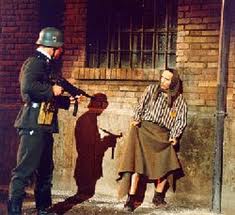
Der Stellvertreter aka Amen (2002) The Disillusioning Reaction of the Catholic Church to the Holocaust

In the beginning of Costa Gavras´ Der Stellvertreter aka Amen we see how a group of children with special needs is transported to an extermination camp and gassed. When this is being found out people are shocked and taken aback and, together with the Catholic Church, they fight these practices that are ultimately stopped.

This noble reaction of the Church is not repeated however when they are asked for assistance in stopping the extermination of Jews. Nor do the alerted Allies help. Der Stellvertreter explores the shameful failure of the Catholic church and the rest of the world.

The SS officer Kurt Gerstein (Ulrich Tukur), head of the Institute of Hygiene, is a chemist and the developer of the lethal gas Zyklone-B. He thinks that this deadly gas is used to free the concentration camps from vermin and must find out that it is actually used for exterminating Jews. He witnesses this with his own eyes and his outrage and revulsion are so intense that he decides to alarm the Catholic Church. Only one young priest, whose family is of great influence in the Vatican, Riccardo Fontana (Mathieu Kassovitz), feels the urge to support Gerstein, travels to the Vatican and informs the Pope. To no avail. The Church won’t act.

The Church fears many things. They are afraid that communism might spread and are grateful to the Nazis who stopped it. They are afraid that they might not be spared by the Nazis if they oppose too openly. And, as the movie seems to say, they ultimately don’t care too much about the Jews.

Gerstein and Fontana will go on fighting and trying to inform people, to make at least the Allies act. The Allies however don’t want to act as they don’t want to negotiate with criminals. Every time Gerstein and Fontana inform someone about the extent of the atrocities the numbers have risen. From an initial hundred thousand they are soon in the millions. These numbers are symbolized in the numerous takes of riding trains we see during the movie.

As an ultimate sacrifice and because he thinks it is his Christian duty the young priest joins a transport of Italian Jews to one of the concentrations camps.

Kurt Gerstein is a historical figure. After the war all the important figures of Nazi Germany were incarcerate. Gerstein, facing trial and before killing himself, writes a report on everything he has seen. Years later he is found not guilty and rehabilitated.

As interesting as the theme of this movie is I did not find it completely compelling. Maybe because it is based on a theater play (Rolf Hochhut’s Der Stellvertreter aka The Deputy)? I don’t know. I think you will have to find out for yourself. 4/5 stars but still valuable.

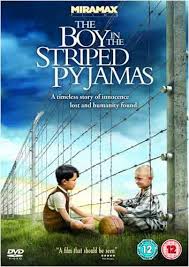
The Boy in the Striped Pyjamas (2008) or An unusual look at the Holocaust

The movie The Boy in the Striped Pyjamas is based on a novel by John Boyne.

The movie tells the story of Bruno, an eight year old boy, whose father is a high ranking Nazi officer newly appointed to be in charge of a concentration camp.

The family leaves Berlin (shot in Budapest, by the way) for a place somewhere in the country, near a concentration camp. The story is purely seen through the eyes of the little boy which creates some very uneasy moments.

I believe that the major theme of this movie is knowing and knowledge. We do know what happened during the third Reich. We know what Endlösung – The Final Solution – means. We know about concentration camps and extermination camps. Watching this movie with all this background information makes for a lot of discomforting moments. All the signs, the chimneys and the smoke, the people in the striped pyjamas… We know what to make of them. Bruno does not. And neither does his mother as it would seem.

The crucial moment is when Bruno meets the boy behind the barbed wire, the boy in the striped pyjamas, Shmuel. An impossible friendship begins. Bruno understands after a while that this boy is a Jew; at the same time he is taught by a fanatic private tutor that Jews are vermin.

Boyne says in an interview that he wanted to tell a different story, add something new to a topic that has been taken up so many times. He is very successful. One thing is for sure, no one who watches The Boy in the Striped Pyjamas is going to forget it easily. The whole way it is told plus the more than atrocious end is by far too unusual to be forgotten.

I am sure it is one of the best movies to teach children the Holocaust.

To be honest, I am still a bit speechless. The whole film and especially the ending are like being kicked in the gut. I am quite awed by the little actors. Asa Butterfield, who plays Bruno, is amazing. This little kid has a way of talking with his eyes that is rarely found in grown up actors. To cut a long story short: Watch it!

See also Children in War Movies: A List

Holocaust Movie Quotes Film Quiz 6

Today´s quiz is an addition to the post of yesterday about Triumph of the Spirit. The quotes below are all taken from Holocaust movies.

The following movies are hidden behind the quotes: La vita è bella aka Life is beautiful, Schindler´s List, Sophie´s Choice, The Diary of Anne Frank, The PianistTriumph of the Spirit, and Holocaust. Do you recognize the quotes? The solutions are just above the respective movie.

Movie 1

“I could have got more out. I could have got more. I don’t know. If I’d just… I could have got more.”
“Oskar, there are eleven hundred people who are alive because of you. Look at them.”
“If I’d made more money… I threw away so much money. You have no idea. If I’d just… ”
“There will be generations because of what you did.”
“I didn’t do enough!”
“You did so much.”
[… looks at his car]
“This car. Goeth would have bought this car. Why did I keep the car? Ten people right there. Ten people. Ten more people.”
[removing Nazi pin from lapel]
“This pin. Two people. This is gold. Two more people. He would have given me two for it, at least one. One more person. A person, Stern. For this.”
[sobbing]
“I could have gotten one more person… and I didn’t! And I… I didn’t!”

Movie 2

It’s an official decree, no Jews allowed in the parks.
“What, are you joking?”
“No, I’m not. I would suggest we sit down on a bench, but that’s also an official decree, no Jews allowed on benches.”
“This is absurd.”
“So, we should just stand here and talk, I don’t think we’re not allowed to do that.”

Movie 3

“Listen, I’m only going to say this once. For those who can hear me tell the rest. First come the SS, our lord and masters. Then comes our block health manager, Kyr. Then come the assistants, Otto and me. Then come the rats. Then come the lice… and then come you.”

Movie 4

“There is no hope! Karl is in prison and Rudi ran away! Never a word from him! And Papa, in Poland, where it’s like they came after him! Mama, you’re acting as if this is a play. Writing letters. Talking about Papa’s patients.”
“It does no harm.”
“You always had that notion that you were someone special, so fine, so educated! The Nazis would never hurt you or your children! And look! Look what’s happened to us!”
[sobs hysterically]
“Anna, your mother can’t be blamed.”
“New Year’s Eve! And who knows if any one of us will be alive for the next New Year!”

Movie 5

“No Jews or Dogs Allowed.” Why do all the shops say, “No Jews Allowed”?
“Oh, that. “Not Allowed” signs are the latest trend! The other day, I was in a shop with my friend the kangaroo, but their sign said, “No Kangaroos Allowed,” and I said to my friend, “Well, what can I do? They don’t allow kangaroos.”
“Why doesn’t our shop have a “Not Allowed” sign?”
“Well, tomorrow, we’ll put one up. We won’t let in anything we don’t like. What don’t you like?”
“Spiders.”
“Good. I don’t like Visigoths. Tomorrow, we’ll get sign: “No Spiders or Visigoths Allowed.”

Movie 6

“You’re so beautiful. I’d like to get you in bed. Are you a polack? You! Are you also one of those filthy communists?”
[walks away]
“I am a pole! I was born in Cracow! I am not a Jew. Neither are my children! They’re not Jews. They are racially pure. I am a Christian. I am a devout Christian.”
[the officer comes back]
You are not a communist? You are a believer.”
“Yes sir, I believe in Christ.”
“You believe in Christ the redeemer?”
“Yes.”
[looks at the children] “Did He not say… “Suffer the children, come unto me?” ”
[…remains silent]
“You may keep one of your children.”
“I beg your pardon?”
“You may keep one of your children. The other must go away.”
“You mean, I have to choose?”
“You are a Polack, not a Yid. That gives you a privilidge, a choice.”
“I can’t choose. I can’t choose!”
“Be quiet.”
“I can’t choose!”
“Make a choice. Or I’ll send both of them over there. Make a choice.”
“Don’t make me choose! I can’t!”
“Shut up! Enough! I’ll send them both over there! I told you to shut up! Make a choice!”
“I can’t choose! Please! I can’t choose!”
[to an officer] “Take BOTH children away!”

Movie 7

“I know it’s terrible trying to have any faith when people are doing such horrible… But you know what I sometimes think? I think the world may be going through a phase, the way I was with mother. It’ll pass. Maybe not hundreds of years, but someday. – I still believe, in spite of everything, that people are really good at heart.”

If you liked this quiz, don´t miss some of the others:

Vietnam Movie Quotes 3

Film Pictures Quiz