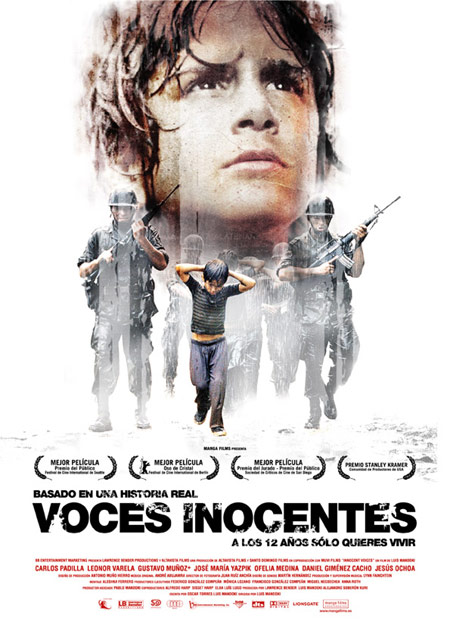
Voces Inocentes aka Innocent Voices (2004) Children as Soldiers in the Civil War in El Salvador

Based on a true story, Luis Mandoki’s Voces Inocentes aka Innocent Voices is going directly on my list of all time favourites, regardless of the genre. This Mexico/US/Puerto Rico co-production is an astonishingly beautiful movie despite the atrocities it depicts. It is simply awesome and as good as Army of Crime about which I raved last year. It is one of the movies on my Children in War Movies List and a s such worth watching in any case.

What makes this movie so incredible is the fact that it works on many levels. It is as much the story of a childhood and a little boy, as an in-depth look at a way of life we are less than familiar with and a civil war we have almost forgotten about. Last but not least it shows the portrait of a mother (Leonor Varela) whose spirited fight and love for her children makes her one of the most memorable and dignified characters I have seen in any movie.

The war, that started in 1980 and lasted 12 years, was initially a conflict between the army and the campesinos, the land owners, over land rights. When they didn’t come to an arrangement the campesinos formed a guerilla, the FMLN, to defend their rights. The war escalated into a bloody civil war. On top of that the US felt the urge to provide the Army with weapons and heir assisstance, fearing that the guerrilleros would be supported by the USSR. The war cost 75’000 lives and over 1 Mio people fled the country. Lacking men, the Army recruited young boys who were barely 12 years old. Oscar Torres, who wrote the script, is the model for Chava, the little boy, whose story we see.

The movie starts with soldiers escorting little boys holding their hands over their heads, to an execution place. They walk in the pouring rain and we hear Chava’s voice in the off. It’s a beautifully filmed scene that immediately sets the tone for the whole movie. We will see many scenes that take place in the pouring rain and are of great beauty despite the fact that they show horrors.

Chava (Carlos Padilla) lives alone with his mother and his little brother and sister. The father has fled the country and gone to the US. Chava’s young and beautiful mother, Kella, is truly a memorable character. Tender and fierce at the same time, she defends her children and fights for their survival. These are the poorest of the poor, their houses are only shacks with cardboard roofs. Kella tries to make a living as a seamstress. Imagine living in a shack when at night there is fighting in the roads. Bullets easily enter the walls of the houses and come flying past your head, there is hardly any cover apart from mattresses that are build up against those thinnest of walls. It is hard to imagine that people not only lived in such poverty but had to endure a war like this that threatened their lives on a daily basis. Many got killed like this, in their own house.

Young Chava is a cheerful and funny little boy. Despite the war, he plays with his friends, falls in love with a little girl, fights with his mother, finds a means to earn money. Even though they have nothing, live precariously, his childhood seems almost enchanted. The tiniest things amuse him, he lives with great intensity, knows no boredom.

The main theme of the movie is the threat that the soldiers will come and get Chava and his friends. We see many scenes in which little boys are recruited by force. The procedures are quite upsetting. Some of the boys around Chava finally decide to join the guerilla in order to avoid the military. And that is what little Chava does in the end as well. The final scene of the movie brings us back to the beginning. Chava and his friends have joined the guerilla and were caught by the Army. Unless they get help, they will most probably be executed.

The actors are amazing, especially the children. They are really awesome. The movie is full of beautiful scenes that allow us to have a look at these precarious lives in poverty. They convey a melancholic beauty that is quite special. There are a few songs that are important in the movie. They had been forbidden by the army but were listened to anyway.

The movie manages to mix a lot of different tones. At times it is sad and melancholic, at times it is thoughtful almost meditative, then again it’s funny or just downright tragic. Innocent voices is a gem, a must-see.

One final word: the people from El Salvador were apparently not entirely happy about this movie because none of the actors is from El Salvador and it has been filmed in Mexico.
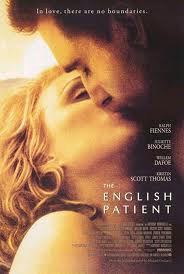
Anthony Minghella’s The English Patient (1996)

Rarely did a movie deserve the Academy Awards as much as The English Patient. It is one of the most beautiful war romances that I have ever seen. Or, to be accurate, two of the most beautiful romances as the movie tells two parallel stories. Based on Michael Ondaatje’s wonderful eponymous novel, The English Patient combines everything that an accomplished movie needs. Beautiful pictures, a touching story, an intriguing plotline, wonderful music, great characters  and outstanding actors. This is one of the movies that I have watched at least three times and every time I discovered another layer. It is surprisingly rich and, I would argue, flawless.

They call him “The English Patient” (Ralph Fiennes), the mysterious man, they rescued from a shot down airplane in the desert during WWII. He is heavily burned, will probably not survive. They bring him to Italy and a young nurse, Hana (Juliette Binoche), volunteers to stay back and take care of him. She moves with him into an abandoned villa. He doesn’t know his identity but Hana finds a notebook and with its help the memory returns slowly and the story unfolds in flashbacks.

They are not alone for long, Kip (Naveen Andrews), a young Sikh and the thief David Caravaggio (Willem Dafoe) join her. Kip is part of a bomb disposal unit and the growing love between Hana and him is the second love story in this movie. It is beautiful but by far less tragic than that between the English patient and his lover. Caravaggio adds even another story line to the already rich plot. He is someone who thinks he knows who the badly burned man is. In fact he is sure that the patient is someone who wronged him once.

The flashbacks show us the mysterious patient, the Hungarian Count Almásy, 1930 in the Sahara desert. He is a mapmaker of the Royal Geographical Society. At the beginning of WWII he is still in the Sahara where he meets the British agent Geoffrey Clifton (Colin Firth) and his beautiful wife Catherine  (Kristin Scott Thomas). Despite their fighting the attraction, they fall in love. They have an affair that ends abruptly when Catherine breaks it off. They meet again later and the following events make this probably one of the most tragic movie romances of all time.

The figure of Count Almásy is actually based on a real person, only his story was a different one.

The nurse Hana is certainly one of the most appealing nurses in any war movie. The gentleness and devotion with which she takes care of the dying man is touching. I am sure that there were many nurses like her in different wars and they deserve an homage.  I have a great deal of admiration for these courageous, disinterested women.

The intensity of the interwoven stories, the mysteries, the wonderful settings (the desert, Italy during the war, the Italian villa), the gripping part of the bomb defusing, all this together make this an absolute must-see.  Last but not least I’d like to mention the beautiful score by Gabriel Yared (you can listen to it here).

Movies on the Falklands War (1982): A List

To be honest, I am ashamed to have to admit that I know hardly anything about the Falklands War. Lucky I know where it is located but that is about it. No idea why it happened or what was going on. I remember the name of Margaret Thatcher somehow tied to it. That’s it. I wasn’t any less surprised that there had been a few movies on the war in the Falklands and I have made the resolution that I will at least try to watch one of those that I have collected for my list. If anyone knows the one or the other, let me know and advise, which one I have to watch. Without knowing any better, I think I would go for either Resurrected or This is England. The latter seems to be more about the fallout of the war than the war itself.

  • Los Chicos De La Guerra, directed by Bebe Kamin, (ARG 1984) mit Carlos Abbate, Luis Agustoni
  • An Ungentlemanly Act, directed by  Stuart Urban, (GB 199, TV) starring Ian Richardson, Rosemary Leach
  • Tumbledown, directed by  Richard Eyre (GB 1988, TV) starring Colin Firth, Paul Rhys, David Calder
  • Resurrected, directed by Paul Greengrass (GB 1989) starring Tom Bell, Rita Tushingham, David Thewlis, Rudi Davies
  • The Falklands Play, directed by Michael Samuels, (GB 2002) mit Patricia Hodge, James Fox, Michael Cochrane
  • Blessed by Fire aka Iluminados por el fuego directed by Tristán Bauer (ARG/ ESP 2005) starring Gastón Pauls, Pablo Riva, César Albarracín
  • This Is England, directed by Shane Meadows (GBR 2006) starring Thomas Turgoose, Stephen Graham, Jo Hartley, Andrew Shim

Patton (1970) A Great Actor in an Excellent Biopic

Patton is a fascinating, surprising movie and totally not what I had expected. Especially not after the first ten minutes in which we see George C. Scott perform the so-called Blood and Guts Speech. Quite off-putting, to be honest. As much as I like transparent and open communication, this wasn’t promising. What I sensed at the beginning is exactly what the movie has been reproached of doing, namely not taking an anti-war position. 1970 was not exactly a time in which people were in favour of a movie that seems to glorify warriors. Well, that is not what it’s a l about as I discovered when I watched the rest. No, this is an excellent biopic with an absolutely amazing main actor. A portrait of a character with numerous dazzling facets.

The movie follows Patton’s WWII years, starting in Africa, continuing in Europe, until the moment when he comes to rescue the by now famous 101st Airborne at Bastogne.

Patton is mentioned in many a war movie but we do not see him so often. We know that there was a lot of competition between him and the British General Montgomery and ultimately also between him and Feldmarschall Rommel. Rommel seemed to have had a lot of respect regarding Patton’s skills, whereas Montgomery was too full of himself to register anyone else (what a peacock).

Patton is an epic character, a larger than life figure but what puzzled me most is his belief in reincarnation. This isn’t what I had expected and it was the element of the movie that fascinated me the most. He was convinced to be the reincarnation of an ancient warrior, he even remembered some battle fields from former lives. On the other hand he was a believing Christian. Truly a man of many contradictions or rather complex aspects. He wrote poetry but despised cowardice which led to an unlucky event – the unfair slapping of a shell-shocked soldier – that cost him his position.

Precisely this event surprised me even more than his belief in reincarnation. I’m not saying people should be slapped, no matter what for, but that this led to his removal from command seems very surprising, humiliating and also unfair. I rather assume that Washington didn’t approve of his being to outspoken. Plus he was absolutely not Russian friendly and didn’t make a secret of it.

All in all I think this is truly one of the most spellbinding biopics or character studies I have ever seen. Such a fascinating personality and what a splendid actor. 5/5

Under Fire (1983) War and Journalism or Whose Side Are You On?

I don’t take sides, I take pictures (Nick Nolte as Russel Price in Under Fire)

The least you can say about Under Fire is that is an extremely interesting movie with four fascinating character portraits played by four outstanding actors.

Under Fire belongs to the war movie subgenre of War and Journalism. There are quite a lot of movies in this sub-genre and a great many are from the 80s. The Year of Living Dangerously, Circle of Deceit, The Killing Fields, Salvador, Missing and later movies like Welcome to Sarajevo (see my post).

The movie opens in Tchad. The photographer Russel Price (Nick Nolte) and the mercenary Oates (Ed Harris) meet and discuss their work. Oates points out that Price isn’t much better. He is profiting as much from every war there is as Oates is. None of them is more interested in politics than the other. When they part we know that they will meet again.

Before Price departs to the latest war zone, Nicaragua, we are introduced to two other journalists, Claire (Joanna Cassidy) and Alex Gazier (Gene Hackman). Claire and Alex are a couple but she breaks up with him before leaving to Nicaragua and we already sense she will be romantically involved with Russell.

At first when arriving in Nicaragua, Price isn’t interested in background information. He wants to know if the beer is good and what the food is like. Fortunately the movie nevertheless fills us in on the basics. We hear that the revolutionaries, headed by a guy named Rafael, fight the government of president Somoza who is supported by the US and a few other details. Claire and Price meet the French agent Jazy (Jean-Louis Trintignant), a dubious character, that seems to be in favour of the rebels, they also meet the president and his press officer.

While they are in Nicaragua – falling in love, getting to know the country – something happens to Price. He meets Oates again and sees him kill one of the revolutionaries in cold blood. This makes Price understand his own actions and how cynical they are.  He becomes aware that he cannot stay out of this anymore. It bdawns on him, that the Sandinistas are right, that the government is corrupt and supported by the US who are afraid of a communist Nicaragua. In order to support the revolution, he takes a fake picture. He serves the rebels but triggers a flood of violence during which Alex is killed by the president’s soldiers (this is based on a true story). He takes a picture of this as well and triggers a reaction in the US…

What I really liked about this movie is how subtle it portrays the different people. Nolte, Hackman and Harris are very convincing, each takes another position, stays for another point of view. The cynic mercenary Oates is probably the most stringent character, the one who will make you the most uneasy, although Jazy isn’t a bad example of double standards either. Claire was the least convincing character, she rather served as a enhancer for the others.

Apparently the movie has been considered to be problematic in the US because it openly takes position for the Nicaraguan revolution. I think this is great and daring. It is an ugly chapter in US politics and many efforts have been made to forget about it as soon as possible (Noam Chomsky has written quite eloquently about this).

The movie is visually extremely convincing. John Alcott, Kubrick’s cameraman, has filmed it documentary-style.

The topic of War and Journalism always makes me uneasy. I think we should be informed but I cannot understand how people can take pictures like vultures of dying and dead people and stay uninvolved. Maybe it is not so much journalism as photo journalism that I find problematic. I am really glad for movies like Under Fire. They are valuable and important and illustrate how everything is linked, how one deed leads to another.

There is a trailer on iMDB.

Here is just a video with scenes from the movie and the original soundtrack by Jerry Goldsmith.